Questões de Concurso
Para jornalista
Foram encontradas 10.820 questões
Resolva questões gratuitamente!
Junte-se a mais de 4 milhões de concurseiros!


Ano: 2020
Banca:
VUNESP
Órgão:
Câmara de Mogi Mirim - SP
Prova:
VUNESP - 2020 - Câmara de Mogi Mirim - SP - Jornalista |
Q1681808
Jornalismo
Um vereador criticou uma notícia transmitida pelo canal
comunitário da cidade. Do seu ponto de vista, o apresentador fez uma boa introdução à notícia do interesse da
SABÓ (Sabó – Indústria e Comércio de Auto Peças) em
investir no município, mas, enquanto lia “in off” do corpo da matéria, as imagens apresentadas eram do SAAE
(Serviço Autônomo de Água e Esgoto) . Isto é, houve erro
na edição
Ano: 2020
Banca:
VUNESP
Órgão:
Câmara de Mogi Mirim - SP
Prova:
VUNESP - 2020 - Câmara de Mogi Mirim - SP - Jornalista |
Q1681807
Jornalismo
Um experiente apresentador de televisão escreve: “a
cada página de um telejornal damos o nome de “script”.
Os “scripts” são impressos numa folha de papel e
ordenados segundo uma lógica determinada pelo editor-
-chefe (…)”. O autor compara a ordenação dos “scripts” a
uma árvore em que estão presas as “folhas” de “scripts”.
O nome técnico dessa “arvore” é
Ano: 2020
Banca:
VUNESP
Órgão:
Câmara de Mogi Mirim - SP
Prova:
VUNESP - 2020 - Câmara de Mogi Mirim - SP - Jornalista |
Q1681806
Jornalismo
William Bonner (Jornal Nacional: Modo de fazer) afirma
que na produção do jornal há um momento que parece
ser o “mais esquizofrênico de todo o processo de elaboração de um telejornal”. É o momento em que os produtores apresentam o que foi feito. “Quanto maior a produção, mais eficiente é o trabalho do produtor. Produzir, sim
– mas não a qualquer custo”. Para os produtores a intenção é obter a aprovação do editor-chefe para a maioria
das propostas que foram selecionadas.
As afirmações de Bonner referem-se à
As afirmações de Bonner referem-se à
Ano: 2020
Banca:
VUNESP
Órgão:
Câmara de Mogi Mirim - SP
Prova:
VUNESP - 2020 - Câmara de Mogi Mirim - SP - Jornalista |
Q1681805
Jornalismo
Para os especialistas no assunto, os elementos do discurso jornalístico transportados para a televisão simplificam-se porque, como sucessor do radiojornalismo, o
telejornalismo segue algumas recomendações desse
último.
Entre essas orientações, é correto afirmar que o texto do telejornalismo deve
Entre essas orientações, é correto afirmar que o texto do telejornalismo deve
Ano: 2020
Banca:
VUNESP
Órgão:
Câmara de Mogi Mirim - SP
Prova:
VUNESP - 2020 - Câmara de Mogi Mirim - SP - Jornalista |
Q1681804
Jornalismo
O conceito de framing, traduzido em português como
enquadramento, se aplica à área fotográfica e cinematográfica para referir-se à perspectiva de uma mensagem
visual obtida pelas várias possibilidades de angulação
para obter imagens. Para muitos autores, os enquadramentos influenciam a percepção da audiência, portanto,
estão relacionados à hipótese de
Ano: 2020
Banca:
VUNESP
Órgão:
Câmara de Mogi Mirim - SP
Prova:
VUNESP - 2020 - Câmara de Mogi Mirim - SP - Jornalista |
Q1681803
Jornalismo
Para mostrar aos telespectadores que a emissora está no
local em que transcorre o fato jornalístico que está sendo
coberto, é comum a participação do repórter fazendo
Ano: 2020
Banca:
VUNESP
Órgão:
Câmara de Mogi Mirim - SP
Prova:
VUNESP - 2020 - Câmara de Mogi Mirim - SP - Jornalista |
Q1681802
Jornalismo
Segundo Vera Iris Paternostro, o texto para telejornalismo deve ser “o resultado de uma unidade de raciocínio,
com informações que “caminham” interligadas de maneira clara, desde o início até a conclusão”. Deve haver coerência, logicidade, sem misturar ideias e desenvolver harmoniosamente a sequência do acontecimento noticiado.
A autora, em outras palavras, recomenda que o texto para o telejornalismo tenha
A autora, em outras palavras, recomenda que o texto para o telejornalismo tenha
Ano: 2020
Banca:
VUNESP
Órgão:
Câmara de Mogi Mirim - SP
Provas:
VUNESP - 2020 - Câmara de Mogi Mirim - SP - Jornalista
|
VUNESP - 2020 - Câmara de Mogi Mirim - SP - Analista Legislativo |
Q1681801
Noções de Informática
Uma mensagem de e-mail, enviada e recebida com
sucesso por meio do MS-Outlook 2010, em sua configuração padrão, possuía os campos preenchidos conforme se vê a seguir.
De: [email protected] Para: [email protected] Cc: [email protected] Cco: [email protected] Assunto: [email protected]
Camila ([email protected]), ao receber a mensagem, clicou em responder a todos, e sua mensagem de resposta, automaticamente, passou a ter como destinatários, apenas
De: [email protected] Para: [email protected] Cc: [email protected] Cco: [email protected] Assunto: [email protected]
Camila ([email protected]), ao receber a mensagem, clicou em responder a todos, e sua mensagem de resposta, automaticamente, passou a ter como destinatários, apenas
Ano: 2020
Banca:
VUNESP
Órgão:
Câmara de Mogi Mirim - SP
Provas:
VUNESP - 2020 - Câmara de Mogi Mirim - SP - Jornalista
|
VUNESP - 2020 - Câmara de Mogi Mirim - SP - Analista Legislativo |
Q1681800
Noções de Informática
Um usuário, realizando uma busca por meio do site www.
google.com.br, deseja localizar sites que contenham a
palavra “Mogi” mas não contenham a palavra “Cruzes”.
Assinale a alternativa que contém o argumento de busca que deve ser utilizado no site.
Assinale a alternativa que contém o argumento de busca que deve ser utilizado no site.
Ano: 2020
Banca:
VUNESP
Órgão:
Câmara de Mogi Mirim - SP
Provas:
VUNESP - 2020 - Câmara de Mogi Mirim - SP - Jornalista
|
VUNESP - 2020 - Câmara de Mogi Mirim - SP - Analista Legislativo |
Q1681799
Noções de Informática
Observe a planilha a seguir, elaborada por meio do MS-
-Excel 2010, em sua configuração padrão, por um jornalista que estava analisando pesquisas de opinião realizadas num determinado período de tempo.
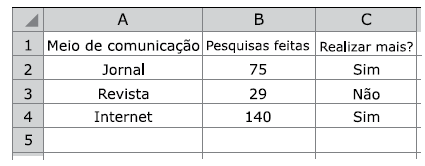
Assinale a alternativa que apresenta a fórmula que deve estar contida na célula C2, para que esta apresente o valor exibido na imagem.
Assinale a alternativa que apresenta a fórmula que deve estar contida na célula C2, para que esta apresente o valor exibido na imagem.
Ano: 2020
Banca:
VUNESP
Órgão:
Câmara de Mogi Mirim - SP
Provas:
VUNESP - 2020 - Câmara de Mogi Mirim - SP - Jornalista
|
VUNESP - 2020 - Câmara de Mogi Mirim - SP - Analista Legislativo |
Q1681798
Noções de Informática
A partir de um documento vazio do MS-Word 2010, em
sua configuração padrão, um usuário executou as ações
a seguir, na ordem especificada.
1 – Digitou uma palavra. 2 – Clicou em alinhar o parágrafo à direita e apertou a tecla Enter. 3 – Digitou uma nova palavra e apertou a tecla Enter. 4 – Clicou em centralizar o parágrafo. 5 – Digitou uma nova palavra e apertou a tecla Enter. 6 – Digitou uma nova palavra e apertou a tecla Enter. 7 – Clicou em justificar o parágrafo. 8 – Digitou uma nova palavra e apertou a tecla Enter.
Após todas as ações executadas, quantos parágrafos ficaram alinhados à direita?
1 – Digitou uma palavra. 2 – Clicou em alinhar o parágrafo à direita e apertou a tecla Enter. 3 – Digitou uma nova palavra e apertou a tecla Enter. 4 – Clicou em centralizar o parágrafo. 5 – Digitou uma nova palavra e apertou a tecla Enter. 6 – Digitou uma nova palavra e apertou a tecla Enter. 7 – Clicou em justificar o parágrafo. 8 – Digitou uma nova palavra e apertou a tecla Enter.
Após todas as ações executadas, quantos parágrafos ficaram alinhados à direita?
Ano: 2020
Banca:
VUNESP
Órgão:
Câmara de Mogi Mirim - SP
Provas:
VUNESP - 2020 - Câmara de Mogi Mirim - SP - Jornalista
|
VUNESP - 2020 - Câmara de Mogi Mirim - SP - Analista Legislativo |
Q1681797
Noções de Informática
Um usuário do MS-Windows 10, em sua configuração
padrão, está com 3 janelas de aplicativos abertas. Para
que esse usuário consiga visualizar a Área de Trabalho
inteira, pode utilizar o atalho por teclado composto pela
tecla Windows +
Ano: 2020
Banca:
VUNESP
Órgão:
Câmara de Mogi Mirim - SP
Provas:
VUNESP - 2020 - Câmara de Mogi Mirim - SP - Jornalista
|
VUNESP - 2020 - Câmara de Mogi Mirim - SP - Analista Legislativo |
Q1681796
Atualidades
As eleições presidenciais do Uruguai serão decididas no
segundo turno, marcado para 24 de novembro. De acordo com a Corte Eleitoral uruguaia, a taxa de participação
nas eleições chegou a 90% – o que a instituição considerou “histórica”.
(https://bit.ly/2WgnfKQ. Publicado em 28.10.2019. Adaptado)
Sobre as eleições do Uruguai, é correto afirmar que
(https://bit.ly/2WgnfKQ. Publicado em 28.10.2019. Adaptado)
Sobre as eleições do Uruguai, é correto afirmar que
Ano: 2020
Banca:
VUNESP
Órgão:
Câmara de Mogi Mirim - SP
Provas:
VUNESP - 2020 - Câmara de Mogi Mirim - SP - Jornalista
|
VUNESP - 2020 - Câmara de Mogi Mirim - SP - Analista Legislativo |
Q1681795
Atualidades
A Fundação Nacional do Índio (Funai) confirmou, nesta
quarta-feira, a nomeação de Ricardo Lopes Dias para o
cargo de coordenador-geral de proteção a índios isolados e
de recente contato. Na semana passada, entidades e lideranças indígenas criticaram a eventual nomeação de Dias.
(https://glo.bo/33igOIU. Publicado em 05.02.2020. Adaptado)
As críticas se referem
(https://glo.bo/33igOIU. Publicado em 05.02.2020. Adaptado)
As críticas se referem
Ano: 2020
Banca:
VUNESP
Órgão:
Câmara de Mogi Mirim - SP
Provas:
VUNESP - 2020 - Câmara de Mogi Mirim - SP - Jornalista
|
VUNESP - 2020 - Câmara de Mogi Mirim - SP - Analista Legislativo |
Q1681794
Atualidades
A Academia de Artes e Ciências Cinematográficas revelou hoje os indicados ao Oscar 2020, cuja cerimônia será
realizada no próximo dia 9 de fevereiro. Coringa, de Todd
Phillips, lidera as indicações, concorrendo a 11 estatuetas, seguido de perto por O Irlandês, de Martin Scorsese,
Era Uma Vez... Em Hollywood, de Quentin Tarantino, e
1917, de Sam Mendes, que disputam em dez categorias.
(https://bit.ly/2YkkUOm. Publicado em 13.01.2020. Adaptado)
Sobre a participação do Brasil no Oscar 2020, é correto afirmar:
(https://bit.ly/2YkkUOm. Publicado em 13.01.2020. Adaptado)
Sobre a participação do Brasil no Oscar 2020, é correto afirmar:
Ano: 2020
Banca:
VUNESP
Órgão:
Câmara de Mogi Mirim - SP
Provas:
VUNESP - 2020 - Câmara de Mogi Mirim - SP - Jornalista
|
VUNESP - 2020 - Câmara de Mogi Mirim - SP - Analista Legislativo |
Q1681793
Atualidades
Convidada pelo presidente da República há três dias, ela
diz agora que “está noivando” com o cargo, atualmente
sob condução do interino José Paulo Martins.
Após conversa produtiva com o presidente, Regina Duarte
estará em Brasília na próxima quarta-feira, 22. “Estamos
noivando”, disse a artista após o encontro ocorrido nesta
tarde no Rio de Janeiro”, diz a nota oficial do Planalto.
(https://bit.ly/2QdYXxA. Publicado em 21.01.2020. Adaptado)
Sobre Regina Duarte, em relação ao atual governo, é correto afirmar:
(https://bit.ly/2QdYXxA. Publicado em 21.01.2020. Adaptado)
Sobre Regina Duarte, em relação ao atual governo, é correto afirmar:
Ano: 2020
Banca:
VUNESP
Órgão:
Câmara de Mogi Mirim - SP
Provas:
VUNESP - 2020 - Câmara de Mogi Mirim - SP - Jornalista
|
VUNESP - 2020 - Câmara de Mogi Mirim - SP - Analista Legislativo |
Q1681792
Atualidades
O vencedor efetivo da guerra civil no país está mais perto que nunca de retomar o último território em mãos dos
rebeldes, um marco que vai selar sua vitória, enquanto
agrava o sofrimento da população.
Nos últimos três meses, suas forças, apoiadas por ataques
aéreos russos, intensificaram o avanço na província,
empurrando quase 1 milhão de moradores na direção da
fronteira ao [norte do país].
(https://bit.ly/3cXFevG. Publicado em 27.02.2020. Adaptado)
O texto se refere ao conflito
(https://bit.ly/3cXFevG. Publicado em 27.02.2020. Adaptado)
O texto se refere ao conflito
Ano: 2020
Banca:
VUNESP
Órgão:
Câmara de Mogi Mirim - SP
Provas:
VUNESP - 2020 - Câmara de Mogi Mirim - SP - Jornalista
|
VUNESP - 2020 - Câmara de Mogi Mirim - SP - Analista Legislativo |
Q1681791
Inglês
Texto associado
Among the press‘s roles are what are called the “three
I’s” – information, interpretation, and interest. Roger Hilsman,
a political scientist and State Department official in the John
F. Kennedy administration, identified “the gathering and
dissemination of information” as a major function of the press.
The flow of information through the press [...] is the lifeblood of
America’s democratic system.
Information in press coverage of foreign affairs is
almost always accompanied by interpretation. Journalists
provide contexts (often called “frames”) in which information
is conveyed. “By suggesting the cause and relationships
of various events,” the political scientist Doris A. Graber
observes, “the media may shape opinions even without telling
their audiences what to believe or think. For example, linking
civil strife in El Salvador [in the 1980s] to the activities of
Soviet and Cuban agents ensured that the American public
would view the situation with considerable alarm.” Among
policymakers in Washington, Hilsman notes, “the press is not
the sole source of interpretation. The president, the secretary
of state, the assistant secretaries, American ambassadors,
senators, congressmen, academic experts – all are sources
of interpretation. But the fact that the press is there every day,
day after day, with its interpretations makes it the principal
competitor of all the others in interpreting events”.
The press also can play an important role in stirring interest
in an issue both in Washington and among the public. During
the Ronald Reagan years media reporting awakened public
interest on starvation in Ethiopia, a topic that Americans had
shown little interest in prior to the appearance of illustrated
stories about dying children in the press and on television. An
example from the James Earl Carter years was the debate
over whether to deploy enhanced radiation nuclear bombs
(also called neutron bombs) in western Europe. The debate
began with a story by Walter Pincus in the Washington Post
on 6 June 1977. A quotation in the story noted that the bombs
would „kill people“ while „leaving buildings and tanks standing.“
Once the story was framed in this negative way – on television
and radio as well as in newspapers and magazines – the
administration was not able to gain public and congressional
support for deploying the new weapon. The unfolding of this
story illustrates a frequent pattern in foreign policy: print
journalists often bring stories to public attention, after which
they are covered by other print and electronic reporters.
(https://www.americanforeignrelations.com/O-W/
The-Press-The-press-s-many-roles.html. Acesso em 22.02.2020)
No trecho “Once the story was framed in this negative
way – on television and radio as well as in newspapers
and magazines – ...“, a expressão em destaque indica
Ano: 2020
Banca:
VUNESP
Órgão:
Câmara de Mogi Mirim - SP
Provas:
VUNESP - 2020 - Câmara de Mogi Mirim - SP - Jornalista
|
VUNESP - 2020 - Câmara de Mogi Mirim - SP - Analista Legislativo |
Q1681790
Inglês
Texto associado
Among the press‘s roles are what are called the “three
I’s” – information, interpretation, and interest. Roger Hilsman,
a political scientist and State Department official in the John
F. Kennedy administration, identified “the gathering and
dissemination of information” as a major function of the press.
The flow of information through the press [...] is the lifeblood of
America’s democratic system.
Information in press coverage of foreign affairs is
almost always accompanied by interpretation. Journalists
provide contexts (often called “frames”) in which information
is conveyed. “By suggesting the cause and relationships
of various events,” the political scientist Doris A. Graber
observes, “the media may shape opinions even without telling
their audiences what to believe or think. For example, linking
civil strife in El Salvador [in the 1980s] to the activities of
Soviet and Cuban agents ensured that the American public
would view the situation with considerable alarm.” Among
policymakers in Washington, Hilsman notes, “the press is not
the sole source of interpretation. The president, the secretary
of state, the assistant secretaries, American ambassadors,
senators, congressmen, academic experts – all are sources
of interpretation. But the fact that the press is there every day,
day after day, with its interpretations makes it the principal
competitor of all the others in interpreting events”.
The press also can play an important role in stirring interest
in an issue both in Washington and among the public. During
the Ronald Reagan years media reporting awakened public
interest on starvation in Ethiopia, a topic that Americans had
shown little interest in prior to the appearance of illustrated
stories about dying children in the press and on television. An
example from the James Earl Carter years was the debate
over whether to deploy enhanced radiation nuclear bombs
(also called neutron bombs) in western Europe. The debate
began with a story by Walter Pincus in the Washington Post
on 6 June 1977. A quotation in the story noted that the bombs
would „kill people“ while „leaving buildings and tanks standing.“
Once the story was framed in this negative way – on television
and radio as well as in newspapers and magazines – the
administration was not able to gain public and congressional
support for deploying the new weapon. The unfolding of this
story illustrates a frequent pattern in foreign policy: print
journalists often bring stories to public attention, after which
they are covered by other print and electronic reporters.
(https://www.americanforeignrelations.com/O-W/
The-Press-The-press-s-many-roles.html. Acesso em 22.02.2020)
According to the third paragraph,
Ano: 2020
Banca:
VUNESP
Órgão:
Câmara de Mogi Mirim - SP
Provas:
VUNESP - 2020 - Câmara de Mogi Mirim - SP - Jornalista
|
VUNESP - 2020 - Câmara de Mogi Mirim - SP - Analista Legislativo |
Q1681789
Inglês
Texto associado
Among the press‘s roles are what are called the “three
I’s” – information, interpretation, and interest. Roger Hilsman,
a political scientist and State Department official in the John
F. Kennedy administration, identified “the gathering and
dissemination of information” as a major function of the press.
The flow of information through the press [...] is the lifeblood of
America’s democratic system.
Information in press coverage of foreign affairs is
almost always accompanied by interpretation. Journalists
provide contexts (often called “frames”) in which information
is conveyed. “By suggesting the cause and relationships
of various events,” the political scientist Doris A. Graber
observes, “the media may shape opinions even without telling
their audiences what to believe or think. For example, linking
civil strife in El Salvador [in the 1980s] to the activities of
Soviet and Cuban agents ensured that the American public
would view the situation with considerable alarm.” Among
policymakers in Washington, Hilsman notes, “the press is not
the sole source of interpretation. The president, the secretary
of state, the assistant secretaries, American ambassadors,
senators, congressmen, academic experts – all are sources
of interpretation. But the fact that the press is there every day,
day after day, with its interpretations makes it the principal
competitor of all the others in interpreting events”.
The press also can play an important role in stirring interest
in an issue both in Washington and among the public. During
the Ronald Reagan years media reporting awakened public
interest on starvation in Ethiopia, a topic that Americans had
shown little interest in prior to the appearance of illustrated
stories about dying children in the press and on television. An
example from the James Earl Carter years was the debate
over whether to deploy enhanced radiation nuclear bombs
(also called neutron bombs) in western Europe. The debate
began with a story by Walter Pincus in the Washington Post
on 6 June 1977. A quotation in the story noted that the bombs
would „kill people“ while „leaving buildings and tanks standing.“
Once the story was framed in this negative way – on television
and radio as well as in newspapers and magazines – the
administration was not able to gain public and congressional
support for deploying the new weapon. The unfolding of this
story illustrates a frequent pattern in foreign policy: print
journalists often bring stories to public attention, after which
they are covered by other print and electronic reporters.
(https://www.americanforeignrelations.com/O-W/
The-Press-The-press-s-many-roles.html. Acesso em 22.02.2020)
No segundo parágrafo, a palavra destacada no trecho –
the press is not the sole source of interpretation – pode
ser substituída, sem alteração de sentido, por:
 Conheça nossos planos