Questões de Concurso
Para engenheiro de produção
Foram encontradas 3.419 questões
Resolva questões gratuitamente!
Junte-se a mais de 4 milhões de concurseiros!


Ano: 2011
Banca:
CESGRANRIO
Órgão:
Transpetro
Prova:
CESGRANRIO - 2011 - Transpetro - Engenheiro Júnior - Engenharia de Produção |
Q170931
Engenharia de Produção
Uma empresa pretende realizar uma previsão de demanda para um determinado item produzido.
A tabela a seguir mostra a demanda realizada nos seis últimos períodos.
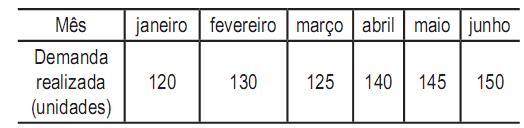
Com base na tabela acima, é INCORRETO afirmar que, utilizando-se o método da média móvel
A tabela a seguir mostra a demanda realizada nos seis últimos períodos.
Com base na tabela acima, é INCORRETO afirmar que, utilizando-se o método da média móvel
Ano: 2011
Banca:
CESGRANRIO
Órgão:
Transpetro
Prova:
CESGRANRIO - 2011 - Transpetro - Engenheiro Júnior - Engenharia de Produção |
Q170930
Engenharia de Produção
Uma empresa possui 200 funcionários contratados para trabalharem 40 horas por semana, em jornada normal de 8 horas.
Se, no mês de agosto, houve 78 ausências e, em relação a meias faltas e atrasos, tinha-se verificado que os funcionários deixaram de trabalhar um total de 16 horas no mês, o índice de absentismo, no referido período, foi de
Se, no mês de agosto, houve 78 ausências e, em relação a meias faltas e atrasos, tinha-se verificado que os funcionários deixaram de trabalhar um total de 16 horas no mês, o índice de absentismo, no referido período, foi de
Ano: 2011
Banca:
CESGRANRIO
Órgão:
Transpetro
Prova:
CESGRANRIO - 2011 - Transpetro - Engenheiro Júnior - Engenharia de Produção |
Q170929
Engenharia de Produção
A Cia. Barbono Ltda. investiu, nos últimos dois anos, aproximadamente R$ 2 milhões de reais na informatização de seus processos financeiros, controle de compras, de
almoxarifado, entre outros processos, integrando todos os departamentos. O Sr. Barbono esperava que os tempos de resposta, principalmente dos processos de compras e controle do almoxarifado, fossem melhorados. Entretanto, após a implantação dos softwares, os processos se tornaram mais lentos, particularmente no setor de compras, onde as aquisições em caráter de urgência aumentaram significativamente as despesas. Uma consultoria foi contratada para fazer um diagnóstico e apontar as causas do problema.
Analise as causas apontadas a seguir.
I - As requisições de compras tinham normas que exigiam assinatura e carimbo devidamente reconhecidos e procedimentos feitos manualmente.
II - O planejamento das necessidades de material era feito quando o estoque terminava.
III - O ?uxo do processo de compras tinha controles rígidos, exigindo assinaturas dos três níveis hierárquicos da organização, chegando até o Sr. Barbono, que podia vetar a solicitação.
IV - A estrutura organizacional era centralizada.
Estão corretas as causas descritas em
almoxarifado, entre outros processos, integrando todos os departamentos. O Sr. Barbono esperava que os tempos de resposta, principalmente dos processos de compras e controle do almoxarifado, fossem melhorados. Entretanto, após a implantação dos softwares, os processos se tornaram mais lentos, particularmente no setor de compras, onde as aquisições em caráter de urgência aumentaram significativamente as despesas. Uma consultoria foi contratada para fazer um diagnóstico e apontar as causas do problema.
Analise as causas apontadas a seguir.
I - As requisições de compras tinham normas que exigiam assinatura e carimbo devidamente reconhecidos e procedimentos feitos manualmente.
II - O planejamento das necessidades de material era feito quando o estoque terminava.
III - O ?uxo do processo de compras tinha controles rígidos, exigindo assinaturas dos três níveis hierárquicos da organização, chegando até o Sr. Barbono, que podia vetar a solicitação.
IV - A estrutura organizacional era centralizada.
Estão corretas as causas descritas em
Ano: 2011
Banca:
CESGRANRIO
Órgão:
Transpetro
Prova:
CESGRANRIO - 2011 - Transpetro - Engenheiro Júnior - Engenharia de Produção |
Q170928
Engenharia de Produção
A Eco Máquinas para Embalagens Ltda. é uma empresa de médio porte, usuária do FMS (Flexible Manufacturing System), que se utiliza da automação para transporte e manuseio de materiais para usinagem.
O uso de um FMS traz como benefício o(a)
O uso de um FMS traz como benefício o(a)
Ano: 2011
Banca:
CESGRANRIO
Órgão:
Transpetro
Prova:
CESGRANRIO - 2011 - Transpetro - Engenheiro Júnior - Engenharia de Produção |
Q170927
Engenharia de Produção
O centro de trabalho de produção de cartões-postais personalizados das Indústrias Beleza Postal Ltda. deve fabricar um lote com 200 unidades de um de seus produtos, conforme pedido PT-123. O tempo de preparação das máquinas é de 30 minutos, e o tempo de operação é de 0,2 horas por unidade.
Nessas condições, o tempo padrão necessário para atender a esse pedido, em horas padrão, está entre
Nessas condições, o tempo padrão necessário para atender a esse pedido, em horas padrão, está entre
Ano: 2011
Banca:
CESGRANRIO
Órgão:
Transpetro
Prova:
CESGRANRIO - 2011 - Transpetro - Engenheiro Júnior - Engenharia de Produção |
Q170926
Engenharia de Produção
O departamento de produção de uma empresa, que atua no ramo de fabricação de envelopes plásticos, dispõe, em seu centro de trabalho, de cinco máquinas, que operam oito horas por dia, durante seis dias por semana. A utilização média desse setor tem sido de 80%, e sua eficiência, de 110%.
Nessas condições, a capacidade calculada para esse centro de trabalho, numa semana média, em horas padrão, está entre
Nessas condições, a capacidade calculada para esse centro de trabalho, numa semana média, em horas padrão, está entre
Ano: 2011
Banca:
CESGRANRIO
Órgão:
Transpetro
Prova:
CESGRANRIO - 2011 - Transpetro - Engenheiro Júnior - Engenharia de Produção |
Q170925
Engenharia de Produção
Em uma fábrica de embalagens, o departamento de produção tem seu centro de trabalho com disponibilidade de 140 horas semanais, sendo que as embalagens são produzidas durante 112 horas, não havendo outra atividade a ser feita.
Nessas condições, o percentual de utilização desse centro de trabalho é de
Nessas condições, o percentual de utilização desse centro de trabalho é de
Ano: 2011
Banca:
CESGRANRIO
Órgão:
Transpetro
Prova:
CESGRANRIO - 2011 - Transpetro - Engenheiro Júnior - Engenharia de Produção |
Q170924
Engenharia de Produção
O processo de determinar, detalhadamente, os recursos necessários para realizar a produção, em cada centro de trabalho, é feito através do CRP (Capacity Requirements Planning).
Um dos insumos exigidos para esse planejamento é o(a)
Um dos insumos exigidos para esse planejamento é o(a)
Ano: 2011
Banca:
CESGRANRIO
Órgão:
Transpetro
Prova:
CESGRANRIO - 2011 - Transpetro - Engenheiro Júnior - Engenharia de Produção |
Q170923
Engenharia de Produção
Um engenheiro de produção de uma fábrica de embalagens atua como projetista de processo de fabricação e deseja avaliar dois métodos para a produção de contêiner, que utiliza em seu insumo material de alta resistência ao impacto. O 1o método tem um custo fixo de R$ 3.000,00 para ferramentaria e gabaritos, e um custo variável de R$ 5,00 por unidade. O 2o método exige a compra de uma máquina importada no valor de R$ 23.000,00 e tem custos variáveis de R$ 2,00 por unidade.
A variação do custo, em mil reais, entre os dois processos para a produção de 4.000 unidades de contêiner produzidas, está compreendida entre
A variação do custo, em mil reais, entre os dois processos para a produção de 4.000 unidades de contêiner produzidas, está compreendida entre
Ano: 2011
Banca:
CESGRANRIO
Órgão:
Transpetro
Prova:
CESGRANRIO - 2011 - Transpetro - Engenheiro Júnior - Engenharia de Produção |
Q170922
Engenharia de Produção
Texto associado
Considere as informações e a tabela a seguir para responder às
questões de nos 24 e 25.
A Indústria de Embalagens Cardoso Ltda. é uma concei-
tuada empresa de fabricação de caixas de papelão es-
peciais. A tabela abaixo apresenta uma lista de recursos
básicos (papelão ondulado e tempo de trabalho) necessá-
rios para a produção de cada grupo de produto.

Essa empresa recebeu uma encomenda de um cliente
especial e precisa fabricar 2.000 caixas tipo A-1, 4.000
caixas tipo B-5 e 6.000 caixas tipo C-7.
questões de nos 24 e 25.
A Indústria de Embalagens Cardoso Ltda. é uma concei-
tuada empresa de fabricação de caixas de papelão es-
peciais. A tabela abaixo apresenta uma lista de recursos
básicos (papelão ondulado e tempo de trabalho) necessá-
rios para a produção de cada grupo de produto.
Essa empresa recebeu uma encomenda de um cliente
especial e precisa fabricar 2.000 caixas tipo A-1, 4.000
caixas tipo B-5 e 6.000 caixas tipo C-7.
O tempo de trabalho, em horas, necessário para atender à encomenda solicitada, está compreendido entre
Ano: 2011
Banca:
CESGRANRIO
Órgão:
Transpetro
Prova:
CESGRANRIO - 2011 - Transpetro - Engenheiro Júnior - Engenharia de Produção |
Q170921
Engenharia de Produção
Texto associado
Considere as informações e a tabela a seguir para responder às
questões de nos 24 e 25.
A Indústria de Embalagens Cardoso Ltda. é uma concei-
tuada empresa de fabricação de caixas de papelão es-
peciais. A tabela abaixo apresenta uma lista de recursos
básicos (papelão ondulado e tempo de trabalho) necessá-
rios para a produção de cada grupo de produto.
Essa empresa recebeu uma encomenda de um cliente
especial e precisa fabricar 2.000 caixas tipo A-1, 4.000
caixas tipo B-5 e 6.000 caixas tipo C-7.
questões de nos 24 e 25.
A Indústria de Embalagens Cardoso Ltda. é uma concei-
tuada empresa de fabricação de caixas de papelão es-
peciais. A tabela abaixo apresenta uma lista de recursos
básicos (papelão ondulado e tempo de trabalho) necessá-
rios para a produção de cada grupo de produto.
Essa empresa recebeu uma encomenda de um cliente
especial e precisa fabricar 2.000 caixas tipo A-1, 4.000
caixas tipo B-5 e 6.000 caixas tipo C-7.
A quantidade necessária de papelão ondulado, em metros quadrados, para atender a essa encomenda, está entre
Ano: 2011
Banca:
CESGRANRIO
Órgão:
Transpetro
Prova:
CESGRANRIO - 2011 - Transpetro - Engenheiro Júnior - Engenharia de Produção |
Q170918
Engenharia de Produção
A receita (vendas) e o custo das mercadorias vendidas (CMV), referentes ao departamento de administração de materiais de uma grande empresa, estão indicados na tabela a seguir.
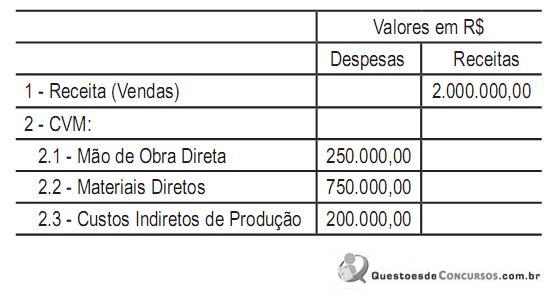
Considerando-se redução de 20% no custo de material direto, redução de 10% nos custos indiretos de produção e que o custo da mão de obra direta permanece inalterado, o lucro, em mil reais, ficará entre
Considerando-se redução de 20% no custo de material direto, redução de 10% nos custos indiretos de produção e que o custo da mão de obra direta permanece inalterado, o lucro, em mil reais, ficará entre
Ano: 2011
Banca:
CESGRANRIO
Órgão:
Transpetro
Prova:
CESGRANRIO - 2011 - Transpetro - Engenheiro Júnior - Engenharia de Produção |
Q170917
Português


O trecho em que se encontra voz passiva pronominal é:
Ano: 2011
Banca:
CESGRANRIO
Órgão:
Transpetro
Provas:
CESGRANRIO - 2011 - Transpetro - Administrador Júnior
|
CESGRANRIO - 2011 - Transpetro - Engenheiro Júnior - Engenharia de Produção |
Q154656
Matemática
Duas empresas diferentes produzem a mesma quantidade de aparelhos celulares, ou seja, ao se comprar um aparelho celular, a probabilidade de ele ter sido produzido por qualquer uma delas é a mesma. Cada aparelho produzido pela fábrica A é defeituoso com probabilidade 1%, enquanto cada aparelho produzido pela fábrica B é defeituoso com probabilidade 5%. Suponha que você compre dois aparelhos celulares que foram produzidos na mesma fábrica. Se o primeiro aparelho foi verificado e é defeituoso, a probabilidade condicional de que o outro aparelho também seja defeituoso é
Ano: 2011
Banca:
CESGRANRIO
Órgão:
Transpetro
Provas:
CESGRANRIO - 2011 - Transpetro - Administrador Júnior
|
CESGRANRIO - 2011 - Transpetro - Engenheiro Júnior - Engenharia de Produção |
CESGRANRIO - 2011 - Transpetro - Químico de Petróleo Júnior |
Q154655
Matemática
A tabela a seguir apresenta algumas estatísticas sobre o número de solicitações à Coordenação de Inspeção, Aceitação e Veto de Navios (COINV) da Transpetro, em 2009, para uso dos terminais aquaviários da empresa por navios de terceiros, por tipo de carga nos últimos 5 anos.
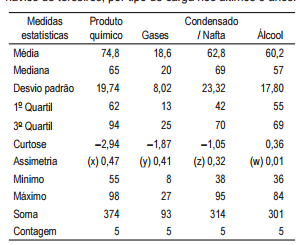
Os sinais de x, y, z e w são, respectivamente,
Os sinais de x, y, z e w são, respectivamente,
Ano: 2011
Banca:
CESGRANRIO
Órgão:
Transpetro
Provas:
CESGRANRIO - 2011 - Transpetro - Administrador Júnior
|
CESGRANRIO - 2011 - Transpetro - Engenheiro Júnior - Engenharia de Produção |
Q154654
Matemática
Dez participantes de um programa de televisão serão distribuídos aleatoriamente em duas casas, sendo que, em cada casa, haverá o mesmo número de participantes, isto é, 5 em cada uma. Desses 10 participantes, 3 preferem a casa X e 2 preferem a casa Y.
Qual é a probabilidade de as preferências serem atendidas?
Qual é a probabilidade de as preferências serem atendidas?
Ano: 2011
Banca:
CESGRANRIO
Órgão:
Transpetro
Provas:
CESGRANRIO - 2011 - Transpetro - Administrador Júnior
|
CESGRANRIO - 2011 - Transpetro - Engenheiro Júnior - Engenharia de Produção |
CESGRANRIO - 2011 - Transpetro - Químico de Petróleo Júnior |
Q154653
Matemática
Um investidor precisa calcular a variância dos lucros de algumas empresas para auxiliá-lo na caracterização do risco de um investimento. As informações sobre lucros são fornecidas em reais e, como ele não quer trabalhar com valores muito grandes, resolveu trabalhar com os números em milhões de reais.
A variância obtida com os dados em milhões de reais é a variância dos dados em reais dividida por
A variância obtida com os dados em milhões de reais é a variância dos dados em reais dividida por
Ano: 2011
Banca:
CESGRANRIO
Órgão:
Transpetro
Provas:
CESGRANRIO - 2011 - Transpetro - Administrador Júnior
|
CESGRANRIO - 2011 - Transpetro - Analista de Sistemas Júnior |
CESGRANRIO - 2011 - Transpetro - Contador Júnior - Contábil |
CESGRANRIO - 2011 - Transpetro - Contador Júnior - Auditoria Interna |
CESGRANRIO - 2011 - Transpetro - Economista Júnior |
CESGRANRIO - 2011 - Transpetro - Engenheiro Júnior - Engenharia de Produção |
CESGRANRIO - 2011 - Transpetro - Médico do trabalho |
CESGRANRIO - 2011 - Transpetro - Engenheiro Júnior - Análise de Projetos de Inverstimentos |
CESGRANRIO - 2011 - Transpetro - Engenheiro Júnior - Geotécnica |
CESGRANRIO - 2011 - Transpetro - Engenheiro Júnior - Elétrica |
CESGRANRIO - 2011 - Transpetro - Engenheiro Júnior - Mecânica |
CESGRANRIO - 2011 - Transpetro - Profissional de Meio Ambiente Júnior |
CESGRANRIO - 2011 - Transpetro - Engenheiro Júnior - Processamento |
CESGRANRIO - 2011 - Transpetro - Engenheiro Júnior - Segurança |
CESGRANRIO - 2011 - Transpetro - Engenheiro Júnior - Naval |
CESGRANRIO - 2011 - Transpetro - Químico de Petróleo Júnior |
CESGRANRIO - 2011 - Transpetro - Engenheiro Júnior - Automação |
Q154636
Inglês
Texto associado
Model copes with chaos to deliver relief
Computer program helps responders transport
supplies in tough conditions
By Rachel Ehrenberg Science News, Web edition: Monday, February 21st, 2011
WASHINGTON — Getting blood or other perishable supplies to an area that’s been struck by an earthquake or hurricane isn’t as simple as asking what brown can do for you. But a new model quickly determines the best routes and means for delivering humanitarian aid, even in situations where bridges are out or airport tarmacs are clogged with planes.
The research, presented February 18 at the annual meeting of the American Association for the Advancement of Science, could help get supplies to areas which have experienced natural disasters or help prepare for efficient distribution of vaccines when the flu hits.
Efficient supply chains have long been a goal of manufacturers, but transport in fragile networks — where supply, demand and delivery routes may be in extremely rapid flux — requires a different approach, said Anna Nagurney of the University of Massachusetts Amherst, who presented the new work. Rather than considering the shortest path from one place to another to maximize profit, her system aims for the cleanest path at minimum cost, while capturing factors such as the perishability of the product and the uncertainty of supply routes. ‘You don’t know where demand is, so it’s tricky,’ said Nagurney. ‘It’s a multicriteria decision-making problem.’
By calculating the total cost associated with each link in a network, accounting for congestion and incorporating penalties for time and products that are lost, the computer model calculates the best supply chain in situations where standard routes may be disrupted.
‘Mathematical tools are essential to develop formal means to predict, and to respond to, such critical perturbations,’ said Iain Couzin of Princeton University, who uses similar computational tools to study collective animal behavior. ‘This is particularly important where response must be rapid and effective, such as during disaster scenarios … or during epidemics or breaches of national security.
’ The work can be applied to immediate, pressing situations, such as getting blood, food or medication to a disaster site, or to longer-term problems such as determining the best locations for manufacturing flu vaccines. . Retrieved April 7th, 2011.
By Rachel Ehrenberg Science News, Web edition: Monday, February 21st, 2011
WASHINGTON — Getting blood or other perishable supplies to an area that’s been struck by an earthquake or hurricane isn’t as simple as asking what brown can do for you. But a new model quickly determines the best routes and means for delivering humanitarian aid, even in situations where bridges are out or airport tarmacs are clogged with planes.
The research, presented February 18 at the annual meeting of the American Association for the Advancement of Science, could help get supplies to areas which have experienced natural disasters or help prepare for efficient distribution of vaccines when the flu hits.
Efficient supply chains have long been a goal of manufacturers, but transport in fragile networks — where supply, demand and delivery routes may be in extremely rapid flux — requires a different approach, said Anna Nagurney of the University of Massachusetts Amherst, who presented the new work. Rather than considering the shortest path from one place to another to maximize profit, her system aims for the cleanest path at minimum cost, while capturing factors such as the perishability of the product and the uncertainty of supply routes. ‘You don’t know where demand is, so it’s tricky,’ said Nagurney. ‘It’s a multicriteria decision-making problem.’
By calculating the total cost associated with each link in a network, accounting for congestion and incorporating penalties for time and products that are lost, the computer model calculates the best supply chain in situations where standard routes may be disrupted.
‘Mathematical tools are essential to develop formal means to predict, and to respond to, such critical perturbations,’ said Iain Couzin of Princeton University, who uses similar computational tools to study collective animal behavior. ‘This is particularly important where response must be rapid and effective, such as during disaster scenarios … or during epidemics or breaches of national security.
’ The work can be applied to immediate, pressing situations, such as getting blood, food or medication to a disaster site, or to longer-term problems such as determining the best locations for manufacturing flu vaccines. . Retrieved April 7th, 2011.
The computer model discussed in the text “…copes with chaos to deliver relief" (title) and analyzes different factors. The only factor
NOT taken in consideration in the model is the
Ano: 2011
Banca:
CESGRANRIO
Órgão:
Transpetro
Provas:
CESGRANRIO - 2011 - Transpetro - Administrador Júnior
|
CESGRANRIO - 2011 - Transpetro - Analista de Sistemas Júnior |
CESGRANRIO - 2011 - Transpetro - Contador Júnior - Contábil |
CESGRANRIO - 2011 - Transpetro - Contador Júnior - Auditoria Interna |
CESGRANRIO - 2011 - Transpetro - Economista Júnior |
CESGRANRIO - 2011 - Transpetro - Engenheiro Júnior - Engenharia de Produção |
CESGRANRIO - 2011 - Transpetro - Médico do trabalho |
CESGRANRIO - 2011 - Transpetro - Engenheiro Júnior - Análise de Projetos de Inverstimentos |
CESGRANRIO - 2011 - Transpetro - Engenheiro Júnior - Geotécnica |
CESGRANRIO - 2011 - Transpetro - Engenheiro Júnior - Elétrica |
CESGRANRIO - 2011 - Transpetro - Engenheiro Júnior - Mecânica |
CESGRANRIO - 2011 - Transpetro - Profissional de Meio Ambiente Júnior |
CESGRANRIO - 2011 - Transpetro - Engenheiro Júnior - Processamento |
CESGRANRIO - 2011 - Transpetro - Engenheiro Júnior - Segurança |
CESGRANRIO - 2011 - Transpetro - Engenheiro Júnior - Naval |
CESGRANRIO - 2011 - Transpetro - Químico de Petróleo Júnior |
CESGRANRIO - 2011 - Transpetro - Engenheiro Júnior - Automação |
Q154635
Inglês
Texto associado
Model copes with chaos to deliver relief
Computer program helps responders transport
supplies in tough conditions
By Rachel Ehrenberg Science News, Web edition: Monday, February 21st, 2011
WASHINGTON — Getting blood or other perishable supplies to an area that’s been struck by an earthquake or hurricane isn’t as simple as asking what brown can do for you. But a new model quickly determines the best routes and means for delivering humanitarian aid, even in situations where bridges are out or airport tarmacs are clogged with planes.
The research, presented February 18 at the annual meeting of the American Association for the Advancement of Science, could help get supplies to areas which have experienced natural disasters or help prepare for efficient distribution of vaccines when the flu hits.
Efficient supply chains have long been a goal of manufacturers, but transport in fragile networks — where supply, demand and delivery routes may be in extremely rapid flux — requires a different approach, said Anna Nagurney of the University of Massachusetts Amherst, who presented the new work. Rather than considering the shortest path from one place to another to maximize profit, her system aims for the cleanest path at minimum cost, while capturing factors such as the perishability of the product and the uncertainty of supply routes. ‘You don’t know where demand is, so it’s tricky,’ said Nagurney. ‘It’s a multicriteria decision-making problem.’
By calculating the total cost associated with each link in a network, accounting for congestion and incorporating penalties for time and products that are lost, the computer model calculates the best supply chain in situations where standard routes may be disrupted.
‘Mathematical tools are essential to develop formal means to predict, and to respond to, such critical perturbations,’ said Iain Couzin of Princeton University, who uses similar computational tools to study collective animal behavior. ‘This is particularly important where response must be rapid and effective, such as during disaster scenarios … or during epidemics or breaches of national security.
’ The work can be applied to immediate, pressing situations, such as getting blood, food or medication to a disaster site, or to longer-term problems such as determining the best locations for manufacturing flu vaccines. . Retrieved April 7th, 2011.
By Rachel Ehrenberg Science News, Web edition: Monday, February 21st, 2011
WASHINGTON — Getting blood or other perishable supplies to an area that’s been struck by an earthquake or hurricane isn’t as simple as asking what brown can do for you. But a new model quickly determines the best routes and means for delivering humanitarian aid, even in situations where bridges are out or airport tarmacs are clogged with planes.
The research, presented February 18 at the annual meeting of the American Association for the Advancement of Science, could help get supplies to areas which have experienced natural disasters or help prepare for efficient distribution of vaccines when the flu hits.
Efficient supply chains have long been a goal of manufacturers, but transport in fragile networks — where supply, demand and delivery routes may be in extremely rapid flux — requires a different approach, said Anna Nagurney of the University of Massachusetts Amherst, who presented the new work. Rather than considering the shortest path from one place to another to maximize profit, her system aims for the cleanest path at minimum cost, while capturing factors such as the perishability of the product and the uncertainty of supply routes. ‘You don’t know where demand is, so it’s tricky,’ said Nagurney. ‘It’s a multicriteria decision-making problem.’
By calculating the total cost associated with each link in a network, accounting for congestion and incorporating penalties for time and products that are lost, the computer model calculates the best supply chain in situations where standard routes may be disrupted.
‘Mathematical tools are essential to develop formal means to predict, and to respond to, such critical perturbations,’ said Iain Couzin of Princeton University, who uses similar computational tools to study collective animal behavior. ‘This is particularly important where response must be rapid and effective, such as during disaster scenarios … or during epidemics or breaches of national security.
’ The work can be applied to immediate, pressing situations, such as getting blood, food or medication to a disaster site, or to longer-term problems such as determining the best locations for manufacturing flu vaccines. . Retrieved April 7th, 2011.
In “The work can be applied to immediate, pressing situations," (lines 41-42), the fragment “can be applied" is replaced, without change in meaning, by
Ano: 2011
Banca:
CESGRANRIO
Órgão:
Transpetro
Provas:
CESGRANRIO - 2011 - Transpetro - Administrador Júnior
|
CESGRANRIO - 2011 - Transpetro - Analista de Sistemas Júnior |
CESGRANRIO - 2011 - Transpetro - Contador Júnior - Contábil |
CESGRANRIO - 2011 - Transpetro - Contador Júnior - Auditoria Interna |
CESGRANRIO - 2011 - Transpetro - Economista Júnior |
CESGRANRIO - 2011 - Transpetro - Engenheiro Júnior - Engenharia de Produção |
CESGRANRIO - 2011 - Transpetro - Médico do trabalho |
CESGRANRIO - 2011 - Transpetro - Engenheiro Júnior - Análise de Projetos de Inverstimentos |
CESGRANRIO - 2011 - Transpetro - Engenheiro Júnior - Geotécnica |
CESGRANRIO - 2011 - Transpetro - Engenheiro Júnior - Elétrica |
CESGRANRIO - 2011 - Transpetro - Engenheiro Júnior - Mecânica |
CESGRANRIO - 2011 - Transpetro - Profissional de Meio Ambiente Júnior |
CESGRANRIO - 2011 - Transpetro - Engenheiro Júnior - Processamento |
CESGRANRIO - 2011 - Transpetro - Engenheiro Júnior - Segurança |
CESGRANRIO - 2011 - Transpetro - Engenheiro Júnior - Naval |
CESGRANRIO - 2011 - Transpetro - Químico de Petróleo Júnior |
CESGRANRIO - 2011 - Transpetro - Engenheiro Júnior - Automação |
Q154634
Inglês
Texto associado
Model copes with chaos to deliver relief
Computer program helps responders transport
supplies in tough conditions
By Rachel Ehrenberg Science News, Web edition: Monday, February 21st, 2011
WASHINGTON — Getting blood or other perishable supplies to an area that’s been struck by an earthquake or hurricane isn’t as simple as asking what brown can do for you. But a new model quickly determines the best routes and means for delivering humanitarian aid, even in situations where bridges are out or airport tarmacs are clogged with planes.
The research, presented February 18 at the annual meeting of the American Association for the Advancement of Science, could help get supplies to areas which have experienced natural disasters or help prepare for efficient distribution of vaccines when the flu hits.
Efficient supply chains have long been a goal of manufacturers, but transport in fragile networks — where supply, demand and delivery routes may be in extremely rapid flux — requires a different approach, said Anna Nagurney of the University of Massachusetts Amherst, who presented the new work. Rather than considering the shortest path from one place to another to maximize profit, her system aims for the cleanest path at minimum cost, while capturing factors such as the perishability of the product and the uncertainty of supply routes. ‘You don’t know where demand is, so it’s tricky,’ said Nagurney. ‘It’s a multicriteria decision-making problem.’
By calculating the total cost associated with each link in a network, accounting for congestion and incorporating penalties for time and products that are lost, the computer model calculates the best supply chain in situations where standard routes may be disrupted.
‘Mathematical tools are essential to develop formal means to predict, and to respond to, such critical perturbations,’ said Iain Couzin of Princeton University, who uses similar computational tools to study collective animal behavior. ‘This is particularly important where response must be rapid and effective, such as during disaster scenarios … or during epidemics or breaches of national security.
’ The work can be applied to immediate, pressing situations, such as getting blood, food or medication to a disaster site, or to longer-term problems such as determining the best locations for manufacturing flu vaccines. . Retrieved April 7th, 2011.
By Rachel Ehrenberg Science News, Web edition: Monday, February 21st, 2011
WASHINGTON — Getting blood or other perishable supplies to an area that’s been struck by an earthquake or hurricane isn’t as simple as asking what brown can do for you. But a new model quickly determines the best routes and means for delivering humanitarian aid, even in situations where bridges are out or airport tarmacs are clogged with planes.
The research, presented February 18 at the annual meeting of the American Association for the Advancement of Science, could help get supplies to areas which have experienced natural disasters or help prepare for efficient distribution of vaccines when the flu hits.
Efficient supply chains have long been a goal of manufacturers, but transport in fragile networks — where supply, demand and delivery routes may be in extremely rapid flux — requires a different approach, said Anna Nagurney of the University of Massachusetts Amherst, who presented the new work. Rather than considering the shortest path from one place to another to maximize profit, her system aims for the cleanest path at minimum cost, while capturing factors such as the perishability of the product and the uncertainty of supply routes. ‘You don’t know where demand is, so it’s tricky,’ said Nagurney. ‘It’s a multicriteria decision-making problem.’
By calculating the total cost associated with each link in a network, accounting for congestion and incorporating penalties for time and products that are lost, the computer model calculates the best supply chain in situations where standard routes may be disrupted.
‘Mathematical tools are essential to develop formal means to predict, and to respond to, such critical perturbations,’ said Iain Couzin of Princeton University, who uses similar computational tools to study collective animal behavior. ‘This is particularly important where response must be rapid and effective, such as during disaster scenarios … or during epidemics or breaches of national security.
’ The work can be applied to immediate, pressing situations, such as getting blood, food or medication to a disaster site, or to longer-term problems such as determining the best locations for manufacturing flu vaccines. . Retrieved April 7th, 2011.
Based on the meanings in the text, the two items are antonymous in

 Conheça nossos planos