Questões de Concurso
Para engenheiro
Foram encontradas 14.124 questões
Resolva questões gratuitamente!
Junte-se a mais de 4 milhões de concurseiros!


Ano: 2024
Banca:
CEV-URCA
Órgão:
Prefeitura de Várzea Alegre - CE
Prova:
CEV-URCA - 2024 - Prefeitura de Várzea Alegre - CE - Engenheiro Civil |
Q3546150
Engenharia Civil
Conforme a NBR 8800:2008, os valores das propriedades mecânicas do aço, referentes ao módulo de elasticidade transversal e à massa específica, são, respectivamente:
Ano: 2024
Banca:
CEV-URCA
Órgão:
Prefeitura de Várzea Alegre - CE
Prova:
CEV-URCA - 2024 - Prefeitura de Várzea Alegre - CE - Engenheiro Civil |
Q3546149
Engenharia Civil
Analise as afirmativas a seguir e assinale a alternativa correta referente ao domínio do estudo da análise estrutural:
I. O momento resultante de um sistema de forças não coplanares, em relação a qualquer ponto no plano destas forças, será sempre perpendicular a este plano.
III. Quando os apoios são em número inferior ao necessário para impedir todos os movimentos possíveis da estrutura, a mesma será dita hipostática, ocorrendo uma situação de equilíbrio instável.
IV. O momento fletor atuante numa seção é definido como sendo a soma algébrica dos momentos das forças situadas de um dos lados desta seção, em relação ao eixo normal à seção que contém o seu centro de gravidade.
Ano: 2024
Banca:
CEV-URCA
Órgão:
Prefeitura de Várzea Alegre - CE
Prova:
CEV-URCA - 2024 - Prefeitura de Várzea Alegre - CE - Engenheiro Civil |
Q3546148
Engenharia Civil
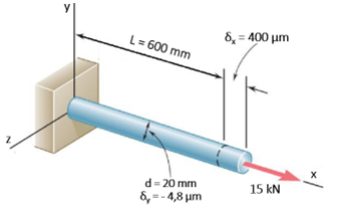
Considere uma barra de 600 mm de comprimento e 20 mm de diâmetro, produzida com material homogêneo e isotrópico. Após a aplicação de uma carga axial de 15 kN, a mesma sofre um aumento no comprimento de 400 µm e diminuição no diâmetro de 4,8 µm. O módulo de elasticidade e o coeficiente de Poisson do material são, respectivamente:
Ano: 2024
Banca:
INSTITUTO AOCP
Órgão:
UFS
Prova:
INSTITUTO AOCP - 2024 - UFS - Engenheiro Civil - Classe E |
Q3539408
Engenharia Civil
Considerando a NR 18 – Condições e Meio
Ambiente de Trabalho na Indústria da Construção,
em um canteiro de obras com 24 (vinte e quatro)
trabalhadores, a instalação sanitária deve ser
constituída de um número mínimo de
Ano: 2024
Banca:
INSTITUTO AOCP
Órgão:
UFS
Prova:
INSTITUTO AOCP - 2024 - UFS - Engenheiro Civil - Classe E |
Q3539407
Engenharia Civil
No planejamento de obras, há uma técnica que
permite gerar cronogramas com grande
quantidade de atividades interligadas entre si e
com o grau de detalhe que se quer obter,
dependendo do nível de detalhamento abordado
pelo planejador na listagem das atividades. Como
é denominada essa técnica?
Ano: 2024
Banca:
INSTITUTO AOCP
Órgão:
UFS
Prova:
INSTITUTO AOCP - 2024 - UFS - Engenheiro Civil - Classe E |
Q3539406
Engenharia Civil
Em solos moles, com excesso de umidade e
presença de matéria orgânica, que demonstram
baixa capacidade de suporte à ação de cargas e
impedem o tráfego de qualquer equipamento para
a realização de terraplenagem, emprega-se um
equipamento que permite escavar e retirar solo à
distância e até a profundidade de alguns metros.
Como é denominado esse equipamento?
Ano: 2024
Banca:
INSTITUTO AOCP
Órgão:
UFS
Prova:
INSTITUTO AOCP - 2024 - UFS - Engenheiro Civil - Classe E |
Q3539405
Engenharia de Transportes e Trânsito
A respeito do conceito de densidade ou
concentração de uma corrente de tráfego,
assinale a alternativa INCORRETA.
Ano: 2024
Banca:
INSTITUTO AOCP
Órgão:
UFS
Prova:
INSTITUTO AOCP - 2024 - UFS - Engenheiro Civil - Classe E |
Q3539404
Engenharia Civil
Considerando o preparo de superfícies para
pintura em uma edificação residencial térrea, no
caso de reboco (não fraco) recém-executado
sobre alvenaria, é correto afirmar que se deve
Ano: 2024
Banca:
INSTITUTO AOCP
Órgão:
UFS
Prova:
INSTITUTO AOCP - 2024 - UFS - Engenheiro Civil - Classe E |
Q3539403
Engenharia Civil
No memorial descritivo de uma obra, no
detalhamento sobre a instalação do revestimento
de piso externo com placas cerâmicas e com
utilização de argamassa colante, havia a previsão
de execução de uma camada, diretamente sobre o
solo, constituída de pedra britada compactada,
sobre a qual seria executada a base. Como é
denominada essa camada?
Ano: 2024
Banca:
INSTITUTO AOCP
Órgão:
UFS
Prova:
INSTITUTO AOCP - 2024 - UFS - Engenheiro Civil - Classe E |
Q3539402
Engenharia Civil
Fenômeno no cimento Portland que compreende
a evolução das propriedades mecânicas da pasta
no início do processo de endurecimento, em que
fica definido um momento no qual a pasta adquire
certa consistência que a torna imprópria ao
trabalho. O enunciado refere-se ao fenômeno da
Ano: 2024
Banca:
INSTITUTO AOCP
Órgão:
UFS
Prova:
INSTITUTO AOCP - 2024 - UFS - Engenheiro Civil - Classe E |
Q3539401
Engenharia Civil
Em relação à exsudação no concreto, informe se é
verdadeiro (V) ou falso (F) o que se afirma a
seguir e assinale a alternativa com a sequência
correta.
( ) A exsudação é uma forma particular de segregação, em que a água da mistura tende a elevar-se à superfície do concreto recentemente lançado.
( ) A exsudação é um fenômeno provocado pela impossibilidade de os constituintes sólidos fixarem toda a água da mistura e depende, em grande escala, das propriedades do cimento.
( ) Como resultado da exsudação, o topo de cada camada de concreto pode tornar-se muito úmido e, se a água for impedida de se evaporar, pela camada que lhe é superposta, poderá resultar uma camada de concreto poroso, fraco e de pouca durabilidade.
( ) A exsudação pode causar também o enfraquecimento da aderência pasta-agregado, em alguns pontos, e a redução de permeabilidade.
( ) A exsudação é uma forma particular de segregação, em que a água da mistura tende a elevar-se à superfície do concreto recentemente lançado.
( ) A exsudação é um fenômeno provocado pela impossibilidade de os constituintes sólidos fixarem toda a água da mistura e depende, em grande escala, das propriedades do cimento.
( ) Como resultado da exsudação, o topo de cada camada de concreto pode tornar-se muito úmido e, se a água for impedida de se evaporar, pela camada que lhe é superposta, poderá resultar uma camada de concreto poroso, fraco e de pouca durabilidade.
( ) A exsudação pode causar também o enfraquecimento da aderência pasta-agregado, em alguns pontos, e a redução de permeabilidade.
Ano: 2024
Banca:
INSTITUTO AOCP
Órgão:
UFS
Prova:
INSTITUTO AOCP - 2024 - UFS - Engenheiro Civil - Classe E |
Q3539400
Engenharia Civil
A respeito do Símbolo Internacional de Acesso –
SIA, que indica a acessibilidade nas edificações,
no mobiliário, nos espaços e nos equipamentos
urbanos, é INCORRETO afirmar que
Ano: 2024
Banca:
INSTITUTO AOCP
Órgão:
UFS
Prova:
INSTITUTO AOCP - 2024 - UFS - Engenheiro Civil - Classe E |
Q3539399
Engenharia Civil
Em relação às combinações últimas a considerar
sobre uma estrutura de aço, informe se é
verdadeiro (V) ou falso (F) o que se afirma a
seguir e assinale a alternativa com a sequência
correta.
( ) As combinações últimas normais decorrem do uso previsto para a edificação.
( ) As combinações últimas especiais decorrem da atuação de ações variáveis de natureza ou intensidade especial, cujos efeitos não superam em intensidade os efeitos produzidos pelas ações consideradas nas combinações normais.
( ) As combinações últimas de construção devem ser levadas em conta nas estruturas em que haja riscos de ocorrência de estados-limites últimos, já durante a fase de construção.
( ) Nas combinações últimas excepcionais, o carregamento excepcional é transitório, com duração extremamente longa.
( ) As combinações últimas normais decorrem do uso previsto para a edificação.
( ) As combinações últimas especiais decorrem da atuação de ações variáveis de natureza ou intensidade especial, cujos efeitos não superam em intensidade os efeitos produzidos pelas ações consideradas nas combinações normais.
( ) As combinações últimas de construção devem ser levadas em conta nas estruturas em que haja riscos de ocorrência de estados-limites últimos, já durante a fase de construção.
( ) Nas combinações últimas excepcionais, o carregamento excepcional é transitório, com duração extremamente longa.
Ano: 2024
Banca:
INSTITUTO AOCP
Órgão:
UFS
Prova:
INSTITUTO AOCP - 2024 - UFS - Engenheiro Civil - Classe E |
Q3539398
Engenharia Civil
Em projetos de estruturas de madeira, os
requisitos de dimensionamento dependem da
esbeltez da peça. O índice de esbeltez das peças
sujeitas à compressão axial ou à flexocompressão
NÃO pode ser maior que
Ano: 2024
Banca:
INSTITUTO AOCP
Órgão:
UFS
Prova:
INSTITUTO AOCP - 2024 - UFS - Engenheiro Civil - Classe E |
Q3539397
Engenharia Civil
Em relação ao controle de fissuração em
estruturas de concreto armado, informe se é
verdadeiro (V) ou falso (F) o que se afirma a
seguir e assinale a alternativa com a sequência
correta.
( ) A fissuração em elementos estruturais de concreto armado é inevitável, devido à grande variabilidade e à baixa resistência do concreto à tração.
( ) Visando obter bom desempenho relacionado à proteção das armaduras quanto à corrosão e à aceitabilidade sensorial dos usuários, busca-se controlar a abertura de fissuras.
( ) Há fissuras que podem ocorrer por causas como retração plástica térmica ou devido a reações químicas internas do concreto nas primeiras idades, devendo ser evitadas ou limitadas por cuidados tecnológicos, especialmente na definição do traço e na cura do concreto.
( ) Por controle de fissuração quanto à aceitabilidade sensorial, entende-se a situação em que as fissuras passam a causar desconforto psicológico aos usuários, embora não representem perda de segurança da estrutura.
( ) A fissuração em elementos estruturais de concreto armado é inevitável, devido à grande variabilidade e à baixa resistência do concreto à tração.
( ) Visando obter bom desempenho relacionado à proteção das armaduras quanto à corrosão e à aceitabilidade sensorial dos usuários, busca-se controlar a abertura de fissuras.
( ) Há fissuras que podem ocorrer por causas como retração plástica térmica ou devido a reações químicas internas do concreto nas primeiras idades, devendo ser evitadas ou limitadas por cuidados tecnológicos, especialmente na definição do traço e na cura do concreto.
( ) Por controle de fissuração quanto à aceitabilidade sensorial, entende-se a situação em que as fissuras passam a causar desconforto psicológico aos usuários, embora não representem perda de segurança da estrutura.
Ano: 2024
Banca:
INSTITUTO AOCP
Órgão:
UFS
Prova:
INSTITUTO AOCP - 2024 - UFS - Engenheiro Civil - Classe E |
Q3539396
Engenharia Civil
Em lajes maciças de concreto armado, deve-se
respeitar uma espessura mínima. Nesse contexto,
em lajes para cobertura não em balanço, o valor
mínimo de espessura é de
Ano: 2024
Banca:
INSTITUTO AOCP
Órgão:
UFS
Prova:
INSTITUTO AOCP - 2024 - UFS - Engenheiro Civil - Classe E |
Q3539395
Engenharia Civil
Nos sistemas hidráulicos para combate a
incêndio, há uma bomba hidráulica centrífuga
destinada a manter o sistema pressurizado em
uma faixa preestabelecida. Essa bomba é
denominada
Ano: 2024
Banca:
INSTITUTO AOCP
Órgão:
UFS
Prova:
INSTITUTO AOCP - 2024 - UFS - Engenheiro Civil - Classe E |
Q3539394
Engenharia Civil
Dentre os sistemas de hidrantes e de
mangotinhos para combate a incêndio, aquele que
NÃO requer jato compacto e é usual em edifícios
residenciais em geral é o
Ano: 2024
Banca:
INSTITUTO AOCP
Órgão:
UFS
Prova:
INSTITUTO AOCP - 2024 - UFS - Engenheiro Civil - Classe E |
Q3539393
Engenharia Civil
No equipamento empregado na sondagem de
simples reconhecimento com SPT (Standard
Penetration Test), há uma peça de aço, terminada
em bisel e dotada de duas saídas laterais para
água, denominada
Ano: 2024
Banca:
INSTITUTO AOCP
Órgão:
UFS
Prova:
INSTITUTO AOCP - 2024 - UFS - Engenheiro Civil - Classe E |
Q3539392
Engenharia Civil
Na escavação de cavas em fundações rasas, caso
se utilizem equipamentos mecânicos, a
profundidade de escavação com esses
equipamentos deve ser paralisada a

 Conheça nossos planos