Selecionar segmento
Estude com questões de diferentes segmentos
Atenção: Isso limpará todos os campos já preenchidos no filtro!
Foram encontradas 37 questões
Resolva questões gratuitamente!
Junte-se a mais de 4 milhões de concurseiros!


Ano: 2006
Banca:
NC-UFPR
Órgão:
SANEPAR
Provas:
NC-UFPR - 2006 - SANEPAR - Analista de Informatica - Suporte Técnico - Mainframe
|
NC-UFPR - 2006 - SANEPAR - Analista de Informatica - Analise de Sistemas - Plataforma Baixa |
Q2749850
Arquitetura de Software
A JCL – Job Control Language é muito precisa e possui regras de gramática, indicações (statements) e sintaxe
específicas que devem ser seguidas, como no exemplo geral:
//DDNAME^DD^DSN=U19999A.PROGRAM.DATA,DISP=SHR^Comme nt
Baseado no exposto, considere as afirmativas abaixo:
//DDNAME^DD^DSN=U19999A.PROGRAM.DATA,DISP=SHR^Comme nt
Baseado no exposto, considere as afirmativas abaixo:
Ano: 2006
Banca:
NC-UFPR
Órgão:
SANEPAR
Provas:
NC-UFPR - 2006 - SANEPAR - Analista de Informatica - Suporte Técnico - Mainframe
|
NC-UFPR - 2006 - SANEPAR - Analista de Informatica - Analise de Sistemas - Plataforma Baixa |
Q2749849
Arquitetura de Software
Sobre os conceitos que envolvem a Arquitetura IBM Mainframe, suas aplicações e produtos, assinale a alternativa correta
Ano: 2006
Banca:
NC-UFPR
Órgão:
SANEPAR
Provas:
NC-UFPR - 2006 - SANEPAR - Analista de Informatica - Suporte Técnico - Mainframe
|
NC-UFPR - 2006 - SANEPAR - Analista de Informatica - Analise de Sistemas - Plataforma Baixa |
Q2749848
Arquitetura de Software
Sobre o CICS, analise as seguintes afirmações:
1. CICS significa Customer Information Control System e é uma familia de servidores de aplicação e conectores que proporciona gerenciamento de transações on line.
2. CICS proporciona conectividade para aplicações industriais de missão crítica.
3. O CICS que inclui Transaction Server para o z/OS V3.1 extende aplicações CICS para a arquitetura orientada a serviços e proporciona um eficiente e efetivo ambiente para aplicações escritas em COBOL, PL/I, C, C++ e Java.
4. O CICS Tools melhora a utilização de recursos além de favorecer e estimular funcionalidade e eficiência no sistema SICS. 5. O CICS Configuration Manager para z/OS V1.1 opera com CICS TS para z/OS V3.1 (5655-M15), CICS TS para z/OS V2.2 e V2.3 (5697-E93) e CICS TS para OS/390 V1.3 (5655-147)
Assinale a alternativa correta:
1. CICS significa Customer Information Control System e é uma familia de servidores de aplicação e conectores que proporciona gerenciamento de transações on line.
2. CICS proporciona conectividade para aplicações industriais de missão crítica.
3. O CICS que inclui Transaction Server para o z/OS V3.1 extende aplicações CICS para a arquitetura orientada a serviços e proporciona um eficiente e efetivo ambiente para aplicações escritas em COBOL, PL/I, C, C++ e Java.
4. O CICS Tools melhora a utilização de recursos além de favorecer e estimular funcionalidade e eficiência no sistema SICS. 5. O CICS Configuration Manager para z/OS V1.1 opera com CICS TS para z/OS V3.1 (5655-M15), CICS TS para z/OS V2.2 e V2.3 (5697-E93) e CICS TS para OS/390 V1.3 (5655-147)
Assinale a alternativa correta:
Ano: 2006
Banca:
NC-UFPR
Órgão:
SANEPAR
Provas:
NC-UFPR - 2006 - SANEPAR - Analista de Informatica - Suporte Técnico - Mainframe
|
NC-UFPR - 2006 - SANEPAR - Analista de Informatica - Analise de Sistemas - Plataforma Baixa |
Q2749847
Arquitetura de Software
Sobre o JCL – Job Control Language, analise as seguintes afirmações:
1. JCL é uma script language usada para controlar a execução de programas em sistemas IBM Batch.
2. JCL é uma script language usada na família de mainframes IBM 360, 370, 390 e ES/9000.
3. O papel da JCL jamais foi assumido por outras arquiteturas como DOS Batch e UNIX´s Bourne Shell.
Assinale a alternativa correta:
1. JCL é uma script language usada para controlar a execução de programas em sistemas IBM Batch.
2. JCL é uma script language usada na família de mainframes IBM 360, 370, 390 e ES/9000.
3. O papel da JCL jamais foi assumido por outras arquiteturas como DOS Batch e UNIX´s Bourne Shell.
Assinale a alternativa correta:
Ano: 2006
Banca:
NC-UFPR
Órgão:
SANEPAR
Provas:
NC-UFPR - 2006 - SANEPAR - Analista de Informatica - Suporte Técnico - Mainframe
|
NC-UFPR - 2006 - SANEPAR - Analista de Informatica - Analise de Sistemas - Plataforma Baixa |
Q2749846
Arquitetura de Software
Sobre o IBM z/OS, analise as seguintes afirmativas:
1. O IBM z/OS provê uma base segura, escalável e de alta performance para aplicações ON DEMAND.
2. O IBM z/OS pode ajudar a simplificar a estrutura de IT por permitir a integração de aplicações em uma imagem simples z/OS (simple z/OS® image).
3. Servidores IBM mainframe e z/OS podem ajudar a criar um ambiente operacional on demand.
Assinale a alternativa correta:
1. O IBM z/OS provê uma base segura, escalável e de alta performance para aplicações ON DEMAND.
2. O IBM z/OS pode ajudar a simplificar a estrutura de IT por permitir a integração de aplicações em uma imagem simples z/OS (simple z/OS® image).
3. Servidores IBM mainframe e z/OS podem ajudar a criar um ambiente operacional on demand.
Assinale a alternativa correta:
Ano: 2006
Banca:
NC-UFPR
Órgão:
SANEPAR
Provas:
NC-UFPR - 2006 - SANEPAR - Analista de Informatica - Suporte Técnico - Mainframe
|
NC-UFPR - 2006 - SANEPAR - Analista de Informatica - Analise de Sistemas - Plataforma Baixa |
Q2749845
Arquitetura de Software
Na Arquitetura IBM/390 temos o PSW – Program-Status Word, analise as seguintes afirmativas
1. O PSW inclui os endereços de instrução.
2. O PSW inclui códigos de condição (condition code)
3. O PSW inclui informações usadas para controlar sequencias de controle (control instruction sequencing)
4. O PSW permite determinar o estado da CPU.
Assinale a alternativa correta:
1. O PSW inclui os endereços de instrução.
2. O PSW inclui códigos de condição (condition code)
3. O PSW inclui informações usadas para controlar sequencias de controle (control instruction sequencing)
4. O PSW permite determinar o estado da CPU.
Assinale a alternativa correta:
Ano: 2006
Banca:
NC-UFPR
Órgão:
SANEPAR
Provas:
NC-UFPR - 2006 - SANEPAR - Analista de Informatica - Suporte Técnico - Mainframe
|
NC-UFPR - 2006 - SANEPAR - Analista de Informatica - Analise de Sistemas - Plataforma Baixa |
Q2749844
Arquitetura de Software
Sobre SPOOL, considere a figura abaixo que apresenta a tela do SPOOL FILE DUPLICATION UTILITY (DOQ/400) para
IBM:
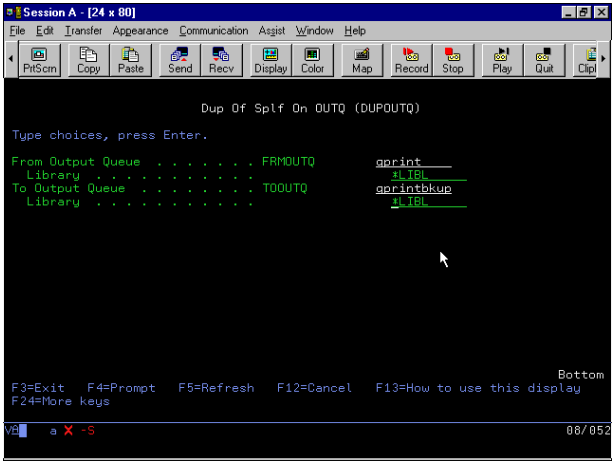
Assinale a alternativa que indica o que mostra a tela acima.
Assinale a alternativa que indica o que mostra a tela acima.
Ano: 2006
Banca:
NC-UFPR
Órgão:
SANEPAR
Provas:
NC-UFPR - 2006 - SANEPAR - Analista de Informatica - Suporte Técnico - Mainframe
|
NC-UFPR - 2006 - SANEPAR - Analista de Informatica - Analise de Sistemas - Plataforma Baixa |
Q2749843
Arquitetura de Software
Quanto aos conceitos que envolvem CA – ROSCOE 6.0, analise as afirmativas abaixo:
1. CA-ROSCOE 6.0 opera sobre o IBM System 30xx, 43xx, ou plataforma compatível operando MVS/370 SP1.3.3, MVS/XA SP2.1.0, ou MVS/ESA SP3.1.0, OS/390 V1R1, com os níveis associados de Jes2 or JES3
2. CA-ROSCOE 6.0 é um sistema de desenvolvimento de programas on-line de alta performance para o ambiente MVS.
3. CA-ROSCOE 6.0 suporta IBM MVS/ESA 5.1 e o novo ambiente S390/Parallel Sysplex (HPCS).
4. CA-ROSCOE 6.0 não suporta configurações dinâmicas de I/O, conhecido por DCD (Dynamic I/O Configurations).
Assinale a alternativa correta:
1. CA-ROSCOE 6.0 opera sobre o IBM System 30xx, 43xx, ou plataforma compatível operando MVS/370 SP1.3.3, MVS/XA SP2.1.0, ou MVS/ESA SP3.1.0, OS/390 V1R1, com os níveis associados de Jes2 or JES3
2. CA-ROSCOE 6.0 é um sistema de desenvolvimento de programas on-line de alta performance para o ambiente MVS.
3. CA-ROSCOE 6.0 suporta IBM MVS/ESA 5.1 e o novo ambiente S390/Parallel Sysplex (HPCS).
4. CA-ROSCOE 6.0 não suporta configurações dinâmicas de I/O, conhecido por DCD (Dynamic I/O Configurations).
Assinale a alternativa correta:
Ano: 2006
Banca:
NC-UFPR
Órgão:
SANEPAR
Provas:
NC-UFPR - 2006 - SANEPAR - Analista de Informatica - Suporte Técnico - Mainframe
|
NC-UFPR - 2006 - SANEPAR - Analista de Informatica - Analise de Sistemas - Plataforma Baixa |
Q2749842
Arquitetura de Software
Sobre os conceitos que envolvem ADABAS C, considere as seguintes afirmativas:
1. ADABAS C é um SGBDR - Sistema Gerenciador de Banco de Dados Relacional.
2. ADABAS C pode ser utilizado sobre a plataforma UNIX.
3. ADABAS C é uma Metodologia de Desenvolvimento de Sistemas Orientado a Objetos e não uma Metodologia de Desenvolvimento de Sistemas Estruturados.
5. ADABAS C é uma linguagem de programação baseado na Plataforma C.
Assinale a alternativa correta.
1. ADABAS C é um SGBDR - Sistema Gerenciador de Banco de Dados Relacional.
2. ADABAS C pode ser utilizado sobre a plataforma UNIX.
3. ADABAS C é uma Metodologia de Desenvolvimento de Sistemas Orientado a Objetos e não uma Metodologia de Desenvolvimento de Sistemas Estruturados.
5. ADABAS C é uma linguagem de programação baseado na Plataforma C.
Assinale a alternativa correta.
Ano: 2006
Banca:
NC-UFPR
Órgão:
SANEPAR
Provas:
NC-UFPR - 2006 - SANEPAR - Analista de Informatica - Suporte Técnico - Mainframe
|
NC-UFPR - 2006 - SANEPAR - Analista de Informatica - Analise de Sistemas - Plataforma Baixa |
Q2749841
Arquitetura de Software
Sobre TLMS, considere as seguintes afirmativas:
1. TLMS é uma metodologia de desenvolvimento de Sistemas Estruturados baseados no DMA (Direct Memory Access).
2. Uma das maiores áreas de interesse de TMLS é o eSW (embedded software).
3. TLMS é um acrônimo e significa Transaction Level Models.
4. TLMS e PIPELINE são sinônimos e operam em sistemas Batch
Assinale a alternativa correta.
1. TLMS é uma metodologia de desenvolvimento de Sistemas Estruturados baseados no DMA (Direct Memory Access).
2. Uma das maiores áreas de interesse de TMLS é o eSW (embedded software).
3. TLMS é um acrônimo e significa Transaction Level Models.
4. TLMS e PIPELINE são sinônimos e operam em sistemas Batch
Assinale a alternativa correta.
Ano: 2006
Banca:
NC-UFPR
Órgão:
SANEPAR
Provas:
NC-UFPR - 2006 - SANEPAR - Analista de Informatica - Suporte Técnico - Mainframe
|
NC-UFPR - 2006 - SANEPAR - Analista de Informatica - Analise de Sistemas - Plataforma Baixa |
Q2749840
Arquitetura de Software
Sobre SPOOL, considere as seguintes afirmativas:
1. SPOOL é um acrônimo e significa Simultaneous Peripheral Operations OnLine. 2. SPOOL possui o comando de manipulação: ORDER. 3. SPOOL possui o comando de manipulação: PURGE. 4. SPOOL possui o comando de manipulação: CHANGE. 5. SPOOL possui o comando de manipulação: QUERY.
Assinale a alternativa correta.
1. SPOOL é um acrônimo e significa Simultaneous Peripheral Operations OnLine. 2. SPOOL possui o comando de manipulação: ORDER. 3. SPOOL possui o comando de manipulação: PURGE. 4. SPOOL possui o comando de manipulação: CHANGE. 5. SPOOL possui o comando de manipulação: QUERY.
Assinale a alternativa correta.
Ano: 2006
Banca:
NC-UFPR
Órgão:
SANEPAR
Provas:
NC-UFPR - 2006 - SANEPAR - Analista de Informatica - Suporte Técnico - Mainframe
|
NC-UFPR - 2006 - SANEPAR - Analista de Informatica - Analise de Sistemas - Plataforma Baixa |
Q2749839
Arquitetura de Software
CICS TCP/IP é uma feature do OS/390 IP que permite você escrever aplicações CICS que podem atuar como clientes
ou servidores em uma rede baseada no TCP/IP. Sua principal intenção é suporte a aplicações peer-to-peer,
significando que ambos os terminais da conexão são programáveis:
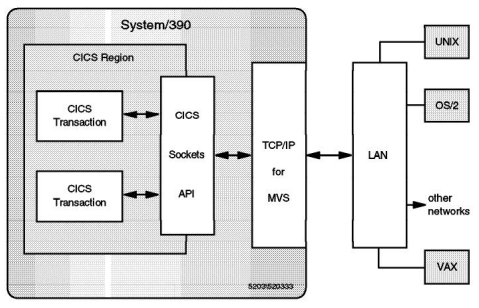
Assinale a alternativa que descreve a explicação do enunciado com a representação da figura acima.
Assinale a alternativa que descreve a explicação do enunciado com a representação da figura acima.
Ano: 2006
Banca:
NC-UFPR
Órgão:
SANEPAR
Provas:
NC-UFPR - 2006 - SANEPAR - Analista de Informatica - Suporte Técnico - Mainframe
|
NC-UFPR - 2006 - SANEPAR - Analista de Informatica - Analise de Sistemas - Plataforma Baixa |
Q2749838
Noções de Informática
O OS/390 Socket API suporta os seguintes tipos de Socket:
1. Stream Sockets. 2. Datagram Sockets. 3. Raw Sockets. 4. XNTr3 Sockets 5. Optimal CTWoo Sockets
Assinale a alternativa correta:
1. Stream Sockets. 2. Datagram Sockets. 3. Raw Sockets. 4. XNTr3 Sockets 5. Optimal CTWoo Sockets
Assinale a alternativa correta:
Ano: 2006
Banca:
NC-UFPR
Órgão:
SANEPAR
Provas:
NC-UFPR - 2006 - SANEPAR - Analista de Informatica - Suporte Técnico - Mainframe
|
NC-UFPR - 2006 - SANEPAR - Analista de Informatica - Analise de Sistemas - Plataforma Baixa |
Q2749837
Arquitetura de Software
Considere os componentes do programa IBM z/OS do gateway do Tivoli Workload Scheduler:
1. EEWTCP02. 2. EEWTCP00. 3. EEWTCx. 4. EEWTCy. 5. EEWTCPt.
São componentes do programa acima:
1. EEWTCP02. 2. EEWTCP00. 3. EEWTCx. 4. EEWTCy. 5. EEWTCPt.
São componentes do programa acima:
Ano: 2006
Banca:
NC-UFPR
Órgão:
SANEPAR
Provas:
NC-UFPR - 2006 - SANEPAR - Analista de Informatica - Suporte Técnico - Mainframe
|
NC-UFPR - 2006 - SANEPAR - Analista de Informatica - Analise de Sistemas - Plataforma Baixa |
Q2749836
Arquitetura de Software
A seguir são apresentado alguns comandos que envolvem o IBM z/OS. Numere a coluna da direita com base nas
informações da coluna da esquerda, os propósitos com seus respectivos conceitos:
1. jbxtract 2. at | mat 3. batch | mbatch 4. caxtract 5. jobstdl
( ) Apenas no UNIX. Submete um job para ser executado o mais breve possível.
( ) Extrai informações sobre jobs.
( ) Extrai informações sobre calendários.
( ) Retorna os nomes de caminhos de arquivos de lista padrão
( ) Apenas no UNIX. Submete um job para ser executado em um período específico.
Assinale a seqüência correta da coluna da direita, de cima para baixo:
1. jbxtract 2. at | mat 3. batch | mbatch 4. caxtract 5. jobstdl
( ) Apenas no UNIX. Submete um job para ser executado o mais breve possível.
( ) Extrai informações sobre jobs.
( ) Extrai informações sobre calendários.
( ) Retorna os nomes de caminhos de arquivos de lista padrão
( ) Apenas no UNIX. Submete um job para ser executado em um período específico.
Assinale a seqüência correta da coluna da direita, de cima para baixo:
Ano: 2006
Banca:
NC-UFPR
Órgão:
SANEPAR
Provas:
NC-UFPR - 2006 - SANEPAR - Analista de Informatica - Suporte Técnico - Mainframe
|
NC-UFPR - 2006 - SANEPAR - Analista de Informatica - Analise de Sistemas - Plataforma Baixa |
Q2749835
Inglês
Texto associado
Engineering and the Industrial Revolution
The first phase of modern engineering emerged in the Scientific Revolution. Galileo`s Two New Sciences, which seeks systematic
explanations and adopts a scientific approach to practical problems, is a landmark regarded by many engineer historians as the
beginning of structural analysis, the mathematical representation and design of building structures. This phase of engineering lasted
through the First Industrial Revolution, when machines, increasingly powered by steam engines, started to replace muscles in most
production. While pulling off the revolution, traditional artisans transformed themselves to modern professionals. The French, more
rationalistic oriented, spearheaded civil engineering with emphasis on mathematics and developed university engineering education
under the sponsorship of their government. The British, more empirically oriented, pioneered mechanical engineering and
autonomous professional societies under the laissez-faire attitude of their government. Gradually, practical thinking became
sicentific in addition to intuitive, as engineers developed mathematical analysis and controlled experiments. Technical training
shifted from apprenticeship to university education. Information flowed more quickly in organized meetings and journal publications
as professional societies emerged.
(www.creating technology.org/history.htm)
Place a mark in the alternative which CANNOT be inferred from the sentence: "Information flowed more quickly in organized meetings and journal publications as professional societies emerged."
Ano: 2006
Banca:
NC-UFPR
Órgão:
SANEPAR
Provas:
NC-UFPR - 2006 - SANEPAR - Analista de Informatica - Suporte Técnico - Mainframe
|
NC-UFPR - 2006 - SANEPAR - Analista de Informatica - Analise de Sistemas - Plataforma Baixa |
Q2749834
Inglês
Texto associado
Engineering and the Industrial Revolution
The first phase of modern engineering emerged in the Scientific Revolution. Galileo`s Two New Sciences, which seeks systematic
explanations and adopts a scientific approach to practical problems, is a landmark regarded by many engineer historians as the
beginning of structural analysis, the mathematical representation and design of building structures. This phase of engineering lasted
through the First Industrial Revolution, when machines, increasingly powered by steam engines, started to replace muscles in most
production. While pulling off the revolution, traditional artisans transformed themselves to modern professionals. The French, more
rationalistic oriented, spearheaded civil engineering with emphasis on mathematics and developed university engineering education
under the sponsorship of their government. The British, more empirically oriented, pioneered mechanical engineering and
autonomous professional societies under the laissez-faire attitude of their government. Gradually, practical thinking became
sicentific in addition to intuitive, as engineers developed mathematical analysis and controlled experiments. Technical training
shifted from apprenticeship to university education. Information flowed more quickly in organized meetings and journal publications
as professional societies emerged.
(www.creating technology.org/history.htm)
According to the text, during the Scientific Revolution:
Ano: 2006
Banca:
NC-UFPR
Órgão:
SANEPAR
Provas:
NC-UFPR - 2006 - SANEPAR - Analista de Informatica - Suporte Técnico - Mainframe
|
NC-UFPR - 2006 - SANEPAR - Analista de Informatica - Analise de Sistemas - Plataforma Baixa |
Q2749833
Inglês
Texto associado
Engineering and the Industrial Revolution
The first phase of modern engineering emerged in the Scientific Revolution. Galileo`s Two New Sciences, which seeks systematic
explanations and adopts a scientific approach to practical problems, is a landmark regarded by many engineer historians as the
beginning of structural analysis, the mathematical representation and design of building structures. This phase of engineering lasted
through the First Industrial Revolution, when machines, increasingly powered by steam engines, started to replace muscles in most
production. While pulling off the revolution, traditional artisans transformed themselves to modern professionals. The French, more
rationalistic oriented, spearheaded civil engineering with emphasis on mathematics and developed university engineering education
under the sponsorship of their government. The British, more empirically oriented, pioneered mechanical engineering and
autonomous professional societies under the laissez-faire attitude of their government. Gradually, practical thinking became
sicentific in addition to intuitive, as engineers developed mathematical analysis and controlled experiments. Technical training
shifted from apprenticeship to university education. Information flowed more quickly in organized meetings and journal publications
as professional societies emerged.
(www.creating technology.org/history.htm)
Consider the following afirmatives:
1. The French government supported higher education in engineering. 2. The British government`s attitude helped create autonomous professional societies. 3. The French and the British governments had similar attitudes concerning the development of engineering. 4. The focus of engineering was more scientific in France than in Great Britain.
According to the text:
1. The French government supported higher education in engineering. 2. The British government`s attitude helped create autonomous professional societies. 3. The French and the British governments had similar attitudes concerning the development of engineering. 4. The focus of engineering was more scientific in France than in Great Britain.
According to the text:
Ano: 2006
Banca:
NC-UFPR
Órgão:
SANEPAR
Provas:
NC-UFPR - 2006 - SANEPAR - Analista de Informatica - Suporte Técnico - Mainframe
|
NC-UFPR - 2006 - SANEPAR - Analista de Informatica - Analise de Sistemas - Plataforma Baixa |
Q2749832
Inglês
Texto associado
Engineering and the Industrial Revolution
The first phase of modern engineering emerged in the Scientific Revolution. Galileo`s Two New Sciences, which seeks systematic
explanations and adopts a scientific approach to practical problems, is a landmark regarded by many engineer historians as the
beginning of structural analysis, the mathematical representation and design of building structures. This phase of engineering lasted
through the First Industrial Revolution, when machines, increasingly powered by steam engines, started to replace muscles in most
production. While pulling off the revolution, traditional artisans transformed themselves to modern professionals. The French, more
rationalistic oriented, spearheaded civil engineering with emphasis on mathematics and developed university engineering education
under the sponsorship of their government. The British, more empirically oriented, pioneered mechanical engineering and
autonomous professional societies under the laissez-faire attitude of their government. Gradually, practical thinking became
sicentific in addition to intuitive, as engineers developed mathematical analysis and controlled experiments. Technical training
shifted from apprenticeship to university education. Information flowed more quickly in organized meetings and journal publications
as professional societies emerged.
(www.creating technology.org/history.htm)
According to the text, an important change in the first phase of modern engineering was:
Ano: 2006
Banca:
NC-UFPR
Órgão:
SANEPAR
Provas:
NC-UFPR - 2006 - SANEPAR - Analista de Informatica - Suporte Técnico - Mainframe
|
NC-UFPR - 2006 - SANEPAR - Analista de Informatica - Analise de Sistemas - Plataforma Baixa |
Q2749831
Inglês
Texto associado
Engineering and the Industrial Revolution
The first phase of modern engineering emerged in the Scientific Revolution. Galileo`s Two New Sciences, which seeks systematic
explanations and adopts a scientific approach to practical problems, is a landmark regarded by many engineer historians as the
beginning of structural analysis, the mathematical representation and design of building structures. This phase of engineering lasted
through the First Industrial Revolution, when machines, increasingly powered by steam engines, started to replace muscles in most
production. While pulling off the revolution, traditional artisans transformed themselves to modern professionals. The French, more
rationalistic oriented, spearheaded civil engineering with emphasis on mathematics and developed university engineering education
under the sponsorship of their government. The British, more empirically oriented, pioneered mechanical engineering and
autonomous professional societies under the laissez-faire attitude of their government. Gradually, practical thinking became
sicentific in addition to intuitive, as engineers developed mathematical analysis and controlled experiments. Technical training
shifted from apprenticeship to university education. Information flowed more quickly in organized meetings and journal publications
as professional societies emerged.
(www.creating technology.org/history.htm)
According to the text, a landmark in engineering is:

 Conheça nossos planos