Questões de Concurso
Para tradutor intérprete
Foram encontradas 724 questões
Resolva questões gratuitamente!
Junte-se a mais de 4 milhões de concurseiros!


Para questionar a postura conservadora em relação à fidelidade da tradução, Gile (1995) realizou um experimento para ajudar seus alunos a entender essa questão. O experimento foi adaptado para a disciplina de tradução do Curso de Letras da Universidade Federal de Santa Catarina (UFSC) e é reproduzido abaixo:
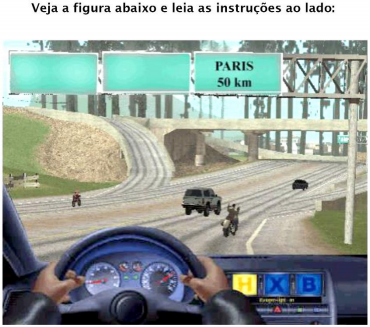
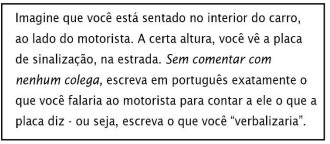
Algumas amostras dos resultados das verbalizações:
1. 50 km para Paris.
2. Só mais 50 km e chegamos a Paris.
3. Vamos chegar a Paris daqui a 50 km.
4.Paris está a 50 km daqui.
5. Estamos quase lá! Mais meia hora!
6. Puxa, ainda falta tanto para Paris!
7. Olha só! A placa diz que Paris está a 50 km daqui.
Considerando a variação nos resultados e as reflexões sobre os conceitos de fidelidade, a variedade de verbalização para
a mesma imagem é explicada:

Sobre a história do intérprete de Libras no Brasil, considere as seguintes afirmativas:
1. A estudante Denise Coutinho foi a primeira pessoa a assumir a interpretação da Libras publicamente, em evento coletivo, podendo ser considerada a primeira intérprete de Libras no Rio de Janeiro, quiçá no Brasil.
2. Ricardo Sander foi o primeiro intérprete a apresentar o Hino Nacional em Libras, em eventos oficiais da FENEIS.
3. Em 1988, a FENEIS realizou, no Rio de Janeiro, o I Encontro Nacional dos Intérpretes em Língua de Sinais e, nesse ano, publicou uma espécie de manual, com o título “A Importância dos Intérpretes da Linguagem de Sinais”.
4. Em 2002, foi realizado o II Encontro Nacional de Intérpretes, na Universidade Federal de Santa Catarina (UFSC), ocasião em que foi aprovado o código de ética da categoria. Nessa ocasião, a intérprete e pesquisadora de Libras Ronice Muller de Quadros lançou o livro “O tradutor e intérprete de língua brasileira de sinais e língua portuguesa”.
Assinale a alternativa correta.
Numere a coluna da direita, relacionando as premissas extraídas das ideias de Friedrich Schleiermacher, apresentadas por Heidermann (2009), com os respectivos tipos de tradução.
1. Tradução intralingual.
2. Tradução interpessoal.
3. Tradução intrapessoal.
( ) Às vezes, os nossos próprios discursos devem ser traduzidos depois de um certo tempo, se quisermos que continuem sendo nossos.
( ) Não só os diversos dialetos dos diferentes grupos étnicos de um povo e os diferentes desenvolvimentos dessa mesma língua ou dialeto em diferentes séculos já são, num sentido mais restrito, línguas diferentes e, não raras vezes, precisam de uma tradução entre si.
( ) Mesmo os contemporâneos não separados por dialetos, pertencentes a distintas classes sociais que, pouco relacionadas em seu trato, divergem muito em sua formação, muitas vezes só conseguem se entender através de uma intermediação.
( ) Mas, não é que frequentemente precisamos traduzir o discurso de um outro que é igual a nós, porém de personalidade e mentalidade diferentes, quando sentimos que as mesmas palavras teriam um sentido bem diferente na nossa boca ou ao menos um valor mais forte ou mais fraco que na dele e que, se quiséssemos expressar à nossa maneira o mesmo que ele expressou, utilizaríamos palavras e locuções totalmente diferentes?
Assinale a alternativa que apresenta a numeração correta da coluna da direita, de cima para baixo.
Sobre a constituição do profissional tradutor intérprete, considere as seguintes afirmativas:
1. Vários autores, entre eles Massuti e Santos (2008), argumentam que o processo de tradução se configura para além de aspectos linguísticos, pois requer estratégias que levem em conta não só as subjetividades do tradutor intérprete e da pessoa surda, mas, também, aspectos que são centrais na cultura surda e na cultura ouvinte.
2. Perlin (2006) conceitua o tradutor intérprete de língua de sinais (TILS) como intérprete da cultura, da língua e da história das pessoas surdas. O ato de traduzir/interpretar é fazer parte da história do outro, o outro surdo. E fazer parte significa se colocar à disposição para entender esse outro, os seus afetos e as suas experiências de vida.
3. Segundo Marques e Oliveira (2009), a partir de uma perspectiva fenomenológica, os tradutores intérpretes de língua de sinais estão o tempo todo assimilando e internalizando novos lugares, novas temporalidades e movendo símbolos carregados de afetividade, motivo pelo qual se encontram num espaço privilegiado de acumulação de conhecimento maximizado em relação a Ser Surdo.
4. Para Massutti (2007), o intérprete seria como um leitor cultural e agenciador de sentidos traduzidos em zonas fronteiriças de contato, marcadas por tensões subjetivas que reinventam os sujeitos não de acordo com uma ou outra cultura, mas conforme o regime híbrido que tece enredos emotivos e cognitivos.
Assinale a alternativa correta.
Considere as imagens abaixo, extraídas de Strobel e Fernandes (1998):
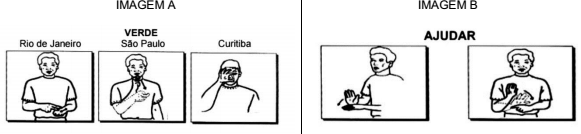
Com base nessas imagens, assinale a alternativa correta.
Considere o texto abaixo:
[...] as línguas de sinais podem fornecer novas perspectivas teóricas sobre as línguas humanas, sobre os determinantes da linguagem e o processo de aquisição e desenvolvimento de uma língua que apresenta certas particularidades em relação às línguas orais.
(QUADROS; KARNOPP, 2004, p. 37)
No que diz respeito à relação entre estudos linguísticos e línguas de sinais, sob o ponto de vista das autoras, é correto afirmar:
Sobre a relação entre língua oral e língua de sinais apontada por Gesser (2009), identifique como verdadeiras (V) ou falsas (F) as seguintes afirmativas:
( ) A língua de sinais tem estrutura própria e é autônoma, ou seja, independente de qualquer língua oral em sua concepção linguística. Apesar disso, no bimodalismo, a estrutura sintática do português, muitas vezes, é presente durante o uso da Libras.
( ) As marcas de imposição da estrutura do português em falares sinalizados se caracteriza como uma forma de hibridismo e funciona como uma estratégia para aqueles ouvintes que estão iniciando o contato e a aprendizagem da língua de sinais, sendo que a fala oral é inerente à cultura dos ouvintes e, portanto, é difícil desvencilhar-se dela.
( ) As marcas de imposição da estrutura do português em falares sinalizados advêm das mãos de surdos oralizados (congênitos ou adquiridos) que, em primeiro lugar, fazem uso da oralidade e rejeitam a língua de sinais. A partir do momento em que passam a utilizar a língua de sinais, eles o fazem ainda tendo em vista a supremacia da fala.
( ) A comunidade surda está inserida na e cercada pela comunidade majoritária ouvinte, e isso faz com que as línguas de sinais estejam em contato direto com as línguas orais locais. Essa “coabitação” linguística faz com que haja não compreensão entre surdos e ouvintes.
( ) A relação entre as línguas não é, nem nunca foi, neutra ou simétrica. Sempre há em jogo questões de poder e as decorrentes situações de conflito, como no caso da língua oral e da língua de sinais, em que a língua dominante tenta abocanhar a língua dominada.
Assinale a alternativa que apresenta a sequência correta, de cima para baixo.
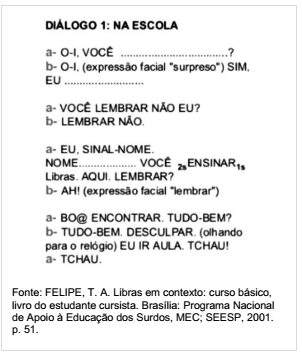
A glosa ao lado se refere ao registro de uma interação em Libras. Baseando-se na transcrição dos sinais, assinale a alternativa correta.
Sobre os conceitos e campos epistemológicos apresentados por Skliar (1998), que apreendem a educação de surdos em uma visão socioantropológica, numere a coluna da direita de acordo com sua correspondência com a coluna da esquerda.
1. Surdez.
2. Cultura Surda.
3. Estudos Surdos.
4. Multiculturalismo.
5. Ouvintismo.
( ) Apresenta características que são específicas, que se traduzem de forma visual. As formas de organizar o pensamento e a linguagem transcendem as formas ouvintes. Elas são de outra ordem, uma ordem com base visual, e por isso têm características que podem ser ininteligíveis aos ouvintes. Ela se manifesta mediante a coletividade que se constitui a partir dos próprios surdos.
( ) Pode ser definido como um território de investigação educativa e de proposições políticas que, por meio de um conjunto de concepções linguísticas, culturais, comunitárias e de identidades, definem uma particular aproximação ao conhecimento sobre a surdez e os surdos.
( ) Se constitui em uma diferença politicamente reconhecida e localizada, na maioria das vezes, dentro do discurso da deficiência e caracteriza identidades múltiplas e multifacetadas.
( ) Define um conjunto de representações dos ouvintes a partir do qual o surdo está obrigado a olhar-se e narrar-se como se fosse ouvinte. Nessa perspectiva é que acontecem as percepções do ser deficiente, do não ser ouvinte, percepções que legitimam as práticas terapêuticas.
( ) Apresenta a surdez como uma diferença política e uma experiência visual para pensarmos as identidades surdas a partir do conceito de diferença, e não de deficiência. Essa compreensão implica distanciarmo-nos do conceito de diferença como exclusão e marginalização e nega uma atribuição puramente externa do ser surdo a alguma característica marcante, como, por exemplo, não ouvir.
Assinale a alternativa que apresenta a numeração correta da coluna da direita, de cima para baixo.
Considere o seguinte fragmento:
Pode-se debater se a surdez é ou não “preferível” à cegueira quando adquirida não muito cedo na vida; mas nascer surdo é infinitamente mais grave do que nascer cego pelo menos de forma potencial. Isso porque os que têm surdez pré-linguística, incapazes de ouvir seus pais, correm o risco de ficar seriamente atrasados, quando não permanentemente deficientes, na compreensão da língua, a menos que se tomem providências eficazes com toda a presteza. E ser deficiente na linguagem, para um ser humano, é uma das calamidades mais terríveis [...].
(SACKS, O. Vendo Vozes. Uma jornada pelo mundo dos Surdos. Rio de Janeiro: Imago, 1990, p. 19)
Assinale a alternativa que demonstra o entendimento do autor quanto às relações entre surdez e linguagem.

 Conheça nossos planos