Foram encontradas 151 questões
Resolva questões gratuitamente!
Junte-se a mais de 4 milhões de concurseiros!


Text 2
Here are four passages from an article on awareness of English as a lingua franca (ELF):
1) “Few will deny that research in the area of English as a lingua franca (ELF) has significantly contributed to our understanding of many different facets of communication involving non-native speakers of English. Such studies have added valuable insights to the growing research in the domain of critical applied linguistics and critical pedagogy and have prompted many scholars to problematize all aspects of English language teaching, learning, testing, curriculum designing, etc.”
2) “It is important at this stage to distinguish between the critical and the transformative perspective in ESOL teacher education. While they both share the element of reflection, they are different in a crucial way, although the former has often been seen as an umbrella term that subsumes the latter.”
3) “Critical pedagogy is invaluable in our attempt to understand the complex processes of the global spread of English and the intricate ways in which it continues to be localized and relocalized (Pennycook, 2010). It has the tools to help teachers appreciate the complications of context and the various underlying and often hidden discourses, from learner identity construction in the ESOL classroom (Norton and Toohey, 2011) to language testing (Shohamy, 2004) to the politics of pedagogy in the ‘classroom as a microcosm of the larger social and cultural world’” (Pennycook, 2001: 138).
4) “The value of an ELF-aware transformative perspective to ESOL teacher education lies in its power to help teachers define ELF for themselves and for their teaching contexts. In this way, teachers are involved in the co-construction of ELF and, in particular, in the development of one or more pedagogical frameworks for ELF. To achieve this, teachers have to have an informed awareness of the ELF construct, a critical awareness of their own deeper convictions about essential aspects of language, communication, and language teaching/learning, and the capability to bring about sustainable change in their teaching.”
From Sifakis, N. C. (2014). "ELF awareness as an opportunity for change: a transformative perspective for ESOL teacher education". Journal of English as a Lingua Franca, 3/2: 317-335.
Text 2
Here are four passages from an article on awareness of English as a lingua franca (ELF):
1) “Few will deny that research in the area of English as a lingua franca (ELF) has significantly contributed to our understanding of many different facets of communication involving non-native speakers of English. Such studies have added valuable insights to the growing research in the domain of critical applied linguistics and critical pedagogy and have prompted many scholars to problematize all aspects of English language teaching, learning, testing, curriculum designing, etc.”
2) “It is important at this stage to distinguish between the critical and the transformative perspective in ESOL teacher education. While they both share the element of reflection, they are different in a crucial way, although the former has often been seen as an umbrella term that subsumes the latter.”
3) “Critical pedagogy is invaluable in our attempt to understand the complex processes of the global spread of English and the intricate ways in which it continues to be localized and relocalized (Pennycook, 2010). It has the tools to help teachers appreciate the complications of context and the various underlying and often hidden discourses, from learner identity construction in the ESOL classroom (Norton and Toohey, 2011) to language testing (Shohamy, 2004) to the politics of pedagogy in the ‘classroom as a microcosm of the larger social and cultural world’” (Pennycook, 2001: 138).
4) “The value of an ELF-aware transformative perspective to ESOL teacher education lies in its power to help teachers define ELF for themselves and for their teaching contexts. In this way, teachers are involved in the co-construction of ELF and, in particular, in the development of one or more pedagogical frameworks for ELF. To achieve this, teachers have to have an informed awareness of the ELF construct, a critical awareness of their own deeper convictions about essential aspects of language, communication, and language teaching/learning, and the capability to bring about sustainable change in their teaching.”
From Sifakis, N. C. (2014). "ELF awareness as an opportunity for change: a transformative perspective for ESOL teacher education". Journal of English as a Lingua Franca, 3/2: 317-335.
Text 2
Here are four passages from an article on awareness of English as a lingua franca (ELF):
1) “Few will deny that research in the area of English as a lingua franca (ELF) has significantly contributed to our understanding of many different facets of communication involving non-native speakers of English. Such studies have added valuable insights to the growing research in the domain of critical applied linguistics and critical pedagogy and have prompted many scholars to problematize all aspects of English language teaching, learning, testing, curriculum designing, etc.”
2) “It is important at this stage to distinguish between the critical and the transformative perspective in ESOL teacher education. While they both share the element of reflection, they are different in a crucial way, although the former has often been seen as an umbrella term that subsumes the latter.”
3) “Critical pedagogy is invaluable in our attempt to understand the complex processes of the global spread of English and the intricate ways in which it continues to be localized and relocalized (Pennycook, 2010). It has the tools to help teachers appreciate the complications of context and the various underlying and often hidden discourses, from learner identity construction in the ESOL classroom (Norton and Toohey, 2011) to language testing (Shohamy, 2004) to the politics of pedagogy in the ‘classroom as a microcosm of the larger social and cultural world’” (Pennycook, 2001: 138).
4) “The value of an ELF-aware transformative perspective to ESOL teacher education lies in its power to help teachers define ELF for themselves and for their teaching contexts. In this way, teachers are involved in the co-construction of ELF and, in particular, in the development of one or more pedagogical frameworks for ELF. To achieve this, teachers have to have an informed awareness of the ELF construct, a critical awareness of their own deeper convictions about essential aspects of language, communication, and language teaching/learning, and the capability to bring about sustainable change in their teaching.”
From Sifakis, N. C. (2014). "ELF awareness as an opportunity for change: a transformative perspective for ESOL teacher education". Journal of English as a Lingua Franca, 3/2: 317-335.
As regards Passage 2, analyse the assertions below:
I. A critical orientation may include a transformative view.
II. Critical and transformative perspectives in ESOL are indistinguishable.
III. Transformative perspectives are wider than critical orientations.
Choose the correct answer:
Text 1
Multiliteracies
Text 1
Multiliteracies
Text 1
Multiliteracies
Read the following extract from Text 1: “Multiliteracies recognizes both the increasing cultural and linguistic diversity in the new globalized society and the new variety of text forms from multiple communicative technologies.” (L.11-14)
(imagem)
The alternative from Lotherington (2006) that has some analogy to this passage is:
Text 1
Multiliteracies
As leis 11.645 e 10.639 incluíram no currículo oficial escolar a obrigatoriedade do estudo das Histórias e Culturas Indígenas.
A esse respeito, analise as afirmativas a seguir.
I. Essas leis proporcionam às comunidades e povos indígenas a possibilidade de recuperar suas memórias históricas, reafirmar suas identidades étnicas e valorizar suas línguas e conhecimentos.
II. Essas leis garantem às comunidades e povos indígenas o acesso às informações, conhecimentos técnicos e científicos da sociedade nacional e demais sociedades indígenas.
III. Essas leis marcam a segregação dos povos indígenas que devem receber tratamento especial quanto à adaptação dos saberes da sociedade atual.
Está correto o que se afirma em
Nas unidades escolares da rede municipal de São Paulo, o atendimento aos educandos portadores de deficiência, com Transtornos Globais do Desenvolvimento – TGD ou com Altas Habilidades / Superdotação – AH/SD, deverá seguir a Portaria nº 1.185.
A esse respeito, assinale V para a afirmativa verdadeira e F para a falsa.
( ) Deve ser estruturado um plano de Atendimento Educacional Especializado básico para atender a todos os alunos que necessitam de atendimento especial.
( ) Deve ser elaborado um Plano de Atendimento Educacional Especializado individual, que deverá ter um orientador de atendimento, independentemente da forma ofertada.
( ) Deve ser preparada uma versão reduzida do planejamento curricular da escola com o objetivo de atender esses educandos.
As afirmativas são, respectivamente,
“O conhecimento do tema Atmosfera, por exemplo, na aula de determinado ano ou série, lecionado por meio de um método, registrado em um texto, desenvolvido rapidamente e avaliado com uma prova objetiva, por exemplo, não é um conhecimento que os estudantes têm sobre a Terra”. (Sacristan, 2013, p. 20)
A esse respeito assinale a opção que apresenta um argumento do autor para a afirmativa em destaque.
Paula é professora de artes do Ensino Fundamental e, em suas aulas, procura trabalhar conteúdos relacionados a valores, normas e atitudes.
Para a realização desse trabalho devem ser considerados os objetivos listados a seguir, à exceção de um. Assinale-o.
Observe o gráfico a seguir:
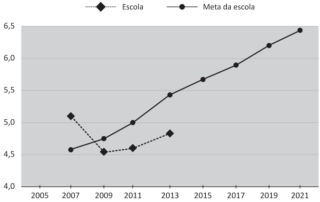
(Evolução do IDEB na Escola Orquídea - 5º ano – Os dados se referem à uma escola real, processados e divulgados pela plataforma QEdu. O nome da escola é fictício)
Sobre o IDEB, analise as afirmativas a seguir.
I. É o principal indicador adotado pelo Governo Federal para traçar metas educacionais a serem alcançadas por escolas e redes estaduais e municipais.
II. A ideia central da adoção de metas pelo IDEB é a de obter um maior comprometimento das redes e escolas com a melhoria dos indicadores educacionais.
III. O indicador expressa exclusivamente uma medida da aprendizagem dos alunos, a partir dos resultados da Prova Brasil.
Está correto o que se afirma em
Observe a figura a seguir.
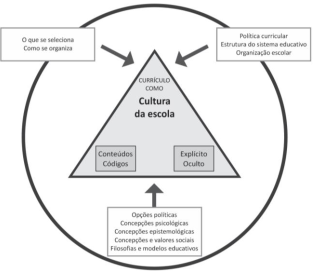
Adaptado. Fonte: SACRISTÁN, 2000, p. 36. In: São Paulo: “Diálogos interdisciplinares a caminho da autoria”)
O documento “Diálogos interdisciplinares a caminho da autoria”, organizado pela Secretaria Municipal de Educação de São Paulo, apresenta este esquema para sintetizar a compreensão de currículo construída na Rede.
A partir da análise desse esquema é possível identificar três
conjuntos de condicionantes na estrutura desse currículo.
Assinale a afirmativa que os apresenta.
Sobre o Atendimento Educacional Especializado nas unidades educacionais da Rede Municipal de Ensino de São Paulo, assinale V para a afirmativa verdadeira e F para a falsa.
( ) As Escolas Municipais de Educação Infantil (EMEIs) que aderiram ao Programa “São Paulo Integral” e que tiverem crianças matriculadas com algum tipo de deficiência, o atendimento itinerante será prestado pelo Professor de Apoio e Acompanhamento à Inclusão (PAAI).
( ) O Atendimento Educacional Especializado (AEE) será entendido como o serviço organizado institucionalmente e prestado aos educandos que dele necessitem em caráter complementar ou suplementar às atividades escolares.
( ) O encaminhamento dos educandos para o AEE dar-se-á após avaliação pedagógica/estudo de caso.
As afirmativas são, respectivamente,
Felipe é professor de Física do 2º ano do Ensino Médio. Ele costuma acompanhar a aprendizagem de seus alunos por meio da participação nas aulas, dos exercícios realizados individual e coletivamente e dos trabalhos e provas que compõem a avaliação institucional da escola.
O professor reconhece que a avaliação da aprendizagem no Ensino Médio, conforme previsto nas Diretrizes Curriculares Nacionais do Ensino Médio, envolve, ainda, a seguinte dimensão:
Relacione as Modalidades da Educação Básica à respectiva característica.
1. Educação de Jovens e Adultos
2. Educação Especial
3. Educação Profissional e Tecnológica
4. Educação do Campo
( ) Integra-se aos diferentes níveis e modalidades de educação e às dimensões do trabalho, da ciência e da tecnologia, e articula-se com o ensino regular e com outras modalidades educacionais.
( ) Destina-se aos que se situam em faixa etária superior à considerada própria para a conclusão do Ensino Fundamental e do Ensino Médio.
( ) Está prevista para população específica, com adequações necessárias às peculiaridades contextuais de cada região.
( ) Modalidade transversal a todos os níveis, etapas e modalidades de ensino, é parte integrante da educação regular, devendo ser prevista no projeto político-pedagógico da unidade escolar.
Assinale a opção que indica a relação correta, de cima para baixo.
A LDB/96 define o Ensino Médio como etapa final da Educação Básica.
Nessa etapa do ensino
Leia a manchete a seguir.
'Fiquei revoltada' , diz mãe de criança anã que teve matrícula escolar negada
Escola de Votorantin (SP) foi condenada a pagar indenização de R$ 20 mil. Instituição nega preconceito e afirma que vai recorrer de decisão.
(Matéria publicada no site de notícias G1, em 19/01/2016).
Esse caso é um exemplo de descumprimento do seguinte
princípio legal:
O documento Programa Mais Educação propõe a ampliação e a qualificação da Educação de Jovens e Adultos.
Sobre as reflexões do documento sobre o tema, assinale V para a afirmativa verdadeira e F para a falsa.
( ) A EJA deve ser reconhecida nas suas especificidades, assumindo seu papel de atuar na transformação da realidade social e rompendo com a ideia de que seria uma reprodução do Ensino Fundamental.
( ) O público da EJA deve ser atendido em condições estruturais equivalentes a todos os demais educandos, promovendo a equidade.
( ) O currículo da EJA deve contemplar a diversidade, possibilitando a reorganização dos tempos e espaços, configurando um currículo significativo, ligado às práticas sociais.
As afirmativas são, respectivamente,

 Conheça nossos planos