Questões de Concurso
Para professor - controle automação instrumentação industrial
Foram encontradas 151 questões
Resolva questões gratuitamente!
Junte-se a mais de 4 milhões de concurseiros!


I.A melhoria contínua é um processo que visa alcançar a perfeição absoluta nos processos empresariais.
ll.Implementar a melhoria contínua pode contribuir para reduzir custos operacionais e aumentar a eficiência da empresa.
lll.O Ciclo PDCA consiste nas etapas de Planejar, Desenvolver, Controlar e Anular.
IV.O Diagrama de lshikawa, também conhecido como Diagrama de Causa e Efeito, é uma ferramenta utilizada para identificar possíveis causas de problemas.
V.O Seis Sigma é uma metodologia que não se baseia em técnicas estatísticas para analisar dados e promover melhorias.
É correto o que se afirma em:
-Rede de comunicação industrial baseada em EtherCAT, para controle em tempo real.
-Implementação de um Digital Twin, para simulação e otimização em tempo real.
-Algoritmos de machine learning, para detecção precoce de falhas e manutenção preditiva.
-Interface homem-máquina (IHM) baseada em realidade aumentada.
-Integração com sistemas MES (Manufacturing Execution System) e ERP (Enterprise Resource Planning).
Durante a operação, o sistema deve lidar com perturbações estocásticas na composição da matéria-prima e variações na demanda de produção, mantendo a qualidade do produto final dentro de especificações rigorosas. Considerando esse cenário, é correto o que se afirma em:
-RC1 inicia o ciclo ao receber uma peça do STI.
-RC1 processa a peça e a transfere para RC2 quando o sensor S1 é ativado.
-RC2 realiza operações adicionais e deposita a peça no STI quando o sensor S2 é ativado.
-O STI move a peça para a próxima estação.
-O sistema utiliza algoritmos de machine /earning para otimização contínua e manutenção preditiva. Durante a operação, foram observadas variações na qualidade do produto final e na eficiência energética.
Considerando esse cenário, é correto o que se afirma em:
(Elaborado com base em MIZUKAMI, M. G.M. Ensino, as abordagens do processo. São Paulo:EPU, 1986).
Considerando o exposto, assinale a alternativa que corretamente relaciona as principais teorias educacionais que permearam ou permeiam a educação brasileira; o papel que a escola, o professor e o estudante tiveram ou têm segundo essas teorias e a maneira como elas percebiam ou percebem o processo de ensino e aprendizagem:
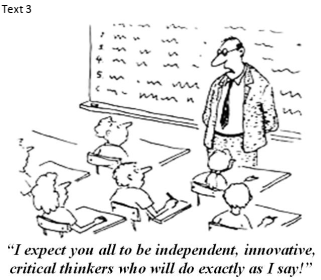
Text 2
Here are four passages from an article on awareness of English as a lingua franca (ELF):
1) “Few will deny that research in the area of English as a lingua franca (ELF) has significantly contributed to our understanding of many different facets of communication involving non-native speakers of English. Such studies have added valuable insights to the growing research in the domain of critical applied linguistics and critical pedagogy and have prompted many scholars to problematize all aspects of English language teaching, learning, testing, curriculum designing, etc.”
2) “It is important at this stage to distinguish between the critical and the transformative perspective in ESOL teacher education. While they both share the element of reflection, they are different in a crucial way, although the former has often been seen as an umbrella term that subsumes the latter.”
3) “Critical pedagogy is invaluable in our attempt to understand the complex processes of the global spread of English and the intricate ways in which it continues to be localized and relocalized (Pennycook, 2010). It has the tools to help teachers appreciate the complications of context and the various underlying and often hidden discourses, from learner identity construction in the ESOL classroom (Norton and Toohey, 2011) to language testing (Shohamy, 2004) to the politics of pedagogy in the ‘classroom as a microcosm of the larger social and cultural world’” (Pennycook, 2001: 138).
4) “The value of an ELF-aware transformative perspective to ESOL teacher education lies in its power to help teachers define ELF for themselves and for their teaching contexts. In this way, teachers are involved in the co-construction of ELF and, in particular, in the development of one or more pedagogical frameworks for ELF. To achieve this, teachers have to have an informed awareness of the ELF construct, a critical awareness of their own deeper convictions about essential aspects of language, communication, and language teaching/learning, and the capability to bring about sustainable change in their teaching.”
From Sifakis, N. C. (2014). "ELF awareness as an opportunity for change: a transformative perspective for ESOL teacher education". Journal of English as a Lingua Franca, 3/2: 317-335.
Text 2
Here are four passages from an article on awareness of English as a lingua franca (ELF):
1) “Few will deny that research in the area of English as a lingua franca (ELF) has significantly contributed to our understanding of many different facets of communication involving non-native speakers of English. Such studies have added valuable insights to the growing research in the domain of critical applied linguistics and critical pedagogy and have prompted many scholars to problematize all aspects of English language teaching, learning, testing, curriculum designing, etc.”
2) “It is important at this stage to distinguish between the critical and the transformative perspective in ESOL teacher education. While they both share the element of reflection, they are different in a crucial way, although the former has often been seen as an umbrella term that subsumes the latter.”
3) “Critical pedagogy is invaluable in our attempt to understand the complex processes of the global spread of English and the intricate ways in which it continues to be localized and relocalized (Pennycook, 2010). It has the tools to help teachers appreciate the complications of context and the various underlying and often hidden discourses, from learner identity construction in the ESOL classroom (Norton and Toohey, 2011) to language testing (Shohamy, 2004) to the politics of pedagogy in the ‘classroom as a microcosm of the larger social and cultural world’” (Pennycook, 2001: 138).
4) “The value of an ELF-aware transformative perspective to ESOL teacher education lies in its power to help teachers define ELF for themselves and for their teaching contexts. In this way, teachers are involved in the co-construction of ELF and, in particular, in the development of one or more pedagogical frameworks for ELF. To achieve this, teachers have to have an informed awareness of the ELF construct, a critical awareness of their own deeper convictions about essential aspects of language, communication, and language teaching/learning, and the capability to bring about sustainable change in their teaching.”
From Sifakis, N. C. (2014). "ELF awareness as an opportunity for change: a transformative perspective for ESOL teacher education". Journal of English as a Lingua Franca, 3/2: 317-335.
Based on Siqueira (2011), analyse the statements below.
I. ELF has derived from “native” speakers and is a unique variety of English.
II. Most interactions in ELF today are between “non-native” speakers.
III. ELF has become a diverse, multiple and nomad language.
IV. It is possible to codify a general variety of ELF.
Choose the correct answer:

 Conheça nossos planos