Selecionar segmento
Estude com questões de diferentes segmentos
Atenção: Isso limpará todos os campos já preenchidos no filtro!
Foram encontradas 16.917 questões
Resolva questões gratuitamente!
Junte-se a mais de 4 milhões de concurseiros!


Ano: 2012
Banca:
FCC
Órgão:
TRT - 6ª Região (PE)
Prova:
FCC - 2012 - TRT - 6ª Região (PE) - Analista Judiciário - Medicina do Trabalho |
Q241705
Medicina
O metabolismo do organismo depende das reações químicas celulares para obtenção da energia dos alimentos e uso pelos diversos sistemas fisiológicos dos tecidos. Existe uma molécula lábil, encontrada em todas as células, que tem a capacidade peculiar de participar de várias reações acopladas - reações com o alimento para a obtenção de energia e reações diversas para o fornecimento de energia às células. Por esta razão foi denominada moeda energética do organismo, passível de ser adquirida e usada repetidamente. Esta molécula é
Ano: 2012
Banca:
FCC
Órgão:
TRT - 6ª Região (PE)
Prova:
FCC - 2012 - TRT - 6ª Região (PE) - Analista Judiciário - Medicina do Trabalho |
Q241704
Medicina
Sobre os efeitos do monóxido de carbono (CO) na fisiologia respiratória, considere as afirmações:
I. O monóxido de carbono combina-se com a molécula de hemoglobina no mesmo ponto em que se liga o oxigênio, porém com afinidade e tenacidade muito maiores, podendo deslocar o oxigênio da hemoglobina.
II. O oxigênio em altas pressões alveolares desloca o monóxido de carbono de sua combinação com a hemoglobina.
III. A administração simultânea de dióxido de carbono a 5% ao paciente intoxicado por CO é benéfica, por estimular o centro respiratório aumentando a ventilação alveolar.
Está correto o que se afirma em
I. O monóxido de carbono combina-se com a molécula de hemoglobina no mesmo ponto em que se liga o oxigênio, porém com afinidade e tenacidade muito maiores, podendo deslocar o oxigênio da hemoglobina.
II. O oxigênio em altas pressões alveolares desloca o monóxido de carbono de sua combinação com a hemoglobina.
III. A administração simultânea de dióxido de carbono a 5% ao paciente intoxicado por CO é benéfica, por estimular o centro respiratório aumentando a ventilação alveolar.
Está correto o que se afirma em
Ano: 2012
Banca:
FCC
Órgão:
TRT - 6ª Região (PE)
Prova:
FCC - 2012 - TRT - 6ª Região (PE) - Analista Judiciário - Medicina do Trabalho |
Q241703
Segurança e Saúde no Trabalho
A Perda Auditiva Induzida por Ruído (PAIR) é resultante de um processo fisiopatológico que ocorre fundamentalmente no(a) I , localizado no(a) II . Os verdadeiros receptores sensoriais deste órgão são as células III , que quando estimuladas geram impulsos que são transmitidos pelo IV até o sistema nervoso central.
A alternativa que preenche as lacunas I, II, III e IV, respectivamente, é
A alternativa que preenche as lacunas I, II, III e IV, respectivamente, é
Ano: 2012
Banca:
FCC
Órgão:
TRT - 6ª Região (PE)
Prova:
FCC - 2012 - TRT - 6ª Região (PE) - Analista Judiciário - Medicina do Trabalho |
Q241702
Segurança e Saúde no Trabalho
Uma equipe de pesquisadores está desenvolvendo um novo teste bioquímico para o diagnóstico precoce da osteólise de falanges distais de quirodáctilos, doença relacionada à exposição ao cloreto de vinila, principalmente na indústria de síntese do PVC. O novo marcador, denominado beta-3-calcitolisina, é identificado mais precocemente do que as alterações radiológicas nos indivíduos que desenvolveram a doença. No processo de avaliação do teste diagnóstico, foram encontrados os resultados:
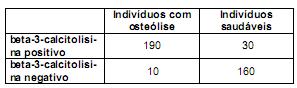
Para este teste, a sensibilidade e a acurácia foram, res- pectivamente,
Para este teste, a sensibilidade e a acurácia foram, res- pectivamente,
Ano: 2012
Banca:
FCC
Órgão:
TRT - 6ª Região (PE)
Prova:
FCC - 2012 - TRT - 6ª Região (PE) - Analista Judiciário - Medicina do Trabalho |
Q241701
Segurança e Saúde no Trabalho
Um aluno de pós-graduação em Medicina do Trabalho irá iniciar um estudo para investigar se a exposição ocupacional a radiações ionizantes constituiria um fator de risco estatisticamente significativo para a ocorrência de anemia aplástica. No ambulatório de hematologia de sua universidade, pôde encontrar 42 pacientes com este diagnóstico. O desenho de estudo mais apropriado e a medida de associação a ser encontrada são, respectivamente:
Ano: 2012
Banca:
FCC
Órgão:
TRT - 6ª Região (PE)
Prova:
FCC - 2012 - TRT - 6ª Região (PE) - Analista Judiciário - Medicina do Trabalho |
Q241700
Segurança e Saúde no Trabalho
A Norma Operacional de Saúde do Trabalhador (NOST- SUS), de 30 de outubro de 1998, tem por objetivo orientar e instrumentalizar a realização das ações de saúde dos trabalhadores, pelos Estados, Distrito Federal e Municípios. São ações previstas nesta Norma a
I. garantia do atendimento ao acidentado do trabalho e ao suspeito ou portador de doença profissional ou do trabalho, por meio da rede própria ou contratada, dentro de seu nível de responsabilidade da atenção.
II. notificação dos agravos à saúde e dos riscos relacionados com o trabalho, alimentando regularmente o sistema de informações dos órgãos e serviços de vigilância, assim como a base de dados de interesse nacional.
III. realização de ações de vigilância nos ambientes e processos de trabalho, compreendendo a identificação das situações de risco e a tomada de medidas pertinentes para a resolução da situação e a investigação epidemiológica.
Os itens I, II e III são atribuições, respectivamente, das esferas
I. garantia do atendimento ao acidentado do trabalho e ao suspeito ou portador de doença profissional ou do trabalho, por meio da rede própria ou contratada, dentro de seu nível de responsabilidade da atenção.
II. notificação dos agravos à saúde e dos riscos relacionados com o trabalho, alimentando regularmente o sistema de informações dos órgãos e serviços de vigilância, assim como a base de dados de interesse nacional.
III. realização de ações de vigilância nos ambientes e processos de trabalho, compreendendo a identificação das situações de risco e a tomada de medidas pertinentes para a resolução da situação e a investigação epidemiológica.
Os itens I, II e III são atribuições, respectivamente, das esferas
Ano: 2012
Banca:
FCC
Órgão:
TRT - 6ª Região (PE)
Prova:
FCC - 2012 - TRT - 6ª Região (PE) - Analista Judiciário - Medicina do Trabalho |
Q241699
Segurança e Saúde no Trabalho
A Vigilância Ambiental em Saúde é um conjunto de ações que proporciona o conhecimento e a detecção de qualquer mudança nos fatores determinantes e condicionantes do meio ambiente que interferem na saúde humana, com a finalidade de identificar as medidas de prevenção e controle dos fatores de risco ambientais relacionados às doenças ou outros agravos à saúde. São objetivos da Vigilância Ambiental em Saúde:
I. Identificar os riscos e divulgar as informações referentes aos fatores ambientais condicionantes e determinantes das doenças e outros agravos à saúde.
II. Produzir e interpretar informações, visando a disponibilizar ao SUS instrumentos para o planejamento e execução de ações relativas às atividades de promoção da saúde e de prevenção e controle de doenças relacionadas ao meio ambiente.
III. Fiscalizar a execução das ações de proteção da saúde humana relacionadas ao controle e recuperação do meio ambiente, aplicando as multas cabíveis ao detectar o descumprimento das normas que regem as relações entre trabalho e meio ambiente.
IV. Conhecer e estimular a interação entre saúde, meio ambiente e desenvolvimento, visando ao fortalecimento da participação da população na promoção da saúde e qualidade de vida.
Está correto o que se afirma APENAS em
I. Identificar os riscos e divulgar as informações referentes aos fatores ambientais condicionantes e determinantes das doenças e outros agravos à saúde.
II. Produzir e interpretar informações, visando a disponibilizar ao SUS instrumentos para o planejamento e execução de ações relativas às atividades de promoção da saúde e de prevenção e controle de doenças relacionadas ao meio ambiente.
III. Fiscalizar a execução das ações de proteção da saúde humana relacionadas ao controle e recuperação do meio ambiente, aplicando as multas cabíveis ao detectar o descumprimento das normas que regem as relações entre trabalho e meio ambiente.
IV. Conhecer e estimular a interação entre saúde, meio ambiente e desenvolvimento, visando ao fortalecimento da participação da população na promoção da saúde e qualidade de vida.
Está correto o que se afirma APENAS em
Ano: 2012
Banca:
FCC
Órgão:
TRT - 6ª Região (PE)
Prova:
FCC - 2012 - TRT - 6ª Região (PE) - Analista Judiciário - Medicina do Trabalho |
Q241698
Segurança e Saúde no Trabalho

Supondo que Eunice tenha direito à aposentadoria por invalidez e necessite de auxílio permanente de outra pessoa a aposentadoria consistirá em
Ano: 2012
Banca:
FCC
Órgão:
TRT - 6ª Região (PE)
Prova:
FCC - 2012 - TRT - 6ª Região (PE) - Analista Judiciário - Medicina do Trabalho |
Q241697
Segurança e Saúde no Trabalho
O período de carência para que faça jus à aposentadoria por invalidez é de
Ano: 2012
Banca:
FCC
Órgão:
TRT - 6ª Região (PE)
Prova:
FCC - 2012 - TRT - 6ª Região (PE) - Analista Judiciário - Medicina do Trabalho |
Q241696
Segurança e Saúde no Trabalho
Uma empreiteira iniciará, simultaneamente, duas obras, uma com 80 e outra com 120 trabalhadores em uma mesma cidade do interior do Estado de Pernambuco. A previsão de término das obras é de 250 e 200 dias, respectivamente. Sobre a Comissão Interna de Prevenção de Acidentes - CIPA a ser constituída, é correto afirmar que
Ano: 2012
Banca:
FCC
Órgão:
TRT - 6ª Região (PE)
Prova:
FCC - 2012 - TRT - 6ª Região (PE) - Analista Judiciário - Medicina do Trabalho |
Q241695
Segurança e Saúde no Trabalho
Um médico do trabalho é consultado por uma construtora que irá iniciar a obra de um condomínio, com 45 trabalhadores, sobre a necessidade de comunicação prévia e elaboração do Programa de Condições e Meio Ambiente de Trabalho - PCMAT. Ele afirma corretamente que
Ano: 2012
Banca:
FCC
Órgão:
TRT - 6ª Região (PE)
Prova:
FCC - 2012 - TRT - 6ª Região (PE) - Analista Judiciário - Medicina do Trabalho |
Q241694
Segurança e Saúde no Trabalho
A Norma Regulamentadora No 16, sobre as atividades e operações perigosas, estabelece:
I. O armazenamento e transporte de explosivos e de inflamáveis são caracterizados como atividades ou operações perigosas.
II. Ao trabalhador é assegurada a percepção de adicional de 30% sobre o salário, sem os acréscimos resultantes de gratificações, prêmios ou participação nos lucros da empresa.
III. As operações de transporte de inflamáveis líquidos ou gasosos liquefeitos, em quaisquer vasilhames e a granel, são consideradas em condições de periculosidade, exceto para o transporte em pequenas quantidades (estabelecidas por esta Norma) e excluídas as quantidades de inflamáveis contidas nos tanques para consumo próprio dos veículos.
Está correto o que se afirma em
I. O armazenamento e transporte de explosivos e de inflamáveis são caracterizados como atividades ou operações perigosas.
II. Ao trabalhador é assegurada a percepção de adicional de 30% sobre o salário, sem os acréscimos resultantes de gratificações, prêmios ou participação nos lucros da empresa.
III. As operações de transporte de inflamáveis líquidos ou gasosos liquefeitos, em quaisquer vasilhames e a granel, são consideradas em condições de periculosidade, exceto para o transporte em pequenas quantidades (estabelecidas por esta Norma) e excluídas as quantidades de inflamáveis contidas nos tanques para consumo próprio dos veículos.
Está correto o que se afirma em
Ano: 2012
Banca:
FCC
Órgão:
TRT - 6ª Região (PE)
Prova:
FCC - 2012 - TRT - 6ª Região (PE) - Analista Judiciário - Medicina do Trabalho |
Q241693
Segurança e Saúde no Trabalho
O exercício de trabalho em condições de insalubridade de graus máximo, médio e mínimo assegura ao trabalhador a percepção de acréscimo salarial, respectivamente, equivalente a:
Ano: 2012
Banca:
FCC
Órgão:
TRT - 6ª Região (PE)
Prova:
FCC - 2012 - TRT - 6ª Região (PE) - Analista Judiciário - Medicina do Trabalho |
Q241692
Segurança e Saúde no Trabalho
A Norma Regulamentadora No 15, que discorre sobre atividades e operações insalubres, estabelece:
Ano: 2012
Banca:
FCC
Órgão:
TRT - 6ª Região (PE)
Prova:
FCC - 2012 - TRT - 6ª Região (PE) - Analista Judiciário - Medicina do Trabalho |
Q241691
Segurança e Saúde no Trabalho
Sobre a organização, funcionamento e treinamento das Comissões Internas de Prevenção de Acidentes - CIPA, é correto afirmar:
Ano: 2012
Banca:
FCC
Órgão:
TRT - 6ª Região (PE)
Prova:
FCC - 2012 - TRT - 6ª Região (PE) - Analista Judiciário - Medicina do Trabalho |
Q241690
Segurança e Saúde no Trabalho
Sobre os profissionais que integram os Serviços Especializados em Engenharia de Segurança e em Medicina do Trabalho, é correto afirmar:
Ano: 2012
Banca:
FCC
Órgão:
TRT - 6ª Região (PE)
Prova:
FCC - 2012 - TRT - 6ª Região (PE) - Analista Judiciário - Medicina do Trabalho |
Q241689
Segurança e Saúde no Trabalho
O Programa de Prevenção de Riscos Ambientais - PPRA considera como riscos ambientais aqueles representados por agentes físicos, químicos ou biológicos, capazes de causar dano à saúde do trabalhador.
Considere as afirmativas:
I. Vibrações, pressões anormais, temperaturas extremas, poeiras e névoas constituem agentes físicos.
II. Gases, vapores, radiações ionizantes e não ionizantes constituem agentes químicos.
III. Bactérias, fungos, vírus, protozoários e fumos constituem agentes biológicos.
Está INCORRETO o que se afirma em
Considere as afirmativas:
I. Vibrações, pressões anormais, temperaturas extremas, poeiras e névoas constituem agentes físicos.
II. Gases, vapores, radiações ionizantes e não ionizantes constituem agentes químicos.
III. Bactérias, fungos, vírus, protozoários e fumos constituem agentes biológicos.
Está INCORRETO o que se afirma em
Ano: 2012
Banca:
FCC
Órgão:
TRT - 6ª Região (PE)
Prova:
FCC - 2012 - TRT - 6ª Região (PE) - Analista Judiciário - Medicina do Trabalho |
Q241688
Segurança e Saúde no Trabalho
Carlos é funcionário de uma indústria farmacêutica e trabalha operando uma empilhadeira. Há dois meses sofreu uma fratura de tornozelo em um acidente automobilístico quando retornava da casa de sua namorada. Recebeu o tratamento apropriado e hoje retorna às atividades laborais.
O exame médico de retorno ao trabalho
O exame médico de retorno ao trabalho
Ano: 2012
Banca:
FCC
Órgão:
TRT - 6ª Região (PE)
Prova:
FCC - 2012 - TRT - 6ª Região (PE) - Analista Judiciário - Medicina do Trabalho |
Q241687
Segurança e Saúde no Trabalho
Sobre o Programa de Controle Médico de Saúde Ocupacional - PCMSO, é correto afirmar:
Ano: 2012
Banca:
FCC
Órgão:
TRT - 6ª Região (PE)
Provas:
FCC - 2012 - TRT - 6ª Região (PE) - Analista Judiciário - Área Administrativa
|
FCC - 2012 - TRT - 6ª Região (PE) - Analista Judiciário - Arquivologia |
FCC - 2012 - TRT - 6ª Região (PE) - Analista Judiciário - Biblioteconomia |
FCC - 2012 - TRT - 6ª Região (PE) - Analista Judiciário - Arquitetura |
FCC - 2012 - TRT - 6ª Região (PE) - Analista Judiciário - Comunicação Social |
FCC - 2012 - TRT - 6ª Região (PE) - Analista Judiciário - Engenharia Civil |
FCC - 2012 - TRT - 6ª Região (PE) - Analista Judiciário - Engenharia Elétrica |
FCC - 2012 - TRT - 6ª Região (PE) - Analista Judiciário - Engenharia Mecânica |
FCC - 2012 - TRT - 6ª Região (PE) - Analista Judiciário - Estatística |
FCC - 2012 - TRT - 6ª Região (PE) - Analista Judiciário - Contabilidade |
FCC - 2012 - TRT - 6ª Região (PE) - Analista Judiciário - Odontologia |
FCC - 2012 - TRT - 6ª Região (PE) - Analista Judiciário - Medicina - Psiquiátrica |
FCC - 2012 - TRT - 6ª Região (PE) - Analista Judiciário - Serviço Social |
FCC - 2012 - TRT - 6ª Região (PE) - Analista Judiciário - Tecnologia da Informação |
FCC - 2012 - TRT - 6ª Região (PE) - Analista Judiciário - Fisioterapia |
FCC - 2012 - TRT - 6ª Região (PE) - Analista Judiciário - Enfermagem |
FCC - 2012 - TRT - 6ª Região (PE) - Analista Judiciário - Psicologia |
FCC - 2012 - TRT - 6ª Região (PE) - Analista Judiciário - Medicina do Trabalho |
Q240367
Ética na Administração Pública
O comportamento ético na gestão pública exige que se valorize

 Conheça nossos planos