Selecionar segmento
Estude com questões de diferentes segmentos
Atenção: Isso limpará todos os campos já preenchidos no filtro!
Foram encontradas 31.304 questões
Resolva questões gratuitamente!
Junte-se a mais de 4 milhões de concurseiros!


Ano: 2023
Banca:
FGV
Órgão:
Prefeitura de São José dos Campos - SP
Prova:
FGV - 2023 - Prefeitura de São José dos Campos - SP - Professor II - Inglês |
Q2344905
Inglês
Texto associado
Read Text IV and answer the question that follow it
Text IV
Teaching Reading Strategies
No matter what we are reading there are effective reading
strategies we call on in order to make meaning from the text. Many
of these strategies can be taught with comics and graphic novels.
The ones highlighted below are particularly important when
reading graphic texts.
Drawing Inferences
In comics and graphic novels, perhaps more than any other text,
readers must build understanding by filling in gaps. A whole world
of information is left in the gutter between the panels. The comic
artist expects the reader to infer the action that takes place off the
page. The more complex and sophisticated the comic, the more
important this strategy becomes. If the reader is not making
inferences, he is lost. Understanding this strategy and using it
effectively will help students read ’between the lines’ in more
traditional print narratives.
Visualization
Students who struggle with reading may not understand what
should be going on in the reader’s imagination during reading.
With comics and other visual texts, the images are there for the
reader. Through comics students can be taught how to create their
own mental images when reading more traditional texts.
It is important that students understand the visual cues that are
provided in the text. Although the words and images work
together to tell the story, comics are primarily visual narratives.
Therefore readers must draw on and integrate some important
background knowledge and understandings about visual texts,
comic elements and narrative structures in order to make
meaning. The more knowledge readers have about the way visual
texts work, the more successful they are likely to be.
Adapted from https://www.literacytoday.ca/home/reading/readingstrategies/reading-visual-texts/reading-comics
The opposite of “below” (1st paragraph) is:
Ano: 2023
Banca:
FGV
Órgão:
Prefeitura de São José dos Campos - SP
Prova:
FGV - 2023 - Prefeitura de São José dos Campos - SP - Professor II - Inglês |
Q2344904
Inglês
Texto associado
Read Text IV and answer the question that follow it
Text IV
Teaching Reading Strategies
No matter what we are reading there are effective reading
strategies we call on in order to make meaning from the text. Many
of these strategies can be taught with comics and graphic novels.
The ones highlighted below are particularly important when
reading graphic texts.
Drawing Inferences
In comics and graphic novels, perhaps more than any other text,
readers must build understanding by filling in gaps. A whole world
of information is left in the gutter between the panels. The comic
artist expects the reader to infer the action that takes place off the
page. The more complex and sophisticated the comic, the more
important this strategy becomes. If the reader is not making
inferences, he is lost. Understanding this strategy and using it
effectively will help students read ’between the lines’ in more
traditional print narratives.
Visualization
Students who struggle with reading may not understand what
should be going on in the reader’s imagination during reading.
With comics and other visual texts, the images are there for the
reader. Through comics students can be taught how to create their
own mental images when reading more traditional texts.
It is important that students understand the visual cues that are
provided in the text. Although the words and images work
together to tell the story, comics are primarily visual narratives.
Therefore readers must draw on and integrate some important
background knowledge and understandings about visual texts,
comic elements and narrative structures in order to make
meaning. The more knowledge readers have about the way visual
texts work, the more successful they are likely to be.
Adapted from https://www.literacytoday.ca/home/reading/readingstrategies/reading-visual-texts/reading-comics
The pronoun in “The ones highlighted” (1st paragraph) refers to:
Ano: 2023
Banca:
FGV
Órgão:
Prefeitura de São José dos Campos - SP
Prova:
FGV - 2023 - Prefeitura de São José dos Campos - SP - Professor II - Inglês |
Q2344903
Inglês
Texto associado
Read Text IV and answer the question that follow it
Text IV
Teaching Reading Strategies
No matter what we are reading there are effective reading
strategies we call on in order to make meaning from the text. Many
of these strategies can be taught with comics and graphic novels.
The ones highlighted below are particularly important when
reading graphic texts.
Drawing Inferences
In comics and graphic novels, perhaps more than any other text,
readers must build understanding by filling in gaps. A whole world
of information is left in the gutter between the panels. The comic
artist expects the reader to infer the action that takes place off the
page. The more complex and sophisticated the comic, the more
important this strategy becomes. If the reader is not making
inferences, he is lost. Understanding this strategy and using it
effectively will help students read ’between the lines’ in more
traditional print narratives.
Visualization
Students who struggle with reading may not understand what
should be going on in the reader’s imagination during reading.
With comics and other visual texts, the images are there for the
reader. Through comics students can be taught how to create their
own mental images when reading more traditional texts.
It is important that students understand the visual cues that are
provided in the text. Although the words and images work
together to tell the story, comics are primarily visual narratives.
Therefore readers must draw on and integrate some important
background knowledge and understandings about visual texts,
comic elements and narrative structures in order to make
meaning. The more knowledge readers have about the way visual
texts work, the more successful they are likely to be.
Adapted from https://www.literacytoday.ca/home/reading/readingstrategies/reading-visual-texts/reading-comics
“No matter” in “No matter what we are reading” can be replaced
without change in meaning by:
Ano: 2023
Banca:
FGV
Órgão:
Prefeitura de São José dos Campos - SP
Prova:
FGV - 2023 - Prefeitura de São José dos Campos - SP - Professor II - Inglês |
Q2344902
Inglês
Texto associado
Read Text IV and answer the question that follow it
Text IV
Teaching Reading Strategies
No matter what we are reading there are effective reading
strategies we call on in order to make meaning from the text. Many
of these strategies can be taught with comics and graphic novels.
The ones highlighted below are particularly important when
reading graphic texts.
Drawing Inferences
In comics and graphic novels, perhaps more than any other text,
readers must build understanding by filling in gaps. A whole world
of information is left in the gutter between the panels. The comic
artist expects the reader to infer the action that takes place off the
page. The more complex and sophisticated the comic, the more
important this strategy becomes. If the reader is not making
inferences, he is lost. Understanding this strategy and using it
effectively will help students read ’between the lines’ in more
traditional print narratives.
Visualization
Students who struggle with reading may not understand what
should be going on in the reader’s imagination during reading.
With comics and other visual texts, the images are there for the
reader. Through comics students can be taught how to create their
own mental images when reading more traditional texts.
It is important that students understand the visual cues that are
provided in the text. Although the words and images work
together to tell the story, comics are primarily visual narratives.
Therefore readers must draw on and integrate some important
background knowledge and understandings about visual texts,
comic elements and narrative structures in order to make
meaning. The more knowledge readers have about the way visual
texts work, the more successful they are likely to be.
Adapted from https://www.literacytoday.ca/home/reading/readingstrategies/reading-visual-texts/reading-comics
Based on the text, mark the statements below as TRUE (T) or FALSE
(F).
( ) This text aims at helping teachers improve their practice.
( ) When reading comics, one should read only the words written on the page.
( ) Visual cues are irrelevant when teaching reading to students.
The statements are, respectively:
( ) This text aims at helping teachers improve their practice.
( ) When reading comics, one should read only the words written on the page.
( ) Visual cues are irrelevant when teaching reading to students.
The statements are, respectively:
Ano: 2023
Banca:
FGV
Órgão:
Prefeitura de São José dos Campos - SP
Prova:
FGV - 2023 - Prefeitura de São José dos Campos - SP - Professor II - Inglês |
Q2344901
Inglês
Texto associado
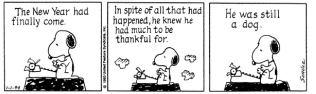
Read Text III and answer the question that follow it
Text III
From: https://peanuts.fandom.com/wiki/January_1994_comic_strips
The word “still” in the third panel is a(n):
Ano: 2023
Banca:
FGV
Órgão:
Prefeitura de São José dos Campos - SP
Prova:
FGV - 2023 - Prefeitura de São José dos Campos - SP - Professor II - Inglês |
Q2344900
Inglês
Texto associado
Read Text III and answer the question that follow it
Text III
From: https://peanuts.fandom.com/wiki/January_1994_comic_strips
In the second panel “In spite of” may be replaced by:
Ano: 2023
Banca:
FGV
Órgão:
Prefeitura de São José dos Campos - SP
Prova:
FGV - 2023 - Prefeitura de São José dos Campos - SP - Professor II - Inglês |
Q2344899
Inglês
Texto associado
Read Text III and answer the question that follow it
Text III
From: https://peanuts.fandom.com/wiki/January_1994_comic_strips
The word “finally” in the first panel is equivalent in meaning to:
Ano: 2023
Banca:
FGV
Órgão:
Prefeitura de São José dos Campos - SP
Prova:
FGV - 2023 - Prefeitura de São José dos Campos - SP - Professor II - Inglês |
Q2344898
Inglês
Texto associado
Read Text III and answer the question that follow it
Text III
From: https://peanuts.fandom.com/wiki/January_1994_comic_strips
The verb tense in the first panel is the:
Ano: 2023
Banca:
FGV
Órgão:
Prefeitura de São José dos Campos - SP
Prova:
FGV - 2023 - Prefeitura de São José dos Campos - SP - Professor II - Inglês |
Q2344897
Inglês
Texto associado
Read Text III and answer the question that follow it
Text III
From: https://peanuts.fandom.com/wiki/January_1994_comic_strips
In the second panel, Snoopy is:
Ano: 2023
Banca:
FGV
Órgão:
Prefeitura de São José dos Campos - SP
Prova:
FGV - 2023 - Prefeitura de São José dos Campos - SP - Professor II - Inglês |
Q2344896
Inglês
Texto associado
Read Text III and answer the question that follow it
Text III
From: https://peanuts.fandom.com/wiki/January_1994_comic_strips
In this comic strip, Snoopy is busy writing a(n):
Ano: 2023
Banca:
FGV
Órgão:
Prefeitura de São José dos Campos - SP
Prova:
FGV - 2023 - Prefeitura de São José dos Campos - SP - Professor II - Inglês |
Q2344895
Inglês
Texto associado
Read Text III and answer the question that follow it
Text III
From: https://peanuts.fandom.com/wiki/January_1994_comic_strips
Based on Text III, analyse the assertions below:
I. Snoopy, the dog, narrates the story in the present time.
II. Bad things may have happened to the character.
III. Snoopy’s aim is to criticize new technologies.
Choose the correct answer:
I. Snoopy, the dog, narrates the story in the present time.
II. Bad things may have happened to the character.
III. Snoopy’s aim is to criticize new technologies.
Choose the correct answer:
Ano: 2023
Banca:
FGV
Órgão:
Prefeitura de São José dos Campos - SP
Prova:
FGV - 2023 - Prefeitura de São José dos Campos - SP - Professor II - Inglês |
Q2344894
Inglês
Texto associado
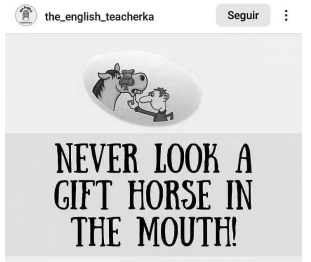
Read Text II and answer the question that follow it
Text II
The classes of the words “gift” and “give” are the same as in:
Ano: 2023
Banca:
FGV
Órgão:
Prefeitura de São José dos Campos - SP
Prova:
FGV - 2023 - Prefeitura de São José dos Campos - SP - Professor II - Inglês |
Q2344893
Inglês
Texto associado
Read Text II and answer the question that follow it
Text II
The verb used in the post is in the:
Ano: 2023
Banca:
FGV
Órgão:
Prefeitura de São José dos Campos - SP
Prova:
FGV - 2023 - Prefeitura de São José dos Campos - SP - Professor II - Inglês |
Q2344892
Inglês
Texto associado
Read Text II and answer the question that follow it
Text II
The sentence in the post means that one should not look into a
horse mouth because the horse:
Ano: 2023
Banca:
FGV
Órgão:
Prefeitura de São José dos Campos - SP
Prova:
FGV - 2023 - Prefeitura de São José dos Campos - SP - Professor II - Inglês |
Q2344891
Inglês
Texto associado
Read Text II and answer the question that follow it
Text II
This Instagram post illustrates a(n):
Ano: 2023
Banca:
FGV
Órgão:
Prefeitura de São José dos Campos - SP
Prova:
FGV - 2023 - Prefeitura de São José dos Campos - SP - Professor II - Inglês |
Q2344890
Inglês
Texto associado
Read Text I and answer the question that follow it:
Text I
Multimodality in the English language classroom:
A systematic review of literature
Literacy in the 21st century is now no longer regarded simply
as the ability to use a language competently in a mono-cultural
setting. Literacy today involves students knowing how to navigate
across an increasingly complex communication landscape and to
negotiate a range of contexts and patterns of intercultural
meanings as well as the prevalence of multimodal texts.
Contemporary communication environment is characterised
by multimodal meaning-making, that is the “multiplicities of media
and modes”, as well as “increasing local diversity and global
connectedness” (New London Group, 1996, p. 62) which
necessitates a shift in the pedagogical approaches that are
adopted by teachers. This is especially so in the digital age where
a sole focus on language in literacy is no longer sufficient for the
new workplace given that a revised sense of ‘competence’ is
required. The recognition of social diversity also demands
pedagogical approaches that engage with the transcultural and
multicultural classroom. Issues of the day such as fake news and
social justice concerns also need to be addressed in the literacy
classroom.
Multimodality focuses on understanding how semiotic
resources (visual, gestural, spatial, linguistic, and others) work and
are organised. Multimodality in education adopts an expanded
view of literacy to include the range of multimodal communicative
practices which young people are involved in today's digital age.
Multimodal pedagogies refer to the ways in which the teacher can
design learning experiences using a range of multimodal
resources. It involves teachers making design choices in the ways
in which the curriculum content is expressed, arranged, and sequenced multimodally. Multimodal pedagogies also involve
designing opportunities for students to explore and perform ideas
and identities using a range of meaning-making resources. The
teaching and learning activities often involve drawing from the
students’ funds of knowledge and their lifeworld. With multimodal
pedagogies, teachers orchestrate the learning process by weaving
together a series of knowledge representations into a cohesive
tapestry and in so doing make apt selection of meaning-making
resources to design the students’ learning experience.
Adapted from https://www.sciencedirect.com/science
/article/abs/pii/S0898589822000365
The sentence that presents the verb form in the passive voice is:
Ano: 2023
Banca:
FGV
Órgão:
Prefeitura de São José dos Campos - SP
Prova:
FGV - 2023 - Prefeitura de São José dos Campos - SP - Professor II - Inglês |
Q2344889
Inglês
Texto associado
Read Text I and answer the question that follow it:
Text I
Multimodality in the English language classroom:
A systematic review of literature
Literacy in the 21st century is now no longer regarded simply
as the ability to use a language competently in a mono-cultural
setting. Literacy today involves students knowing how to navigate
across an increasingly complex communication landscape and to
negotiate a range of contexts and patterns of intercultural
meanings as well as the prevalence of multimodal texts.
Contemporary communication environment is characterised
by multimodal meaning-making, that is the “multiplicities of media
and modes”, as well as “increasing local diversity and global
connectedness” (New London Group, 1996, p. 62) which
necessitates a shift in the pedagogical approaches that are
adopted by teachers. This is especially so in the digital age where
a sole focus on language in literacy is no longer sufficient for the
new workplace given that a revised sense of ‘competence’ is
required. The recognition of social diversity also demands
pedagogical approaches that engage with the transcultural and
multicultural classroom. Issues of the day such as fake news and
social justice concerns also need to be addressed in the literacy
classroom.
Multimodality focuses on understanding how semiotic
resources (visual, gestural, spatial, linguistic, and others) work and
are organised. Multimodality in education adopts an expanded
view of literacy to include the range of multimodal communicative
practices which young people are involved in today's digital age.
Multimodal pedagogies refer to the ways in which the teacher can
design learning experiences using a range of multimodal
resources. It involves teachers making design choices in the ways
in which the curriculum content is expressed, arranged, and sequenced multimodally. Multimodal pedagogies also involve
designing opportunities for students to explore and perform ideas
and identities using a range of meaning-making resources. The
teaching and learning activities often involve drawing from the
students’ funds of knowledge and their lifeworld. With multimodal
pedagogies, teachers orchestrate the learning process by weaving
together a series of knowledge representations into a cohesive
tapestry and in so doing make apt selection of meaning-making
resources to design the students’ learning experience.
Adapted from https://www.sciencedirect.com/science
/article/abs/pii/S0898589822000365
The figure of speech that the excerpt “by weaving together a series
of knowledge representations into a cohesive tapestry”
(3rd paragraph) offers is a(n):
Ano: 2023
Banca:
FGV
Órgão:
Prefeitura de São José dos Campos - SP
Prova:
FGV - 2023 - Prefeitura de São José dos Campos - SP - Professor II - Inglês |
Q2344888
Inglês
Texto associado
Read Text I and answer the question that follow it:
Text I
Multimodality in the English language classroom:
A systematic review of literature
Literacy in the 21st century is now no longer regarded simply
as the ability to use a language competently in a mono-cultural
setting. Literacy today involves students knowing how to navigate
across an increasingly complex communication landscape and to
negotiate a range of contexts and patterns of intercultural
meanings as well as the prevalence of multimodal texts.
Contemporary communication environment is characterised
by multimodal meaning-making, that is the “multiplicities of media
and modes”, as well as “increasing local diversity and global
connectedness” (New London Group, 1996, p. 62) which
necessitates a shift in the pedagogical approaches that are
adopted by teachers. This is especially so in the digital age where
a sole focus on language in literacy is no longer sufficient for the
new workplace given that a revised sense of ‘competence’ is
required. The recognition of social diversity also demands
pedagogical approaches that engage with the transcultural and
multicultural classroom. Issues of the day such as fake news and
social justice concerns also need to be addressed in the literacy
classroom.
Multimodality focuses on understanding how semiotic
resources (visual, gestural, spatial, linguistic, and others) work and
are organised. Multimodality in education adopts an expanded
view of literacy to include the range of multimodal communicative
practices which young people are involved in today's digital age.
Multimodal pedagogies refer to the ways in which the teacher can
design learning experiences using a range of multimodal
resources. It involves teachers making design choices in the ways
in which the curriculum content is expressed, arranged, and sequenced multimodally. Multimodal pedagogies also involve
designing opportunities for students to explore and perform ideas
and identities using a range of meaning-making resources. The
teaching and learning activities often involve drawing from the
students’ funds of knowledge and their lifeworld. With multimodal
pedagogies, teachers orchestrate the learning process by weaving
together a series of knowledge representations into a cohesive
tapestry and in so doing make apt selection of meaning-making
resources to design the students’ learning experience.
Adapted from https://www.sciencedirect.com/science
/article/abs/pii/S0898589822000365
The opposite of the adverb in “The teaching and learning activities
often involve” (3rd paragraph) is:
Ano: 2023
Banca:
FGV
Órgão:
Prefeitura de São José dos Campos - SP
Prova:
FGV - 2023 - Prefeitura de São José dos Campos - SP - Professor II - Inglês |
Q2344887
Inglês
Texto associado
Read Text I and answer the question that follow it:
Text I
Multimodality in the English language classroom:
A systematic review of literature
Literacy in the 21st century is now no longer regarded simply
as the ability to use a language competently in a mono-cultural
setting. Literacy today involves students knowing how to navigate
across an increasingly complex communication landscape and to
negotiate a range of contexts and patterns of intercultural
meanings as well as the prevalence of multimodal texts.
Contemporary communication environment is characterised
by multimodal meaning-making, that is the “multiplicities of media
and modes”, as well as “increasing local diversity and global
connectedness” (New London Group, 1996, p. 62) which
necessitates a shift in the pedagogical approaches that are
adopted by teachers. This is especially so in the digital age where
a sole focus on language in literacy is no longer sufficient for the
new workplace given that a revised sense of ‘competence’ is
required. The recognition of social diversity also demands
pedagogical approaches that engage with the transcultural and
multicultural classroom. Issues of the day such as fake news and
social justice concerns also need to be addressed in the literacy
classroom.
Multimodality focuses on understanding how semiotic
resources (visual, gestural, spatial, linguistic, and others) work and
are organised. Multimodality in education adopts an expanded
view of literacy to include the range of multimodal communicative
practices which young people are involved in today's digital age.
Multimodal pedagogies refer to the ways in which the teacher can
design learning experiences using a range of multimodal
resources. It involves teachers making design choices in the ways
in which the curriculum content is expressed, arranged, and sequenced multimodally. Multimodal pedagogies also involve
designing opportunities for students to explore and perform ideas
and identities using a range of meaning-making resources. The
teaching and learning activities often involve drawing from the
students’ funds of knowledge and their lifeworld. With multimodal
pedagogies, teachers orchestrate the learning process by weaving
together a series of knowledge representations into a cohesive
tapestry and in so doing make apt selection of meaning-making
resources to design the students’ learning experience.
Adapted from https://www.sciencedirect.com/science
/article/abs/pii/S0898589822000365
The modal verb in “The teacher can design learning experiences”
(3rd paragraph) indicates:
Ano: 2023
Banca:
FGV
Órgão:
Prefeitura de São José dos Campos - SP
Prova:
FGV - 2023 - Prefeitura de São José dos Campos - SP - Professor II - Inglês |
Q2344886
Inglês
Texto associado
Read Text I and answer the question that follow it:
Text I
Multimodality in the English language classroom:
A systematic review of literature
Literacy in the 21st century is now no longer regarded simply
as the ability to use a language competently in a mono-cultural
setting. Literacy today involves students knowing how to navigate
across an increasingly complex communication landscape and to
negotiate a range of contexts and patterns of intercultural
meanings as well as the prevalence of multimodal texts.
Contemporary communication environment is characterised
by multimodal meaning-making, that is the “multiplicities of media
and modes”, as well as “increasing local diversity and global
connectedness” (New London Group, 1996, p. 62) which
necessitates a shift in the pedagogical approaches that are
adopted by teachers. This is especially so in the digital age where
a sole focus on language in literacy is no longer sufficient for the
new workplace given that a revised sense of ‘competence’ is
required. The recognition of social diversity also demands
pedagogical approaches that engage with the transcultural and
multicultural classroom. Issues of the day such as fake news and
social justice concerns also need to be addressed in the literacy
classroom.
Multimodality focuses on understanding how semiotic
resources (visual, gestural, spatial, linguistic, and others) work and
are organised. Multimodality in education adopts an expanded
view of literacy to include the range of multimodal communicative
practices which young people are involved in today's digital age.
Multimodal pedagogies refer to the ways in which the teacher can
design learning experiences using a range of multimodal
resources. It involves teachers making design choices in the ways
in which the curriculum content is expressed, arranged, and sequenced multimodally. Multimodal pedagogies also involve
designing opportunities for students to explore and perform ideas
and identities using a range of meaning-making resources. The
teaching and learning activities often involve drawing from the
students’ funds of knowledge and their lifeworld. With multimodal
pedagogies, teachers orchestrate the learning process by weaving
together a series of knowledge representations into a cohesive
tapestry and in so doing make apt selection of meaning-making
resources to design the students’ learning experience.
Adapted from https://www.sciencedirect.com/science
/article/abs/pii/S0898589822000365
The adjective in “a sole focus on language in literacy
(2nd paragraph) is similar in meaning to:

 Conheça nossos planos