Questões de Concurso
Para professor - inglês
Foram encontradas 31.120 questões
Resolva questões gratuitamente!
Junte-se a mais de 4 milhões de concurseiros!


Ano: 2025
Banca:
Instituto UniFil
Órgão:
Prefeitura de Mandirituba - PR
Prova:
Instituto UniFil - 2025 - Prefeitura de Mandirituba - PR - Professor de Inglês |
Q4257976
Inglês
Texto associado
Should all pupils get the right to an outdoor education week?
Kirsten Campbell
In a matter of days the government will make a decision
that could affect generations of children to come. For many, the
Primary 7 outdoor residential trip is one of the highlights of
their school days. For some, it is inspirational, even lifechanging. A members bill making its way through the Scottish
Parliament would guarantee a week of residential outdoor
education for every pupil. When it was put first put forward by
Conservative MSP Liz Smith, the Schools (Residential
Outdoor Education) (Scotland) bill won majority support, but it
faces what could prove to be an insurmountable obstacle.
Without government financial backing it looks doomed to fall.
And at a time when budgets are already tight, not everyone is
convinced such a commitment is the best use of resources.
Liz Smith, herself a former teacher, says she has seen
the benefits of outdoor education first hand and wants to ensure
every child gets the opportunity during their time at school. Her
proposed new law would mean every pupil in Scotland is
entitled to four nights and five days of outdoor education. But
while it was backed in principle in March, it cannot proceed
unless the government tables a financial resolution - and so far
that hasn't happened. Smith believes the experience of outdoor
education can be transformative for children. “I think we should
be trying to level up, to ensure that young people, whoever they
are, whatever their background, whatever their family
circumstances, they should have that opportunity.” She argues
the benefits are powerful - and backed up by evidence. “The
statistics we have show that if they have participated in
residential outdoor education, their attendance is better, their
behaviour is better, their self-discipline is better.”
“What could be better than that?”
But there is a postcode lottery in provision of residential
outdoor education, with research for the University of
Edinburgh stating that just a third of secondary schools and only
a quarter of primary schools offer this type of experience.
Thirty minutes from Glasgow, Dounans outdoor education
centre, in the Loch Lomond and The Trossachs National Park,
gives school groups a taste of the outdoors. A Primary 7 group
from Fife is spending a week taking part in activities like
canoeing, tree climbing and raft-building. Harris, 11, was first
to climb to the top of a tall tree as his classmates looked on.
“When everyone was cheering me on that helped,” he said. “I
was proud of myself for doing that because it was really high.”
Ten-year-old Orla was next. “I was nervous and shivery and
thought it did look pretty high. It was like a feeling of
accomplishment - I felt super happy and joyful.”
One of the biggest problems though is that the
experience doesn't come cheap. Liz Smith estimates the policy
would cost between £25m and £40m a year. The minister for
children, Natalie Don-Innes, told MSPs that was unaffordable
and ringfencing cash for outdoor education could be to the
detriment of other activities. She said: “Where would you seek
to cut funding from in education? Would it be our teachers, our
schools, would it be nurseries or our colleges?”
A Scottish government spokesman said: “Both the
education committee and the Scottish government have been
clear that outstanding issues on the affordability of the bill,
impact on the education workforce and ensuring provision is
equitable for children across Scotland, need to be addressed before a decision can be taken to lodge a motion for a financial
resolution.”
The Convention of Scottish Local Authorities (Cosla)
also has concerns about the practicalities, questioning the
impact on staffing, the costs of transport and what it would
mean for schools' ability to take part in other trips relating to
geography, history or the arts. But the Outward Bound Trust
believes it would be an investment. It has highlighted the
findings of a global study across eight countries, including the
UK, which concluded that for every £1 invested in Outward
Bound programmes, there is a return of between £5 and £15 in
societal value.
Chief Executive Martin Davidson said: “Outward
Bound doesn't teach young people to canoe or to climb, what
we teach young people is about themselves. “But we do that
through fantastic adventures and outdoor activities that help
them learn about themselves and working with others.” The
Scottish Parliament will continue to grapple with the issues in
both the chamber and in committee over the next couple of
days. But time is running out. If the funding issues aren't
resolved by the end of the month, the legislation will fall,
despite having the backing of most MSPs.
Available on https://www.bbc.com/news/articles/cy4rnjxwjyyo
What is the rhetorical function of the question
“What could be better than that?” after listing the
evidence of improved student behavior and
discipline?
Ano: 2025
Banca:
Instituto UniFil
Órgão:
Prefeitura de Mandirituba - PR
Prova:
Instituto UniFil - 2025 - Prefeitura de Mandirituba - PR - Professor de Inglês |
Q4257975
Inglês
Texto associado
Should all pupils get the right to an outdoor education week?
Kirsten Campbell
In a matter of days the government will make a decision
that could affect generations of children to come. For many, the
Primary 7 outdoor residential trip is one of the highlights of
their school days. For some, it is inspirational, even lifechanging. A members bill making its way through the Scottish
Parliament would guarantee a week of residential outdoor
education for every pupil. When it was put first put forward by
Conservative MSP Liz Smith, the Schools (Residential
Outdoor Education) (Scotland) bill won majority support, but it
faces what could prove to be an insurmountable obstacle.
Without government financial backing it looks doomed to fall.
And at a time when budgets are already tight, not everyone is
convinced such a commitment is the best use of resources.
Liz Smith, herself a former teacher, says she has seen
the benefits of outdoor education first hand and wants to ensure
every child gets the opportunity during their time at school. Her
proposed new law would mean every pupil in Scotland is
entitled to four nights and five days of outdoor education. But
while it was backed in principle in March, it cannot proceed
unless the government tables a financial resolution - and so far
that hasn't happened. Smith believes the experience of outdoor
education can be transformative for children. “I think we should
be trying to level up, to ensure that young people, whoever they
are, whatever their background, whatever their family
circumstances, they should have that opportunity.” She argues
the benefits are powerful - and backed up by evidence. “The
statistics we have show that if they have participated in
residential outdoor education, their attendance is better, their
behaviour is better, their self-discipline is better.”
“What could be better than that?”
But there is a postcode lottery in provision of residential
outdoor education, with research for the University of
Edinburgh stating that just a third of secondary schools and only
a quarter of primary schools offer this type of experience.
Thirty minutes from Glasgow, Dounans outdoor education
centre, in the Loch Lomond and The Trossachs National Park,
gives school groups a taste of the outdoors. A Primary 7 group
from Fife is spending a week taking part in activities like
canoeing, tree climbing and raft-building. Harris, 11, was first
to climb to the top of a tall tree as his classmates looked on.
“When everyone was cheering me on that helped,” he said. “I
was proud of myself for doing that because it was really high.”
Ten-year-old Orla was next. “I was nervous and shivery and
thought it did look pretty high. It was like a feeling of
accomplishment - I felt super happy and joyful.”
One of the biggest problems though is that the
experience doesn't come cheap. Liz Smith estimates the policy
would cost between £25m and £40m a year. The minister for
children, Natalie Don-Innes, told MSPs that was unaffordable
and ringfencing cash for outdoor education could be to the
detriment of other activities. She said: “Where would you seek
to cut funding from in education? Would it be our teachers, our
schools, would it be nurseries or our colleges?”
A Scottish government spokesman said: “Both the
education committee and the Scottish government have been
clear that outstanding issues on the affordability of the bill,
impact on the education workforce and ensuring provision is
equitable for children across Scotland, need to be addressed before a decision can be taken to lodge a motion for a financial
resolution.”
The Convention of Scottish Local Authorities (Cosla)
also has concerns about the practicalities, questioning the
impact on staffing, the costs of transport and what it would
mean for schools' ability to take part in other trips relating to
geography, history or the arts. But the Outward Bound Trust
believes it would be an investment. It has highlighted the
findings of a global study across eight countries, including the
UK, which concluded that for every £1 invested in Outward
Bound programmes, there is a return of between £5 and £15 in
societal value.
Chief Executive Martin Davidson said: “Outward
Bound doesn't teach young people to canoe or to climb, what
we teach young people is about themselves. “But we do that
through fantastic adventures and outdoor activities that help
them learn about themselves and working with others.” The
Scottish Parliament will continue to grapple with the issues in
both the chamber and in committee over the next couple of
days. But time is running out. If the funding issues aren't
resolved by the end of the month, the legislation will fall,
despite having the backing of most MSPs.
Available on https://www.bbc.com/news/articles/cy4rnjxwjyyo
Based on Martin Davidson's statement, what is the
fundamental purpose of the outdoor activities
facilitated by the Outward Bound Trust?
Ano: 2025
Banca:
Instituto UniFil
Órgão:
Prefeitura de Mandirituba - PR
Prova:
Instituto UniFil - 2025 - Prefeitura de Mandirituba - PR - Professor de Inglês |
Q4257974
Inglês
Texto associado
Should all pupils get the right to an outdoor education week?
Kirsten Campbell
In a matter of days the government will make a decision
that could affect generations of children to come. For many, the
Primary 7 outdoor residential trip is one of the highlights of
their school days. For some, it is inspirational, even lifechanging. A members bill making its way through the Scottish
Parliament would guarantee a week of residential outdoor
education for every pupil. When it was put first put forward by
Conservative MSP Liz Smith, the Schools (Residential
Outdoor Education) (Scotland) bill won majority support, but it
faces what could prove to be an insurmountable obstacle.
Without government financial backing it looks doomed to fall.
And at a time when budgets are already tight, not everyone is
convinced such a commitment is the best use of resources.
Liz Smith, herself a former teacher, says she has seen
the benefits of outdoor education first hand and wants to ensure
every child gets the opportunity during their time at school. Her
proposed new law would mean every pupil in Scotland is
entitled to four nights and five days of outdoor education. But
while it was backed in principle in March, it cannot proceed
unless the government tables a financial resolution - and so far
that hasn't happened. Smith believes the experience of outdoor
education can be transformative for children. “I think we should
be trying to level up, to ensure that young people, whoever they
are, whatever their background, whatever their family
circumstances, they should have that opportunity.” She argues
the benefits are powerful - and backed up by evidence. “The
statistics we have show that if they have participated in
residential outdoor education, their attendance is better, their
behaviour is better, their self-discipline is better.”
“What could be better than that?”
But there is a postcode lottery in provision of residential
outdoor education, with research for the University of
Edinburgh stating that just a third of secondary schools and only
a quarter of primary schools offer this type of experience.
Thirty minutes from Glasgow, Dounans outdoor education
centre, in the Loch Lomond and The Trossachs National Park,
gives school groups a taste of the outdoors. A Primary 7 group
from Fife is spending a week taking part in activities like
canoeing, tree climbing and raft-building. Harris, 11, was first
to climb to the top of a tall tree as his classmates looked on.
“When everyone was cheering me on that helped,” he said. “I
was proud of myself for doing that because it was really high.”
Ten-year-old Orla was next. “I was nervous and shivery and
thought it did look pretty high. It was like a feeling of
accomplishment - I felt super happy and joyful.”
One of the biggest problems though is that the
experience doesn't come cheap. Liz Smith estimates the policy
would cost between £25m and £40m a year. The minister for
children, Natalie Don-Innes, told MSPs that was unaffordable
and ringfencing cash for outdoor education could be to the
detriment of other activities. She said: “Where would you seek
to cut funding from in education? Would it be our teachers, our
schools, would it be nurseries or our colleges?”
A Scottish government spokesman said: “Both the
education committee and the Scottish government have been
clear that outstanding issues on the affordability of the bill,
impact on the education workforce and ensuring provision is
equitable for children across Scotland, need to be addressed before a decision can be taken to lodge a motion for a financial
resolution.”
The Convention of Scottish Local Authorities (Cosla)
also has concerns about the practicalities, questioning the
impact on staffing, the costs of transport and what it would
mean for schools' ability to take part in other trips relating to
geography, history or the arts. But the Outward Bound Trust
believes it would be an investment. It has highlighted the
findings of a global study across eight countries, including the
UK, which concluded that for every £1 invested in Outward
Bound programmes, there is a return of between £5 and £15 in
societal value.
Chief Executive Martin Davidson said: “Outward
Bound doesn't teach young people to canoe or to climb, what
we teach young people is about themselves. “But we do that
through fantastic adventures and outdoor activities that help
them learn about themselves and working with others.” The
Scottish Parliament will continue to grapple with the issues in
both the chamber and in committee over the next couple of
days. But time is running out. If the funding issues aren't
resolved by the end of the month, the legislation will fall,
despite having the backing of most MSPs.
Available on https://www.bbc.com/news/articles/cy4rnjxwjyyo
In the sentence, “The Scottish Parliament will
continue to grapple with the issues...”, the use of the
Future Continuous tense (“will continue to grapple”)
serves to emphasize:
Ano: 2025
Banca:
Instituto UniFil
Órgão:
Prefeitura de Mandirituba - PR
Prova:
Instituto UniFil - 2025 - Prefeitura de Mandirituba - PR - Professor de Inglês |
Q4257973
Inglês
Texto associado
Should all pupils get the right to an outdoor education week?
Kirsten Campbell
In a matter of days the government will make a decision
that could affect generations of children to come. For many, the
Primary 7 outdoor residential trip is one of the highlights of
their school days. For some, it is inspirational, even lifechanging. A members bill making its way through the Scottish
Parliament would guarantee a week of residential outdoor
education for every pupil. When it was put first put forward by
Conservative MSP Liz Smith, the Schools (Residential
Outdoor Education) (Scotland) bill won majority support, but it
faces what could prove to be an insurmountable obstacle.
Without government financial backing it looks doomed to fall.
And at a time when budgets are already tight, not everyone is
convinced such a commitment is the best use of resources.
Liz Smith, herself a former teacher, says she has seen
the benefits of outdoor education first hand and wants to ensure
every child gets the opportunity during their time at school. Her
proposed new law would mean every pupil in Scotland is
entitled to four nights and five days of outdoor education. But
while it was backed in principle in March, it cannot proceed
unless the government tables a financial resolution - and so far
that hasn't happened. Smith believes the experience of outdoor
education can be transformative for children. “I think we should
be trying to level up, to ensure that young people, whoever they
are, whatever their background, whatever their family
circumstances, they should have that opportunity.” She argues
the benefits are powerful - and backed up by evidence. “The
statistics we have show that if they have participated in
residential outdoor education, their attendance is better, their
behaviour is better, their self-discipline is better.”
“What could be better than that?”
But there is a postcode lottery in provision of residential
outdoor education, with research for the University of
Edinburgh stating that just a third of secondary schools and only
a quarter of primary schools offer this type of experience.
Thirty minutes from Glasgow, Dounans outdoor education
centre, in the Loch Lomond and The Trossachs National Park,
gives school groups a taste of the outdoors. A Primary 7 group
from Fife is spending a week taking part in activities like
canoeing, tree climbing and raft-building. Harris, 11, was first
to climb to the top of a tall tree as his classmates looked on.
“When everyone was cheering me on that helped,” he said. “I
was proud of myself for doing that because it was really high.”
Ten-year-old Orla was next. “I was nervous and shivery and
thought it did look pretty high. It was like a feeling of
accomplishment - I felt super happy and joyful.”
One of the biggest problems though is that the
experience doesn't come cheap. Liz Smith estimates the policy
would cost between £25m and £40m a year. The minister for
children, Natalie Don-Innes, told MSPs that was unaffordable
and ringfencing cash for outdoor education could be to the
detriment of other activities. She said: “Where would you seek
to cut funding from in education? Would it be our teachers, our
schools, would it be nurseries or our colleges?”
A Scottish government spokesman said: “Both the
education committee and the Scottish government have been
clear that outstanding issues on the affordability of the bill,
impact on the education workforce and ensuring provision is
equitable for children across Scotland, need to be addressed before a decision can be taken to lodge a motion for a financial
resolution.”
The Convention of Scottish Local Authorities (Cosla)
also has concerns about the practicalities, questioning the
impact on staffing, the costs of transport and what it would
mean for schools' ability to take part in other trips relating to
geography, history or the arts. But the Outward Bound Trust
believes it would be an investment. It has highlighted the
findings of a global study across eight countries, including the
UK, which concluded that for every £1 invested in Outward
Bound programmes, there is a return of between £5 and £15 in
societal value.
Chief Executive Martin Davidson said: “Outward
Bound doesn't teach young people to canoe or to climb, what
we teach young people is about themselves. “But we do that
through fantastic adventures and outdoor activities that help
them learn about themselves and working with others.” The
Scottish Parliament will continue to grapple with the issues in
both the chamber and in committee over the next couple of
days. But time is running out. If the funding issues aren't
resolved by the end of the month, the legislation will fall,
despite having the backing of most MSPs.
Available on https://www.bbc.com/news/articles/cy4rnjxwjyyo
How does the perspective of the Outward Bound
Trust on the bill's cost contrast with the concerns of
minister Natalie Don-Innes?
Ano: 2025
Banca:
Instituto UniFil
Órgão:
Prefeitura de Mandirituba - PR
Prova:
Instituto UniFil - 2025 - Prefeitura de Mandirituba - PR - Professor de Inglês |
Q4257972
Inglês
Texto associado
Should all pupils get the right to an outdoor education week?
Kirsten Campbell
In a matter of days the government will make a decision
that could affect generations of children to come. For many, the
Primary 7 outdoor residential trip is one of the highlights of
their school days. For some, it is inspirational, even lifechanging. A members bill making its way through the Scottish
Parliament would guarantee a week of residential outdoor
education for every pupil. When it was put first put forward by
Conservative MSP Liz Smith, the Schools (Residential
Outdoor Education) (Scotland) bill won majority support, but it
faces what could prove to be an insurmountable obstacle.
Without government financial backing it looks doomed to fall.
And at a time when budgets are already tight, not everyone is
convinced such a commitment is the best use of resources.
Liz Smith, herself a former teacher, says she has seen
the benefits of outdoor education first hand and wants to ensure
every child gets the opportunity during their time at school. Her
proposed new law would mean every pupil in Scotland is
entitled to four nights and five days of outdoor education. But
while it was backed in principle in March, it cannot proceed
unless the government tables a financial resolution - and so far
that hasn't happened. Smith believes the experience of outdoor
education can be transformative for children. “I think we should
be trying to level up, to ensure that young people, whoever they
are, whatever their background, whatever their family
circumstances, they should have that opportunity.” She argues
the benefits are powerful - and backed up by evidence. “The
statistics we have show that if they have participated in
residential outdoor education, their attendance is better, their
behaviour is better, their self-discipline is better.”
“What could be better than that?”
But there is a postcode lottery in provision of residential
outdoor education, with research for the University of
Edinburgh stating that just a third of secondary schools and only
a quarter of primary schools offer this type of experience.
Thirty minutes from Glasgow, Dounans outdoor education
centre, in the Loch Lomond and The Trossachs National Park,
gives school groups a taste of the outdoors. A Primary 7 group
from Fife is spending a week taking part in activities like
canoeing, tree climbing and raft-building. Harris, 11, was first
to climb to the top of a tall tree as his classmates looked on.
“When everyone was cheering me on that helped,” he said. “I
was proud of myself for doing that because it was really high.”
Ten-year-old Orla was next. “I was nervous and shivery and
thought it did look pretty high. It was like a feeling of
accomplishment - I felt super happy and joyful.”
One of the biggest problems though is that the
experience doesn't come cheap. Liz Smith estimates the policy
would cost between £25m and £40m a year. The minister for
children, Natalie Don-Innes, told MSPs that was unaffordable
and ringfencing cash for outdoor education could be to the
detriment of other activities. She said: “Where would you seek
to cut funding from in education? Would it be our teachers, our
schools, would it be nurseries or our colleges?”
A Scottish government spokesman said: “Both the
education committee and the Scottish government have been
clear that outstanding issues on the affordability of the bill,
impact on the education workforce and ensuring provision is
equitable for children across Scotland, need to be addressed before a decision can be taken to lodge a motion for a financial
resolution.”
The Convention of Scottish Local Authorities (Cosla)
also has concerns about the practicalities, questioning the
impact on staffing, the costs of transport and what it would
mean for schools' ability to take part in other trips relating to
geography, history or the arts. But the Outward Bound Trust
believes it would be an investment. It has highlighted the
findings of a global study across eight countries, including the
UK, which concluded that for every £1 invested in Outward
Bound programmes, there is a return of between £5 and £15 in
societal value.
Chief Executive Martin Davidson said: “Outward
Bound doesn't teach young people to canoe or to climb, what
we teach young people is about themselves. “But we do that
through fantastic adventures and outdoor activities that help
them learn about themselves and working with others.” The
Scottish Parliament will continue to grapple with the issues in
both the chamber and in committee over the next couple of
days. But time is running out. If the funding issues aren't
resolved by the end of the month, the legislation will fall,
despite having the backing of most MSPs.
Available on https://www.bbc.com/news/articles/cy4rnjxwjyyo
The text states there is a “postcode lottery” in the
provision of outdoor education. What does this
idiomatic expression imply?
Ano: 2025
Banca:
Instituto UniFil
Órgão:
Prefeitura de Mandirituba - PR
Prova:
Instituto UniFil - 2025 - Prefeitura de Mandirituba - PR - Professor de Inglês |
Q4257971
Inglês
Texto associado
Should all pupils get the right to an outdoor education week?
Kirsten Campbell
In a matter of days the government will make a decision
that could affect generations of children to come. For many, the
Primary 7 outdoor residential trip is one of the highlights of
their school days. For some, it is inspirational, even lifechanging. A members bill making its way through the Scottish
Parliament would guarantee a week of residential outdoor
education for every pupil. When it was put first put forward by
Conservative MSP Liz Smith, the Schools (Residential
Outdoor Education) (Scotland) bill won majority support, but it
faces what could prove to be an insurmountable obstacle.
Without government financial backing it looks doomed to fall.
And at a time when budgets are already tight, not everyone is
convinced such a commitment is the best use of resources.
Liz Smith, herself a former teacher, says she has seen
the benefits of outdoor education first hand and wants to ensure
every child gets the opportunity during their time at school. Her
proposed new law would mean every pupil in Scotland is
entitled to four nights and five days of outdoor education. But
while it was backed in principle in March, it cannot proceed
unless the government tables a financial resolution - and so far
that hasn't happened. Smith believes the experience of outdoor
education can be transformative for children. “I think we should
be trying to level up, to ensure that young people, whoever they
are, whatever their background, whatever their family
circumstances, they should have that opportunity.” She argues
the benefits are powerful - and backed up by evidence. “The
statistics we have show that if they have participated in
residential outdoor education, their attendance is better, their
behaviour is better, their self-discipline is better.”
“What could be better than that?”
But there is a postcode lottery in provision of residential
outdoor education, with research for the University of
Edinburgh stating that just a third of secondary schools and only
a quarter of primary schools offer this type of experience.
Thirty minutes from Glasgow, Dounans outdoor education
centre, in the Loch Lomond and The Trossachs National Park,
gives school groups a taste of the outdoors. A Primary 7 group
from Fife is spending a week taking part in activities like
canoeing, tree climbing and raft-building. Harris, 11, was first
to climb to the top of a tall tree as his classmates looked on.
“When everyone was cheering me on that helped,” he said. “I
was proud of myself for doing that because it was really high.”
Ten-year-old Orla was next. “I was nervous and shivery and
thought it did look pretty high. It was like a feeling of
accomplishment - I felt super happy and joyful.”
One of the biggest problems though is that the
experience doesn't come cheap. Liz Smith estimates the policy
would cost between £25m and £40m a year. The minister for
children, Natalie Don-Innes, told MSPs that was unaffordable
and ringfencing cash for outdoor education could be to the
detriment of other activities. She said: “Where would you seek
to cut funding from in education? Would it be our teachers, our
schools, would it be nurseries or our colleges?”
A Scottish government spokesman said: “Both the
education committee and the Scottish government have been
clear that outstanding issues on the affordability of the bill,
impact on the education workforce and ensuring provision is
equitable for children across Scotland, need to be addressed before a decision can be taken to lodge a motion for a financial
resolution.”
The Convention of Scottish Local Authorities (Cosla)
also has concerns about the practicalities, questioning the
impact on staffing, the costs of transport and what it would
mean for schools' ability to take part in other trips relating to
geography, history or the arts. But the Outward Bound Trust
believes it would be an investment. It has highlighted the
findings of a global study across eight countries, including the
UK, which concluded that for every £1 invested in Outward
Bound programmes, there is a return of between £5 and £15 in
societal value.
Chief Executive Martin Davidson said: “Outward
Bound doesn't teach young people to canoe or to climb, what
we teach young people is about themselves. “But we do that
through fantastic adventures and outdoor activities that help
them learn about themselves and working with others.” The
Scottish Parliament will continue to grapple with the issues in
both the chamber and in committee over the next couple of
days. But time is running out. If the funding issues aren't
resolved by the end of the month, the legislation will fall,
despite having the backing of most MSPs.
Available on https://www.bbc.com/news/articles/cy4rnjxwjyyo
Which of the following arguments does Liz Smith use
to advocate for the bill's passage?
Ano: 2025
Banca:
Instituto UniFil
Órgão:
Prefeitura de Mandirituba - PR
Prova:
Instituto UniFil - 2025 - Prefeitura de Mandirituba - PR - Professor de Inglês |
Q4257970
Inglês
Texto associado
Should all pupils get the right to an outdoor education week?
Kirsten Campbell
In a matter of days the government will make a decision
that could affect generations of children to come. For many, the
Primary 7 outdoor residential trip is one of the highlights of
their school days. For some, it is inspirational, even lifechanging. A members bill making its way through the Scottish
Parliament would guarantee a week of residential outdoor
education for every pupil. When it was put first put forward by
Conservative MSP Liz Smith, the Schools (Residential
Outdoor Education) (Scotland) bill won majority support, but it
faces what could prove to be an insurmountable obstacle.
Without government financial backing it looks doomed to fall.
And at a time when budgets are already tight, not everyone is
convinced such a commitment is the best use of resources.
Liz Smith, herself a former teacher, says she has seen
the benefits of outdoor education first hand and wants to ensure
every child gets the opportunity during their time at school. Her
proposed new law would mean every pupil in Scotland is
entitled to four nights and five days of outdoor education. But
while it was backed in principle in March, it cannot proceed
unless the government tables a financial resolution - and so far
that hasn't happened. Smith believes the experience of outdoor
education can be transformative for children. “I think we should
be trying to level up, to ensure that young people, whoever they
are, whatever their background, whatever their family
circumstances, they should have that opportunity.” She argues
the benefits are powerful - and backed up by evidence. “The
statistics we have show that if they have participated in
residential outdoor education, their attendance is better, their
behaviour is better, their self-discipline is better.”
“What could be better than that?”
But there is a postcode lottery in provision of residential
outdoor education, with research for the University of
Edinburgh stating that just a third of secondary schools and only
a quarter of primary schools offer this type of experience.
Thirty minutes from Glasgow, Dounans outdoor education
centre, in the Loch Lomond and The Trossachs National Park,
gives school groups a taste of the outdoors. A Primary 7 group
from Fife is spending a week taking part in activities like
canoeing, tree climbing and raft-building. Harris, 11, was first
to climb to the top of a tall tree as his classmates looked on.
“When everyone was cheering me on that helped,” he said. “I
was proud of myself for doing that because it was really high.”
Ten-year-old Orla was next. “I was nervous and shivery and
thought it did look pretty high. It was like a feeling of
accomplishment - I felt super happy and joyful.”
One of the biggest problems though is that the
experience doesn't come cheap. Liz Smith estimates the policy
would cost between £25m and £40m a year. The minister for
children, Natalie Don-Innes, told MSPs that was unaffordable
and ringfencing cash for outdoor education could be to the
detriment of other activities. She said: “Where would you seek
to cut funding from in education? Would it be our teachers, our
schools, would it be nurseries or our colleges?”
A Scottish government spokesman said: “Both the
education committee and the Scottish government have been
clear that outstanding issues on the affordability of the bill,
impact on the education workforce and ensuring provision is
equitable for children across Scotland, need to be addressed before a decision can be taken to lodge a motion for a financial
resolution.”
The Convention of Scottish Local Authorities (Cosla)
also has concerns about the practicalities, questioning the
impact on staffing, the costs of transport and what it would
mean for schools' ability to take part in other trips relating to
geography, history or the arts. But the Outward Bound Trust
believes it would be an investment. It has highlighted the
findings of a global study across eight countries, including the
UK, which concluded that for every £1 invested in Outward
Bound programmes, there is a return of between £5 and £15 in
societal value.
Chief Executive Martin Davidson said: “Outward
Bound doesn't teach young people to canoe or to climb, what
we teach young people is about themselves. “But we do that
through fantastic adventures and outdoor activities that help
them learn about themselves and working with others.” The
Scottish Parliament will continue to grapple with the issues in
both the chamber and in committee over the next couple of
days. But time is running out. If the funding issues aren't
resolved by the end of the month, the legislation will fall,
despite having the backing of most MSPs.
Available on https://www.bbc.com/news/articles/cy4rnjxwjyyo
In the phrase “...ringfencing cash for outdoor
education could be to the detriment of other
activities,” the word “detriment” is closest in
meaning to
Ano: 2025
Banca:
Instituto UniFil
Órgão:
Prefeitura de Mandirituba - PR
Prova:
Instituto UniFil - 2025 - Prefeitura de Mandirituba - PR - Professor de Inglês |
Q4257969
Inglês
Texto associado
Should all pupils get the right to an outdoor education week?
Kirsten Campbell
In a matter of days the government will make a decision
that could affect generations of children to come. For many, the
Primary 7 outdoor residential trip is one of the highlights of
their school days. For some, it is inspirational, even lifechanging. A members bill making its way through the Scottish
Parliament would guarantee a week of residential outdoor
education for every pupil. When it was put first put forward by
Conservative MSP Liz Smith, the Schools (Residential
Outdoor Education) (Scotland) bill won majority support, but it
faces what could prove to be an insurmountable obstacle.
Without government financial backing it looks doomed to fall.
And at a time when budgets are already tight, not everyone is
convinced such a commitment is the best use of resources.
Liz Smith, herself a former teacher, says she has seen
the benefits of outdoor education first hand and wants to ensure
every child gets the opportunity during their time at school. Her
proposed new law would mean every pupil in Scotland is
entitled to four nights and five days of outdoor education. But
while it was backed in principle in March, it cannot proceed
unless the government tables a financial resolution - and so far
that hasn't happened. Smith believes the experience of outdoor
education can be transformative for children. “I think we should
be trying to level up, to ensure that young people, whoever they
are, whatever their background, whatever their family
circumstances, they should have that opportunity.” She argues
the benefits are powerful - and backed up by evidence. “The
statistics we have show that if they have participated in
residential outdoor education, their attendance is better, their
behaviour is better, their self-discipline is better.”
“What could be better than that?”
But there is a postcode lottery in provision of residential
outdoor education, with research for the University of
Edinburgh stating that just a third of secondary schools and only
a quarter of primary schools offer this type of experience.
Thirty minutes from Glasgow, Dounans outdoor education
centre, in the Loch Lomond and The Trossachs National Park,
gives school groups a taste of the outdoors. A Primary 7 group
from Fife is spending a week taking part in activities like
canoeing, tree climbing and raft-building. Harris, 11, was first
to climb to the top of a tall tree as his classmates looked on.
“When everyone was cheering me on that helped,” he said. “I
was proud of myself for doing that because it was really high.”
Ten-year-old Orla was next. “I was nervous and shivery and
thought it did look pretty high. It was like a feeling of
accomplishment - I felt super happy and joyful.”
One of the biggest problems though is that the
experience doesn't come cheap. Liz Smith estimates the policy
would cost between £25m and £40m a year. The minister for
children, Natalie Don-Innes, told MSPs that was unaffordable
and ringfencing cash for outdoor education could be to the
detriment of other activities. She said: “Where would you seek
to cut funding from in education? Would it be our teachers, our
schools, would it be nurseries or our colleges?”
A Scottish government spokesman said: “Both the
education committee and the Scottish government have been
clear that outstanding issues on the affordability of the bill,
impact on the education workforce and ensuring provision is
equitable for children across Scotland, need to be addressed before a decision can be taken to lodge a motion for a financial
resolution.”
The Convention of Scottish Local Authorities (Cosla)
also has concerns about the practicalities, questioning the
impact on staffing, the costs of transport and what it would
mean for schools' ability to take part in other trips relating to
geography, history or the arts. But the Outward Bound Trust
believes it would be an investment. It has highlighted the
findings of a global study across eight countries, including the
UK, which concluded that for every £1 invested in Outward
Bound programmes, there is a return of between £5 and £15 in
societal value.
Chief Executive Martin Davidson said: “Outward
Bound doesn't teach young people to canoe or to climb, what
we teach young people is about themselves. “But we do that
through fantastic adventures and outdoor activities that help
them learn about themselves and working with others.” The
Scottish Parliament will continue to grapple with the issues in
both the chamber and in committee over the next couple of
days. But time is running out. If the funding issues aren't
resolved by the end of the month, the legislation will fall,
despite having the backing of most MSPs.
Available on https://www.bbc.com/news/articles/cy4rnjxwjyyo
According to the text, why is government financial
backing considered an “insurmountable obstacle”
for the bill?
Ano: 2025
Banca:
Instituto UniFil
Órgão:
Prefeitura de Mandirituba - PR
Prova:
Instituto UniFil - 2025 - Prefeitura de Mandirituba - PR - Professor de Inglês |
Q4257968
Inglês
Texto associado
Should all pupils get the right to an outdoor education week?
Kirsten Campbell
In a matter of days the government will make a decision
that could affect generations of children to come. For many, the
Primary 7 outdoor residential trip is one of the highlights of
their school days. For some, it is inspirational, even lifechanging. A members bill making its way through the Scottish
Parliament would guarantee a week of residential outdoor
education for every pupil. When it was put first put forward by
Conservative MSP Liz Smith, the Schools (Residential
Outdoor Education) (Scotland) bill won majority support, but it
faces what could prove to be an insurmountable obstacle.
Without government financial backing it looks doomed to fall.
And at a time when budgets are already tight, not everyone is
convinced such a commitment is the best use of resources.
Liz Smith, herself a former teacher, says she has seen
the benefits of outdoor education first hand and wants to ensure
every child gets the opportunity during their time at school. Her
proposed new law would mean every pupil in Scotland is
entitled to four nights and five days of outdoor education. But
while it was backed in principle in March, it cannot proceed
unless the government tables a financial resolution - and so far
that hasn't happened. Smith believes the experience of outdoor
education can be transformative for children. “I think we should
be trying to level up, to ensure that young people, whoever they
are, whatever their background, whatever their family
circumstances, they should have that opportunity.” She argues
the benefits are powerful - and backed up by evidence. “The
statistics we have show that if they have participated in
residential outdoor education, their attendance is better, their
behaviour is better, their self-discipline is better.”
“What could be better than that?”
But there is a postcode lottery in provision of residential
outdoor education, with research for the University of
Edinburgh stating that just a third of secondary schools and only
a quarter of primary schools offer this type of experience.
Thirty minutes from Glasgow, Dounans outdoor education
centre, in the Loch Lomond and The Trossachs National Park,
gives school groups a taste of the outdoors. A Primary 7 group
from Fife is spending a week taking part in activities like
canoeing, tree climbing and raft-building. Harris, 11, was first
to climb to the top of a tall tree as his classmates looked on.
“When everyone was cheering me on that helped,” he said. “I
was proud of myself for doing that because it was really high.”
Ten-year-old Orla was next. “I was nervous and shivery and
thought it did look pretty high. It was like a feeling of
accomplishment - I felt super happy and joyful.”
One of the biggest problems though is that the
experience doesn't come cheap. Liz Smith estimates the policy
would cost between £25m and £40m a year. The minister for
children, Natalie Don-Innes, told MSPs that was unaffordable
and ringfencing cash for outdoor education could be to the
detriment of other activities. She said: “Where would you seek
to cut funding from in education? Would it be our teachers, our
schools, would it be nurseries or our colleges?”
A Scottish government spokesman said: “Both the
education committee and the Scottish government have been
clear that outstanding issues on the affordability of the bill,
impact on the education workforce and ensuring provision is
equitable for children across Scotland, need to be addressed before a decision can be taken to lodge a motion for a financial
resolution.”
The Convention of Scottish Local Authorities (Cosla)
also has concerns about the practicalities, questioning the
impact on staffing, the costs of transport and what it would
mean for schools' ability to take part in other trips relating to
geography, history or the arts. But the Outward Bound Trust
believes it would be an investment. It has highlighted the
findings of a global study across eight countries, including the
UK, which concluded that for every £1 invested in Outward
Bound programmes, there is a return of between £5 and £15 in
societal value.
Chief Executive Martin Davidson said: “Outward
Bound doesn't teach young people to canoe or to climb, what
we teach young people is about themselves. “But we do that
through fantastic adventures and outdoor activities that help
them learn about themselves and working with others.” The
Scottish Parliament will continue to grapple with the issues in
both the chamber and in committee over the next couple of
days. But time is running out. If the funding issues aren't
resolved by the end of the month, the legislation will fall,
despite having the backing of most MSPs.
Available on https://www.bbc.com/news/articles/cy4rnjxwjyyo
In the sentence “Without government financial
backing it looks doomed to fall,” what does the word
“doomed” suggest about the bill's future?
Ano: 2025
Banca:
Instituto UniFil
Órgão:
Prefeitura de Mandirituba - PR
Prova:
Instituto UniFil - 2025 - Prefeitura de Mandirituba - PR - Professor de Inglês |
Q4257967
Inglês
Texto associado
Should all pupils get the right to an outdoor education week?
Kirsten Campbell
In a matter of days the government will make a decision
that could affect generations of children to come. For many, the
Primary 7 outdoor residential trip is one of the highlights of
their school days. For some, it is inspirational, even lifechanging. A members bill making its way through the Scottish
Parliament would guarantee a week of residential outdoor
education for every pupil. When it was put first put forward by
Conservative MSP Liz Smith, the Schools (Residential
Outdoor Education) (Scotland) bill won majority support, but it
faces what could prove to be an insurmountable obstacle.
Without government financial backing it looks doomed to fall.
And at a time when budgets are already tight, not everyone is
convinced such a commitment is the best use of resources.
Liz Smith, herself a former teacher, says she has seen
the benefits of outdoor education first hand and wants to ensure
every child gets the opportunity during their time at school. Her
proposed new law would mean every pupil in Scotland is
entitled to four nights and five days of outdoor education. But
while it was backed in principle in March, it cannot proceed
unless the government tables a financial resolution - and so far
that hasn't happened. Smith believes the experience of outdoor
education can be transformative for children. “I think we should
be trying to level up, to ensure that young people, whoever they
are, whatever their background, whatever their family
circumstances, they should have that opportunity.” She argues
the benefits are powerful - and backed up by evidence. “The
statistics we have show that if they have participated in
residential outdoor education, their attendance is better, their
behaviour is better, their self-discipline is better.”
“What could be better than that?”
But there is a postcode lottery in provision of residential
outdoor education, with research for the University of
Edinburgh stating that just a third of secondary schools and only
a quarter of primary schools offer this type of experience.
Thirty minutes from Glasgow, Dounans outdoor education
centre, in the Loch Lomond and The Trossachs National Park,
gives school groups a taste of the outdoors. A Primary 7 group
from Fife is spending a week taking part in activities like
canoeing, tree climbing and raft-building. Harris, 11, was first
to climb to the top of a tall tree as his classmates looked on.
“When everyone was cheering me on that helped,” he said. “I
was proud of myself for doing that because it was really high.”
Ten-year-old Orla was next. “I was nervous and shivery and
thought it did look pretty high. It was like a feeling of
accomplishment - I felt super happy and joyful.”
One of the biggest problems though is that the
experience doesn't come cheap. Liz Smith estimates the policy
would cost between £25m and £40m a year. The minister for
children, Natalie Don-Innes, told MSPs that was unaffordable
and ringfencing cash for outdoor education could be to the
detriment of other activities. She said: “Where would you seek
to cut funding from in education? Would it be our teachers, our
schools, would it be nurseries or our colleges?”
A Scottish government spokesman said: “Both the
education committee and the Scottish government have been
clear that outstanding issues on the affordability of the bill,
impact on the education workforce and ensuring provision is
equitable for children across Scotland, need to be addressed before a decision can be taken to lodge a motion for a financial
resolution.”
The Convention of Scottish Local Authorities (Cosla)
also has concerns about the practicalities, questioning the
impact on staffing, the costs of transport and what it would
mean for schools' ability to take part in other trips relating to
geography, history or the arts. But the Outward Bound Trust
believes it would be an investment. It has highlighted the
findings of a global study across eight countries, including the
UK, which concluded that for every £1 invested in Outward
Bound programmes, there is a return of between £5 and £15 in
societal value.
Chief Executive Martin Davidson said: “Outward
Bound doesn't teach young people to canoe or to climb, what
we teach young people is about themselves. “But we do that
through fantastic adventures and outdoor activities that help
them learn about themselves and working with others.” The
Scottish Parliament will continue to grapple with the issues in
both the chamber and in committee over the next couple of
days. But time is running out. If the funding issues aren't
resolved by the end of the month, the legislation will fall,
despite having the backing of most MSPs.
Available on https://www.bbc.com/news/articles/cy4rnjxwjyyo
What is the primary goal of the bill being discussed
in the Scottish Parliament, according to the text?
Ano: 2025
Banca:
Creative Group
Órgão:
Prefeitura de Marcos Parente - PI
Prova:
Creative Group - 2025 - Prefeitura de Marcos Parente - PI - Professor do Segundo Ciclo do Fundamental - Disciplina Inglês |
Q4176428
Inglês
Texto associado
Read the text and answer the three following questions
Best Part (feat. H.E.R.)
Daniel Caesar
You don't know, babe
When you hold me
And kiss me slowly
It's the sweetest thing
And it don't change
If I had it my way
You would know that you are
You're the coffee that I need in the morning
You're my sunshine in the rain when it's pouring
Won't you give yourself to me?
Give it all, oh
I just wanna see
I just wanna see how beautiful you are
You know that I see it
I know you're a star
Where you go, I'll follow
No matter how far
If life is a movie
Oh, you're the best part, oh
You're the best part, oh
Best part
It's this sunrise
And those brown eyes, yes
You're the one that I desire
When we wake up
And then we make love
It makes me feel so nice
You're my water when I'm stuck in the desert
You're the Tylenol I take when my head hurts
You're the sunshine on my life
I just wanna see how beautiful you are
You know that I see it
I know you're a star
Where you go, I'll follow
No matter how far
If life is a movie
Then you're the best part, oh
You're the best part, oh
Best part
If you love me, won't you say something?
If you love me, won't you, won't you
If you love me, won't you say something?
If you love me, won't you
Love me, won't yo
Fonte: https://www.letras.mus.br/daniel-caesar/best-part/
Read the statements about the lyrics of “Best Part.”
Mark each one as True (T) or False (F), then choose the correct sequence.
I. ( ) The singer uses metaphors such as “coffee in the morning” and “sunshine in the rain” to express emotional comfort and affection.
II. ( ) When he says “Where you go, I’ll follow,” the singer suggests unconditional commitment to the person he loves.
III. ( ) The lyric “You're the Tylenol I take when my head hurts” is meant to describe the partner as a source of emotional relief.
IV. ( ) The song presents the relationship as fragile and temporary, emphasizing loss and separation.
Choose the correct sequence:
Mark each one as True (T) or False (F), then choose the correct sequence.
I. ( ) The singer uses metaphors such as “coffee in the morning” and “sunshine in the rain” to express emotional comfort and affection.
II. ( ) When he says “Where you go, I’ll follow,” the singer suggests unconditional commitment to the person he loves.
III. ( ) The lyric “You're the Tylenol I take when my head hurts” is meant to describe the partner as a source of emotional relief.
IV. ( ) The song presents the relationship as fragile and temporary, emphasizing loss and separation.
Choose the correct sequence:
Ano: 2025
Banca:
Creative Group
Órgão:
Prefeitura de Marcos Parente - PI
Prova:
Creative Group - 2025 - Prefeitura de Marcos Parente - PI - Professor do Segundo Ciclo do Fundamental - Disciplina Inglês |
Q4176427
Inglês
Texto associado
Read the text and answer the three following questions
Best Part (feat. H.E.R.)
Daniel Caesar
You don't know, babe
When you hold me
And kiss me slowly
It's the sweetest thing
And it don't change
If I had it my way
You would know that you are
You're the coffee that I need in the morning
You're my sunshine in the rain when it's pouring
Won't you give yourself to me?
Give it all, oh
I just wanna see
I just wanna see how beautiful you are
You know that I see it
I know you're a star
Where you go, I'll follow
No matter how far
If life is a movie
Oh, you're the best part, oh
You're the best part, oh
Best part
It's this sunrise
And those brown eyes, yes
You're the one that I desire
When we wake up
And then we make love
It makes me feel so nice
You're my water when I'm stuck in the desert
You're the Tylenol I take when my head hurts
You're the sunshine on my life
I just wanna see how beautiful you are
You know that I see it
I know you're a star
Where you go, I'll follow
No matter how far
If life is a movie
Then you're the best part, oh
You're the best part, oh
Best part
If you love me, won't you say something?
If you love me, won't you, won't you
If you love me, won't you say something?
If you love me, won't you
Love me, won't yo
Fonte: https://www.letras.mus.br/daniel-caesar/best-part/
In the chorus “If life is a movie / Then you're the best
part”, it is correct to interpret that:
Ano: 2025
Banca:
Creative Group
Órgão:
Prefeitura de Marcos Parente - PI
Prova:
Creative Group - 2025 - Prefeitura de Marcos Parente - PI - Professor do Segundo Ciclo do Fundamental - Disciplina Inglês |
Q4176426
Inglês
Texto associado
Read the text and answer the three following questions
Best Part (feat. H.E.R.)
Daniel Caesar
You don't know, babe
When you hold me
And kiss me slowly
It's the sweetest thing
And it don't change
If I had it my way
You would know that you are
You're the coffee that I need in the morning
You're my sunshine in the rain when it's pouring
Won't you give yourself to me?
Give it all, oh
I just wanna see
I just wanna see how beautiful you are
You know that I see it
I know you're a star
Where you go, I'll follow
No matter how far
If life is a movie
Oh, you're the best part, oh
You're the best part, oh
Best part
It's this sunrise
And those brown eyes, yes
You're the one that I desire
When we wake up
And then we make love
It makes me feel so nice
You're my water when I'm stuck in the desert
You're the Tylenol I take when my head hurts
You're the sunshine on my life
I just wanna see how beautiful you are
You know that I see it
I know you're a star
Where you go, I'll follow
No matter how far
If life is a movie
Then you're the best part, oh
You're the best part, oh
Best part
If you love me, won't you say something?
If you love me, won't you, won't you
If you love me, won't you say something?
If you love me, won't you
Love me, won't yo
Fonte: https://www.letras.mus.br/daniel-caesar/best-part/
In the verses “You're the coffee that I need in the morning / You're my sunshine in the rain when it's pouring”,
the singer uses metaphors to express that:
Ano: 2025
Banca:
Creative Group
Órgão:
Prefeitura de Marcos Parente - PI
Prova:
Creative Group - 2025 - Prefeitura de Marcos Parente - PI - Professor do Segundo Ciclo do Fundamental - Disciplina Inglês |
Q4176425
Inglês
MY FATHER, THE ASTRONAUT
If the moon was Europe, my father was an astronaut who died on his
way to the moon.
My father, the failed moonwalker, blinded by space.
My father, the
Black cosmonaut, frenzied
by thirst. My father who heard the voice of God, clear as the call to
prayer, suspended in that dark desert.
My father who wore a spacesuit slashed by longing, spinning towards
the vast desolate.
On a night when the angels have drawn back their wings, you may
glimpse my father
hurtling through space, his body carried by gravity’s absence, blood
collecting in his head,
his tears pink, gelatinous clots, unable to fall. (2022, Warsan Shire. From: Bless the Daughter Raised by a Voice in Her Head Publisher: Penguin Random house)
In light of the the excerpt from “My Father, the Astronaut” by Warsan Shire, which of the following single words most aptly encapsulates the overarching emotional and symbolic tenor of the passage?
If the moon was Europe, my father was an astronaut who died on his
way to the moon.
My father, the failed moonwalker, blinded by space.
My father, the
Black cosmonaut, frenzied
by thirst. My father who heard the voice of God, clear as the call to
prayer, suspended in that dark desert.
My father who wore a spacesuit slashed by longing, spinning towards
the vast desolate.
On a night when the angels have drawn back their wings, you may
glimpse my father
hurtling through space, his body carried by gravity’s absence, blood
collecting in his head,
his tears pink, gelatinous clots, unable to fall. (2022, Warsan Shire. From: Bless the Daughter Raised by a Voice in Her Head Publisher: Penguin Random house)
In light of the the excerpt from “My Father, the Astronaut” by Warsan Shire, which of the following single words most aptly encapsulates the overarching emotional and symbolic tenor of the passage?
Ano: 2025
Banca:
Creative Group
Órgão:
Prefeitura de Marcos Parente - PI
Prova:
Creative Group - 2025 - Prefeitura de Marcos Parente - PI - Professor do Segundo Ciclo do Fundamental - Disciplina Inglês |
Q4176424
Inglês
Read the excerpt below:
“Do not underestimate others, nor idolize them too much. Be polite, but not perfect. Do things you never imagined before. Do not lie, but do not reveal the whole truth. Dance alone when no one is watching. Have fun while your wolf has not arrived.”— Martha Medeiros
Considering that the metaphor “your wolf” can represent the inevitability of death, it is correct to affirm that:
“Do not underestimate others, nor idolize them too much. Be polite, but not perfect. Do things you never imagined before. Do not lie, but do not reveal the whole truth. Dance alone when no one is watching. Have fun while your wolf has not arrived.”— Martha Medeiros
Considering that the metaphor “your wolf” can represent the inevitability of death, it is correct to affirm that:
Ano: 2025
Banca:
Creative Group
Órgão:
Prefeitura de Marcos Parente - PI
Prova:
Creative Group - 2025 - Prefeitura de Marcos Parente - PI - Professor do Segundo Ciclo do Fundamental - Disciplina Inglês |
Q4176423
Inglês
Read the sentences below and choose the option that
correctly identifies the type of conditional used.
Sentence: “If he hadn’t ignored the weather warnings, he wouldn’t be stuck at the airport now.”Based on standard conditional forms, this sentence is:
Sentence: “If he hadn’t ignored the weather warnings, he wouldn’t be stuck at the airport now.”Based on standard conditional forms, this sentence is:
Ano: 2025
Banca:
Creative Group
Órgão:
Prefeitura de Marcos Parente - PI
Prova:
Creative Group - 2025 - Prefeitura de Marcos Parente - PI - Professor do Segundo Ciclo do Fundamental - Disciplina Inglês |
Q4176422
Linguística
In the comic strip, Calvin repeatedly asks his mother
for permission using the modal verb “can”, proposing increasingly unreasonable actions (e.g., setting
fire to his mattress, riding his tricycle on the roof).
His mother denies every request with the same formulaic response: “No, Calvin.” After a series of absurd questions, Calvin finally asks for something reasonable: a cookie. The mother again refuses with
“No, Calvin,” leading Calvin to conclude, “She’s on
to me.”
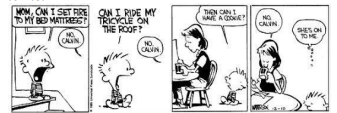
Based on a pragmatic and discourse-analysis perspective, which statement BEST explains the mother’s response pattern and Calvin’s final inference?
Based on a pragmatic and discourse-analysis perspective, which statement BEST explains the mother’s response pattern and Calvin’s final inference?
Ano: 2025
Banca:
Creative Group
Órgão:
Prefeitura de Marcos Parente - PI
Prova:
Creative Group - 2025 - Prefeitura de Marcos Parente - PI - Professor do Segundo Ciclo do Fundamental - Disciplina Inglês |
Q4176421
Linguística
“We have defined a sentence as a string of words. A
given sentence always consists of the same words,
and in the same order. Any change in the words, or
in their order, makes a different sentence.” Based on
the statement “Accent and voice quality belong
strictly to the utterance, not to the sentence uttered,”
it is possible to conclude that:
Ano: 2025
Banca:
Creative Group
Órgão:
Prefeitura de Marcos Parente - PI
Prova:
Creative Group - 2025 - Prefeitura de Marcos Parente - PI - Professor do Segundo Ciclo do Fundamental - Disciplina Inglês |
Q4176420
Pedagogia
Read the excerpt below:
“Teacher of language has received the knowledge of linguistic theory to teach language. Linguistics has been used as one of the disciplines which contribute to the theory of language teaching.
The knowledge of linguistic theory has been used as a device to help the language teacher.” Source: Middle-East Journal of Scientific Research 15 (8): Author: Ali Akbar Khansir – Applied Linguistics and English Language Teaching. The discussion emphasizes that Linguistics provides theoretical foundations that support language teachers in understanding linguistic structure, selecting methods, and developing appropriate teaching materials. It also states that the teacher’s role is not to teach theoretical linguistics, but to apply linguistic principles in the classroom. Based on these ideas, analyze the statements below:
I. The global expansion of English increasesthe need for teachers to master linguistic knowledge that supports intercultural communication and effective lesson planning.
II. It is argued that linguists and language teachers perform the same professional role, since both work directly with the scientific description of language.
III. Linguistics, although not offering ready-made teaching methods, provides theoretical principles that help teachers understand how language works and produce suitable learning materials.
IV. Applied Linguistics also includes the study of teaching methods and error-correction strategies related to language learning.
Choose the correct alternative.
“Teacher of language has received the knowledge of linguistic theory to teach language. Linguistics has been used as one of the disciplines which contribute to the theory of language teaching.
The knowledge of linguistic theory has been used as a device to help the language teacher.” Source: Middle-East Journal of Scientific Research 15 (8): Author: Ali Akbar Khansir – Applied Linguistics and English Language Teaching. The discussion emphasizes that Linguistics provides theoretical foundations that support language teachers in understanding linguistic structure, selecting methods, and developing appropriate teaching materials. It also states that the teacher’s role is not to teach theoretical linguistics, but to apply linguistic principles in the classroom. Based on these ideas, analyze the statements below:
I. The global expansion of English increasesthe need for teachers to master linguistic knowledge that supports intercultural communication and effective lesson planning.
II. It is argued that linguists and language teachers perform the same professional role, since both work directly with the scientific description of language.
III. Linguistics, although not offering ready-made teaching methods, provides theoretical principles that help teachers understand how language works and produce suitable learning materials.
IV. Applied Linguistics also includes the study of teaching methods and error-correction strategies related to language learning.
Choose the correct alternative.
Ano: 2025
Banca:
Creative Group
Órgão:
Prefeitura de Marcos Parente - PI
Prova:
Creative Group - 2025 - Prefeitura de Marcos Parente - PI - Professor do Segundo Ciclo do Fundamental - Disciplina Inglês |
Q4176419
Inglês
Modal verbs in English express different functions
such as logical possibility, ability, necessity, and permission. Considering these uses, choose the alternative
in which the modal verb is correctly used according to
its function.

 Conheça nossos planos