Questões de Concurso
Para see-pb
Foram encontradas 767 questões
Resolva questões gratuitamente!
Junte-se a mais de 4 milhões de concurseiros!


When is it time to stop studying?
It's 10 p.m. and six government employees are out checking the streets of Seoul, South Korea. But these are not police officers searching for teenagers who are behaving badly. Their mission is to find children who are still studying. And stop them. Education in South Korea is very competitive. The aim of almost every schoolchild is to get into one of the country’s top universities. Only the students with the best grades get a place. The school day starts at 8 a.m. and the students finish studying somewhere between 10 p.m. and 1 a.m. at night. This is because many go to private academies called hagwon after school. Around 74 percent of all students attend a hagwon after their regular classes finish. A year’s course costs, on average, $2,600 per student. In Seoul, there are more private tutors than schoolteachers, and the most popular ones make millions of dollars a year from online and in-person classes. Most parents rely on private tutoring to get their children into a university. With so much time spent in the classroom, all that students in South Korean high schools do is study and sleep. Some of them are so exhausted that they cannot stay awake the next day at school. It is a common sight to see a teacher explaining the lesson while a third of the students are asleep on their desks. The teachers don’t seem to mind. There are even special pillows for sale that fit over the arms of the chairs to make sleeping in class more comfortable. Ironically, the students spend class time sleeping so that they can stay up late studying that night. The South Korean government has been aware of the faults in the system for some time, but now they have passed some reforms. Today, schoolteachers have to meet certain standards or take additional training courses. However, the biggest challenge for the government is the hagwons. Hagwons have been banned from having classes after 10 p.m., which is why there are street patrols searching for children who are studying after that time. If they find any in class, the owner of the hagwon is punished and the students are sent home. It's a strange world, where some children have to be told to stop studying while others are reluctant to start. Adapted from: LATHAM-KOENIG, Christina & OXENDEN, Clive. American English File 3 - Workbook. 2"“ edition. Oxford: OUP, 2014.
In the sentence “However, the biggest challenge for the government is the hagwons.” (last paragraph), the word HOWEVER could be correctly replaced in this context, without change of meaning, by:
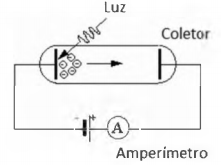
A figura a seguir, ilustra uma versão simplificada do aparato que foi utilizado no estudo do efeito:
O comprimento de onda (λ) de De Broglie de um
elétron cuja energia cinética é 100 eV é, em  :
considere os seguintes dados:
:
considere os seguintes dados:
1 = 10-10 m , h = 6,6 x 10⁻³⁴ J ˑ s ,
1 eV = 1,6 x 10⁻¹⁹ J, √29 ≅ 5,4 .
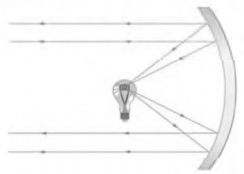
Em óptica geométrica, grande parte dos resultados obtidos, ocorre mediante aproximação chamada paraxial, ou seja, para pequenos ângulos. Na figura a seguir, uma lâmpada encontra-se posicionada em frente de um espelho esférico; os raios de luz saindo da lâmpada seguem a trajetória indicada, pois ela está situada:
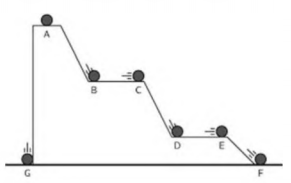
Na figura a seguir, pode-se ver várias esferas rolando nos diferentes níveis de uma rampa em degraus. Designando a energia potencial gravitacional de uma esfera por Ep, é correto então afirmar que:
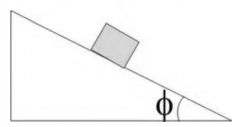
No próximo desenho, o bloco de massa m, encontra-se em equilíbrio estático em um plano inclinado, ou seja, está na iminência de escorregar. Para um ângulo Φ= 45, o coeficiente de átrio estático (μE) nesse caso será então de:
A razão das capacidades térmicas molares a pressão e volume constantes (ϒ) de um gás ideal, onde sua CV = 42 J/mol K é dada por:
Dado: considere a constante universal dos gases R = 8,314 J/mol K
O comprimento de onda (λ) da onda descrita pela equação a seguir é, em unidades do (SI): adote π =3,14 nos cálculos.
y(x, t) = 0,02 cos(0,25x - 50t + π/3)
Em certo ponto do espaço, um elétron cuja massa é 9,11 x 10⁻³¹ kg experimenta uma força cujo módulo é 3,2 x 10⁻¹⁹ N.
Nesse ponto, o módulo do campo elétrico será, então, em unidades do (SI) de:
Um precipitador eletrostático, também chamado muitas vezes de filtro de ar eletrostático, é um equipamento para controlar a poluição em fábricas que emitem gases e partículas poluentes na atmosfera. Tal equipamento, captura os poluentes e libera os gases limpos na atmosfera. Uma mancha de poeira em um desses precipitadores tem 1,000 x1012 prótons, e possui uma carga de - 5nC. Utilizando os princípios da eletrostática, pode-se dizer que o número de elétrons na mancha de poeira é de:
Dados: carga elétrica elementar 1,6 x 10¹⁹ C.
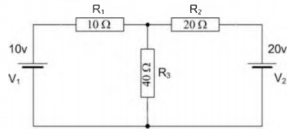
As correntes, medidas em ampères, cruzando os resistores R1, R2 e R3 no circuito a seguir, são aproximadamente de:

 Conheça nossos planos