Questões de Concurso
Para fapesp
Foram encontradas 200 questões
Resolva questões gratuitamente!
Junte-se a mais de 4 milhões de concurseiros!


Rule of Law and Democracy: Addressing
the Gap Between Policies and Practices

The Declaration adopted on 24 September 2012 by the United Nations General Assembly at the High-level Meeting on the Rule of Law at the National and International Levels reaffirmed that “human rights, the rule of law and democracy are interlinked and mutually reinforcing and that they belong to the universal and indivisible core values and principles of the United Nations”. Indeed, government responsiveness to the interests and needs of the greatest number of citizens is strictly associated with the capacity of democratic institutions and processes to bolster the dimensions of rights, equality and accountability.
If considered not solely an instrument of the government but as a rule to which the entire society, including the government, is bound, the rule of law is fundamental in advancing democracy. Strengthening the rule of law has to be approached not only by focusing on the application of norms and procedures. One must also emphasize its fundamental role in protecting rights and advancing inclusiveness, in this way framing the protection of rights within the broader discourse on human development.
A common feature of both democracy and the rule of law is that a purely institutional approach does not say anything about actual outcomes of processes and procedures, even if the latter are formally correct. When addressing the rule of law and democracy nexus, a fundamental distinction has to be drawn between “rule by law”, whereby law is an instrument of government and government is considered above the law, and “rule of law”, which implies that everyone in society is bound by the law, including the government. Essentially, constitutional limits on power, a key feature of democracy, require adherence to the rule of law.
Another key dimension of the rule of law-democracy nexus is the recognition that building democracy and the rule of law may be convergent and mutually reinforcing processes whenever the rule of law is defined in broad, endsbased terms rather than in narrow, formal and exclusively procedural terms. The nexus is strong whenever the rule of law is conceived in its relationship with substantive outcomes, like justice and democratic governance.
(https://unchronicle.un.org/article/rule-law-and-democracy-addressinggap-between-policies-and-practices.
Adaptado)
Rule of Law and Democracy: Addressing
the Gap Between Policies and Practices
The Declaration adopted on 24 September 2012 by the United Nations General Assembly at the High-level Meeting on the Rule of Law at the National and International Levels reaffirmed that “human rights, the rule of law and democracy are interlinked and mutually reinforcing and that they belong to the universal and indivisible core values and principles of the United Nations”. Indeed, government responsiveness to the interests and needs of the greatest number of citizens is strictly associated with the capacity of democratic institutions and processes to bolster the dimensions of rights, equality and accountability.
If considered not solely an instrument of the government but as a rule to which the entire society, including the government, is bound, the rule of law is fundamental in advancing democracy. Strengthening the rule of law has to be approached not only by focusing on the application of norms and procedures. One must also emphasize its fundamental role in protecting rights and advancing inclusiveness, in this way framing the protection of rights within the broader discourse on human development.
A common feature of both democracy and the rule of law is that a purely institutional approach does not say anything about actual outcomes of processes and procedures, even if the latter are formally correct. When addressing the rule of law and democracy nexus, a fundamental distinction has to be drawn between “rule by law”, whereby law is an instrument of government and government is considered above the law, and “rule of law”, which implies that everyone in society is bound by the law, including the government. Essentially, constitutional limits on power, a key feature of democracy, require adherence to the rule of law.
Another key dimension of the rule of law-democracy nexus is the recognition that building democracy and the rule of law may be convergent and mutually reinforcing processes whenever the rule of law is defined in broad, endsbased terms rather than in narrow, formal and exclusively procedural terms. The nexus is strong whenever the rule of law is conceived in its relationship with substantive outcomes, like justice and democratic governance.
(https://unchronicle.un.org/article/rule-law-and-democracy-addressinggap-between-policies-and-practices.
Adaptado)
Rule of Law and Democracy: Addressing
the Gap Between Policies and Practices
The Declaration adopted on 24 September 2012 by the United Nations General Assembly at the High-level Meeting on the Rule of Law at the National and International Levels reaffirmed that “human rights, the rule of law and democracy are interlinked and mutually reinforcing and that they belong to the universal and indivisible core values and principles of the United Nations”. Indeed, government responsiveness to the interests and needs of the greatest number of citizens is strictly associated with the capacity of democratic institutions and processes to bolster the dimensions of rights, equality and accountability.
If considered not solely an instrument of the government but as a rule to which the entire society, including the government, is bound, the rule of law is fundamental in advancing democracy. Strengthening the rule of law has to be approached not only by focusing on the application of norms and procedures. One must also emphasize its fundamental role in protecting rights and advancing inclusiveness, in this way framing the protection of rights within the broader discourse on human development.
A common feature of both democracy and the rule of law is that a purely institutional approach does not say anything about actual outcomes of processes and procedures, even if the latter are formally correct. When addressing the rule of law and democracy nexus, a fundamental distinction has to be drawn between “rule by law”, whereby law is an instrument of government and government is considered above the law, and “rule of law”, which implies that everyone in society is bound by the law, including the government. Essentially, constitutional limits on power, a key feature of democracy, require adherence to the rule of law.
Another key dimension of the rule of law-democracy nexus is the recognition that building democracy and the rule of law may be convergent and mutually reinforcing processes whenever the rule of law is defined in broad, endsbased terms rather than in narrow, formal and exclusively procedural terms. The nexus is strong whenever the rule of law is conceived in its relationship with substantive outcomes, like justice and democratic governance.
(https://unchronicle.un.org/article/rule-law-and-democracy-addressinggap-between-policies-and-practices.
Adaptado)
Rule of Law and Democracy: Addressing
the Gap Between Policies and Practices
The Declaration adopted on 24 September 2012 by the United Nations General Assembly at the High-level Meeting on the Rule of Law at the National and International Levels reaffirmed that “human rights, the rule of law and democracy are interlinked and mutually reinforcing and that they belong to the universal and indivisible core values and principles of the United Nations”. Indeed, government responsiveness to the interests and needs of the greatest number of citizens is strictly associated with the capacity of democratic institutions and processes to bolster the dimensions of rights, equality and accountability.
If considered not solely an instrument of the government but as a rule to which the entire society, including the government, is bound, the rule of law is fundamental in advancing democracy. Strengthening the rule of law has to be approached not only by focusing on the application of norms and procedures. One must also emphasize its fundamental role in protecting rights and advancing inclusiveness, in this way framing the protection of rights within the broader discourse on human development.
A common feature of both democracy and the rule of law is that a purely institutional approach does not say anything about actual outcomes of processes and procedures, even if the latter are formally correct. When addressing the rule of law and democracy nexus, a fundamental distinction has to be drawn between “rule by law”, whereby law is an instrument of government and government is considered above the law, and “rule of law”, which implies that everyone in society is bound by the law, including the government. Essentially, constitutional limits on power, a key feature of democracy, require adherence to the rule of law.
Another key dimension of the rule of law-democracy nexus is the recognition that building democracy and the rule of law may be convergent and mutually reinforcing processes whenever the rule of law is defined in broad, endsbased terms rather than in narrow, formal and exclusively procedural terms. The nexus is strong whenever the rule of law is conceived in its relationship with substantive outcomes, like justice and democratic governance.
(https://unchronicle.un.org/article/rule-law-and-democracy-addressinggap-between-policies-and-practices.
Adaptado)
Rule of Law and Democracy: Addressing
the Gap Between Policies and Practices
The Declaration adopted on 24 September 2012 by the United Nations General Assembly at the High-level Meeting on the Rule of Law at the National and International Levels reaffirmed that “human rights, the rule of law and democracy are interlinked and mutually reinforcing and that they belong to the universal and indivisible core values and principles of the United Nations”. Indeed, government responsiveness to the interests and needs of the greatest number of citizens is strictly associated with the capacity of democratic institutions and processes to bolster the dimensions of rights, equality and accountability.
If considered not solely an instrument of the government but as a rule to which the entire society, including the government, is bound, the rule of law is fundamental in advancing democracy. Strengthening the rule of law has to be approached not only by focusing on the application of norms and procedures. One must also emphasize its fundamental role in protecting rights and advancing inclusiveness, in this way framing the protection of rights within the broader discourse on human development.
A common feature of both democracy and the rule of law is that a purely institutional approach does not say anything about actual outcomes of processes and procedures, even if the latter are formally correct. When addressing the rule of law and democracy nexus, a fundamental distinction has to be drawn between “rule by law”, whereby law is an instrument of government and government is considered above the law, and “rule of law”, which implies that everyone in society is bound by the law, including the government. Essentially, constitutional limits on power, a key feature of democracy, require adherence to the rule of law.
Another key dimension of the rule of law-democracy nexus is the recognition that building democracy and the rule of law may be convergent and mutually reinforcing processes whenever the rule of law is defined in broad, endsbased terms rather than in narrow, formal and exclusively procedural terms. The nexus is strong whenever the rule of law is conceived in its relationship with substantive outcomes, like justice and democratic governance.
(https://unchronicle.un.org/article/rule-law-and-democracy-addressinggap-between-policies-and-practices.
Adaptado)
Um advogado, cujo endereço eletrônico de e-mail é advogado_silva, preparou e enviou um e-mail, utilizando o MS-Outlook 2010, a partir da sua configuração padrão, para 5 (cinco) clientes, cujos endereços eletrônicos de e-mail são: cliente _1_ silva, cliente _2_ oliva, cliente _ 3_ felix, cliente _4_ sonia e cliente _5_bola.
No campo “Para”, contém o endereço de e-mail: cliente _1_ silva.
No campo “Cc”, contém os endereços de e-mail: cliente _4_ sonia e cliente _5_ bola.
No campo “Cco”, contém os endereços de e-mail: cliente _2_ oliva e cliente_3_felix.
No campo “Assunto”, contém a frase: Comunicado de mudança de endereço.
O cliente _1_ silva após receber o e-mail, usou a opção do Outlook 2010, “Responder a todos” para enviar agradecimento ao e-mail recebido.
Assinale a alternativa correta com o número total de pessoas, que receberam o e-mail de retorno do cliente_1_silva.
Em uma planilha do MS-Excel 2010, a partir da sua configuração padrão, utilizada por uma Universidade para controlar as solicitações de bolsa para pesquisa, a coluna A contém o número do Projeto, a coluna B contém o nome do Pesquisador, a coluna C contém a titulação do Pesquisador, a coluna D contém o tema da pesquisa e a coluna E contém a indicação se o projeto de pesquisa foi aprovado (SIM) ou (NÃO).
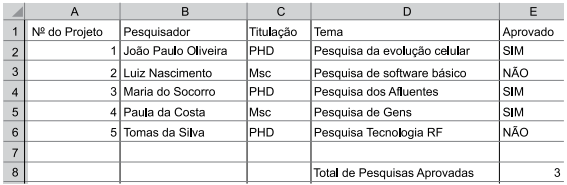
A fórmula aplicada na célula E8, para calcular o Total de projetos aprovados (SIM) é
Uma planilha do MS-Excel 2010, a partir da sua configuração padrão, utilizada por um advogado para controlar os processos trabalhistas, conforme ilustra a figura a seguir, contém na coluna A o número do processo, na coluna B o nome do cliente, na coluna C contra quem o cliente está reclamando, na coluna D o valor da causa, na coluna E o valor de honorários do advogado por processo e na coluna F a indicação se a causa teve sucesso (SIM) ou (NÃO). O advogado só receberá os honorários se o campo Sucesso for SIM.
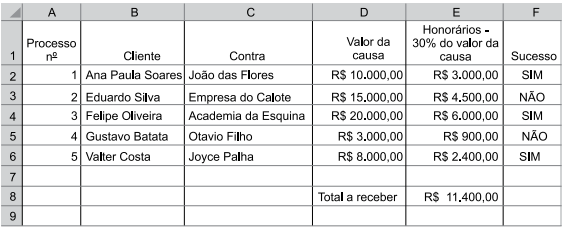
A fórmula usada na célula E8, para calcular o total de honorários recebidos quando o campo Sucesso for SIM, é
Em um documento que está sendo editado no MS-Word 2010, a partir da sua configuração padrão, usando a fonte Times New Roman, parte do texto foi previamente selecionada, conforme ilustra a figura.

O processo colocado contra a empresa  tem um valor total de R$ 5.000,00.
Esse processo deverá durar 2 anos, mas pode demorar mais em virtude das instâncias das
defesas de apelação.
tem um valor total de R$ 5.000,00.
Esse processo deverá durar 2 anos, mas pode demorar mais em virtude das instâncias das
defesas de apelação.
Após isso, foi aplicada a seguinte sequência de ícones  .
.
Assinale a alternativa que apresenta o resultado final dessa operação.
No MS-Word 2010, em sua configuração padrão, a partir da aba ________, no grupo _________ , o ícone que permite adicionar uma Caixa de Texto, em um documento que está sendo editado é ________ .
Assinale a alternativa que preenche corretamente as lacunas do texto.
( ) O memorando é a modalidade de comunicação entre unidades administrativas de um mesmo órgão, que podem estar hierarquicamente em mesmo nível ou em níveis diferentes. Trata-se, portanto, de uma forma de comunicação eminentemente interna. ( ) A tramitação do memorando em qualquer órgão deve pautar-se pela rapidez e pela simplicidade de procedimentos burocráticos. ( ) Os despachos ao memorando jamais devem ser dados no próprio documento e, sim, em adendos. Esse procedimento permite formar uma espécie de processo, assegurando maior transparência à tomada de decisões, e permitindo que se historie o andamento da matéria tratada no memorando. ( ) De acordo com sua finalidade, o memorando apresenta duas formas básicas de estrutura: uma para aquela que tenha caráter exclusivamente informativo e outra para a que proponha alguma medida ou submeta projeto de ato normativo.
I. a impessoalidade. II. a formalidade e a padronização. III. a concisão.
É correto o que está contido em
Quanto ao Microsoft Outlook, analise as assertivas abaixo.
I. Calendário integrado, que permite o agendamento de reuniões, eventos e compromissos.
II. Conexão com servidores de e-mail IMAP e P,OP3.
III. Definir ou remover tarefas.
IV. Definir ou remover lembretes.
É correto o que se afirma em
I. Endereço de e-mail do destinatário. II. Assunto da mensagem. III. Dados do servidor de e-mail do destinatário. IV. Escopo do e-mail. V. Cc e Co.
Diante do exposto, pode-se afirmar que não são campos disponíveis para preenchimento obrigatório pelos usuários os que estão contidos em
I. Régua e linhas de grade. II. Verificar ortografia e macros. III. Caixa de texto e WordART. IV. Tabela e formas. V. Cabeçalho e rodapé e som.
Diante do exposto, pode-se afirmar que os recursos que não estão localizados na guia "Inserir" estão contidos em

 Conheça nossos planos