Foram encontradas 3.474 questões
Resolva questões gratuitamente!
Junte-se a mais de 4 milhões de concurseiros!


A frase abaixo foi transcrita sem os sinais de pontuação e sem letras maiúsculas:
“A vida é como um balão quando nos deparamos com ventos fortes a solução não é lutar contra eles mas procurar novas altitudes novos ventos que levem da direção certa”
A forma de reescrevê-la com a pontuação adequada é:
Uma preposição pode estar presente numa frase ou por exigência de um termo anterior (regência), ou por uma necessidade de dar uma informação no texto, sem exigência de um termo anterior. A frase abaixo em que a preposição DE é exigida por um outro vocábulo que a antecede é:
Text 4
Exploring Identity-based Challenges to
English Teachers’ Professional Growth
Heather Camp
Minnesota State University-Mankato
Research on pre-service teacher education indicates that identity construction is an important facet of becoming a teacher. To establish oneself as a teaching professional, a person must craft a teacher identity out of the personal and professional discourses that surround him/her. This idea is consistent with contemporary theories of identity construction, which posit that the self is discursively constructed, made and remade by the various discourses that encompass the person. Such discourses -- “pattern[s] of thinking, speaking, behaving, and interacting that [are] socially, culturally, and historically constructed and sanctioned by a specific group or groups of people” (Miller Marsh 456) -- are constantly intermingling, wrangling for ideological power and dynamically shaping one another. To construct an identity, an individual must integrate these diverse discourses, weaving them together to form a dynamic but cohesive sense of self. On one hand, this twining process has the potential to promote psychological development, leading to the attainment of “an expanded, integrated self, more diverse and richer in the possibilities for action that these multiple identities afford” (Brown 676). Yet, it also may produce identity destabilization and fragmentation, leading to uncertainty, distress and stymied psychological growth.
New teachers are confronted with the task of adopting new discourses, and of forging relationships between old and new strands of their identities. Succeeding at this process facilitates the development of a secure and satisfying professional sense-of-self: research indicates that the attainment of an integrated identity helps teachers transition into and find satisfaction within the teaching profession, teach effectively, and nurture students’ self-development. Further, it suggests that attaining a cohesive identity better prepares teachers to champion educational reform.
Yet, research also suggests that accessing this array of rewards can be difficult. As teachers seek to integrate their teacherly roles with other discourses that contribute to their sense of self, they may encounter identity conflicts that work against a sense of identity cohesiveness. Encountering such conflicts can lead to emotional turmoil and stunted professional growth, even leading some student teachers (and practicing teachers) to leave the teaching profession altogether.
Growing awareness of the importance of professional identity construction and the psychological labor it demands has led to an upsurge in scholarship on pre-service teacher identity formation. […] This scholarship has drawn attention to the complexity of identity construction for pre-service teachers and offered educators insights into how they might support these students through this important work.
Adapted from http://scholarworks.wmich.edu/cgi/ viewcontent.cgi?article=1030&context=wte
Duboc (2016, p. 65) mentions three generations of evaluation practices. Match the frameworks and the focus of their methods:
1. Behaviorism
2. Constructivism
3. Sociocultural theories
( ) Learner-centered methods
( ) Language-centered methods
( ) Learning-centered methods
Indicate the option that shows the correct matching, from top to bottom.
Text 2
Here are four passages from an article on awareness of English as a lingua franca (ELF):
1) “Few will deny that research in the area of English as a lingua franca (ELF) has significantly contributed to our understanding of many different facets of communication involving non-native speakers of English. Such studies have added valuable insights to the growing research in the domain of critical applied linguistics and critical pedagogy and have prompted many scholars to problematize all aspects of English language teaching, learning, testing, curriculum designing, etc.”
2) “It is important at this stage to distinguish between the critical and the transformative perspective in ESOL teacher education. While they both share the element of reflection, they are different in a crucial way, although the former has often been seen as an umbrella term that subsumes the latter.”
3) “Critical pedagogy is invaluable in our attempt to understand the complex processes of the global spread of English and the intricate ways in which it continues to be localized and relocalized (Pennycook, 2010). It has the tools to help teachers appreciate the complications of context and the various underlying and often hidden discourses, from learner identity construction in the ESOL classroom (Norton and Toohey, 2011) to language testing (Shohamy, 2004) to the politics of pedagogy in the ‘classroom as a microcosm of the larger social and cultural world’” (Pennycook, 2001: 138).
4) “The value of an ELF-aware transformative perspective to ESOL teacher education lies in its power to help teachers define ELF for themselves and for their teaching contexts. In this way, teachers are involved in the co-construction of ELF and, in particular, in the development of one or more pedagogical frameworks for ELF. To achieve this, teachers have to have an informed awareness of the ELF construct, a critical awareness of their own deeper convictions about essential aspects of language, communication, and language teaching/learning, and the capability to bring about sustainable change in their teaching.”
From Sifakis, N. C. (2014). "ELF awareness as an opportunity for change: a transformative perspective for ESOL teacher education". Journal of English as a Lingua Franca, 3/2: 317-335.
Text 2
Here are four passages from an article on awareness of English as a lingua franca (ELF):
1) “Few will deny that research in the area of English as a lingua franca (ELF) has significantly contributed to our understanding of many different facets of communication involving non-native speakers of English. Such studies have added valuable insights to the growing research in the domain of critical applied linguistics and critical pedagogy and have prompted many scholars to problematize all aspects of English language teaching, learning, testing, curriculum designing, etc.”
2) “It is important at this stage to distinguish between the critical and the transformative perspective in ESOL teacher education. While they both share the element of reflection, they are different in a crucial way, although the former has often been seen as an umbrella term that subsumes the latter.”
3) “Critical pedagogy is invaluable in our attempt to understand the complex processes of the global spread of English and the intricate ways in which it continues to be localized and relocalized (Pennycook, 2010). It has the tools to help teachers appreciate the complications of context and the various underlying and often hidden discourses, from learner identity construction in the ESOL classroom (Norton and Toohey, 2011) to language testing (Shohamy, 2004) to the politics of pedagogy in the ‘classroom as a microcosm of the larger social and cultural world’” (Pennycook, 2001: 138).
4) “The value of an ELF-aware transformative perspective to ESOL teacher education lies in its power to help teachers define ELF for themselves and for their teaching contexts. In this way, teachers are involved in the co-construction of ELF and, in particular, in the development of one or more pedagogical frameworks for ELF. To achieve this, teachers have to have an informed awareness of the ELF construct, a critical awareness of their own deeper convictions about essential aspects of language, communication, and language teaching/learning, and the capability to bring about sustainable change in their teaching.”
From Sifakis, N. C. (2014). "ELF awareness as an opportunity for change: a transformative perspective for ESOL teacher education". Journal of English as a Lingua Franca, 3/2: 317-335.
Based on Siqueira (2011), analyse the statements below.
I. ELF has derived from “native” speakers and is a unique variety of English.
II. Most interactions in ELF today are between “non-native” speakers.
III. ELF has become a diverse, multiple and nomad language.
IV. It is possible to codify a general variety of ELF.
Choose the correct answer:
Text 2
Here are four passages from an article on awareness of English as a lingua franca (ELF):
1) “Few will deny that research in the area of English as a lingua franca (ELF) has significantly contributed to our understanding of many different facets of communication involving non-native speakers of English. Such studies have added valuable insights to the growing research in the domain of critical applied linguistics and critical pedagogy and have prompted many scholars to problematize all aspects of English language teaching, learning, testing, curriculum designing, etc.”
2) “It is important at this stage to distinguish between the critical and the transformative perspective in ESOL teacher education. While they both share the element of reflection, they are different in a crucial way, although the former has often been seen as an umbrella term that subsumes the latter.”
3) “Critical pedagogy is invaluable in our attempt to understand the complex processes of the global spread of English and the intricate ways in which it continues to be localized and relocalized (Pennycook, 2010). It has the tools to help teachers appreciate the complications of context and the various underlying and often hidden discourses, from learner identity construction in the ESOL classroom (Norton and Toohey, 2011) to language testing (Shohamy, 2004) to the politics of pedagogy in the ‘classroom as a microcosm of the larger social and cultural world’” (Pennycook, 2001: 138).
4) “The value of an ELF-aware transformative perspective to ESOL teacher education lies in its power to help teachers define ELF for themselves and for their teaching contexts. In this way, teachers are involved in the co-construction of ELF and, in particular, in the development of one or more pedagogical frameworks for ELF. To achieve this, teachers have to have an informed awareness of the ELF construct, a critical awareness of their own deeper convictions about essential aspects of language, communication, and language teaching/learning, and the capability to bring about sustainable change in their teaching.”
From Sifakis, N. C. (2014). "ELF awareness as an opportunity for change: a transformative perspective for ESOL teacher education". Journal of English as a Lingua Franca, 3/2: 317-335.
Text 2
Here are four passages from an article on awareness of English as a lingua franca (ELF):
1) “Few will deny that research in the area of English as a lingua franca (ELF) has significantly contributed to our understanding of many different facets of communication involving non-native speakers of English. Such studies have added valuable insights to the growing research in the domain of critical applied linguistics and critical pedagogy and have prompted many scholars to problematize all aspects of English language teaching, learning, testing, curriculum designing, etc.”
2) “It is important at this stage to distinguish between the critical and the transformative perspective in ESOL teacher education. While they both share the element of reflection, they are different in a crucial way, although the former has often been seen as an umbrella term that subsumes the latter.”
3) “Critical pedagogy is invaluable in our attempt to understand the complex processes of the global spread of English and the intricate ways in which it continues to be localized and relocalized (Pennycook, 2010). It has the tools to help teachers appreciate the complications of context and the various underlying and often hidden discourses, from learner identity construction in the ESOL classroom (Norton and Toohey, 2011) to language testing (Shohamy, 2004) to the politics of pedagogy in the ‘classroom as a microcosm of the larger social and cultural world’” (Pennycook, 2001: 138).
4) “The value of an ELF-aware transformative perspective to ESOL teacher education lies in its power to help teachers define ELF for themselves and for their teaching contexts. In this way, teachers are involved in the co-construction of ELF and, in particular, in the development of one or more pedagogical frameworks for ELF. To achieve this, teachers have to have an informed awareness of the ELF construct, a critical awareness of their own deeper convictions about essential aspects of language, communication, and language teaching/learning, and the capability to bring about sustainable change in their teaching.”
From Sifakis, N. C. (2014). "ELF awareness as an opportunity for change: a transformative perspective for ESOL teacher education". Journal of English as a Lingua Franca, 3/2: 317-335.
Text 2
Here are four passages from an article on awareness of English as a lingua franca (ELF):
1) “Few will deny that research in the area of English as a lingua franca (ELF) has significantly contributed to our understanding of many different facets of communication involving non-native speakers of English. Such studies have added valuable insights to the growing research in the domain of critical applied linguistics and critical pedagogy and have prompted many scholars to problematize all aspects of English language teaching, learning, testing, curriculum designing, etc.”
2) “It is important at this stage to distinguish between the critical and the transformative perspective in ESOL teacher education. While they both share the element of reflection, they are different in a crucial way, although the former has often been seen as an umbrella term that subsumes the latter.”
3) “Critical pedagogy is invaluable in our attempt to understand the complex processes of the global spread of English and the intricate ways in which it continues to be localized and relocalized (Pennycook, 2010). It has the tools to help teachers appreciate the complications of context and the various underlying and often hidden discourses, from learner identity construction in the ESOL classroom (Norton and Toohey, 2011) to language testing (Shohamy, 2004) to the politics of pedagogy in the ‘classroom as a microcosm of the larger social and cultural world’” (Pennycook, 2001: 138).
4) “The value of an ELF-aware transformative perspective to ESOL teacher education lies in its power to help teachers define ELF for themselves and for their teaching contexts. In this way, teachers are involved in the co-construction of ELF and, in particular, in the development of one or more pedagogical frameworks for ELF. To achieve this, teachers have to have an informed awareness of the ELF construct, a critical awareness of their own deeper convictions about essential aspects of language, communication, and language teaching/learning, and the capability to bring about sustainable change in their teaching.”
From Sifakis, N. C. (2014). "ELF awareness as an opportunity for change: a transformative perspective for ESOL teacher education". Journal of English as a Lingua Franca, 3/2: 317-335.
As regards Passage 2, analyse the assertions below:
I. A critical orientation may include a transformative view.
II. Critical and transformative perspectives in ESOL are indistinguishable.
III. Transformative perspectives are wider than critical orientations.
Choose the correct answer:
Text 2
Here are four passages from an article on awareness of English as a lingua franca (ELF):
1) “Few will deny that research in the area of English as a lingua franca (ELF) has significantly contributed to our understanding of many different facets of communication involving non-native speakers of English. Such studies have added valuable insights to the growing research in the domain of critical applied linguistics and critical pedagogy and have prompted many scholars to problematize all aspects of English language teaching, learning, testing, curriculum designing, etc.”
2) “It is important at this stage to distinguish between the critical and the transformative perspective in ESOL teacher education. While they both share the element of reflection, they are different in a crucial way, although the former has often been seen as an umbrella term that subsumes the latter.”
3) “Critical pedagogy is invaluable in our attempt to understand the complex processes of the global spread of English and the intricate ways in which it continues to be localized and relocalized (Pennycook, 2010). It has the tools to help teachers appreciate the complications of context and the various underlying and often hidden discourses, from learner identity construction in the ESOL classroom (Norton and Toohey, 2011) to language testing (Shohamy, 2004) to the politics of pedagogy in the ‘classroom as a microcosm of the larger social and cultural world’” (Pennycook, 2001: 138).
4) “The value of an ELF-aware transformative perspective to ESOL teacher education lies in its power to help teachers define ELF for themselves and for their teaching contexts. In this way, teachers are involved in the co-construction of ELF and, in particular, in the development of one or more pedagogical frameworks for ELF. To achieve this, teachers have to have an informed awareness of the ELF construct, a critical awareness of their own deeper convictions about essential aspects of language, communication, and language teaching/learning, and the capability to bring about sustainable change in their teaching.”
From Sifakis, N. C. (2014). "ELF awareness as an opportunity for change: a transformative perspective for ESOL teacher education". Journal of English as a Lingua Franca, 3/2: 317-335.
The following sentences present information provided in each of the passages from Text 2. Read them, add the corresponding number of each passage (1 to 4), and mark the option that presents the correct sequencing:
( ) Both perspectives attribute value to reflection.
( ) The classroom should be seen as part of a wider context.
( ) ELF teachers are stimulated to reflect on their own teaching.
( ) ELF studies have had great impact on English language teaching.
Text 1
Multiliteracies
Text 1
Multiliteracies
Text 1
Multiliteracies
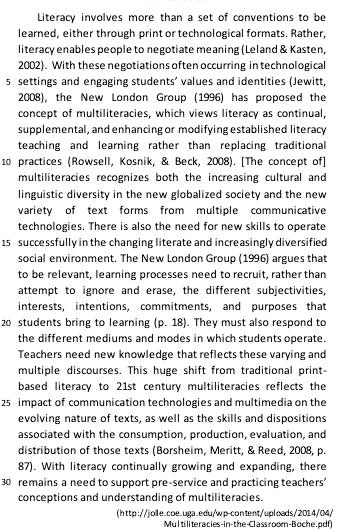
Read the following extract from Text 1: “Multiliteracies recognizes both the increasing cultural and linguistic diversity in the new globalized society and the new variety of text forms from multiple communicative technologies.” (L.11-14)
(imagem)
The alternative from Lotherington (2006) that has some analogy to this passage is:

 Conheça nossos planos