Foram encontradas 5.054 questões
Resolva questões gratuitamente!
Junte-se a mais de 4 milhões de concurseiros!


Leia o texto e responda à questão.
Culture is really an integral part of the interaction between language and thought. Cultural patterns, customs, and ways of life are expressed in language; culture-specific world views are reflected in language. Each culture has at its disposal a particular range of colours, illustrating its particular world view on what color is and how to identify color. The African Shona and Bassa peoples, for example, have fewer color categories than speakers of European languages and they break up the spectrum at different points, as shown below:

Of course, the Shona or Bassa are able to perceive and describe other colors, in the same way that an English speaker might describe a “dark bluish green”, but the labels which the language provides tend to shape the person’s overall cognitive organization of color and to cause varying degrees of color discrimination. Eskimo tribes commonly have as many as seven different words for snow to distinguish among different types of snow (falling snow, snow on the ground, fluffy snow, wet snow, etc.), whereas certain African cultures in the equatorial forests of Zaire have no word at all for snow.
(Douglas Brown. Principles of language learning and teaching.
5th ed. Longman, 2000. Adaptado)
Leia o texto e responda à questão.
Culture is really an integral part of the interaction between language and thought. Cultural patterns, customs, and ways of life are expressed in language; culture-specific world views are reflected in language. Each culture has at its disposal a particular range of colours, illustrating its particular world view on what color is and how to identify color. The African Shona and Bassa peoples, for example, have fewer color categories than speakers of European languages and they break up the spectrum at different points, as shown below:
Of course, the Shona or Bassa are able to perceive and describe other colors, in the same way that an English speaker might describe a “dark bluish green”, but the labels which the language provides tend to shape the person’s overall cognitive organization of color and to cause varying degrees of color discrimination. Eskimo tribes commonly have as many as seven different words for snow to distinguish among different types of snow (falling snow, snow on the ground, fluffy snow, wet snow, etc.), whereas certain African cultures in the equatorial forests of Zaire have no word at all for snow.
(Douglas Brown. Principles of language learning and teaching.
5th ed. Longman, 2000. Adaptado)
Leia o texto e responda à questão.
Culture is really an integral part of the interaction between language and thought. Cultural patterns, customs, and ways of life are expressed in language; culture-specific world views are reflected in language. Each culture has at its disposal a particular range of colours, illustrating its particular world view on what color is and how to identify color. The African Shona and Bassa peoples, for example, have fewer color categories than speakers of European languages and they break up the spectrum at different points, as shown below:
Of course, the Shona or Bassa are able to perceive and describe other colors, in the same way that an English speaker might describe a “dark bluish green”, but the labels which the language provides tend to shape the person’s overall cognitive organization of color and to cause varying degrees of color discrimination. Eskimo tribes commonly have as many as seven different words for snow to distinguish among different types of snow (falling snow, snow on the ground, fluffy snow, wet snow, etc.), whereas certain African cultures in the equatorial forests of Zaire have no word at all for snow.
(Douglas Brown. Principles of language learning and teaching.
5th ed. Longman, 2000. Adaptado)
Leia o texto e responda à questão.
Culture is really an integral part of the interaction between language and thought. Cultural patterns, customs, and ways of life are expressed in language; culture-specific world views are reflected in language. Each culture has at its disposal a particular range of colours, illustrating its particular world view on what color is and how to identify color. The African Shona and Bassa peoples, for example, have fewer color categories than speakers of European languages and they break up the spectrum at different points, as shown below:
Of course, the Shona or Bassa are able to perceive and describe other colors, in the same way that an English speaker might describe a “dark bluish green”, but the labels which the language provides tend to shape the person’s overall cognitive organization of color and to cause varying degrees of color discrimination. Eskimo tribes commonly have as many as seven different words for snow to distinguish among different types of snow (falling snow, snow on the ground, fluffy snow, wet snow, etc.), whereas certain African cultures in the equatorial forests of Zaire have no word at all for snow.
(Douglas Brown. Principles of language learning and teaching.
5th ed. Longman, 2000. Adaptado)
Leia a charge e responda à questão.
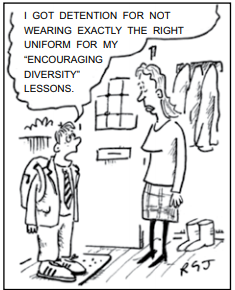
(www.cartoonstock.com)
Humor in the charge derives from
Em uma aula de Educação Física, os alunos realizam uma atividade de “pula sela” quando um aluno, ao pular por cima do outro, tropeça e cai com suas mãos espalmadas no chão, logo começando a chorar de dor.
O professor, ao se aproximar, nota uma deformidade na região do antebraço do aluno e constata se tratar de uma fratura, que precisaria ser imobilizada para que o acidentado fosse encaminhado adequadamente ao serviço médico.
Nessa situação, assinale a alternativa que menciona os locais e a forma correta de realizar essa imobilização.
Para colocar em prática os procedimentos de socorros de urgência adequados, é preciso saber avaliar e classificar lesões. Pensando nisso, analise a situação a seguir:
Em uma aula de Educação Física, enquanto jogava handebol, um aluno que possuía um alargador em sua orelha teve o lóbulo dela completamente arrancado por um de seus colegas que, acidentalmente, enroscou o dedo no alargador durante um arremesso ao gol.
Segundo Flegel (2015), essa lesão é classificada como
Durante um semestre, as aulas de Educação Física foram voltadas à estimulação da capacidade aeróbia. Corridas de longa duração em intensidades moderadas, pular corda por mais de cinco minutos e atividades semelhantes foram utilizadas para atingir esse objetivo.
Assinale a alternativa que contém uma das alterações fisiológicas que devem ter ocorrido no organismo dos alunos, ao final do semestre, decorrentes desse tipo de exercitação.
Durante uma aula de Educação Física, os alunos realizam uma série de exercícios físicos com o intuito de desenvolverem a força muscular. Dois desses exercícios são flexão de braços, em que, sobre quatro apoios, devem aproximar e afastar o tronco do solo flexionando e estendendo os cotovelos, e agachamento estático começando na posição ereta e com os pés afastados na mesma largura dos ombros, flexionam os joelhos até um ângulo de 90 graus e, permanecem nessa posição por 30 segundos.
Tomando como base o valor médio da pressão arterial em repouso de cada indivíduo, é correto afirmar que, durante a execução desses exercícios, a pressão arterial
Um professor de Educação Física, ao trabalhar a modalidade de futebol com o objetivo de que seus alunos aprimorem a habilidade de chutar a bola ao gol, sugere diversos exercícios nos quais eles chutam ao gol de diversos lugares da quadra, com a bola parada, com a bola em movimento, após receber um passe, após conduzir a bola por alguns metros, e em situações com marcadores que tentam impedir o chute.
Segundo Magill (2002), ao conduzir a aula dessa forma, o professor agiu de maneira
A fase _______________do desenvolvimento motor é resultado da fase de movimentos _____________. Nesta fase, o movimento torna-se uma ferramenta que se aplica a muitas atividades motoras complexas presentes na vida diária, na recreação e nos objetivos esportivos.
Assinale a alternativa que contém as palavras que, segundo Gallahue (2001), completam a frase correta e respectivamente.
Em uma aula cujo tema era introduzir o estudo das lutas, o professor explica aos alunos que há movimentos que são comuns a diferentes modalidades de luta.
Assinale a alternativa que menciona alguns movimentos de lutas considerados básicos de acordo com Freitas (In: Scarpato, 2007).
Um professor de Educação Física começa o semestre perguntando a seus alunos quais modalidades esportivas gostariam de praticar durante as aulas. A partir disso, foram escolhidas as quatro mais votadas. No decorrer do semestre, o professor pediu que os alunos relatassem como costumavam praticar, fora da escola, tais modalidades e suas variações, estimulando-os a proporem transformações nas regras, nos materiais utilizados e no espaço utilizado para a prática.
Pensando no esporte inserido na Educação Física escolar, é correto afirmar que o professor conduziu suas aulas de maneira
Em uma aula de Educação Física, duas equipes mistas são formadas para jogar uma partida de basquetebol com três regras diferentes. A primeira limita o arremesso ao cesto somente após todos os integrantes terem recebido a bola pelo menos uma vez. A segunda diz respeito a quem poderá marcar os pontos, pois uma pessoa que já realizou um ponto só poderá marcar outro após todos da sua equipe terem marcado. A terceira estipula que, se um ponto foi marcado por um menino, o próximo terá de ser marcado por uma menina, ou vice-versa.
Além do estímulo ao desenvolvimento de habilidades óculo-manuais e outras habilidades motoras como correr, saltar, etc., é correto afirmar que essa atividade estimula

 Conheça nossos planos