Selecionar segmento
Estude com questões de diferentes segmentos
Atenção: Isso limpará todos os campos já preenchidos no filtro!
Foram encontradas 325 questões
Resolva questões gratuitamente!
Junte-se a mais de 4 milhões de concurseiros!


Ano: 2024
Banca:
EDUCA
Órgão:
Prefeitura de Juru - PB
Prova:
EDUCA - 2024 - Prefeitura de Juru - PB - Professor de Matemática |
Q2452465
Matemática
Numa competição escolar estão inscritos 11 times para
disputar os troféus de ouro, prata e bronze.
De quantas formas diferentes poderão ser distribuídos os troféus em função dos três times vencedores:
De quantas formas diferentes poderão ser distribuídos os troféus em função dos três times vencedores:
Ano: 2024
Banca:
EDUCA
Órgão:
Prefeitura de Juru - PB
Prova:
EDUCA - 2024 - Prefeitura de Juru - PB - Professor de Matemática |
Q2452464
Matemática
A divisão do polinômio A(x) = x3 - 7x2 + 7x +15 pelo polinômio B(x) = x2 - 2x - 3 tem como
resultado o polinômio
R(x)
, tal que:
Ano: 2024
Banca:
EDUCA
Órgão:
Prefeitura de Juru - PB
Prova:
EDUCA - 2024 - Prefeitura de Juru - PB - Professor de Matemática |
Q2452463
Matemática
Assinale a função real cuja soma e o produto dos seus
zeros são, respectivamente, 3 e -10.
Ano: 2024
Banca:
EDUCA
Órgão:
Prefeitura de Juru - PB
Prova:
EDUCA - 2024 - Prefeitura de Juru - PB - Professor de Matemática |
Q2452462
Matemática
Em decorrência de uma crise de mercado, um
comerciante fez dois aumentos sucessivos em todas as
suas mercadorias. O primeiro aumento foi de 40% e o
segundo foi de 30%. Passada a crise, o comerciante
deseja retornar os preços de suas mercadorias aos
valores anteriores ao primeiro aumento. Nesse sentido,
o percentual de redução nos preços que ele deverá
aplicar nas mercadorias será da ordem de:
Ano: 2024
Banca:
EDUCA
Órgão:
Prefeitura de Juru - PB
Prova:
EDUCA - 2024 - Prefeitura de Juru - PB - Professor de Matemática |
Q2452461
Matemática
Quando cheio, o reservatório de água de uma cidade
suporta 30 dias de consumo normal pelos habitantes
sem necessidade de reabastecimento. A esse
reservatório estão ligadas duas bombas de
abastecimento, sendo a primeira capaz de enchê-lo
sozinha em 12 dias, e a segunda em 5 dias. Estando esse
reservatório inicialmente vazio, e sendo ligadas
simultaneamente as duas bombas de abastecimento
para não se interromper o consumo diário normal dos
habitantes, após quantos dias o reservatório estará
totalmente cheio:
Ano: 2024
Banca:
EDUCA
Órgão:
Prefeitura de Juru - PB
Prova:
EDUCA - 2024 - Prefeitura de Juru - PB - Professor de Matemática |
Q2452457
Pedagogia
De acordo com a Resolução nº 4, de 2 de outubro de
2009, Art. 4º Considera-se público-alvo do AEE:
I. Alunos com deficiência: aqueles que têm impedimentos de longo prazo de natureza física, intelectual, mental ou sensorial.
II. Alunos com transtornos globais do desenvolvimento: aqueles que apresentam um quadro de alterações no desenvolvimento neuropsicomotor, comprometimento nas relações sociais, na comunicação ou estereotipias motoras. Incluem-se nessa definição alunos com autismo clássico, síndrome de Asperger, síndrome de Rett, transtorno desintegrativo da infância (psicoses) e transtornos invasivos sem outra especificação.
III. Alunos com altas habilidades/superdotação: aqueles que apresentam um potencial elevado e grande envolvimento com as áreas do conhecimento humano, isoladas ou combinadas: intelectual, liderança, psicomotora, artes e criatividade.
Está(ão) CORRETO(S):
I. Alunos com deficiência: aqueles que têm impedimentos de longo prazo de natureza física, intelectual, mental ou sensorial.
II. Alunos com transtornos globais do desenvolvimento: aqueles que apresentam um quadro de alterações no desenvolvimento neuropsicomotor, comprometimento nas relações sociais, na comunicação ou estereotipias motoras. Incluem-se nessa definição alunos com autismo clássico, síndrome de Asperger, síndrome de Rett, transtorno desintegrativo da infância (psicoses) e transtornos invasivos sem outra especificação.
III. Alunos com altas habilidades/superdotação: aqueles que apresentam um potencial elevado e grande envolvimento com as áreas do conhecimento humano, isoladas ou combinadas: intelectual, liderança, psicomotora, artes e criatividade.
Está(ão) CORRETO(S):
Ano: 2024
Banca:
EDUCA
Órgão:
Prefeitura de Juru - PB
Prova:
EDUCA - 2024 - Prefeitura de Juru - PB - Professor de Matemática |
Q2452456
Pedagogia
Segundo a LDB, Lei nº 9.394/96, Art. 12. “Os
estabelecimentos de ensino, respeitadas as normas
comuns e as do seu sistema de ensino, terão os
Municípios a incumbência de”, entre outros, EXCETO:
Ano: 2024
Banca:
EDUCA
Órgão:
Prefeitura de Juru - PB
Prova:
EDUCA - 2024 - Prefeitura de Juru - PB - Professor de Libras |
Q2452375
Libras
As Leis para os surdos e Libras são determinantes para
a construção de uma sociedade mais inclusiva. Esse
comprometimento com a inclusão nos surdos faz toda
diferença para que eles tenham melhores oportunidades
e condições de vida.
Sobre as Leis para a comunidade surda, entre as outras, analise as alternativas e assinale a INCORRETA:
Sobre as Leis para a comunidade surda, entre as outras, analise as alternativas e assinale a INCORRETA:
Ano: 2024
Banca:
EDUCA
Órgão:
Prefeitura de Juru - PB
Prova:
EDUCA - 2024 - Prefeitura de Juru - PB - Professor de Libras |
Q2452372
Libras
Surdocega é a pessoa que apresenta perdas visual e
auditiva combinadas. Algumas pessoas surdocegas têm
perdas totais desses sentidos, outras não, podendo
manter resíduos auditivos e/ou visuais.
De forma geral, a surdocegueira é classificada da seguinte forma:
I. Surdocegos pré-linguísticos: normalmente bebês ou crianças que tiveram perdas severas de audição e de visão antes da aquisição de linguagem e de língua, também chamada de surdocegueira congênita, causada pela síndrome de Usher tipo I, ou outras síndromes/patologias.
II. Surdocegos pós-linguísticos: são crianças, jovens ou adultos que tiveram perdas significativas e severas de audição e de visão após a desenvolvimento de linguagem e aquisição de língua vocal ou sinalizada, muitos já alfabetizados. Nesses casos, a elegibilidade do tipo de comunicação é naturalmente da pessoa com surdocegueira.
Assinale a alternativa CORRETA:
De forma geral, a surdocegueira é classificada da seguinte forma:
I. Surdocegos pré-linguísticos: normalmente bebês ou crianças que tiveram perdas severas de audição e de visão antes da aquisição de linguagem e de língua, também chamada de surdocegueira congênita, causada pela síndrome de Usher tipo I, ou outras síndromes/patologias.
II. Surdocegos pós-linguísticos: são crianças, jovens ou adultos que tiveram perdas significativas e severas de audição e de visão após a desenvolvimento de linguagem e aquisição de língua vocal ou sinalizada, muitos já alfabetizados. Nesses casos, a elegibilidade do tipo de comunicação é naturalmente da pessoa com surdocegueira.
Assinale a alternativa CORRETA:
Ano: 2024
Banca:
EDUCA
Órgão:
Prefeitura de Juru - PB
Prova:
EDUCA - 2024 - Prefeitura de Juru - PB - Professor de Libras |
Q2452371
Libras
A Libras é basicamente produzida pelas mãos e sua
estrutura sublexical é constituída a partir dos seguintes
parâmetros:
Assinale a alternativa INCORRETA:
Assinale a alternativa INCORRETA:
Ano: 2024
Banca:
EDUCA
Órgão:
Prefeitura de Juru - PB
Prova:
EDUCA - 2024 - Prefeitura de Juru - PB - Professor de Libras |
Q2452370
Libras
Na PRIMEIRA COLUNA está representada a
concepção de visão clínica-patológica, na qual as
capacidades do surdo são desvalorizadas. Já na
SEGUNDA COLUNA, vemos a concepção sócio-antropológica, que compreende o sujeito por sua
diferença e não por sua deficiência, bem como respeita
sua língua e cultura.
A respeito das Representações sociais do Surdo, analise as alternativas e assinale a INCORRETA:
A respeito das Representações sociais do Surdo, analise as alternativas e assinale a INCORRETA:
Ano: 2024
Banca:
EDUCA
Órgão:
Prefeitura de Juru - PB
Prova:
EDUCA - 2024 - Prefeitura de Juru - PB - Professor de Libras |
Q2452369
Libras
Sobre a História da Educação de Surdos no Brasil,
analise os itens a seguir:
I. No Brasil, a história da educação de surdos iniciou-se com a criação do Instituto de Surdos-Mudos, hoje atual Instituto Nacional de Educação de surdos - INES, fundado em 26 de setembro de 1857, pelo professor surdo francês E. Huet, que veio ao Brasil a convite do Imperador D. Pedro II para trabalhar na educação de surdos.
II. No início, os surdos eram educados por linguagem escrita articulada e falada, datilologia e sinais. O curso tinha a duração de seis anos e era oferecido a alunos dos dois sexos, na idade de sete a dezesseis anos. A disciplina "Leitura sobre os Lábios" estaria voltada apenas para os que apresentassem aptidões a desenvolver a linguagem oral. Havia uma seleção e, consequentemente, trabalho diferenciado para os que não tivessem condições de ser oralizados.
III. A escola inclusiva surgiu com a finalidade de mostrar um novo caminho para a educação do surdo, pois a metodologia é um caminho que atende de forma satisfatória as especificidades do surdo, considerando todos os aspectos culturais deste sujeito.
IV. A história da inclusão remonta à Idade Média, época em que ocorriam muitas matanças e perseguições às pessoas que nasciam com alguma deficiência. Portanto, a trajetória das pessoas com necessidades educativas especiais, ou seja, pessoas com deficiência, é marcada pela exclusão, pois elas não eram consideradas pertencentes à sociedade, sendo, a maioria, abandonadas, escondidas ou mortas.
V. O primeiro passo para romper barreiras no processo de identidade dos alunos surdos foi desencadeado através da valorização da primeira língua dos surdos, que é a LIBRAS, da construção das regras de convivência no ambiente escolar e da convivência de todos os alunos, dos diferentes ciclos, em todos os espaços da escola.
Estão CORRETOS:
I. No Brasil, a história da educação de surdos iniciou-se com a criação do Instituto de Surdos-Mudos, hoje atual Instituto Nacional de Educação de surdos - INES, fundado em 26 de setembro de 1857, pelo professor surdo francês E. Huet, que veio ao Brasil a convite do Imperador D. Pedro II para trabalhar na educação de surdos.
II. No início, os surdos eram educados por linguagem escrita articulada e falada, datilologia e sinais. O curso tinha a duração de seis anos e era oferecido a alunos dos dois sexos, na idade de sete a dezesseis anos. A disciplina "Leitura sobre os Lábios" estaria voltada apenas para os que apresentassem aptidões a desenvolver a linguagem oral. Havia uma seleção e, consequentemente, trabalho diferenciado para os que não tivessem condições de ser oralizados.
III. A escola inclusiva surgiu com a finalidade de mostrar um novo caminho para a educação do surdo, pois a metodologia é um caminho que atende de forma satisfatória as especificidades do surdo, considerando todos os aspectos culturais deste sujeito.
IV. A história da inclusão remonta à Idade Média, época em que ocorriam muitas matanças e perseguições às pessoas que nasciam com alguma deficiência. Portanto, a trajetória das pessoas com necessidades educativas especiais, ou seja, pessoas com deficiência, é marcada pela exclusão, pois elas não eram consideradas pertencentes à sociedade, sendo, a maioria, abandonadas, escondidas ou mortas.
V. O primeiro passo para romper barreiras no processo de identidade dos alunos surdos foi desencadeado através da valorização da primeira língua dos surdos, que é a LIBRAS, da construção das regras de convivência no ambiente escolar e da convivência de todos os alunos, dos diferentes ciclos, em todos os espaços da escola.
Estão CORRETOS:
Ano: 2024
Banca:
EDUCA
Órgão:
Prefeitura de Juru - PB
Prova:
EDUCA - 2024 - Prefeitura de Juru - PB - Professor de Libras |
Q2452368
Pedagogia
Sobre educação inclusiva e educação especial, analise
as alternativas e assinale a INCORRETA:
Ano: 2024
Banca:
EDUCA
Órgão:
Prefeitura de Juru - PB
Prova:
EDUCA - 2024 - Prefeitura de Juru - PB - Professor de Libras |
Q2452365
Pedagogia
De acordo com a LDB, Lei nº 9.394/96, “Art. 18. “Os
sistemas municipais de ensino compreendem”:
I. As instituições do ensino fundamental, médio e de educação infantil mantidas pelo Poder Público municipal.
II. As instituições de educação infantil criadas e mantidas pela iniciativa privada.
III. Os órgãos municipais de educação.
Está(ão) CORRETO(S):
I. As instituições do ensino fundamental, médio e de educação infantil mantidas pelo Poder Público municipal.
II. As instituições de educação infantil criadas e mantidas pela iniciativa privada.
III. Os órgãos municipais de educação.
Está(ão) CORRETO(S):
Ano: 2024
Banca:
EDUCA
Órgão:
Prefeitura de Juru - PB
Prova:
EDUCA - 2024 - Prefeitura de Juru - PB - Professor de Inglês |
Q2452360
Inglês
Read the excerpt that follows from Khalid and Husnin’s (2019) paper “CHALLENGES AND SUPPORT FOR
THE DEVELOPMENT OF NOVICE TEACHERS’ PROFESSIONAL IDENTITIES”.
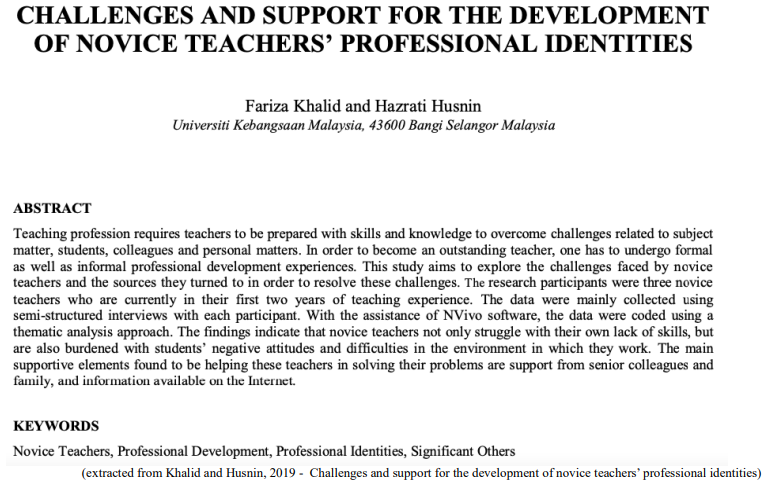
“In order to become effective, teachers have to be professionally prepared. Teachers therefore need to experience continuing professional development so as to become more effective (Harris, 2002). For pre-service teachers, teaching practice is one of the key elements in their training (Haigh and Tuck, 1999; Hill and Brodin, 2004). Through pre-service training, student teachers are provided with experience in teaching and learning in and outside the classroom, as well as opportunities to enhance the development of their characters so as to become ethical and professional (Kennedy, 2006). Some past studies have proven that teaching practice helps pre-service teachers to have better discussions with lecturers and mentors, and thus helps pre-service teachers to determine the approaches to use and their implications in teaching (Botha and Reddy, 2011; Agbo, 2003). In addition, teaching practice has been found to help pre-service teachers to enhance those skills related to problem identification, decision making, and the selection of approaches to overcome problems in classroom situations, and has also been found to be incredibly significant in developing pre-service teachers’ confidence in themselves (Khalid, 2014). Nevertheless, teachers’ professional development is not merely limited to preservice training. Berliner (1995) views the initial stage of new teachers’ professionalism as the critical stage in which novice teachers will face numerous conflicts, responsibilities and tasks”.
That being said, relying on linguistic skills and reading techniques, check the answer which is associated with the global meaning of the excerpt of the paper provided.
“In order to become effective, teachers have to be professionally prepared. Teachers therefore need to experience continuing professional development so as to become more effective (Harris, 2002). For pre-service teachers, teaching practice is one of the key elements in their training (Haigh and Tuck, 1999; Hill and Brodin, 2004). Through pre-service training, student teachers are provided with experience in teaching and learning in and outside the classroom, as well as opportunities to enhance the development of their characters so as to become ethical and professional (Kennedy, 2006). Some past studies have proven that teaching practice helps pre-service teachers to have better discussions with lecturers and mentors, and thus helps pre-service teachers to determine the approaches to use and their implications in teaching (Botha and Reddy, 2011; Agbo, 2003). In addition, teaching practice has been found to help pre-service teachers to enhance those skills related to problem identification, decision making, and the selection of approaches to overcome problems in classroom situations, and has also been found to be incredibly significant in developing pre-service teachers’ confidence in themselves (Khalid, 2014). Nevertheless, teachers’ professional development is not merely limited to preservice training. Berliner (1995) views the initial stage of new teachers’ professionalism as the critical stage in which novice teachers will face numerous conflicts, responsibilities and tasks”.
That being said, relying on linguistic skills and reading techniques, check the answer which is associated with the global meaning of the excerpt of the paper provided.
Ano: 2024
Banca:
EDUCA
Órgão:
Prefeitura de Juru - PB
Prova:
EDUCA - 2024 - Prefeitura de Juru - PB - Professor de Inglês |
Q2452359
Inglês
Comparative Adjectives compare one person or thing
with another and enable us to say whether a person or thing has more or less of a particular quality. On the
other hand, Superlative Adjectives describe one person
or thing as having more of a quality than all other
people or things in a group. Both Comparatives and
Superlatives Adjectives can be used to highlight
SUPERIORITY, as their principles and rules of
formation may differ typically based on the type of
adjectives, may it be short or long. That being said,
check (T) for TRUE and (F) for FALSE, considering
the information provided on Comparatives and
Superlatives Adjectives formation to highlight
SUPERIORITY, then check the correct answer.
( ) The comparative of short adjectives such as “pretty, happy and heavy” are “prettyer than, happyer than and heavyer than”, for the vowel “y” is preceded by another consonant.
( ) The comparative of long adjectives such as “beautiful, interesting and expensive” are “beautifuler than, interestinger than and expensiver than”, as the suffix “ER” is considered to be the general rule for those type of adjectives.
( ) The comparative of short adjectives such as “grey, fey and stray” are “greier than, feier than and straier than”, for the vowel “y” is preceded by another vowel.
( ) The comparative of Latin origin adjectives such as “basic, famous and competent” are “more basic than, more famous than and more competent than”, for using “more” before adjectives like those is considered to be the most adequate rule to use.
( ) The comparative of short adjectives such as “nice, wise and late” are “nicer than, wiser than and later than”, for they are all ending in “E”, and adding only the suffix “R” at the end of those type of adjectives is the correct rule to use.
( ) The superlative of short adjectives such as “fat, thin and big” are “the fatter, the thinner and the bigger”, for they all are ending in “C-V-C” (consonant-vowel-consonant).
( ) The superlative of irregular adjectives such as “good, bad and far” are “the goodest, the baddest and the farrest”, for adding the suffix “EST” at the end of those type of adjectives is considered to be the most appropriate rule to use.
( ) The superlative of long adjectives such as “pleasant, intelligent and successful” are “the most pleasant, the most intelligent and the most successful”, for adding “most” before those types of adjectives, instead of suffixes such as “ST, EST or IEST”, is the correct rule to use.
( ) The superlative of short adjectives such as “much, some and many” is “the most”, not because those adjectives are necessarily short, but because they are all irregular and share at certain point and extent the same semantics – meaning.
( ) If it is correct to say adjectives such as “bad, good and far” are irregular, it is also correct to say that the comparative of these adjectives are “worse than, better than and farther than” in this respective order.
( ) The comparative of short adjectives such as “pretty, happy and heavy” are “prettyer than, happyer than and heavyer than”, for the vowel “y” is preceded by another consonant.
( ) The comparative of long adjectives such as “beautiful, interesting and expensive” are “beautifuler than, interestinger than and expensiver than”, as the suffix “ER” is considered to be the general rule for those type of adjectives.
( ) The comparative of short adjectives such as “grey, fey and stray” are “greier than, feier than and straier than”, for the vowel “y” is preceded by another vowel.
( ) The comparative of Latin origin adjectives such as “basic, famous and competent” are “more basic than, more famous than and more competent than”, for using “more” before adjectives like those is considered to be the most adequate rule to use.
( ) The comparative of short adjectives such as “nice, wise and late” are “nicer than, wiser than and later than”, for they are all ending in “E”, and adding only the suffix “R” at the end of those type of adjectives is the correct rule to use.
( ) The superlative of short adjectives such as “fat, thin and big” are “the fatter, the thinner and the bigger”, for they all are ending in “C-V-C” (consonant-vowel-consonant).
( ) The superlative of irregular adjectives such as “good, bad and far” are “the goodest, the baddest and the farrest”, for adding the suffix “EST” at the end of those type of adjectives is considered to be the most appropriate rule to use.
( ) The superlative of long adjectives such as “pleasant, intelligent and successful” are “the most pleasant, the most intelligent and the most successful”, for adding “most” before those types of adjectives, instead of suffixes such as “ST, EST or IEST”, is the correct rule to use.
( ) The superlative of short adjectives such as “much, some and many” is “the most”, not because those adjectives are necessarily short, but because they are all irregular and share at certain point and extent the same semantics – meaning.
( ) If it is correct to say adjectives such as “bad, good and far” are irregular, it is also correct to say that the comparative of these adjectives are “worse than, better than and farther than” in this respective order.
Ano: 2024
Banca:
EDUCA
Órgão:
Prefeitura de Juru - PB
Prova:
EDUCA - 2024 - Prefeitura de Juru - PB - Professor de Inglês |
Q2452358
Inglês
Sentence can be defined as a group of one or more
words. On the other hand, sentence structure is
understood as the way basic grammatical elements (a
subject, predicate, and sometimes direct or indirect
objects) of a sentence are combined. The rules for how
a sentence is constructed are simple. These include the
necessity for a subject, predicate, and object (in that
order) in every sentence. Beyond that, we can also add
elements like prepositions and conjunctions. In
English, for example, sentences can be classified as
simple, complex and compound. That being said, check
the answer that provides the correct information about
the types of sentence structure in English.
Ano: 2024
Banca:
EDUCA
Órgão:
Prefeitura de Juru - PB
Prova:
EDUCA - 2024 - Prefeitura de Juru - PB - Professor de Inglês |
Q2452357
Inglês
When it comes to word formation, a prefix is an affix
which is placed before a word. Adding it to the
beginning of one word changes it into another word.
Some prefixes are used to convey a “negative
meaning”. That being said, check the answer whose
prefix was not used to convey a negative meaning.
Ano: 2024
Banca:
EDUCA
Órgão:
Prefeitura de Juru - PB
Prova:
EDUCA - 2024 - Prefeitura de Juru - PB - Professor de Inglês |
Q2452356
Inglês
Verb forms help us to make time reference through
their tense. Tense shows whether an action or a state
took, take or will take place. For example, the simple
past tense is used to express actions that have already
happened; the simple present tense is used to express
an action that is taking place or happening now; and,
the simple future tense is used to express an action
which will certainly take place at a time later than now.
With that in mind, check the answer whose information
provided is the only one correct about simple tenses
sentences structure and verb conjugation.
Ano: 2024
Banca:
EDUCA
Órgão:
Prefeitura de Juru - PB
Prova:
EDUCA - 2024 - Prefeitura de Juru - PB - Professor de Inglês |
Q2452355
Inglês
Paragraphs are the basic building blocks of any writing. A paragraph is a group of sentences that deal with a
single topic. The parts of the paragraph are linked
together by phrases and conjunctions. They guide the
reader through the arguments presented. That being
said, check the alternative whose information provided
is the only one correct when it comes to the different
types of sentences of a well-structured paragraph.

 Conheça nossos planos