Selecionar segmento
Estude com questões de diferentes segmentos
Atenção: Isso limpará todos os campos já preenchidos no filtro!
Foram encontradas 471 questões
Resolva questões gratuitamente!
Junte-se a mais de 4 milhões de concurseiros!


Ano: 2026
Banca:
CPCON
Órgão:
Prefeitura de Itabaiana - PB
Prova:
CPCON - 2026 - Prefeitura de Itabaiana - PB - Professor de Língua inglesa |
Q4100900
Inglês
Texto associado
TEXTI
The Benefits of a New Space Race
In October 2003 China became only the third nation to launch a human into space aboard its own rocket. Colonel Yang Liwei,
China's first taikonaut, orbited the Earth for barely a day before returning, slightly shaken, to a landing in Mongolia. It was a significant
technical achievement for a country that has been struggling to modernize its economy and its technology, and the Chinese government
trumpeted it to its people and the world. Although Yang's flight received considerable attention around the globe, what was almost
ignored is the fact that after his feet were firmly on the ground, the orbital module from his Shenzhou spacecraft continued to circle the
earth, carrying several military payloads. The module is apparently equipped both with a reconnaissance camera capable of spotting
objects on the ground about a yard long, and an array of antennas for intercepting radar and other signals from hundreds of miles away.
Despite this, Shenzhou is not something the United States should be concerned about, but should actually encourage.
China is pursuing a human space program for three primary reasons: international prestige, domestic pacification, and
industrial policy. A human space program enhances China's status as a major power, at least within the Pacific region. It also feeds
nationalist hunger among the populace, making them proud of the achievements of their country even while they realize that they live
under an authoritarian and corrupt government – bread and circuses for the masses. Finally, a Chinese “white paper” about space makes
clear that the Chinese anticipate numerous technological developments to flow from their space program. Building a space capability
requires improvements in manufacturing, computers and materials that the Chinese hope to use in other areas of their economy.
Because China is a rival to the United States, it is not in American interests to see them gain international prestige, pacify an oppressed
population, or improve their technology.
But now that China has entered the human spaceflight arena, and President Bush has proposed a new exploration plan,
America's best move might be to engage the Chinese in future cooperation in human spaceflight, such as dangling the possibility of
sending future missions to the International Space Station, and possibly even future competition in this realm as well. For several years
the Western science press has been filled with articles about China's space ambitions. Reporters have claimed that China has bold plans
for a large human spaceflight program, including everything from space stations to Moon landings. Many of these reports, however,
have generated bad translations of articles originally published in Chinese, or handwaved away the laws of physics. China's space
ambitions are in reality much less dramatic and the requirements to achieve some of these goals much higher than the press has implied.
Although most of these stories are false, it would be in America's best interest if they are true, and a shrewd strategy to encourage
China's peaceful exploration of space, with humans, is called for.
Human spaceflight is enormously expensive, even in places where labor is cheap. Despite the slow and deliberate pace of the
Chinese human spaceflight program so far, it is clear that China has spent a considerable amount of money to acquire this new
capability – nearly $2 billion. In addition to developing a spacecraft and launching four previous unmanned missions, China has also
built a new rocket, a new launch pad, and a large assembly building for integrating all of the equipment, as well as various other support
facilities, such as a tracking station in Namibia and several tracking ships. Recovery forces such as helicopters and aircraft cost
additional money. China may also demonstrate the value of spaceflight at diverting domestic attention from government oppression
and corruption. But the Chinese government is going to do this anyway with other events, such as the 2008 Olympics. As for China's
industrial policy, the United States long ago learned that the spin-off argument is a weak one; although developing spacecraft does
produce some useful technologies, it is generally inefficient. If you want a faster computer chip, then develop one; there is no need to go
to the Moon to do so. The only demonstrated payoff of human spaceflight is prestige.
Source: Available at: http://www.thespacereview.com/article/137/1. Accessed on: April 30 , 2026. (Adapted.)
In the fourth paragraph of the text I, the author discusses the “spin-off argument” to support the idea that:
Ano: 2026
Banca:
CPCON
Órgão:
Prefeitura de Itabaiana - PB
Prova:
CPCON - 2026 - Prefeitura de Itabaiana - PB - Professor de Língua inglesa |
Q4100899
Inglês
Texto associado
TEXTI
The Benefits of a New Space Race
In October 2003 China became only the third nation to launch a human into space aboard its own rocket. Colonel Yang Liwei,
China's first taikonaut, orbited the Earth for barely a day before returning, slightly shaken, to a landing in Mongolia. It was a significant
technical achievement for a country that has been struggling to modernize its economy and its technology, and the Chinese government
trumpeted it to its people and the world. Although Yang's flight received considerable attention around the globe, what was almost
ignored is the fact that after his feet were firmly on the ground, the orbital module from his Shenzhou spacecraft continued to circle the
earth, carrying several military payloads. The module is apparently equipped both with a reconnaissance camera capable of spotting
objects on the ground about a yard long, and an array of antennas for intercepting radar and other signals from hundreds of miles away.
Despite this, Shenzhou is not something the United States should be concerned about, but should actually encourage.
China is pursuing a human space program for three primary reasons: international prestige, domestic pacification, and
industrial policy. A human space program enhances China's status as a major power, at least within the Pacific region. It also feeds
nationalist hunger among the populace, making them proud of the achievements of their country even while they realize that they live
under an authoritarian and corrupt government – bread and circuses for the masses. Finally, a Chinese “white paper” about space makes
clear that the Chinese anticipate numerous technological developments to flow from their space program. Building a space capability
requires improvements in manufacturing, computers and materials that the Chinese hope to use in other areas of their economy.
Because China is a rival to the United States, it is not in American interests to see them gain international prestige, pacify an oppressed
population, or improve their technology.
But now that China has entered the human spaceflight arena, and President Bush has proposed a new exploration plan,
America's best move might be to engage the Chinese in future cooperation in human spaceflight, such as dangling the possibility of
sending future missions to the International Space Station, and possibly even future competition in this realm as well. For several years
the Western science press has been filled with articles about China's space ambitions. Reporters have claimed that China has bold plans
for a large human spaceflight program, including everything from space stations to Moon landings. Many of these reports, however,
have generated bad translations of articles originally published in Chinese, or handwaved away the laws of physics. China's space
ambitions are in reality much less dramatic and the requirements to achieve some of these goals much higher than the press has implied.
Although most of these stories are false, it would be in America's best interest if they are true, and a shrewd strategy to encourage
China's peaceful exploration of space, with humans, is called for.
Human spaceflight is enormously expensive, even in places where labor is cheap. Despite the slow and deliberate pace of the
Chinese human spaceflight program so far, it is clear that China has spent a considerable amount of money to acquire this new
capability – nearly $2 billion. In addition to developing a spacecraft and launching four previous unmanned missions, China has also
built a new rocket, a new launch pad, and a large assembly building for integrating all of the equipment, as well as various other support
facilities, such as a tracking station in Namibia and several tracking ships. Recovery forces such as helicopters and aircraft cost
additional money. China may also demonstrate the value of spaceflight at diverting domestic attention from government oppression
and corruption. But the Chinese government is going to do this anyway with other events, such as the 2008 Olympics. As for China's
industrial policy, the United States long ago learned that the spin-off argument is a weak one; although developing spacecraft does
produce some useful technologies, it is generally inefficient. If you want a faster computer chip, then develop one; there is no need to go
to the Moon to do so. The only demonstrated payoff of human spaceflight is prestige.
Source: Available at: http://www.thespacereview.com/article/137/1. Accessed on: April 30 , 2026. (Adapted.)
In the second paragraph of the text I, the author states: “It also feeds nationalist hunger among the populace...”. Considering the context
of the sentence, which of the following words could replace “populace” without altering the original meaning?
Ano: 2026
Banca:
CPCON
Órgão:
Prefeitura de Itabaiana - PB
Prova:
CPCON - 2026 - Prefeitura de Itabaiana - PB - Professor de Língua inglesa |
Q4100898
Inglês
Texto associado
TEXTI
The Benefits of a New Space Race
In October 2003 China became only the third nation to launch a human into space aboard its own rocket. Colonel Yang Liwei,
China's first taikonaut, orbited the Earth for barely a day before returning, slightly shaken, to a landing in Mongolia. It was a significant
technical achievement for a country that has been struggling to modernize its economy and its technology, and the Chinese government
trumpeted it to its people and the world. Although Yang's flight received considerable attention around the globe, what was almost
ignored is the fact that after his feet were firmly on the ground, the orbital module from his Shenzhou spacecraft continued to circle the
earth, carrying several military payloads. The module is apparently equipped both with a reconnaissance camera capable of spotting
objects on the ground about a yard long, and an array of antennas for intercepting radar and other signals from hundreds of miles away.
Despite this, Shenzhou is not something the United States should be concerned about, but should actually encourage.
China is pursuing a human space program for three primary reasons: international prestige, domestic pacification, and
industrial policy. A human space program enhances China's status as a major power, at least within the Pacific region. It also feeds
nationalist hunger among the populace, making them proud of the achievements of their country even while they realize that they live
under an authoritarian and corrupt government – bread and circuses for the masses. Finally, a Chinese “white paper” about space makes
clear that the Chinese anticipate numerous technological developments to flow from their space program. Building a space capability
requires improvements in manufacturing, computers and materials that the Chinese hope to use in other areas of their economy.
Because China is a rival to the United States, it is not in American interests to see them gain international prestige, pacify an oppressed
population, or improve their technology.
But now that China has entered the human spaceflight arena, and President Bush has proposed a new exploration plan,
America's best move might be to engage the Chinese in future cooperation in human spaceflight, such as dangling the possibility of
sending future missions to the International Space Station, and possibly even future competition in this realm as well. For several years
the Western science press has been filled with articles about China's space ambitions. Reporters have claimed that China has bold plans
for a large human spaceflight program, including everything from space stations to Moon landings. Many of these reports, however,
have generated bad translations of articles originally published in Chinese, or handwaved away the laws of physics. China's space
ambitions are in reality much less dramatic and the requirements to achieve some of these goals much higher than the press has implied.
Although most of these stories are false, it would be in America's best interest if they are true, and a shrewd strategy to encourage
China's peaceful exploration of space, with humans, is called for.
Human spaceflight is enormously expensive, even in places where labor is cheap. Despite the slow and deliberate pace of the
Chinese human spaceflight program so far, it is clear that China has spent a considerable amount of money to acquire this new
capability – nearly $2 billion. In addition to developing a spacecraft and launching four previous unmanned missions, China has also
built a new rocket, a new launch pad, and a large assembly building for integrating all of the equipment, as well as various other support
facilities, such as a tracking station in Namibia and several tracking ships. Recovery forces such as helicopters and aircraft cost
additional money. China may also demonstrate the value of spaceflight at diverting domestic attention from government oppression
and corruption. But the Chinese government is going to do this anyway with other events, such as the 2008 Olympics. As for China's
industrial policy, the United States long ago learned that the spin-off argument is a weak one; although developing spacecraft does
produce some useful technologies, it is generally inefficient. If you want a faster computer chip, then develop one; there is no need to go
to the Moon to do so. The only demonstrated payoff of human spaceflight is prestige.
Source: Available at: http://www.thespacereview.com/article/137/1. Accessed on: April 30 , 2026. (Adapted.)
In the first paragraph of the text I, the author writes: “Although Yang's flight received considerable attention around the globe, what was
almost ignored is the fact that...”. In the third paragraph, the text states: “Although most of these stories are false, it would be in
America's best interest if they are true...”. Regarding the use of the connective “Although” in both excerpts, it is CORRECT to state
that:
Ano: 2026
Banca:
CPCON
Órgão:
Prefeitura de Itabaiana - PB
Prova:
CPCON - 2026 - Prefeitura de Itabaiana - PB - Professor de Língua inglesa |
Q4100897
Inglês
Texto associado
TEXTI
The Benefits of a New Space Race
In October 2003 China became only the third nation to launch a human into space aboard its own rocket. Colonel Yang Liwei,
China's first taikonaut, orbited the Earth for barely a day before returning, slightly shaken, to a landing in Mongolia. It was a significant
technical achievement for a country that has been struggling to modernize its economy and its technology, and the Chinese government
trumpeted it to its people and the world. Although Yang's flight received considerable attention around the globe, what was almost
ignored is the fact that after his feet were firmly on the ground, the orbital module from his Shenzhou spacecraft continued to circle the
earth, carrying several military payloads. The module is apparently equipped both with a reconnaissance camera capable of spotting
objects on the ground about a yard long, and an array of antennas for intercepting radar and other signals from hundreds of miles away.
Despite this, Shenzhou is not something the United States should be concerned about, but should actually encourage.
China is pursuing a human space program for three primary reasons: international prestige, domestic pacification, and
industrial policy. A human space program enhances China's status as a major power, at least within the Pacific region. It also feeds
nationalist hunger among the populace, making them proud of the achievements of their country even while they realize that they live
under an authoritarian and corrupt government – bread and circuses for the masses. Finally, a Chinese “white paper” about space makes
clear that the Chinese anticipate numerous technological developments to flow from their space program. Building a space capability
requires improvements in manufacturing, computers and materials that the Chinese hope to use in other areas of their economy.
Because China is a rival to the United States, it is not in American interests to see them gain international prestige, pacify an oppressed
population, or improve their technology.
But now that China has entered the human spaceflight arena, and President Bush has proposed a new exploration plan,
America's best move might be to engage the Chinese in future cooperation in human spaceflight, such as dangling the possibility of
sending future missions to the International Space Station, and possibly even future competition in this realm as well. For several years
the Western science press has been filled with articles about China's space ambitions. Reporters have claimed that China has bold plans
for a large human spaceflight program, including everything from space stations to Moon landings. Many of these reports, however,
have generated bad translations of articles originally published in Chinese, or handwaved away the laws of physics. China's space
ambitions are in reality much less dramatic and the requirements to achieve some of these goals much higher than the press has implied.
Although most of these stories are false, it would be in America's best interest if they are true, and a shrewd strategy to encourage
China's peaceful exploration of space, with humans, is called for.
Human spaceflight is enormously expensive, even in places where labor is cheap. Despite the slow and deliberate pace of the
Chinese human spaceflight program so far, it is clear that China has spent a considerable amount of money to acquire this new
capability – nearly $2 billion. In addition to developing a spacecraft and launching four previous unmanned missions, China has also
built a new rocket, a new launch pad, and a large assembly building for integrating all of the equipment, as well as various other support
facilities, such as a tracking station in Namibia and several tracking ships. Recovery forces such as helicopters and aircraft cost
additional money. China may also demonstrate the value of spaceflight at diverting domestic attention from government oppression
and corruption. But the Chinese government is going to do this anyway with other events, such as the 2008 Olympics. As for China's
industrial policy, the United States long ago learned that the spin-off argument is a weak one; although developing spacecraft does
produce some useful technologies, it is generally inefficient. If you want a faster computer chip, then develop one; there is no need to go
to the Moon to do so. The only demonstrated payoff of human spaceflight is prestige.
Source: Available at: http://www.thespacereview.com/article/137/1. Accessed on: April 30 , 2026. (Adapted.)
The text I uses several words formed through the addition of suffixes. Analyze the words “achievement” (1st paragraph),
“authoritarian” (2nd paragraph), and “inefficient” (4th paragraph). Which of the following morphological analyses is CORRECT?
Ano: 2026
Banca:
CPCON
Órgão:
Prefeitura de Itabaiana - PB
Prova:
CPCON - 2026 - Prefeitura de Itabaiana - PB - Professor de Língua inglesa |
Q4100896
Inglês
Texto associado
TEXTI
The Benefits of a New Space Race
In October 2003 China became only the third nation to launch a human into space aboard its own rocket. Colonel Yang Liwei,
China's first taikonaut, orbited the Earth for barely a day before returning, slightly shaken, to a landing in Mongolia. It was a significant
technical achievement for a country that has been struggling to modernize its economy and its technology, and the Chinese government
trumpeted it to its people and the world. Although Yang's flight received considerable attention around the globe, what was almost
ignored is the fact that after his feet were firmly on the ground, the orbital module from his Shenzhou spacecraft continued to circle the
earth, carrying several military payloads. The module is apparently equipped both with a reconnaissance camera capable of spotting
objects on the ground about a yard long, and an array of antennas for intercepting radar and other signals from hundreds of miles away.
Despite this, Shenzhou is not something the United States should be concerned about, but should actually encourage.
China is pursuing a human space program for three primary reasons: international prestige, domestic pacification, and
industrial policy. A human space program enhances China's status as a major power, at least within the Pacific region. It also feeds
nationalist hunger among the populace, making them proud of the achievements of their country even while they realize that they live
under an authoritarian and corrupt government – bread and circuses for the masses. Finally, a Chinese “white paper” about space makes
clear that the Chinese anticipate numerous technological developments to flow from their space program. Building a space capability
requires improvements in manufacturing, computers and materials that the Chinese hope to use in other areas of their economy.
Because China is a rival to the United States, it is not in American interests to see them gain international prestige, pacify an oppressed
population, or improve their technology.
But now that China has entered the human spaceflight arena, and President Bush has proposed a new exploration plan,
America's best move might be to engage the Chinese in future cooperation in human spaceflight, such as dangling the possibility of
sending future missions to the International Space Station, and possibly even future competition in this realm as well. For several years
the Western science press has been filled with articles about China's space ambitions. Reporters have claimed that China has bold plans
for a large human spaceflight program, including everything from space stations to Moon landings. Many of these reports, however,
have generated bad translations of articles originally published in Chinese, or handwaved away the laws of physics. China's space
ambitions are in reality much less dramatic and the requirements to achieve some of these goals much higher than the press has implied.
Although most of these stories are false, it would be in America's best interest if they are true, and a shrewd strategy to encourage
China's peaceful exploration of space, with humans, is called for.
Human spaceflight is enormously expensive, even in places where labor is cheap. Despite the slow and deliberate pace of the
Chinese human spaceflight program so far, it is clear that China has spent a considerable amount of money to acquire this new
capability – nearly $2 billion. In addition to developing a spacecraft and launching four previous unmanned missions, China has also
built a new rocket, a new launch pad, and a large assembly building for integrating all of the equipment, as well as various other support
facilities, such as a tracking station in Namibia and several tracking ships. Recovery forces such as helicopters and aircraft cost
additional money. China may also demonstrate the value of spaceflight at diverting domestic attention from government oppression
and corruption. But the Chinese government is going to do this anyway with other events, such as the 2008 Olympics. As for China's
industrial policy, the United States long ago learned that the spin-off argument is a weak one; although developing spacecraft does
produce some useful technologies, it is generally inefficient. If you want a faster computer chip, then develop one; there is no need to go
to the Moon to do so. The only demonstrated payoff of human spaceflight is prestige.
Source: Available at: http://www.thespacereview.com/article/137/1. Accessed on: April 30 , 2026. (Adapted.)
Based on the text I, what is the author's primary argument regarding the United States' strategic response to China's human spaceflight
program?
Ano: 2026
Banca:
CPCON
Órgão:
Prefeitura de Itabaiana - PB
Prova:
CPCON - 2026 - Prefeitura de Itabaiana - PB - Professor de Informática |
Q4100895
Engenharia de Software
Em relação às técnicas de levantamento de requisitos para desenvolvimento de software, analise as assertivas a seguir.
I- A amostragem é uma técnica que consiste em selecionar, de forma organizada, parte dos indivíduos ou elementos de uma população (de usuários, por exemplo), de modo que essa parte represente adequadamente o todo e permita a obtenção de informações relevantes sobre o conjunto completo da população.
II- Entrevistas conduzidas com debates amplamente abertos funcionam bem. No entanto, cabe aos interessados (stakeholders) assegurarem que a conversa permaneça direcionada ao software em desenvolvimento, para que desvios de foco sejam evitados.
III- A etnografia é uma técnica na qual a equipe de análise acompanha diretamente o ambiente de trabalho, observando e registrando como as atividades da equipe operacional realmente ocorrem, para compreender o funcionamento prático dos processos a serem considerados no software em desenvolvimento. Essa abordagem pode ser utilizada em conjunto com a prototipação para validar e refinar a compreensão de como o software deve funcionar.
IV- Brainstorm é uma técnica interativa que envolve reuniões estruturadas, com a participação de todos os interessados (stakeholders), e visa discutir ideias, alinhar expectativas e tomar decisões consensuais sobre o software em desenvolvimento.
É CORRETO o que se afirma apenas em:
I- A amostragem é uma técnica que consiste em selecionar, de forma organizada, parte dos indivíduos ou elementos de uma população (de usuários, por exemplo), de modo que essa parte represente adequadamente o todo e permita a obtenção de informações relevantes sobre o conjunto completo da população.
II- Entrevistas conduzidas com debates amplamente abertos funcionam bem. No entanto, cabe aos interessados (stakeholders) assegurarem que a conversa permaneça direcionada ao software em desenvolvimento, para que desvios de foco sejam evitados.
III- A etnografia é uma técnica na qual a equipe de análise acompanha diretamente o ambiente de trabalho, observando e registrando como as atividades da equipe operacional realmente ocorrem, para compreender o funcionamento prático dos processos a serem considerados no software em desenvolvimento. Essa abordagem pode ser utilizada em conjunto com a prototipação para validar e refinar a compreensão de como o software deve funcionar.
IV- Brainstorm é uma técnica interativa que envolve reuniões estruturadas, com a participação de todos os interessados (stakeholders), e visa discutir ideias, alinhar expectativas e tomar decisões consensuais sobre o software em desenvolvimento.
É CORRETO o que se afirma apenas em:
Ano: 2026
Banca:
CPCON
Órgão:
Prefeitura de Itabaiana - PB
Prova:
CPCON - 2026 - Prefeitura de Itabaiana - PB - Professor de Informática |
Q4100894
Noções de Informática
Considerando os diferentes tipos de software e os conceitos relacionados às suas características e definições, é possível classificá-los
de acordo com sua finalidade, forma de distribuição e modo de funcionamento. Assim, é CORRETO afirmar que:
Ano: 2026
Banca:
CPCON
Órgão:
Prefeitura de Itabaiana - PB
Prova:
CPCON - 2026 - Prefeitura de Itabaiana - PB - Professor de Informática |
Q4100893
Sistemas Operacionais
Ao chegar à escola, o professor de informática percebeu que o computador da secretaria não conseguia detectar nenhuma rede Wi-Fi
disponível. Como utiliza o Windows, o professor abriu o Gerenciador de Dispositivos e constatou que o adaptador de rede sem fio
estava listado entre os dispositivos disponíveis, porém havia um ícone de alerta amarelo ao lado do nome do adaptador.
Com base no que o professor constatou, é CORRETO afirmar que o alerta dizia respeito a um problema de:
Com base no que o professor constatou, é CORRETO afirmar que o alerta dizia respeito a um problema de:
Ano: 2026
Banca:
CPCON
Órgão:
Prefeitura de Itabaiana - PB
Prova:
CPCON - 2026 - Prefeitura de Itabaiana - PB - Professor de Informática |
Q4100892
Sistemas Operacionais
Para que um sistema operacional funcione de maneira estruturada, execute tarefas com eficiência e assegure a proteção das operações
realizadas, é fundamental que seus quatro componentes essenciais apresentem bom desempenho.
Sobre esses quatro componentes principais, é CORRETO afirmar que dizem respeito ao gerenciamento de:
Sobre esses quatro componentes principais, é CORRETO afirmar que dizem respeito ao gerenciamento de:
Ano: 2026
Banca:
CPCON
Órgão:
Prefeitura de Itabaiana - PB
Prova:
CPCON - 2026 - Prefeitura de Itabaiana - PB - Professor de Informática |
Q4100891
Arquitetura de Computadores
A RAM (Random Access Memory) é um tipo de memória utilizada pelo computador para armazenar temporariamente dados e
programas que estão sendo carregados ativamente durante a operação do sistema operacional. Diferentemente de dispositivos de
armazenamento permanente, como discos rígidos ou SSDs (Solid State Drive), a RAM permite que o processador acesse rapidamente
as informações necessárias para executar tarefas, como abrir programas, editar arquivos ou navegar na internet.
Considerando os cenários a seguir, em qual deles está ocorrendo insuficiência de memória RAM?
Considerando os cenários a seguir, em qual deles está ocorrendo insuficiência de memória RAM?
Ano: 2026
Banca:
CPCON
Órgão:
Prefeitura de Itabaiana - PB
Prova:
CPCON - 2026 - Prefeitura de Itabaiana - PB - Professor de Informática |
Q4100890
Noções de Informática
Um professor de informática precisa disponibilizar uma pasta no Google Drive que armazenará provas de diversas matérias, visando à
elaboração de um simulado a ser aplicado na escola pela equipe de coordenação. O objetivo é permitir que todos os professores vejam o
conteúdo das provas e possam fazer comentários, sem alterar os arquivos originais, garantindo a preservação das informações dos
documentos originais.
Considerando as definições de compartilhamento de documentos do Google Drive, em idioma português, é CORRETO afirmar que, para essa necessidade ser adequadamente atendida, deve-se conceder acesso de:
Considerando as definições de compartilhamento de documentos do Google Drive, em idioma português, é CORRETO afirmar que, para essa necessidade ser adequadamente atendida, deve-se conceder acesso de:
Ano: 2026
Banca:
CPCON
Órgão:
Prefeitura de Itabaiana - PB
Prova:
CPCON - 2026 - Prefeitura de Itabaiana - PB - Professor de Informática |
Q4100889
Noções de Informática
Considere a planilha a seguir, elaborada no Microsoft Excel em sua versão em português.
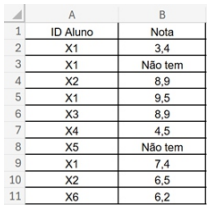
Ao se executar a fórmula: “=SE($B$4 >= 9; B4*2; B4)”, na célula C4, o resultado será 8,9. Então, ao copiar a fórmula da célula C4 para a célula C5, é CORRETO afirmar que o valor resultante na célula C5 será:
Ao se executar a fórmula: “=SE($B$4 >= 9; B4*2; B4)”, na célula C4, o resultado será 8,9. Então, ao copiar a fórmula da célula C4 para a célula C5, é CORRETO afirmar que o valor resultante na célula C5 será:
Ano: 2026
Banca:
CPCON
Órgão:
Prefeitura de Itabaiana - PB
Prova:
CPCON - 2026 - Prefeitura de Itabaiana - PB - Professor de Informática |
Q4100888
Noções de Informática
Considere a planilha a seguir, elaborada no Microsoft Excel em sua versão em português.
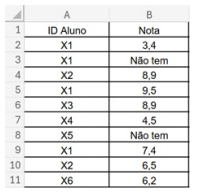
Ao se executar a fórmula: “=SOMASE(A2:A11; "X1"; B2:B11)”, na célula A12, é CORRETO afirmar que o resultado será:
Ao se executar a fórmula: “=SOMASE(A2:A11; "X1"; B2:B11)”, na célula A12, é CORRETO afirmar que o resultado será:
Ano: 2026
Banca:
CPCON
Órgão:
Prefeitura de Itabaiana - PB
Prova:
CPCON - 2026 - Prefeitura de Itabaiana - PB - Professor de Informática |
Q4100887
Noções de Informática
Ao preparar uma atividade no Microsoft Word, um professor precisou copiar partes de textos encontrados na Internet para enriquecer o conteúdo destinado aos alunos. Contudo, ao colar os trechos copiados no documento, percebeu que a formatação original da página, como tipo e tamanho de fonte, cores e espaçamentos, também era aplicada automaticamente ao documento, alterando o padrão visual da atividade.
Para solucionar essa situação, fazendo uso do recurso adequado para ser preservado o padrão de formatação já definido no documento da atividade, é CORRETO afirmar que o professor deve:
Ano: 2026
Banca:
CPCON
Órgão:
Prefeitura de Itabaiana - PB
Prova:
CPCON - 2026 - Prefeitura de Itabaiana - PB - Professor de Informática |
Q4100886
Pedagogia
Segundo Moran (2015, p. 18), as metodologias ativas constituem caminhos iniciais que conduzem a processos mais complexos de
reflexão, promovendo a integração cognitiva, a ampliação de conceitos e a reconstrução de práticas pedagógicas.
Fonte: MORAN, J. Mudando a educação com metodologias ativas. In: SOUZA, Carlos Alberto de; MORALES, Ofélia Elisa Torres (Orgs.). Convergências midiáticas, Educação e cdadania: aproximações jovens. Ponta Grossa: PROEX/UEPG, 2015 (Coleção Mídias Contemporâneas; v. 2). Em relação ao uso de metodologias ativas nas práticas pedagógicas aplicadas à informática, analise as assertivas a seguir.
I- Entre as diferentes estratégias de aprendizagem presentes nas Metodologias Ativas, destaca-se a Aprendizagem Baseada em Times, que pode ser aplicada com facilidade em aulas que envolvem atividades em grupo nos laboratórios de informática. Essa abordagem favorece o desenvolvimento do espírito de equipe, estimula a resolução colaborativa de desafios, promove a troca de conhecimentos entre os alunos e contribui para a construção do pensamento crítico por meio de debates e reflexões no grupo.
II- Ametodologia conhecida como gamificação consiste na utilização de jogos digitais como recurso pedagógico, e, assim, é capaz de promover experiências lúdicas e interativas para contribuir para o processo de aprendizagem.
III- O método da sala de aula invertida (Flipped Classroom) consiste na disponibilização do conteúdo teórico de forma prévia para que os alunos estudem por conta própria, geralmente por meio de vídeos, textos, tutoriais ou podcasts. O tempo em sala é utilizado para atividades práticas, resolução de problemas, projetos e esclarecimento de dúvidas.
IV- A Aprendizagem Baseada em Projetos (ABP) consiste na construção do conhecimento por meio do desenvolvimento de um projeto estruturado, que envolve investigação, planejamento e elaboração de um produto final. A problemática a ser investigada deve emergir das vivências e questionamentos dos próprios alunos, cabendo ao professor atuar como orientador e mediador ao longo do processo de aprendizagem.
É CORRETO o que se afirma em:
Fonte: MORAN, J. Mudando a educação com metodologias ativas. In: SOUZA, Carlos Alberto de; MORALES, Ofélia Elisa Torres (Orgs.). Convergências midiáticas, Educação e cdadania: aproximações jovens. Ponta Grossa: PROEX/UEPG, 2015 (Coleção Mídias Contemporâneas; v. 2). Em relação ao uso de metodologias ativas nas práticas pedagógicas aplicadas à informática, analise as assertivas a seguir.
I- Entre as diferentes estratégias de aprendizagem presentes nas Metodologias Ativas, destaca-se a Aprendizagem Baseada em Times, que pode ser aplicada com facilidade em aulas que envolvem atividades em grupo nos laboratórios de informática. Essa abordagem favorece o desenvolvimento do espírito de equipe, estimula a resolução colaborativa de desafios, promove a troca de conhecimentos entre os alunos e contribui para a construção do pensamento crítico por meio de debates e reflexões no grupo.
II- Ametodologia conhecida como gamificação consiste na utilização de jogos digitais como recurso pedagógico, e, assim, é capaz de promover experiências lúdicas e interativas para contribuir para o processo de aprendizagem.
III- O método da sala de aula invertida (Flipped Classroom) consiste na disponibilização do conteúdo teórico de forma prévia para que os alunos estudem por conta própria, geralmente por meio de vídeos, textos, tutoriais ou podcasts. O tempo em sala é utilizado para atividades práticas, resolução de problemas, projetos e esclarecimento de dúvidas.
IV- A Aprendizagem Baseada em Projetos (ABP) consiste na construção do conhecimento por meio do desenvolvimento de um projeto estruturado, que envolve investigação, planejamento e elaboração de um produto final. A problemática a ser investigada deve emergir das vivências e questionamentos dos próprios alunos, cabendo ao professor atuar como orientador e mediador ao longo do processo de aprendizagem.
É CORRETO o que se afirma em:
Ano: 2026
Banca:
CPCON
Órgão:
Prefeitura de Itabaiana - PB
Prova:
CPCON - 2026 - Prefeitura de Itabaiana - PB - Professor de Informática |
Q4100885
Noções de Informática
Um professor de Informática foi informado que sua escola passou a integrar tecnologias digitais ao cotidiano das aulas. Ao saber da
notícia, para potencializar a aprendizagem de seus alunos, ele passou a organizar conteúdos e materiais em um ambiente virtual de
aprendizagem, realizar encontros síncronos tanto com suas turmas como com pequenos grupos para discutir dúvidas e orientar
projetos. Além disso, passou a aplicar estratégias baseadas em desafios, pontuações e recompensas na realização de atividades para
estimular o engajamento dos alunos e utilizar uma ferramenta específica para distribuir atividades práticas, propor situaçõesproblema, enviar feedbacksindividualizados e acompanhar o progresso do desenvolvimento das soluções.
Considerando esse contexto, é CORRETO afirmar que a indicação da ferramenta digital mais adequada para cada necessidade do professor de informática consiste em:
Considerando esse contexto, é CORRETO afirmar que a indicação da ferramenta digital mais adequada para cada necessidade do professor de informática consiste em:
Ano: 2026
Banca:
CPCON
Órgão:
Prefeitura de Itabaiana - PB
Prova:
CPCON - 2026 - Prefeitura de Itabaiana - PB - Professor de Informática |
Q4100884
Redes de Computadores
A Internet é uma infraestrutura de comunicação global que interconecta milhões de dispositivos de computação por meio de protocolos
padronizados e permite a transmissão e o compartilhamento de dados em escala mundial. Refere-se a uma rede descentralizada que
oferece uma ampla gama de serviços, como e-mail, transferência de arquivos, videoconferência, processamento e armazenamento de
dados na nuvem, e acesso a bilhões de páginas organizadas em websites, por meio de múltiplos domínios do conhecimento. Além de
possibilitar a disseminação de informações, a Internet desempenha um papel significativo no desenvolvimento científico, educacional,
econômico e social, por meio da comunicação facilitada entre indivíduos, organizações e sistemas que ela promove, em tempo real.
Em relação aos conceitos básicos de internet, analise as assertivas a seguir.
I- URL (Uniform Resource Locator) é um protocolo de comunicação utilizado para a transferência de informações na Web. Ele estabelece as regras que permitem que um navegador (cliente) requisite recursos web, como páginas, imagens ou arquivos, a um servidor, e que este, por sua vez, envie as respostas correspondentes. Já HTML (HyperText Markup Language) é uma linguagem de marcação responsável por estruturar e organizar o conteúdo das páginas, definindo como as informações devem ser apresentadas no ambiente web.
II- HTTP (HyperText Transfer Protocol) é o protocolo responsável por identificar a localização de um recurso web na Internet e indicar como ele deve ser acessado, podendo o acesso ao recurso ser realizado de forma segura (com criptografia) ou normalmente.
III- Os cookies são pequenos arquivos de texto armazenados no navegador do usuário, criados a partir do acesso a uma página web. Eles guardam informações relacionadas à navegação do usuário, como preferências, identificadores de sessão e dados de autenticação, e, assim, permitem que o servidor identifique o usuário em tentativas de acesso posteriores e personalize a experiência do usuário de acordo com seu padrão de acesso.
IV- A World Wide Web (WWW) é um sistema de hipermídia que atua sobre a infraestrutura da Internet e promove a integração de várias mídias, como textos, imagens, sons e vídeos, interligadas por sistemas eletrônicos de comunicação por meio de hiperlinks. Esses recursos são acessados por meio de navegadores e transferidos por meio de protocolos como o HTTPou o HTTPS.
É CORRETO o que se afirma apenas em:
Em relação aos conceitos básicos de internet, analise as assertivas a seguir.
I- URL (Uniform Resource Locator) é um protocolo de comunicação utilizado para a transferência de informações na Web. Ele estabelece as regras que permitem que um navegador (cliente) requisite recursos web, como páginas, imagens ou arquivos, a um servidor, e que este, por sua vez, envie as respostas correspondentes. Já HTML (HyperText Markup Language) é uma linguagem de marcação responsável por estruturar e organizar o conteúdo das páginas, definindo como as informações devem ser apresentadas no ambiente web.
II- HTTP (HyperText Transfer Protocol) é o protocolo responsável por identificar a localização de um recurso web na Internet e indicar como ele deve ser acessado, podendo o acesso ao recurso ser realizado de forma segura (com criptografia) ou normalmente.
III- Os cookies são pequenos arquivos de texto armazenados no navegador do usuário, criados a partir do acesso a uma página web. Eles guardam informações relacionadas à navegação do usuário, como preferências, identificadores de sessão e dados de autenticação, e, assim, permitem que o servidor identifique o usuário em tentativas de acesso posteriores e personalize a experiência do usuário de acordo com seu padrão de acesso.
IV- A World Wide Web (WWW) é um sistema de hipermídia que atua sobre a infraestrutura da Internet e promove a integração de várias mídias, como textos, imagens, sons e vídeos, interligadas por sistemas eletrônicos de comunicação por meio de hiperlinks. Esses recursos são acessados por meio de navegadores e transferidos por meio de protocolos como o HTTPou o HTTPS.
É CORRETO o que se afirma apenas em:
Ano: 2026
Banca:
CPCON
Órgão:
Prefeitura de Itabaiana - PB
Prova:
CPCON - 2026 - Prefeitura de Itabaiana - PB - Professor de Informática |
Q4100883
Noções de Informática
Em dezembro de 2023, o Congresso Nacional aprovou a inclusão de competências digitais, como programação e robótica, na Lei de
Diretrizes e Bases da Educação (LDB). A medida determina que o ensino de robótica componha a grade curricular dos ensinos
fundamental e médio, fortalecendo o respaldo legal para iniciativas de tecnologia educacional. Entretanto, a implementação efetiva
ainda enfrenta obstáculos de infraestrutura e formação docente. Documentos do Conselho Nacional de Secretários de Educação
(Consed) apontam que as escolas necessitam de adequações e profissionais qualificados para aplicar os pontos da BNCC que
demandam tecnologias. Além do manuseio de ferramentas, os educadores precisam estar preparados para orientar o pensamento
crítico dos alunos frente ao avanço de tecnologias como a inteligência artificial generativa.
ANDRION, Roseli. Robô transforma aulas de matemática em brincadeira. Pesquisa para Inovação – FAPESP, 27 jan. 2026. Disponível em: https://pesquisaparainovacao.fapesp.br/robo_transforma_aulas_de_matematica_em_brincadeira/3908. Acesso em: 18 fev. 2026.
Diante da perspectiva de, em breve, haver inclusão de aulas de programação no Ensino Fundamental, um professor de informática está organizando uma atividade para seus alunos que aborde a trajetória histórica das linguagens de programação e seus reflexos socioculturais, objetivando promover a construção do conhecimento de maneira reflexiva, crítica e colaborativa. Assim, para alcançar este objetivo, é CORRETO afirmar que o professor deve solicitar aos estudantes para:
ANDRION, Roseli. Robô transforma aulas de matemática em brincadeira. Pesquisa para Inovação – FAPESP, 27 jan. 2026. Disponível em: https://pesquisaparainovacao.fapesp.br/robo_transforma_aulas_de_matematica_em_brincadeira/3908. Acesso em: 18 fev. 2026.
Diante da perspectiva de, em breve, haver inclusão de aulas de programação no Ensino Fundamental, um professor de informática está organizando uma atividade para seus alunos que aborde a trajetória histórica das linguagens de programação e seus reflexos socioculturais, objetivando promover a construção do conhecimento de maneira reflexiva, crítica e colaborativa. Assim, para alcançar este objetivo, é CORRETO afirmar que o professor deve solicitar aos estudantes para:
Ano: 2026
Banca:
CPCON
Órgão:
Prefeitura de Itabaiana - PB
Prova:
CPCON - 2026 - Prefeitura de Itabaiana - PB - Professor de Informática |
Q4100882
Pedagogia
São unidades digitais estruturadas e reutilizáveis, desenvolvidas com finalidade pedagógica, que podem ser integradas a diferentes
contextos educacionais para apoiar o processo de ensino-aprendizagem. Podem assumir diversas formas: textos, vídeos, animações,
simulações e atividades interativas. São concebidos de forma modular, permitindo sua adaptação e reaproveitamento em modalidades
distintas, seja no ensino presencial, híbrido ou à distância. Portanto, é CORRETO afirmar que a descrição apresentada corresponde ao
conceito de:
Ano: 2026
Banca:
CPCON
Órgão:
Prefeitura de Itabaiana - PB
Prova:
CPCON - 2026 - Prefeitura de Itabaiana - PB - Professor de Informática |
Q4100881
Pedagogia
Os modelos tradicionais de ensino, centrados na transmissão de conteúdo pelo professor, eram adequados em um contexto em que o
acesso à informação era limitado. Entretanto, com a expansão da Internet, das técnicas computacionais inteligentes e da ampla
disponibilização de cursos e materiais, tornou-se possível aprender em qualquer momento e lugar, com pessoas de diferentes partes do
mundo. Atualmente, a tecnologia promove a integração entre espaços e tempos, fazendo com que o processo de ensinar e aprender
ocorra de forma contínua e interdependente entre o ambiente físico e o digital. Não se trata mais de dois contextos separados, mas de
um único espaço ampliado, híbrido e interconectado, ou seja, uma sala de aula expandida, viabilizada pelas tecnologias educacionais
digitais. Portanto, é CORRETO afirmar que:

 Conheça nossos planos