Questões de Concurso
Para prefeitura de leopoldina - mg
Foram encontradas 308 questões
Resolva questões gratuitamente!
Junte-se a mais de 4 milhões de concurseiros!


“Há justificativas plausíveis para o impeachment da presidente da República, Dilma Rousseff, do PT? Há divergências entre juristas. Uns, como Ives Gandra da Silva Martins professor emérito da Universidade Mackenzie, avaliam que sim. Chegou a produzir, sob encomenda, um parecer a respeito. Outros sugerem que não. A petista-chefe é corrupta? Está de fato comprovado que seu governo, o todo, é venal? Até agora, não há indícios de que a presidente está envolvida em algum ilícito. Não há provas também de que seu governo é inteiramente corrupto. Porém, mesmo não estando envolvida, pode ser apontada como ‘culpada’ por ser a gestora? Pode um governo ser corrupto, mas não a presidente? É um paradoxo que nem juristas gabaritados estão dando conta de explicar. Num artigo publicado na ‘Folha de S. Paulo’, Ives Gandra garante que, ‘à luz de um raciocínio exclusivamente jurídico, há fundamentação para o pedido de impeachment da presidente Dilma Rousseff’. Ao examinar a Constituição Federal – o Artigo 85, inciso 5º, o Artigo 37, parágrafo 6º, e o parágrafo 4º do Artigo 37 –, o Artigo 9º, inciso 3º, da Lei do Impeachment, e os Artigos 138, 139 e 142 das Lei das SAs, Ives Gandra concluiu que a possibilidade de se pedir o impeachment, com base legal, não é ilegítima.”
(Disponível em: http://www.jornalopcao.com.br/editorial/presidente-dilma-rousseff-pode-sofrer-impeachment-28020/.)
Em relação ao processo de Impeachment da Presidente Dilma Lana Rousseff, analise as afirmativas a seguir.
I. Com a votação realizada pelo Congresso, o processo de Impeachment está praticamente definido, restando ao Senado apenas validar o resultado anterior.
II. A partir da finalização do processo, convocam-se imediatamente novas eleições que devem ocorrer num prazo máximo de 180 dias.
III. A conclusão do processo, para que se torne realmente democrático, exige uma participação mais direta da população, através de um plebiscito compulsório.
IV. Para o Impeachment no Brasil, desde a Constituição de 1891, existe lei que define os crimes de responsabilidade, disciplina a acusação e estabelece o processo e o julgamento.
Está(ão) correta(s) apenas a(s) afirmativa(s)
Ato Institucional nº 3 à Nação
CONSIDERANDO que o Poder Constituinte da Revolução lhe é intrínseco, não apenas para institucionalizá-la, mas para assegurar a continuidade da obra a que se propôs, conforme expresso no Ato Institucional nº 2;
CONSIDERANDO ser imperiosa a adoção de medidas que não permitam se frustrem os superiores objetivos da Revolução;
CONSIDERANDO a necessidade de preservar a tranquilidade e a harmonia política e social do País;
CONSIDERANDO que a edição do Ato Institucional nº 2 estabeleceu eleições indiretas para Presidente e Vice-Presidente da República;
CONSIDERANDO que é imprescindível que se estenda à eleição dos Governadores e Vice-Governo de Estado o processo instituído para a eleição do Presidente e do Vice-Presidente da República; [...]
(Disponível em: http://legis.senado.gov.br/legislacao/ListaPublicacoes.action?id=189347.)
Sobre os atos institucionais, analise as afirmativas a seguir.
I. Foram instrumentos jurídicos que permitiram ao governo legalizar suas ações arbitrárias.
II. São resultado da Doutrina de Segurança Nacional implementada pelos militares na Ditadura. (1964-1985).
III. Com os atos institucionais os militares conseguiram não só angariar a simpatia e apoio da população, como também impedir as guerrilhas urbanas.
IV. Numa primeira instância, são os responsáveis pela manutenção da paz e da satisfação popular durante o período militar.
Está(ão) correta(s) apenas a(s) afirmativa(s)
“Até a descoberta dos metais preciosos a colonização foi marcada pela grande propriedade onde se cultivava predominantemente um gênero destinado à exportação com base no trabalho escravo. A afirmativa de que a Plantation foi a forma básica da colonização foi criticada por alguns historiadores que o projeto ‘plantacionista’ era assumido pela classe dominante colonial, mas a Coroa sempre se preocupou em diversificar a produção e garantir o plantio de gêneros alimentícios para o consumo da própria colônia. Houve uma excessiva redução da estrutura social a senhores e escravos esquecendo-se a importância dos brancos e ignorando-se a existência de um campesinato – pequenos proprietários. Além disso, o negócio da escravidão resultou na cumulação urbana propiciado por capitais investidos no tráfico de escravos. Esse grupo de traficantes não se especializava apenas no comércio de homens, dedicando-se também aos investimentos em prédios urbanos, à usura e às operações de importação e exportação.”
(Fausto, 2002.)
Dentre as marcas deixadas pela grande empresa monocultora que caracterizou o Brasil no período colonial podemos destacar:
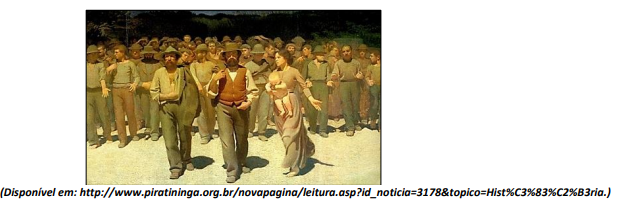
Texto:
“Quarto Stato é uma obra do pintor italiano Pelizza da Volpedo, que foi exposta pela primeira vez em 1902, na Mostra Quadrienal de Turim (Itália). O quadro foi preparado para estar pronto para uma exposição em Paris, em 1900, ou em Veneza, em 1901. Mas não deu. Também foi frustrada sua expectativa de que esse quadro fosse premiado. Na exposição de Turim não teve maiores sucessos. O quadro reflete as posições políticas do autor. Aos 22 anos, Pelizza se aproximou das ideias socialistas muito difusas entre os trabalhadores da cidade e do campo da Itália daquela época e sua visão de mundo se expressa neste quadro síntese da sua vida político-artística. O nome se referia à história europeia e especificamente à Revolução Francesa. Nesta revolução vitoriosa, a burguesia derrubou o domínio do Primeiro e do Segundo Estado, respectivamente a nobreza e o clero, e instaurou o domínio da nova classe ascendente, a burguesia, o Terceiro Estado.”
(Disponível em: http://www.piratininga.org.br/novapagina/leitura.asp?id_noticia=3178&topico=Hist%C3%83%C2%B3ria.)
A imagem e o texto relacionam-se à caminhada dos trabalhadores europeus em busca de liberdade e condições
dignas de vida. No Brasil, especificamente no período Varguista, a situação dos trabalhadores

“[...] Assim, dentro de um espírito antropológico, proponho a seguinte definição de nação: uma comunidade política imaginada e imaginada como sendo intrinsecamente limitada e, ao mesmo tempo, soberana. Ela é imaginada porque mesmo os membros da mais minúscula das nações jamais conhecerão, encontrarão, ou sequer ouvirão falar da maioria de seus companheiros, embora todos tenham em mente a imagem viva da comunhão entre eles. [...] Na verdade, qualquer comunidade maior que a aldeia primordial do contato face a face (e talvez mesmo ela) é imaginada. [...] Imagina-se a nação limitada porque mesmo a maior delas, que agregue, digamos, um bilhão de habitantes, possui fronteiras finitas, ainda que elásticas, para além das quais existem outras nações. Nenhuma delas imagina ter a mesma extensão da humanidade. Nem os nacionalistas mais messiânicos sonham com o dia em que todos os membros da espécie humana se unirão à sua nação.”
(Anderson, Bendict. 2008, p. 33-34 e disponível em: https://www.&rct=j&q=&esrc=s&source=images&cd=&cad=rja& brasileiro%2F&bvm=bv.1205515q9AA&ust=1461797448587161.)
A partir do conceito e origem do nacionalismo e suas configurações ao longo da história, é correto afirmar que:
Trecho I
“Nesse regime, [...] a verdadeira força política, que no apertado unitarismo do império residia no poder real, deslocou-se para os estados. A política dos Estados, isso é, a política que fortifica os vínculos da harmonia entre os Estados e a União é, pois, na sua essência, a política nacional.”
(SALES, Mensagem de 3 de maio de 1902. In: Manifestos e Mensagens. São Paulo: Fundap\Imprensa Oficial, 2007. p. 202.)
Trecho II
“O poder unitarista do Império deu bons resultados enquanto a Província do Rio de Janeiro foi o polo mais dinâmico da economia nacional. Na medida em que a cafeicultura perdeu força no Rio, principalmente devido à exaustão dos solos, e começa a florescer no centro-oeste do país, muitas mudanças ocorrem. Em alguns casos, atinge-se o extremo do separatismo, como nas posições defendidas pelo advogado Alberto Sales, 32 anos, um dos donos de A Província de São Paulo, que no ano passado publicou A Pátria Paulista. No livro, o irmão de Campos Sales, o novo ministro da Justiça, informa que a província paulista tem uma renda anual de 25.000 contos de réis, e mais de 20.000 contos de réis vão para o governo central. ‘Salta aos olhos que o separatismo só poderá ser extremamente vantajoso para os paulistas’, diz Alberto Sales. Como o Império remanchou em atender aos interesses provinciais, a autonomia estadual transformou-se numa reivindicação por excelência.”
(Disponível em: http://veja.abril.com.br/historia/republica/queda-imperio-velha.)
Os trechos anteriormente relacionados referem-se especificamente ao embate entre:
Trecho da carta de Américo Vespúcio.
“[...] Esta terra é muito amena; cheia de inúmeras árvores verdes, e muito grandes, e nunca perdem folha, e todas têm odores suavíssimos, e aromáticos, e produzem inúmeras frutas, e muitas delas boas ao gosto e saudáveis ao Corpo, e os campos produzem muita erva, flores, raízes muito suaves e boas, que umas vezes me maravilhava do odor suave das ervas, e das flores, e do sabor dessas frutas, e raízes, tanto que em mim pensava estar perto do Paraíso terrestre [...]”
(Vespúcio apud Bueno, 2003, p. 15.)
No contexto das grandes navegações e do descobrimento de terras no continente americano, Américo Vespúcio, cosmógrafo e comerciante italiano:
A cultura iorubá no Brasil
Durante os séculos XVI e XIX, a mão de obra no Brasil era composta basicamente de africanos escravizados. Nesse longo período, a sociedade brasileira foi bastante influenciada por africanos, que em grande parte vinham de Angola e Moçambique. Vinham também precedentes da Costa da Mina, atual Nigéria, Gana, Togo e Benim. Entre os grupos que fixaram no Recôncavo baiano, os que mais influenciaram nos costumes dos brasileiros.
(Napolitano, 2013, p. 215.)
Acerca da presença dos iorubás e de outras tribos africanas no contexto do Brasil colonial, analise as afirmativas a seguir, marque V para as verdadeiras e F para as falsas.
( ) Com o Descobrimento da América, a África passou a fazer parte da rota da escravidão, embora, anteriormente, essa prática não existisse em seu continente.
( ) Bantos, sudaneses, iorubás, entre outros povos africanos, praticavam a religião islâmica e, por isso, achavam correta a subserviência.
( ) O candomblé, manifestação religiosa em que as divindades simbolizam forças ancestrais ligadas aos elementos do mundo, foi introduzido no Brasil pelos iorubás.
( ) Para os africanos a arte tinha função religiosa e política servindo para encenar a relação do ser humano com a natureza, entre outras coisas.
A sequência está correta em
“Durante os séculos XV e XVII, a Europa passou por uma série de transformações políticas, intelectual, religiosa e geográfica. É neste cenário que nasce o mercantilismo: conjunto de ideias e práticas econômicas que perdurou durante três séculos em toda Europa. Para os mercantilistas, o ouro e a prata eram o mais perfeito instrumento de aquisição da riqueza. Ou em outras palavras, o ouro e a prata são para a nação, as formas eminentes da riqueza. Para acumular o máximo de ouro e prata, a Espanha, por exemplo, toma uma série de medidas controladoras, para impedir que o metal precioso saia do país. A concepção mercantilista se alarga: para aumentar o volume das exportações de objetos de luxo limita-se o seu consumo no mercado interno. Todavia, serem as importações de ouro e prata superiores às exportações, todo um sistema de regulamentação é elaborado: o estado regulamenta a produção, fiscaliza as exportações e controla as vendas no exterior. (Paul Hugon, 1969) A fiscalização das exportações também objetiva a saída de produtos de matérias-primas que possam ser úteis à defesa do país ou à condução da guerra.”
(Disponível em: http://www.webartigos.com/artigos/ideias-mercantilistas-e-a-teoria-do-comercio-internacional/20756/#ixzz46sZLPcn4.)
O trecho em questão destaca algumas das principais ideias da política mercantilista, a saber:

Tendo em vista a análise da imagem e considerando o contexto socioeconômico do período em questão, é correto
afirmar que:
Learning strategies are the particular approaches or techniques that learners employ to try to learn an L 2. There have been various attempts to discover which strategies are important for L 2 acquisition.
One example of a mental learning strategy employed in L 2 learning is
Refugee judokas searching for peace while fighting for their Olympic dream in Rio

More than two and a half years after they came to Rio de Janeiro to compete in the World Judo Championships, two refugees from the Democratic Republic of the Congo are still here, in pursuit of an extraordinary Olympic dream. When teams from more than 200 countries march into the Maracanã Stadium for the opening ceremony of the Rio 2016 Games on 5 August, Popole Misenga and Yolanda Mabika intend to be among them, walking behind the Olympic flag. The International Olympic Committee (IOC) will mount a unique team of refugee athletes which will compete in Rio. It has been a long journey from central Africa and from a war that has claimed an estimated 5.4 million lives. Mabika, now 28, cannot hold back the tears when she remembers the brothers and sisters she has not seen since 1998, when she was evacuated from her home town to the country’s capital, Kinshasa. It was there, as a child, that she first took up judo. Misenga’s mother was murdered when he was just six years old. The young child wandered for days in the Congolese rainforest before he too was rescued and taken to Kinshasa. Like his compatriot, he soon took to judo, a sport which the Congolese government saw as an ideal way of giving some structure to the lives of the country’s countless orphans. In 2010, Misenga won a bronze medal at the under-20 African Judo Championship. But Misenga and Mabika said training conditions were excessively rigorous, with losing judokas beaten and locked in cells. At the 2013 World Judo Championship, Misenga took the opportunity to begin a better life. After escaping from the team hotel, a couple of days later Misenga found himself in the favela community of Cinco Bocas in northern Rio, home to most of the city’s Congolese community of some 900 people. He sent Mabika a message and she also decided to stay. Life in northern Rio has not always been easy for the judokas. It has been a story of odd jobs and informal employment.The two athletes are now training three times a week at the Instituto Reação. The learning curve has been steep. Geraldo Bernardes, the veteran coach of the Brazilian team in four Olympic Games, says that Misenga and Mabika were initially far too aggressive in training. “They were used to being punished and mistreated when they lost,” Geraldo explains. “I had to tell them that training and fighting are different things.”
Misenga told rio2016.com that he had adjusted to his new surrounds: “I have learnt a lot on the technical side. I can feel in my body that I have learnt what was missing before in my judo.” Their coach says the two judokas are rough diamonds and are still making up for the lost time in their training. Brazil has a strong tradition in the sport and both athletes are hoping that by refining their skills in the country they will make the cut when the IOC decides which athletes (from a shortlist of 43) will form part of Team Refugee in June. In the meantime, both Misenga and Mabika are enjoying their new lives in Rio. The Instituto Reação and the local Estácio de Sá university have given them the opportunity to learn Portuguese, maths and other subjects. Neither of the two judokas has any plan to leave the new home town that has given them so much.
(Available in: http://www.rio2016.com. Adapted.)
Refugee judokas searching for peace while fighting for their Olympic dream in Rio
More than two and a half years after they came to Rio de Janeiro to compete in the World Judo Championships, two refugees from the Democratic Republic of the Congo are still here, in pursuit of an extraordinary Olympic dream. When teams from more than 200 countries march into the Maracanã Stadium for the opening ceremony of the Rio 2016 Games on 5 August, Popole Misenga and Yolanda Mabika intend to be among them, walking behind the Olympic flag. The International Olympic Committee (IOC) will mount a unique team of refugee athletes which will compete in Rio. It has been a long journey from central Africa and from a war that has claimed an estimated 5.4 million lives. Mabika, now 28, cannot hold back the tears when she remembers the brothers and sisters she has not seen since 1998, when she was evacuated from her home town to the country’s capital, Kinshasa. It was there, as a child, that she first took up judo. Misenga’s mother was murdered when he was just six years old. The young child wandered for days in the Congolese rainforest before he too was rescued and taken to Kinshasa. Like his compatriot, he soon took to judo, a sport which the Congolese government saw as an ideal way of giving some structure to the lives of the country’s countless orphans. In 2010, Misenga won a bronze medal at the under-20 African Judo Championship. But Misenga and Mabika said training conditions were excessively rigorous, with losing judokas beaten and locked in cells. At the 2013 World Judo Championship, Misenga took the opportunity to begin a better life. After escaping from the team hotel, a couple of days later Misenga found himself in the favela community of Cinco Bocas in northern Rio, home to most of the city’s Congolese community of some 900 people. He sent Mabika a message and she also decided to stay. Life in northern Rio has not always been easy for the judokas. It has been a story of odd jobs and informal employment.The two athletes are now training three times a week at the Instituto Reação. The learning curve has been steep. Geraldo Bernardes, the veteran coach of the Brazilian team in four Olympic Games, says that Misenga and Mabika were initially far too aggressive in training. “They were used to being punished and mistreated when they lost,” Geraldo explains. “I had to tell them that training and fighting are different things.”
Misenga told rio2016.com that he had adjusted to his new surrounds: “I have learnt a lot on the technical side. I can feel in my body that I have learnt what was missing before in my judo.” Their coach says the two judokas are rough diamonds and are still making up for the lost time in their training. Brazil has a strong tradition in the sport and both athletes are hoping that by refining their skills in the country they will make the cut when the IOC decides which athletes (from a shortlist of 43) will form part of Team Refugee in June. In the meantime, both Misenga and Mabika are enjoying their new lives in Rio. The Instituto Reação and the local Estácio de Sá university have given them the opportunity to learn Portuguese, maths and other subjects. Neither of the two judokas has any plan to leave the new home town that has given them so much.
(Available in: http://www.rio2016.com. Adapted.)
Refugee judokas searching for peace while fighting for their Olympic dream in Rio
More than two and a half years after they came to Rio de Janeiro to compete in the World Judo Championships, two refugees from the Democratic Republic of the Congo are still here, in pursuit of an extraordinary Olympic dream. When teams from more than 200 countries march into the Maracanã Stadium for the opening ceremony of the Rio 2016 Games on 5 August, Popole Misenga and Yolanda Mabika intend to be among them, walking behind the Olympic flag. The International Olympic Committee (IOC) will mount a unique team of refugee athletes which will compete in Rio. It has been a long journey from central Africa and from a war that has claimed an estimated 5.4 million lives. Mabika, now 28, cannot hold back the tears when she remembers the brothers and sisters she has not seen since 1998, when she was evacuated from her home town to the country’s capital, Kinshasa. It was there, as a child, that she first took up judo. Misenga’s mother was murdered when he was just six years old. The young child wandered for days in the Congolese rainforest before he too was rescued and taken to Kinshasa. Like his compatriot, he soon took to judo, a sport which the Congolese government saw as an ideal way of giving some structure to the lives of the country’s countless orphans. In 2010, Misenga won a bronze medal at the under-20 African Judo Championship. But Misenga and Mabika said training conditions were excessively rigorous, with losing judokas beaten and locked in cells. At the 2013 World Judo Championship, Misenga took the opportunity to begin a better life. After escaping from the team hotel, a couple of days later Misenga found himself in the favela community of Cinco Bocas in northern Rio, home to most of the city’s Congolese community of some 900 people. He sent Mabika a message and she also decided to stay. Life in northern Rio has not always been easy for the judokas. It has been a story of odd jobs and informal employment.The two athletes are now training three times a week at the Instituto Reação. The learning curve has been steep. Geraldo Bernardes, the veteran coach of the Brazilian team in four Olympic Games, says that Misenga and Mabika were initially far too aggressive in training. “They were used to being punished and mistreated when they lost,” Geraldo explains. “I had to tell them that training and fighting are different things.”
Misenga told rio2016.com that he had adjusted to his new surrounds: “I have learnt a lot on the technical side. I can feel in my body that I have learnt what was missing before in my judo.” Their coach says the two judokas are rough diamonds and are still making up for the lost time in their training. Brazil has a strong tradition in the sport and both athletes are hoping that by refining their skills in the country they will make the cut when the IOC decides which athletes (from a shortlist of 43) will form part of Team Refugee in June. In the meantime, both Misenga and Mabika are enjoying their new lives in Rio. The Instituto Reação and the local Estácio de Sá university have given them the opportunity to learn Portuguese, maths and other subjects. Neither of the two judokas has any plan to leave the new home town that has given them so much.
(Available in: http://www.rio2016.com. Adapted.)
Refugee judokas searching for peace while fighting for their Olympic dream in Rio
More than two and a half years after they came to Rio de Janeiro to compete in the World Judo Championships, two refugees from the Democratic Republic of the Congo are still here, in pursuit of an extraordinary Olympic dream. When teams from more than 200 countries march into the Maracanã Stadium for the opening ceremony of the Rio 2016 Games on 5 August, Popole Misenga and Yolanda Mabika intend to be among them, walking behind the Olympic flag. The International Olympic Committee (IOC) will mount a unique team of refugee athletes which will compete in Rio. It has been a long journey from central Africa and from a war that has claimed an estimated 5.4 million lives. Mabika, now 28, cannot hold back the tears when she remembers the brothers and sisters she has not seen since 1998, when she was evacuated from her home town to the country’s capital, Kinshasa. It was there, as a child, that she first took up judo. Misenga’s mother was murdered when he was just six years old. The young child wandered for days in the Congolese rainforest before he too was rescued and taken to Kinshasa. Like his compatriot, he soon took to judo, a sport which the Congolese government saw as an ideal way of giving some structure to the lives of the country’s countless orphans. In 2010, Misenga won a bronze medal at the under-20 African Judo Championship. But Misenga and Mabika said training conditions were excessively rigorous, with losing judokas beaten and locked in cells. At the 2013 World Judo Championship, Misenga took the opportunity to begin a better life. After escaping from the team hotel, a couple of days later Misenga found himself in the favela community of Cinco Bocas in northern Rio, home to most of the city’s Congolese community of some 900 people. He sent Mabika a message and she also decided to stay. Life in northern Rio has not always been easy for the judokas. It has been a story of odd jobs and informal employment.The two athletes are now training three times a week at the Instituto Reação. The learning curve has been steep. Geraldo Bernardes, the veteran coach of the Brazilian team in four Olympic Games, says that Misenga and Mabika were initially far too aggressive in training. “They were used to being punished and mistreated when they lost,” Geraldo explains. “I had to tell them that training and fighting are different things.”
Misenga told rio2016.com that he had adjusted to his new surrounds: “I have learnt a lot on the technical side. I can feel in my body that I have learnt what was missing before in my judo.” Their coach says the two judokas are rough diamonds and are still making up for the lost time in their training. Brazil has a strong tradition in the sport and both athletes are hoping that by refining their skills in the country they will make the cut when the IOC decides which athletes (from a shortlist of 43) will form part of Team Refugee in June. In the meantime, both Misenga and Mabika are enjoying their new lives in Rio. The Instituto Reação and the local Estácio de Sá university have given them the opportunity to learn Portuguese, maths and other subjects. Neither of the two judokas has any plan to leave the new home town that has given them so much.
(Available in: http://www.rio2016.com. Adapted.)
Analyse the sentence to answer 6.
Douglas had to apologize _________ little Jim’s mom _________ having played those pranks ______ her.
Choose the sequence to complete the blanks.
Analyse the sentence.

The item that contains an inconsistency and its corresponding correction is:

 Conheça nossos planos