Questões de Concurso
Para fundação osório - rj
Foram encontradas 300 questões
Resolva questões gratuitamente!
Junte-se a mais de 4 milhões de concurseiros!


In a Brazilian high school English classroom, a teacher decides to move away from using text as a pretext for teaching grammar and instead adopts a genre-based approach to teach students how to write research abstracts or digital social media profiles.
The pedagogical strategy that adequately applies this approach is
A high school English teacher in a public school in Salvador, Bahia, decides to integrate Artificial Intelligence (AI) into a project about “Local Heroes:” Students use free AI tools to generate draft biographies and then transform that data into multimodal outputs, such as short videos and social media posts. However, the teacher notices that the AI-generated images for “heroes” consistently depict individuals who do not reflect the diverse Afro-Brazilian population of their community.
Considering that situation, the pedagogical action that best aligns with the ideas discussed in Text I and the concepts of multiliteracies and critical literacy is:
Text I
African schools gear up for the AI revolution
The emergence of cheap or free AI tools is being eagerly embraced by those with smartphones and the ability to get online. As governments and legislators struggle to get their heads around the implications of this powerful technology and work out how to bring in regulations for its safe use, millions of people are enjoying its ability to save time, helping them to transforming raw data into essays, exam answers, or, with a bit more work, even videos and podcasts.
Even in developing countries where electricity and internet access is limited (it’s estimated that over 570 million people in Africa lack electricity), there is enthusiasm for the potential of AI. In the Democratic Republic of the Congo (DRC), for example, a nation riven by internal conflict, poverty and vast inequality, educators are seeing the impact of AI. “It is obvious that our country is lagging behind in terms of new technologies for one reason or another,” says Benjamin Sivanzire, a teacher in Beni, North Kivu Province. “Many parts of the DRC do not even have traditional methods of communication, or even radio or television.” However, even though Mr. Sivanzire and his students are not yet able to make use of AI in their classes, they are seeing it being used in the wider culture, often in a negative way, to manipulate public opinion. The teacher underlines the importance of educating people to distinguish between verifiable information and lies. “There are videos created by artificial intelligence that show images that are not real and have been created for propaganda purposes,” he explains.
One concern that is frequently raised is the extent to which the development of AI tools is concentrated in the hands of a relatively small group of people. Farida Shahid, the independent Special Rapporteur on the right to education, shares these concerns. “AI algorithms are being made by individuals who often sit in a particular location, such as Silicon Valley, where the people who make and test them have their own biases,” she says. “Often the algorithms don’t do well at recognizing people with dark skin. They also have great problems with people who are autistic and don’t like looking into cameras. “Another example is the UK where, recently, an AI program was used to grade exam papers. This led to decisions that were biased against people from certain ethnic backgrounds. We really need to look at this issue more closely, starting with the human rights perspective, and I think that’s where the U.N. role comes in: if you increasingly rely on AI as the source of verification, you’re going to have problems because you are using a framework which privileges white males, and doesn’t reflect the whole gamut of people’s lives and experiences”.
The urgent need to expand the developer talent base has been identified by the UN as central to ensuring that a wide variety of voices are heard in the “EdTech” (educational technology) space. Shafika Isaacs, the head of technology and AI at the UN agency for science, technology and education (UNESCO), says that the number of African EdTech startups has been mushrooming in recent years, with entrepreneurs experimenting with the AIenabled digital tools which could support learning and teaching across many different contexts, including in African languages, and local dialects. “I’ve personally engaged with a startup that matches high school students to career pathways, including choosing the right university, community college or even entrepreneurship program. They have seen strong results because of their focus on children in underprivileged contexts and schools. Tech startups have also looked at developing AI-enabled mobile apps, including chat bots, that can support teachers in teaching literacy or teaching mathematics. “The challenge is that there’s often a disconnect between the public education system and tech startups. We need educators to be proactive in engaging with those developing tools, and we encourage students and teachers to learn how to create and design technologies that are relevant to their linguistic and cultural contexts.”
Many African governments are keen to adopt national AI strategies and integrate AI into their national policies on technologies in education. In Côte d’Ivoire, where AI is already being widely used in the private sector, Mariatou Koné, the Minister of Education, says that the country’s education system is undergoing a transformation, following a 2022 review which recommended a digitalization strategy. “We have put in place initiatives to ensure that everyone is aware of the issue of AI. It can provide individual learning programs, and help struggling students to improve,” said Ms. Koné. “However, we are worried about potential abuses. We have to be able to protect personal data and ensure that learners are aware of the potential dangers.” The Minister agrees that, in order to guard against bias, the pool of engineers building AI tools needs to be expanded. “We need the right tools, adapted to the African context, to the Ivorian context. We have our own history, our own heritage. If we create our own industry, it has to be adapted to the realities of Côte d’Ivoire.”
Available at: https://news.un.org/en/story/2025/01/1159621. Retrieved on: January 6, 2026. Adapted.
An idiom is an expression whose meaning cannot be understood simply by looking at its individual words.
Considering the excerpt from Text I, paragraph 1, “As governments and legislators struggle to get their heads around the implications of this powerful technology”, the correct meaning of the idiomatic phrase get their heads around in the context of the article is
Text I
African schools gear up for the AI revolution
The emergence of cheap or free AI tools is being eagerly embraced by those with smartphones and the ability to get online. As governments and legislators struggle to get their heads around the implications of this powerful technology and work out how to bring in regulations for its safe use, millions of people are enjoying its ability to save time, helping them to transforming raw data into essays, exam answers, or, with a bit more work, even videos and podcasts.
Even in developing countries where electricity and internet access is limited (it’s estimated that over 570 million people in Africa lack electricity), there is enthusiasm for the potential of AI. In the Democratic Republic of the Congo (DRC), for example, a nation riven by internal conflict, poverty and vast inequality, educators are seeing the impact of AI. “It is obvious that our country is lagging behind in terms of new technologies for one reason or another,” says Benjamin Sivanzire, a teacher in Beni, North Kivu Province. “Many parts of the DRC do not even have traditional methods of communication, or even radio or television.” However, even though Mr. Sivanzire and his students are not yet able to make use of AI in their classes, they are seeing it being used in the wider culture, often in a negative way, to manipulate public opinion. The teacher underlines the importance of educating people to distinguish between verifiable information and lies. “There are videos created by artificial intelligence that show images that are not real and have been created for propaganda purposes,” he explains.
One concern that is frequently raised is the extent to which the development of AI tools is concentrated in the hands of a relatively small group of people. Farida Shahid, the independent Special Rapporteur on the right to education, shares these concerns. “AI algorithms are being made by individuals who often sit in a particular location, such as Silicon Valley, where the people who make and test them have their own biases,” she says. “Often the algorithms don’t do well at recognizing people with dark skin. They also have great problems with people who are autistic and don’t like looking into cameras. “Another example is the UK where, recently, an AI program was used to grade exam papers. This led to decisions that were biased against people from certain ethnic backgrounds. We really need to look at this issue more closely, starting with the human rights perspective, and I think that’s where the U.N. role comes in: if you increasingly rely on AI as the source of verification, you’re going to have problems because you are using a framework which privileges white males, and doesn’t reflect the whole gamut of people’s lives and experiences”.
The urgent need to expand the developer talent base has been identified by the UN as central to ensuring that a wide variety of voices are heard in the “EdTech” (educational technology) space. Shafika Isaacs, the head of technology and AI at the UN agency for science, technology and education (UNESCO), says that the number of African EdTech startups has been mushrooming in recent years, with entrepreneurs experimenting with the AIenabled digital tools which could support learning and teaching across many different contexts, including in African languages, and local dialects. “I’ve personally engaged with a startup that matches high school students to career pathways, including choosing the right university, community college or even entrepreneurship program. They have seen strong results because of their focus on children in underprivileged contexts and schools. Tech startups have also looked at developing AI-enabled mobile apps, including chat bots, that can support teachers in teaching literacy or teaching mathematics. “The challenge is that there’s often a disconnect between the public education system and tech startups. We need educators to be proactive in engaging with those developing tools, and we encourage students and teachers to learn how to create and design technologies that are relevant to their linguistic and cultural contexts.”
Many African governments are keen to adopt national AI strategies and integrate AI into their national policies on technologies in education. In Côte d’Ivoire, where AI is already being widely used in the private sector, Mariatou Koné, the Minister of Education, says that the country’s education system is undergoing a transformation, following a 2022 review which recommended a digitalization strategy. “We have put in place initiatives to ensure that everyone is aware of the issue of AI. It can provide individual learning programs, and help struggling students to improve,” said Ms. Koné. “However, we are worried about potential abuses. We have to be able to protect personal data and ensure that learners are aware of the potential dangers.” The Minister agrees that, in order to guard against bias, the pool of engineers building AI tools needs to be expanded. “We need the right tools, adapted to the African context, to the Ivorian context. We have our own history, our own heritage. If we create our own industry, it has to be adapted to the realities of Côte d’Ivoire.”
Available at: https://news.un.org/en/story/2025/01/1159621. Retrieved on: January 6, 2026. Adapted.
During English class, a Brazilian student is reading the first paragraph of Text I. She stops and tells the teacher, “I’m confused. The text says governments want to ‘work out’ how to ‘bring in’ regulations. I know ‘work’ is a job and ‘out’ is the opposite of ‘in’, but it doesn’t make any sense.”
In that situation, the accurate response from the teacher is
Text I
African schools gear up for the AI revolution
The emergence of cheap or free AI tools is being eagerly embraced by those with smartphones and the ability to get online. As governments and legislators struggle to get their heads around the implications of this powerful technology and work out how to bring in regulations for its safe use, millions of people are enjoying its ability to save time, helping them to transforming raw data into essays, exam answers, or, with a bit more work, even videos and podcasts.
Even in developing countries where electricity and internet access is limited (it’s estimated that over 570 million people in Africa lack electricity), there is enthusiasm for the potential of AI. In the Democratic Republic of the Congo (DRC), for example, a nation riven by internal conflict, poverty and vast inequality, educators are seeing the impact of AI. “It is obvious that our country is lagging behind in terms of new technologies for one reason or another,” says Benjamin Sivanzire, a teacher in Beni, North Kivu Province. “Many parts of the DRC do not even have traditional methods of communication, or even radio or television.” However, even though Mr. Sivanzire and his students are not yet able to make use of AI in their classes, they are seeing it being used in the wider culture, often in a negative way, to manipulate public opinion. The teacher underlines the importance of educating people to distinguish between verifiable information and lies. “There are videos created by artificial intelligence that show images that are not real and have been created for propaganda purposes,” he explains.
One concern that is frequently raised is the extent to which the development of AI tools is concentrated in the hands of a relatively small group of people. Farida Shahid, the independent Special Rapporteur on the right to education, shares these concerns. “AI algorithms are being made by individuals who often sit in a particular location, such as Silicon Valley, where the people who make and test them have their own biases,” she says. “Often the algorithms don’t do well at recognizing people with dark skin. They also have great problems with people who are autistic and don’t like looking into cameras. “Another example is the UK where, recently, an AI program was used to grade exam papers. This led to decisions that were biased against people from certain ethnic backgrounds. We really need to look at this issue more closely, starting with the human rights perspective, and I think that’s where the U.N. role comes in: if you increasingly rely on AI as the source of verification, you’re going to have problems because you are using a framework which privileges white males, and doesn’t reflect the whole gamut of people’s lives and experiences”.
The urgent need to expand the developer talent base has been identified by the UN as central to ensuring that a wide variety of voices are heard in the “EdTech” (educational technology) space. Shafika Isaacs, the head of technology and AI at the UN agency for science, technology and education (UNESCO), says that the number of African EdTech startups has been mushrooming in recent years, with entrepreneurs experimenting with the AIenabled digital tools which could support learning and teaching across many different contexts, including in African languages, and local dialects. “I’ve personally engaged with a startup that matches high school students to career pathways, including choosing the right university, community college or even entrepreneurship program. They have seen strong results because of their focus on children in underprivileged contexts and schools. Tech startups have also looked at developing AI-enabled mobile apps, including chat bots, that can support teachers in teaching literacy or teaching mathematics. “The challenge is that there’s often a disconnect between the public education system and tech startups. We need educators to be proactive in engaging with those developing tools, and we encourage students and teachers to learn how to create and design technologies that are relevant to their linguistic and cultural contexts.”
Many African governments are keen to adopt national AI strategies and integrate AI into their national policies on technologies in education. In Côte d’Ivoire, where AI is already being widely used in the private sector, Mariatou Koné, the Minister of Education, says that the country’s education system is undergoing a transformation, following a 2022 review which recommended a digitalization strategy. “We have put in place initiatives to ensure that everyone is aware of the issue of AI. It can provide individual learning programs, and help struggling students to improve,” said Ms. Koné. “However, we are worried about potential abuses. We have to be able to protect personal data and ensure that learners are aware of the potential dangers.” The Minister agrees that, in order to guard against bias, the pool of engineers building AI tools needs to be expanded. “We need the right tools, adapted to the African context, to the Ivorian context. We have our own history, our own heritage. If we create our own industry, it has to be adapted to the realities of Côte d’Ivoire.”
Available at: https://news.un.org/en/story/2025/01/1159621. Retrieved on: January 6, 2026. Adapted.
Text I
African schools gear up for the AI revolution
The emergence of cheap or free AI tools is being eagerly embraced by those with smartphones and the ability to get online. As governments and legislators struggle to get their heads around the implications of this powerful technology and work out how to bring in regulations for its safe use, millions of people are enjoying its ability to save time, helping them to transforming raw data into essays, exam answers, or, with a bit more work, even videos and podcasts.
Even in developing countries where electricity and internet access is limited (it’s estimated that over 570 million people in Africa lack electricity), there is enthusiasm for the potential of AI. In the Democratic Republic of the Congo (DRC), for example, a nation riven by internal conflict, poverty and vast inequality, educators are seeing the impact of AI. “It is obvious that our country is lagging behind in terms of new technologies for one reason or another,” says Benjamin Sivanzire, a teacher in Beni, North Kivu Province. “Many parts of the DRC do not even have traditional methods of communication, or even radio or television.” However, even though Mr. Sivanzire and his students are not yet able to make use of AI in their classes, they are seeing it being used in the wider culture, often in a negative way, to manipulate public opinion. The teacher underlines the importance of educating people to distinguish between verifiable information and lies. “There are videos created by artificial intelligence that show images that are not real and have been created for propaganda purposes,” he explains.
One concern that is frequently raised is the extent to which the development of AI tools is concentrated in the hands of a relatively small group of people. Farida Shahid, the independent Special Rapporteur on the right to education, shares these concerns. “AI algorithms are being made by individuals who often sit in a particular location, such as Silicon Valley, where the people who make and test them have their own biases,” she says. “Often the algorithms don’t do well at recognizing people with dark skin. They also have great problems with people who are autistic and don’t like looking into cameras. “Another example is the UK where, recently, an AI program was used to grade exam papers. This led to decisions that were biased against people from certain ethnic backgrounds. We really need to look at this issue more closely, starting with the human rights perspective, and I think that’s where the U.N. role comes in: if you increasingly rely on AI as the source of verification, you’re going to have problems because you are using a framework which privileges white males, and doesn’t reflect the whole gamut of people’s lives and experiences”.
The urgent need to expand the developer talent base has been identified by the UN as central to ensuring that a wide variety of voices are heard in the “EdTech” (educational technology) space. Shafika Isaacs, the head of technology and AI at the UN agency for science, technology and education (UNESCO), says that the number of African EdTech startups has been mushrooming in recent years, with entrepreneurs experimenting with the AIenabled digital tools which could support learning and teaching across many different contexts, including in African languages, and local dialects. “I’ve personally engaged with a startup that matches high school students to career pathways, including choosing the right university, community college or even entrepreneurship program. They have seen strong results because of their focus on children in underprivileged contexts and schools. Tech startups have also looked at developing AI-enabled mobile apps, including chat bots, that can support teachers in teaching literacy or teaching mathematics. “The challenge is that there’s often a disconnect between the public education system and tech startups. We need educators to be proactive in engaging with those developing tools, and we encourage students and teachers to learn how to create and design technologies that are relevant to their linguistic and cultural contexts.”
Many African governments are keen to adopt national AI strategies and integrate AI into their national policies on technologies in education. In Côte d’Ivoire, where AI is already being widely used in the private sector, Mariatou Koné, the Minister of Education, says that the country’s education system is undergoing a transformation, following a 2022 review which recommended a digitalization strategy. “We have put in place initiatives to ensure that everyone is aware of the issue of AI. It can provide individual learning programs, and help struggling students to improve,” said Ms. Koné. “However, we are worried about potential abuses. We have to be able to protect personal data and ensure that learners are aware of the potential dangers.” The Minister agrees that, in order to guard against bias, the pool of engineers building AI tools needs to be expanded. “We need the right tools, adapted to the African context, to the Ivorian context. We have our own history, our own heritage. If we create our own industry, it has to be adapted to the realities of Côte d’Ivoire.”
Available at: https://news.un.org/en/story/2025/01/1159621. Retrieved on: January 6, 2026. Adapted.
Considering the following excerpts from Text I, the tense/aspect is correctly identified and its use in the text is accurately explained in

Text I
African schools gear up for the AI revolution
The emergence of cheap or free AI tools is being eagerly embraced by those with smartphones and the ability to get online. As governments and legislators struggle to get their heads around the implications of this powerful technology and work out how to bring in regulations for its safe use, millions of people are enjoying its ability to save time, helping them to transforming raw data into essays, exam answers, or, with a bit more work, even videos and podcasts.
Even in developing countries where electricity and internet access is limited (it’s estimated that over 570 million people in Africa lack electricity), there is enthusiasm for the potential of AI. In the Democratic Republic of the Congo (DRC), for example, a nation riven by internal conflict, poverty and vast inequality, educators are seeing the impact of AI. “It is obvious that our country is lagging behind in terms of new technologies for one reason or another,” says Benjamin Sivanzire, a teacher in Beni, North Kivu Province. “Many parts of the DRC do not even have traditional methods of communication, or even radio or television.” However, even though Mr. Sivanzire and his students are not yet able to make use of AI in their classes, they are seeing it being used in the wider culture, often in a negative way, to manipulate public opinion. The teacher underlines the importance of educating people to distinguish between verifiable information and lies. “There are videos created by artificial intelligence that show images that are not real and have been created for propaganda purposes,” he explains.
One concern that is frequently raised is the extent to which the development of AI tools is concentrated in the hands of a relatively small group of people. Farida Shahid, the independent Special Rapporteur on the right to education, shares these concerns. “AI algorithms are being made by individuals who often sit in a particular location, such as Silicon Valley, where the people who make and test them have their own biases,” she says. “Often the algorithms don’t do well at recognizing people with dark skin. They also have great problems with people who are autistic and don’t like looking into cameras. “Another example is the UK where, recently, an AI program was used to grade exam papers. This led to decisions that were biased against people from certain ethnic backgrounds. We really need to look at this issue more closely, starting with the human rights perspective, and I think that’s where the U.N. role comes in: if you increasingly rely on AI as the source of verification, you’re going to have problems because you are using a framework which privileges white males, and doesn’t reflect the whole gamut of people’s lives and experiences”.
The urgent need to expand the developer talent base has been identified by the UN as central to ensuring that a wide variety of voices are heard in the “EdTech” (educational technology) space. Shafika Isaacs, the head of technology and AI at the UN agency for science, technology and education (UNESCO), says that the number of African EdTech startups has been mushrooming in recent years, with entrepreneurs experimenting with the AIenabled digital tools which could support learning and teaching across many different contexts, including in African languages, and local dialects. “I’ve personally engaged with a startup that matches high school students to career pathways, including choosing the right university, community college or even entrepreneurship program. They have seen strong results because of their focus on children in underprivileged contexts and schools. Tech startups have also looked at developing AI-enabled mobile apps, including chat bots, that can support teachers in teaching literacy or teaching mathematics. “The challenge is that there’s often a disconnect between the public education system and tech startups. We need educators to be proactive in engaging with those developing tools, and we encourage students and teachers to learn how to create and design technologies that are relevant to their linguistic and cultural contexts.”
Many African governments are keen to adopt national AI strategies and integrate AI into their national policies on technologies in education. In Côte d’Ivoire, where AI is already being widely used in the private sector, Mariatou Koné, the Minister of Education, says that the country’s education system is undergoing a transformation, following a 2022 review which recommended a digitalization strategy. “We have put in place initiatives to ensure that everyone is aware of the issue of AI. It can provide individual learning programs, and help struggling students to improve,” said Ms. Koné. “However, we are worried about potential abuses. We have to be able to protect personal data and ensure that learners are aware of the potential dangers.” The Minister agrees that, in order to guard against bias, the pool of engineers building AI tools needs to be expanded. “We need the right tools, adapted to the African context, to the Ivorian context. We have our own history, our own heritage. If we create our own industry, it has to be adapted to the realities of Côte d’Ivoire.”
Available at: https://news.un.org/en/story/2025/01/1159621. Retrieved on: January 6, 2026. Adapted.
The adequate response from the teacher as to why the form employed by Ms. Koné properly fits the context meaning is:
Text I
African schools gear up for the AI revolution
The emergence of cheap or free AI tools is being eagerly embraced by those with smartphones and the ability to get online. As governments and legislators struggle to get their heads around the implications of this powerful technology and work out how to bring in regulations for its safe use, millions of people are enjoying its ability to save time, helping them to transforming raw data into essays, exam answers, or, with a bit more work, even videos and podcasts.
Even in developing countries where electricity and internet access is limited (it’s estimated that over 570 million people in Africa lack electricity), there is enthusiasm for the potential of AI. In the Democratic Republic of the Congo (DRC), for example, a nation riven by internal conflict, poverty and vast inequality, educators are seeing the impact of AI. “It is obvious that our country is lagging behind in terms of new technologies for one reason or another,” says Benjamin Sivanzire, a teacher in Beni, North Kivu Province. “Many parts of the DRC do not even have traditional methods of communication, or even radio or television.” However, even though Mr. Sivanzire and his students are not yet able to make use of AI in their classes, they are seeing it being used in the wider culture, often in a negative way, to manipulate public opinion. The teacher underlines the importance of educating people to distinguish between verifiable information and lies. “There are videos created by artificial intelligence that show images that are not real and have been created for propaganda purposes,” he explains.
One concern that is frequently raised is the extent to which the development of AI tools is concentrated in the hands of a relatively small group of people. Farida Shahid, the independent Special Rapporteur on the right to education, shares these concerns. “AI algorithms are being made by individuals who often sit in a particular location, such as Silicon Valley, where the people who make and test them have their own biases,” she says. “Often the algorithms don’t do well at recognizing people with dark skin. They also have great problems with people who are autistic and don’t like looking into cameras. “Another example is the UK where, recently, an AI program was used to grade exam papers. This led to decisions that were biased against people from certain ethnic backgrounds. We really need to look at this issue more closely, starting with the human rights perspective, and I think that’s where the U.N. role comes in: if you increasingly rely on AI as the source of verification, you’re going to have problems because you are using a framework which privileges white males, and doesn’t reflect the whole gamut of people’s lives and experiences”.
The urgent need to expand the developer talent base has been identified by the UN as central to ensuring that a wide variety of voices are heard in the “EdTech” (educational technology) space. Shafika Isaacs, the head of technology and AI at the UN agency for science, technology and education (UNESCO), says that the number of African EdTech startups has been mushrooming in recent years, with entrepreneurs experimenting with the AIenabled digital tools which could support learning and teaching across many different contexts, including in African languages, and local dialects. “I’ve personally engaged with a startup that matches high school students to career pathways, including choosing the right university, community college or even entrepreneurship program. They have seen strong results because of their focus on children in underprivileged contexts and schools. Tech startups have also looked at developing AI-enabled mobile apps, including chat bots, that can support teachers in teaching literacy or teaching mathematics. “The challenge is that there’s often a disconnect between the public education system and tech startups. We need educators to be proactive in engaging with those developing tools, and we encourage students and teachers to learn how to create and design technologies that are relevant to their linguistic and cultural contexts.”
Many African governments are keen to adopt national AI strategies and integrate AI into their national policies on technologies in education. In Côte d’Ivoire, where AI is already being widely used in the private sector, Mariatou Koné, the Minister of Education, says that the country’s education system is undergoing a transformation, following a 2022 review which recommended a digitalization strategy. “We have put in place initiatives to ensure that everyone is aware of the issue of AI. It can provide individual learning programs, and help struggling students to improve,” said Ms. Koné. “However, we are worried about potential abuses. We have to be able to protect personal data and ensure that learners are aware of the potential dangers.” The Minister agrees that, in order to guard against bias, the pool of engineers building AI tools needs to be expanded. “We need the right tools, adapted to the African context, to the Ivorian context. We have our own history, our own heritage. If we create our own industry, it has to be adapted to the realities of Côte d’Ivoire.”
Available at: https://news.un.org/en/story/2025/01/1159621. Retrieved on: January 6, 2026. Adapted.
One of the processes of word formation in English that can be exemplified with Text I is the portmanteau, when blended words and meanings form a new lexical unit.
This is the case of
Text I
African schools gear up for the AI revolution
The emergence of cheap or free AI tools is being eagerly embraced by those with smartphones and the ability to get online. As governments and legislators struggle to get their heads around the implications of this powerful technology and work out how to bring in regulations for its safe use, millions of people are enjoying its ability to save time, helping them to transforming raw data into essays, exam answers, or, with a bit more work, even videos and podcasts.
Even in developing countries where electricity and internet access is limited (it’s estimated that over 570 million people in Africa lack electricity), there is enthusiasm for the potential of AI. In the Democratic Republic of the Congo (DRC), for example, a nation riven by internal conflict, poverty and vast inequality, educators are seeing the impact of AI. “It is obvious that our country is lagging behind in terms of new technologies for one reason or another,” says Benjamin Sivanzire, a teacher in Beni, North Kivu Province. “Many parts of the DRC do not even have traditional methods of communication, or even radio or television.” However, even though Mr. Sivanzire and his students are not yet able to make use of AI in their classes, they are seeing it being used in the wider culture, often in a negative way, to manipulate public opinion. The teacher underlines the importance of educating people to distinguish between verifiable information and lies. “There are videos created by artificial intelligence that show images that are not real and have been created for propaganda purposes,” he explains.
One concern that is frequently raised is the extent to which the development of AI tools is concentrated in the hands of a relatively small group of people. Farida Shahid, the independent Special Rapporteur on the right to education, shares these concerns. “AI algorithms are being made by individuals who often sit in a particular location, such as Silicon Valley, where the people who make and test them have their own biases,” she says. “Often the algorithms don’t do well at recognizing people with dark skin. They also have great problems with people who are autistic and don’t like looking into cameras. “Another example is the UK where, recently, an AI program was used to grade exam papers. This led to decisions that were biased against people from certain ethnic backgrounds. We really need to look at this issue more closely, starting with the human rights perspective, and I think that’s where the U.N. role comes in: if you increasingly rely on AI as the source of verification, you’re going to have problems because you are using a framework which privileges white males, and doesn’t reflect the whole gamut of people’s lives and experiences”.
The urgent need to expand the developer talent base has been identified by the UN as central to ensuring that a wide variety of voices are heard in the “EdTech” (educational technology) space. Shafika Isaacs, the head of technology and AI at the UN agency for science, technology and education (UNESCO), says that the number of African EdTech startups has been mushrooming in recent years, with entrepreneurs experimenting with the AIenabled digital tools which could support learning and teaching across many different contexts, including in African languages, and local dialects. “I’ve personally engaged with a startup that matches high school students to career pathways, including choosing the right university, community college or even entrepreneurship program. They have seen strong results because of their focus on children in underprivileged contexts and schools. Tech startups have also looked at developing AI-enabled mobile apps, including chat bots, that can support teachers in teaching literacy or teaching mathematics. “The challenge is that there’s often a disconnect between the public education system and tech startups. We need educators to be proactive in engaging with those developing tools, and we encourage students and teachers to learn how to create and design technologies that are relevant to their linguistic and cultural contexts.”
Many African governments are keen to adopt national AI strategies and integrate AI into their national policies on technologies in education. In Côte d’Ivoire, where AI is already being widely used in the private sector, Mariatou Koné, the Minister of Education, says that the country’s education system is undergoing a transformation, following a 2022 review which recommended a digitalization strategy. “We have put in place initiatives to ensure that everyone is aware of the issue of AI. It can provide individual learning programs, and help struggling students to improve,” said Ms. Koné. “However, we are worried about potential abuses. We have to be able to protect personal data and ensure that learners are aware of the potential dangers.” The Minister agrees that, in order to guard against bias, the pool of engineers building AI tools needs to be expanded. “We need the right tools, adapted to the African context, to the Ivorian context. We have our own history, our own heritage. If we create our own industry, it has to be adapted to the realities of Côte d’Ivoire.”
Available at: https://news.un.org/en/story/2025/01/1159621. Retrieved on: January 6, 2026. Adapted.
In English, when it comes to word stress, the placement of the primary stress is crucial for intelligibility.
The primary stress is correctly indicated in
Text I
African schools gear up for the AI revolution
The emergence of cheap or free AI tools is being eagerly embraced by those with smartphones and the ability to get online. As governments and legislators struggle to get their heads around the implications of this powerful technology and work out how to bring in regulations for its safe use, millions of people are enjoying its ability to save time, helping them to transforming raw data into essays, exam answers, or, with a bit more work, even videos and podcasts.
Even in developing countries where electricity and internet access is limited (it’s estimated that over 570 million people in Africa lack electricity), there is enthusiasm for the potential of AI. In the Democratic Republic of the Congo (DRC), for example, a nation riven by internal conflict, poverty and vast inequality, educators are seeing the impact of AI. “It is obvious that our country is lagging behind in terms of new technologies for one reason or another,” says Benjamin Sivanzire, a teacher in Beni, North Kivu Province. “Many parts of the DRC do not even have traditional methods of communication, or even radio or television.” However, even though Mr. Sivanzire and his students are not yet able to make use of AI in their classes, they are seeing it being used in the wider culture, often in a negative way, to manipulate public opinion. The teacher underlines the importance of educating people to distinguish between verifiable information and lies. “There are videos created by artificial intelligence that show images that are not real and have been created for propaganda purposes,” he explains.
One concern that is frequently raised is the extent to which the development of AI tools is concentrated in the hands of a relatively small group of people. Farida Shahid, the independent Special Rapporteur on the right to education, shares these concerns. “AI algorithms are being made by individuals who often sit in a particular location, such as Silicon Valley, where the people who make and test them have their own biases,” she says. “Often the algorithms don’t do well at recognizing people with dark skin. They also have great problems with people who are autistic and don’t like looking into cameras. “Another example is the UK where, recently, an AI program was used to grade exam papers. This led to decisions that were biased against people from certain ethnic backgrounds. We really need to look at this issue more closely, starting with the human rights perspective, and I think that’s where the U.N. role comes in: if you increasingly rely on AI as the source of verification, you’re going to have problems because you are using a framework which privileges white males, and doesn’t reflect the whole gamut of people’s lives and experiences”.
The urgent need to expand the developer talent base has been identified by the UN as central to ensuring that a wide variety of voices are heard in the “EdTech” (educational technology) space. Shafika Isaacs, the head of technology and AI at the UN agency for science, technology and education (UNESCO), says that the number of African EdTech startups has been mushrooming in recent years, with entrepreneurs experimenting with the AIenabled digital tools which could support learning and teaching across many different contexts, including in African languages, and local dialects. “I’ve personally engaged with a startup that matches high school students to career pathways, including choosing the right university, community college or even entrepreneurship program. They have seen strong results because of their focus on children in underprivileged contexts and schools. Tech startups have also looked at developing AI-enabled mobile apps, including chat bots, that can support teachers in teaching literacy or teaching mathematics. “The challenge is that there’s often a disconnect between the public education system and tech startups. We need educators to be proactive in engaging with those developing tools, and we encourage students and teachers to learn how to create and design technologies that are relevant to their linguistic and cultural contexts.”
Many African governments are keen to adopt national AI strategies and integrate AI into their national policies on technologies in education. In Côte d’Ivoire, where AI is already being widely used in the private sector, Mariatou Koné, the Minister of Education, says that the country’s education system is undergoing a transformation, following a 2022 review which recommended a digitalization strategy. “We have put in place initiatives to ensure that everyone is aware of the issue of AI. It can provide individual learning programs, and help struggling students to improve,” said Ms. Koné. “However, we are worried about potential abuses. We have to be able to protect personal data and ensure that learners are aware of the potential dangers.” The Minister agrees that, in order to guard against bias, the pool of engineers building AI tools needs to be expanded. “We need the right tools, adapted to the African context, to the Ivorian context. We have our own history, our own heritage. If we create our own industry, it has to be adapted to the realities of Côte d’Ivoire.”
Available at: https://news.un.org/en/story/2025/01/1159621. Retrieved on: January 6, 2026. Adapted.
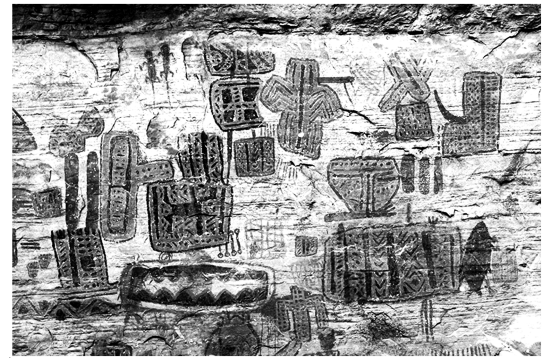 ICMBio, Pinturas rupestres no interior da Gruta do Caboclo, 7 jun. 2021. 1 fotografia. Disponível em: https://www.gov.br/icmbio/pt-br.
Acesso em: 22 jan. 2026. Adaptado.
ICMBio, Pinturas rupestres no interior da Gruta do Caboclo, 7 jun. 2021. 1 fotografia. Disponível em: https://www.gov.br/icmbio/pt-br.
Acesso em: 22 jan. 2026. Adaptado. Os estudos das expressões estilísticas, técnicas e simbólicas dos grafismos rupestres brasileiros nos permitem compreender
Mostra no Metropolitan de Nova York exibe as obras nos vibrantes tons usados na época, demolindo o mito da brancura como sinônimo de beleza O arqueólogo alemão Vinzenz Brinkmann, da Universidade Ludwig Maximilian, em Monique, estudava o uso de ferramentas na Antiguidade. Em busca de marcas microscópicas em estátuas da época, ele desenvolveu uma lâmpada capaz de destacar o relevo da superfície e, por mero acaso, encontrou resíduos de pigmentos apagados pela ação do tempo.
Disponível em: https://veja.abril.com.br/cultura/exposicao-recupera-as-cores-originais-de-estatuas-gregas/. Acesso em: 2 fev. 2026.
Estudos arqueológicos contemporâneos, favorecidos pelo uso de tecnologias, vêm promovendo atualizações na história da arte mundial.
O conceito de beleza clássica, associada à brancura de suas esculturas, foi historicamente estruturado
[...] as manifestações artísticas não podem ser reduzidas às produções legitimadas pelas instituições culturais e veiculadas pela mídia, tampouco a prática artística pode ser vista como mera aquisição de códigos e técnicas. A aprendizagem de Arte precisa alcançar a experiência e a vivência artísticas como prática social, permitindo que os alunos sejam protagonistas e criadores.
BRASIL. Base Nacional Comum Curricular (BNCC). Brasília: MEC, 2018. p. 194.
A Base Nacional Comum Curricular (BNCC) é o documento que rege a construção dos currículos nacionais. O componente curricular Arte está centrado nas linguagens: Artes visuais, Música, Dança e Teatro. A BNCC propõe que o ensino das diferentes linguagens artísticas articule seis dimensões do conhecimento, promovendo uma abordagem ampla e integrada.
Dentre essas dimensões, destaca-se o conceito de Estesia, que diz respeito
Sobre a representação da imagem na Idade Média, Visalli e Godoi consideram que
Compreender seu significado, perceber suas funções, seus destinos e os objetos a que aderem são pontos significativos e essenciais para o trabalho com imagens medievais. Queremos olhar para as construções visuais que os medievais elaboraram abrindo a possibilidade de perceber suas escolhas. Uma dessas escolhas diz respeito ao sentido atribuído a essas construções. A imagem medieval foi definida pela historiografia, tanto pelo o que ela foi, como também pela sua negação: o que ela não foi. Esse reconhecimento apresentou a possibilidade de identificar, ainda, o seu caminhar na história, suas transformações e as posições que ao longo do medievo desfrutou.
VISALLI, A. M.; GODOI, P. W. Estudos sobre imagens medie- vais: o caso das iluminuras. Diálogos (Maringá, Impresso) v. 20, n. 3, p. 131, 2016.
Diante do exposto, segundo a perspectiva historiográfica, as Iluminuras da Idade Média
O Fauvismo é um movimento artístico de vanguarda que surgiu na França de 1904 a 1907, liderado por Henri Matisse. O grupo de artistas que pertenciam a esse movimento fazia oposição ao decorativismo hedonista do Art Nouveau e à inconsistência formal do Simbolismo. Por conceberem a arte como impulso vital, os fauves (os “feras”) começaram pela abordagem crítica de uma série de problemas pictóricos.
Nas experiências estéticas dos Fauvistas, a(o)
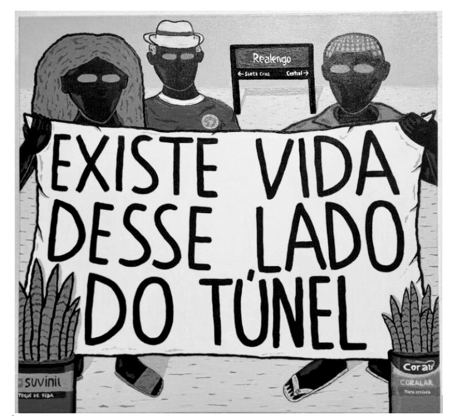 PEREIRA, Guilherme Cunha dos Santos. Gulherme Kid. Existe vida desse lado do túnel!. 2024. Disponível em: https://nutricaovisual.art.br/
artistas-em-pesquisa/guilherme-kid/. Acesso em: 17 jan. 2026. Adaptado.
PEREIRA, Guilherme Cunha dos Santos. Gulherme Kid. Existe vida desse lado do túnel!. 2024. Disponível em: https://nutricaovisual.art.br/
artistas-em-pesquisa/guilherme-kid/. Acesso em: 17 jan. 2026. Adaptado. A obra do artista Guilherme Kid, a partir da temática da arte periférica, propõe uma crítica à realidade carioca, visto que
Nos anos 1980, foi criada e difundida no Brasil a Metodologia Triangular para o ensino de Arte, estruturada em três eixos fundamentais: o fazer artístico, a leitura da obra de arte e a contextualização. Após décadas de desenvolvimento, essa proposta permanece relevante, sendo constantemente aprimorada por pesquisas e práticas pedagógicas.
Considere que, em uma aula de artes para alunos dos anos iniciais do ensino fundamental, o(a) docente apresentou aos estudantes uma obra do artista Juan Miró e propôs uma atividade de releitura.
Levando-se em conta o conceito de releitura em uma perspectiva contemporânea do ensino de artes, conclui- -se que a proposta de releitura
Há uma hegemonia do visual no ensino de Arte que limita a leitura e a fruição estética de obras bidimensionais por pessoas com deficiência visual (DV). Diante desse cenário, coloca-se a necessidade de o professor, ao organizar práticas pedagógicas em arte para o aluno com DV, promover o desenvolvimento de sua cultura, sensibilidade, criatividade e conhecimentos.
Como uma estratégia de acessibilidade que possibilita a leitura e a fruição estética de obras de arte planas para estudantes deficientes visuais, de forma a respeitar sua autonomia, destaca-se a
I - Fundamentando II - Interpretando III - Revelando IV - Descrevendo
P - Incentiva a busca por conhecimentos adicionais em campos teóricos, como história da arte, ou conteúdos relativos à crítica da arte, contextos, autor, época e obras em questão. Q - Possibilita a materialização pelo estudante dos aprendizados construídos, por meio da construção de uma produção de sua autoria. R - Possibilita a interpretação da obra e a correlação de sentimentos, ideias ou sensações pelos estudantes, a partir da imagem em questão. S - Favorece a observação da obra analisada e sua investigação, por meio de anotações sobre os detalhes visualmente percebidos. T - Promove a identificação e a comparação dos elementos de estrutura e organização de composição da obra analisada.
As associações corretas são:
De acordo com a Convenção para a Salvaguarda do Patrimônio Cultural Imaterial da Unesco, de 17 de outubro de 2003, patrimônio imaterial são
[...] as práticas, representações, expressões, conhecimentos e técnicas – junto com os objetos e lugares culturais que estão ligados a essas tradições – que as comunidades e grupos reconhecem como parte de sua cultura. Esse patrimônio é passado de geração em geração e é recriado constantemente pelas comunidades, o que ajuda a criar um sentimento de identidade e continuidade, além de promover o respeito à diversidade cultural e à criatividade humana.
Disponível em: https://bcr.iphan.gov.br/bem-cultural-imaterial/. Acesso em: 01 fev. 2026.
Quando um bem cultural de natureza imaterial é reconhecido pelo Instituto do Patrimônio Histórico e Artístico Nacional (Iphan) como Patrimônio Cultural do Brasil, ele é oficialmente registrado, assumindo-se o compromisso institucional de sua preservação e valorização. Os bens imateriais brasileiros podem ser inscritos em quatro categorias de registros, denominadas livros das

 Conheça nossos planos