Questões de Concurso
Comentadas para médico do trabalho
Foram encontradas 14.801 questões
Resolva questões gratuitamente!
Junte-se a mais de 4 milhões de concurseiros!


Q277196
Direito Sanitário
O mesotelioma maligno de pleura
Q277195
Direito Sanitário
Em relação a imunizações, assinale a alternativa correta.
Q277194
Medicina
É vedado ao médico
Q277193
Direito Sanitário
Sobre o controle de agravos à saúde, assinale a alternativa correta.
Q277192
Direito Sanitário
Avaliar o nível de saúde de uma população não é uma taref a simples. Tradicionalmente utilizam-se vários indicadores, pois nenhum isoladamente preenche todos os critérios desejáveis.
Analisando esse enunciado, pode-se afirmar que as assertivas nele contidas
Analisando esse enunciado, pode-se afirmar que as assertivas nele contidas
Ano: 2012
Banca:
CESGRANRIO
Órgão:
Innova
Provas:
CESGRANRIO - 2012 - Innova - Advogado Júnior
|
CESGRANRIO - 2012 - Innova - Analista de Sistemas Júnior |
CESGRANRIO - 2012 - Innova - Administrador Júnior |
CESGRANRIO - 2012 - Innova - Contador Júnior |
CESGRANRIO - 2012 - Innova - Médico do Trabalho Júnior |
CESGRANRIO - 2012 - Innova - Engenheiro de Equipamento Júnior - Mecânica |
CESGRANRIO - 2012 - Innova - Engenheiro de Equipamento Júnior - Elétrica |
Q276497
Inglês
Texto associado
Text II
The Underwater Centre secures its biggest ever contract – worth $1.3million - to train Russian saturation divers
Your Oil and Gas News Magazine The world's leading commercial diver and Remotely Operated Vehicle (ROV) training facility, based in the Scottish Highlands and Australia, has secured its biggest ever contract – worth US$ 1.3 million – to train Russian saturation divers.
The award cements its reputation as a major service provider for the growing worldwide oil and gas industry. The men, already experienced air divers, were trained on saturation procedures and techniques and will receive the Australian Diver Accreditation Scheme (ADAS) and the Closed Bell certification. More advanced than the ADAS, the Closed Bell is the certification appropriate to deep water dives of 60 meters / 200 feet, using a trimix tank with 16 percent oxygen (O2). During the training, divers lived in a chamber for up to 28 days, which was pressurized to the same pressure of the sea, exactly at the depth that they will be working at. Living and working at pressure mean that they can be transported quickly and efficiently to the work site under the water without decompression stops, allowing divers to work in much greater depths and for much longer periods of time. MRTS Managing Director Alexander Kolikov said: “Oil and gas firms in Russia are currently facing a skills shortage due to the rapidly increasing amount of exploration work underway at the moment. By investing in the training of our divers in saturation diving, we are addressing this need for experts in maintenance and repair activities vital to maintaining Russia's subsea infrastructure." Steve Ham, General Manager at the Fort William Centre said: “We were delighted when MRTS chose The Underwater Centre to train its divers in saturation diving, and I think this is testament to the hard work we have been putting in to ensure our reputation as a world-class training facility. Available at: . Retrieved on: 28 June 2012. Adapted.
In Text II, Steve Ham, General Manager at the Fort William Centre, is
Ano: 2012
Banca:
CESGRANRIO
Órgão:
Innova
Provas:
CESGRANRIO - 2012 - Innova - Advogado Júnior
|
CESGRANRIO - 2012 - Innova - Analista de Sistemas Júnior |
CESGRANRIO - 2012 - Innova - Administrador Júnior |
CESGRANRIO - 2012 - Innova - Contador Júnior |
CESGRANRIO - 2012 - Innova - Médico do Trabalho Júnior |
CESGRANRIO - 2012 - Innova - Engenheiro de Equipamento Júnior - Mecânica |
CESGRANRIO - 2012 - Innova - Engenheiro de Equipamento Júnior - Elétrica |
Q276496
Inglês
Texto associado
Text II
The Underwater Centre secures its biggest ever contract – worth $1.3million - to train Russian saturation divers
Your Oil and Gas News Magazine The world's leading commercial diver and Remotely Operated Vehicle (ROV) training facility, based in the Scottish Highlands and Australia, has secured its biggest ever contract – worth US$ 1.3 million – to train Russian saturation divers.
The award cements its reputation as a major service provider for the growing worldwide oil and gas industry. The men, already experienced air divers, were trained on saturation procedures and techniques and will receive the Australian Diver Accreditation Scheme (ADAS) and the Closed Bell certification. More advanced than the ADAS, the Closed Bell is the certification appropriate to deep water dives of 60 meters / 200 feet, using a trimix tank with 16 percent oxygen (O2). During the training, divers lived in a chamber for up to 28 days, which was pressurized to the same pressure of the sea, exactly at the depth that they will be working at. Living and working at pressure mean that they can be transported quickly and efficiently to the work site under the water without decompression stops, allowing divers to work in much greater depths and for much longer periods of time. MRTS Managing Director Alexander Kolikov said: “Oil and gas firms in Russia are currently facing a skills shortage due to the rapidly increasing amount of exploration work underway at the moment. By investing in the training of our divers in saturation diving, we are addressing this need for experts in maintenance and repair activities vital to maintaining Russia's subsea infrastructure." Steve Ham, General Manager at the Fort William Centre said: “We were delighted when MRTS chose The Underwater Centre to train its divers in saturation diving, and I think this is testament to the hard work we have been putting in to ensure our reputation as a world-class training facility. Available at: . Retrieved on: 28 June 2012. Adapted.
The Underwater Centre secures its biggest ever contract – worth $1.3million - to train Russian saturation divers
Your Oil and Gas News Magazine The world's leading commercial diver and Remotely Operated Vehicle (ROV) training facility, based in the Scottish Highlands and Australia, has secured its biggest ever contract – worth US$ 1.3 million – to train Russian saturation divers.
The award cements its reputation as a major service provider for the growing worldwide oil and gas industry. The men, already experienced air divers, were trained on saturation procedures and techniques and will receive the Australian Diver Accreditation Scheme (ADAS) and the Closed Bell certification. More advanced than the ADAS, the Closed Bell is the certification appropriate to deep water dives of 60 meters / 200 feet, using a trimix tank with 16 percent oxygen (O2). During the training, divers lived in a chamber for up to 28 days, which was pressurized to the same pressure of the sea, exactly at the depth that they will be working at. Living and working at pressure mean that they can be transported quickly and efficiently to the work site under the water without decompression stops, allowing divers to work in much greater depths and for much longer periods of time. MRTS Managing Director Alexander Kolikov said: “Oil and gas firms in Russia are currently facing a skills shortage due to the rapidly increasing amount of exploration work underway at the moment. By investing in the training of our divers in saturation diving, we are addressing this need for experts in maintenance and repair activities vital to maintaining Russia's subsea infrastructure." Steve Ham, General Manager at the Fort William Centre said: “We were delighted when MRTS chose The Underwater Centre to train its divers in saturation diving, and I think this is testament to the hard work we have been putting in to ensure our reputation as a world-class training facility. Available at: . Retrieved on: 28 June 2012. Adapted.
In Text II, Director Kolikov explains that the
Ano: 2012
Banca:
CESGRANRIO
Órgão:
Innova
Provas:
CESGRANRIO - 2012 - Innova - Advogado Júnior
|
CESGRANRIO - 2012 - Innova - Analista de Sistemas Júnior |
CESGRANRIO - 2012 - Innova - Administrador Júnior |
CESGRANRIO - 2012 - Innova - Contador Júnior |
CESGRANRIO - 2012 - Innova - Médico do Trabalho Júnior |
CESGRANRIO - 2012 - Innova - Engenheiro de Equipamento Júnior - Mecânica |
CESGRANRIO - 2012 - Innova - Engenheiro de Equipamento Júnior - Elétrica |
Q276495
Inglês
Texto associado
Text II
The Underwater Centre secures its biggest ever contract – worth $1.3million - to train Russian saturation divers
Your Oil and Gas News Magazine The world's leading commercial diver and Remotely Operated Vehicle (ROV) training facility, based in the Scottish Highlands and Australia, has secured its biggest ever contract – worth US$ 1.3 million – to train Russian saturation divers.
The award cements its reputation as a major service provider for the growing worldwide oil and gas industry. The men, already experienced air divers, were trained on saturation procedures and techniques and will receive the Australian Diver Accreditation Scheme (ADAS) and the Closed Bell certification. More advanced than the ADAS, the Closed Bell is the certification appropriate to deep water dives of 60 meters / 200 feet, using a trimix tank with 16 percent oxygen (O2). During the training, divers lived in a chamber for up to 28 days, which was pressurized to the same pressure of the sea, exactly at the depth that they will be working at. Living and working at pressure mean that they can be transported quickly and efficiently to the work site under the water without decompression stops, allowing divers to work in much greater depths and for much longer periods of time. MRTS Managing Director Alexander Kolikov said: “Oil and gas firms in Russia are currently facing a skills shortage due to the rapidly increasing amount of exploration work underway at the moment. By investing in the training of our divers in saturation diving, we are addressing this need for experts in maintenance and repair activities vital to maintaining Russia's subsea infrastructure." Steve Ham, General Manager at the Fort William Centre said: “We were delighted when MRTS chose The Underwater Centre to train its divers in saturation diving, and I think this is testament to the hard work we have been putting in to ensure our reputation as a world-class training facility. Available at: . Retrieved on: 28 June 2012. Adapted.
The Underwater Centre secures its biggest ever contract – worth $1.3million - to train Russian saturation divers
Your Oil and Gas News Magazine The world's leading commercial diver and Remotely Operated Vehicle (ROV) training facility, based in the Scottish Highlands and Australia, has secured its biggest ever contract – worth US$ 1.3 million – to train Russian saturation divers.
The award cements its reputation as a major service provider for the growing worldwide oil and gas industry. The men, already experienced air divers, were trained on saturation procedures and techniques and will receive the Australian Diver Accreditation Scheme (ADAS) and the Closed Bell certification. More advanced than the ADAS, the Closed Bell is the certification appropriate to deep water dives of 60 meters / 200 feet, using a trimix tank with 16 percent oxygen (O2). During the training, divers lived in a chamber for up to 28 days, which was pressurized to the same pressure of the sea, exactly at the depth that they will be working at. Living and working at pressure mean that they can be transported quickly and efficiently to the work site under the water without decompression stops, allowing divers to work in much greater depths and for much longer periods of time. MRTS Managing Director Alexander Kolikov said: “Oil and gas firms in Russia are currently facing a skills shortage due to the rapidly increasing amount of exploration work underway at the moment. By investing in the training of our divers in saturation diving, we are addressing this need for experts in maintenance and repair activities vital to maintaining Russia's subsea infrastructure." Steve Ham, General Manager at the Fort William Centre said: “We were delighted when MRTS chose The Underwater Centre to train its divers in saturation diving, and I think this is testament to the hard work we have been putting in to ensure our reputation as a world-class training facility. Available at: . Retrieved on: 28 June 2012. Adapted.
About the training, it is stated in Text II that
Ano: 2012
Banca:
CESGRANRIO
Órgão:
Innova
Provas:
CESGRANRIO - 2012 - Innova - Advogado Júnior
|
CESGRANRIO - 2012 - Innova - Analista de Sistemas Júnior |
CESGRANRIO - 2012 - Innova - Administrador Júnior |
CESGRANRIO - 2012 - Innova - Contador Júnior |
CESGRANRIO - 2012 - Innova - Médico do Trabalho Júnior |
CESGRANRIO - 2012 - Innova - Engenheiro de Equipamento Júnior - Mecânica |
CESGRANRIO - 2012 - Innova - Engenheiro de Equipamento Júnior - Elétrica |
Q276494
Inglês
Texto associado
Text II
The Underwater Centre secures its biggest ever contract – worth $1.3million - to train Russian saturation divers
Your Oil and Gas News Magazine The world's leading commercial diver and Remotely Operated Vehicle (ROV) training facility, based in the Scottish Highlands and Australia, has secured its biggest ever contract – worth US$ 1.3 million – to train Russian saturation divers.
The award cements its reputation as a major service provider for the growing worldwide oil and gas industry. The men, already experienced air divers, were trained on saturation procedures and techniques and will receive the Australian Diver Accreditation Scheme (ADAS) and the Closed Bell certification. More advanced than the ADAS, the Closed Bell is the certification appropriate to deep water dives of 60 meters / 200 feet, using a trimix tank with 16 percent oxygen (O2). During the training, divers lived in a chamber for up to 28 days, which was pressurized to the same pressure of the sea, exactly at the depth that they will be working at. Living and working at pressure mean that they can be transported quickly and efficiently to the work site under the water without decompression stops, allowing divers to work in much greater depths and for much longer periods of time. MRTS Managing Director Alexander Kolikov said: “Oil and gas firms in Russia are currently facing a skills shortage due to the rapidly increasing amount of exploration work underway at the moment. By investing in the training of our divers in saturation diving, we are addressing this need for experts in maintenance and repair activities vital to maintaining Russia's subsea infrastructure." Steve Ham, General Manager at the Fort William Centre said: “We were delighted when MRTS chose The Underwater Centre to train its divers in saturation diving, and I think this is testament to the hard work we have been putting in to ensure our reputation as a world-class training facility. Available at: . Retrieved on: 28 June 2012. Adapted.
The Underwater Centre secures its biggest ever contract – worth $1.3million - to train Russian saturation divers
Your Oil and Gas News Magazine The world's leading commercial diver and Remotely Operated Vehicle (ROV) training facility, based in the Scottish Highlands and Australia, has secured its biggest ever contract – worth US$ 1.3 million – to train Russian saturation divers.
The award cements its reputation as a major service provider for the growing worldwide oil and gas industry. The men, already experienced air divers, were trained on saturation procedures and techniques and will receive the Australian Diver Accreditation Scheme (ADAS) and the Closed Bell certification. More advanced than the ADAS, the Closed Bell is the certification appropriate to deep water dives of 60 meters / 200 feet, using a trimix tank with 16 percent oxygen (O2). During the training, divers lived in a chamber for up to 28 days, which was pressurized to the same pressure of the sea, exactly at the depth that they will be working at. Living and working at pressure mean that they can be transported quickly and efficiently to the work site under the water without decompression stops, allowing divers to work in much greater depths and for much longer periods of time. MRTS Managing Director Alexander Kolikov said: “Oil and gas firms in Russia are currently facing a skills shortage due to the rapidly increasing amount of exploration work underway at the moment. By investing in the training of our divers in saturation diving, we are addressing this need for experts in maintenance and repair activities vital to maintaining Russia's subsea infrastructure." Steve Ham, General Manager at the Fort William Centre said: “We were delighted when MRTS chose The Underwater Centre to train its divers in saturation diving, and I think this is testament to the hard work we have been putting in to ensure our reputation as a world-class training facility. Available at: . Retrieved on: 28 June 2012. Adapted.
In Text II, when the author states that the divers completed an air course prior to the saturation diver training, he means that
Ano: 2012
Banca:
CESGRANRIO
Órgão:
Innova
Provas:
CESGRANRIO - 2012 - Innova - Advogado Júnior
|
CESGRANRIO - 2012 - Innova - Analista de Sistemas Júnior |
CESGRANRIO - 2012 - Innova - Administrador Júnior |
CESGRANRIO - 2012 - Innova - Contador Júnior |
CESGRANRIO - 2012 - Innova - Médico do Trabalho Júnior |
CESGRANRIO - 2012 - Innova - Engenheiro de Equipamento Júnior - Mecânica |
CESGRANRIO - 2012 - Innova - Engenheiro de Equipamento Júnior - Elétrica |
Q276493
Inglês
Texto associado
Text II
The Underwater Centre secures its biggest ever contract – worth $1.3million - to train Russian saturation divers
Your Oil and Gas News Magazine The world's leading commercial diver and Remotely Operated Vehicle (ROV) training facility, based in the Scottish Highlands and Australia, has secured its biggest ever contract – worth US$ 1.3 million – to train Russian saturation divers.
The award cements its reputation as a major service provider for the growing worldwide oil and gas industry. The men, already experienced air divers, were trained on saturation procedures and techniques and will receive the Australian Diver Accreditation Scheme (ADAS) and the Closed Bell certification. More advanced than the ADAS, the Closed Bell is the certification appropriate to deep water dives of 60 meters / 200 feet, using a trimix tank with 16 percent oxygen (O2). During the training, divers lived in a chamber for up to 28 days, which was pressurized to the same pressure of the sea, exactly at the depth that they will be working at. Living and working at pressure mean that they can be transported quickly and efficiently to the work site under the water without decompression stops, allowing divers to work in much greater depths and for much longer periods of time. MRTS Managing Director Alexander Kolikov said: “Oil and gas firms in Russia are currently facing a skills shortage due to the rapidly increasing amount of exploration work underway at the moment. By investing in the training of our divers in saturation diving, we are addressing this need for experts in maintenance and repair activities vital to maintaining Russia's subsea infrastructure." Steve Ham, General Manager at the Fort William Centre said: “We were delighted when MRTS chose The Underwater Centre to train its divers in saturation diving, and I think this is testament to the hard work we have been putting in to ensure our reputation as a world-class training facility. Available at: . Retrieved on: 28 June 2012. Adapted.
The Underwater Centre secures its biggest ever contract – worth $1.3million - to train Russian saturation divers
Your Oil and Gas News Magazine The world's leading commercial diver and Remotely Operated Vehicle (ROV) training facility, based in the Scottish Highlands and Australia, has secured its biggest ever contract – worth US$ 1.3 million – to train Russian saturation divers.
The award cements its reputation as a major service provider for the growing worldwide oil and gas industry. The men, already experienced air divers, were trained on saturation procedures and techniques and will receive the Australian Diver Accreditation Scheme (ADAS) and the Closed Bell certification. More advanced than the ADAS, the Closed Bell is the certification appropriate to deep water dives of 60 meters / 200 feet, using a trimix tank with 16 percent oxygen (O2). During the training, divers lived in a chamber for up to 28 days, which was pressurized to the same pressure of the sea, exactly at the depth that they will be working at. Living and working at pressure mean that they can be transported quickly and efficiently to the work site under the water without decompression stops, allowing divers to work in much greater depths and for much longer periods of time. MRTS Managing Director Alexander Kolikov said: “Oil and gas firms in Russia are currently facing a skills shortage due to the rapidly increasing amount of exploration work underway at the moment. By investing in the training of our divers in saturation diving, we are addressing this need for experts in maintenance and repair activities vital to maintaining Russia's subsea infrastructure." Steve Ham, General Manager at the Fort William Centre said: “We were delighted when MRTS chose The Underwater Centre to train its divers in saturation diving, and I think this is testament to the hard work we have been putting in to ensure our reputation as a world-class training facility. Available at: . Retrieved on: 28 June 2012. Adapted.
In Text II, the possessive pronoun its (line 6) refers to
Ano: 2012
Banca:
CESGRANRIO
Órgão:
Innova
Provas:
CESGRANRIO - 2012 - Innova - Advogado Júnior
|
CESGRANRIO - 2012 - Innova - Analista de Sistemas Júnior |
CESGRANRIO - 2012 - Innova - Administrador Júnior |
CESGRANRIO - 2012 - Innova - Contador Júnior |
CESGRANRIO - 2012 - Innova - Médico do Trabalho Júnior |
CESGRANRIO - 2012 - Innova - Engenheiro de Equipamento Júnior - Mecânica |
CESGRANRIO - 2012 - Innova - Engenheiro de Equipamento Júnior - Elétrica |
Q276487
Português
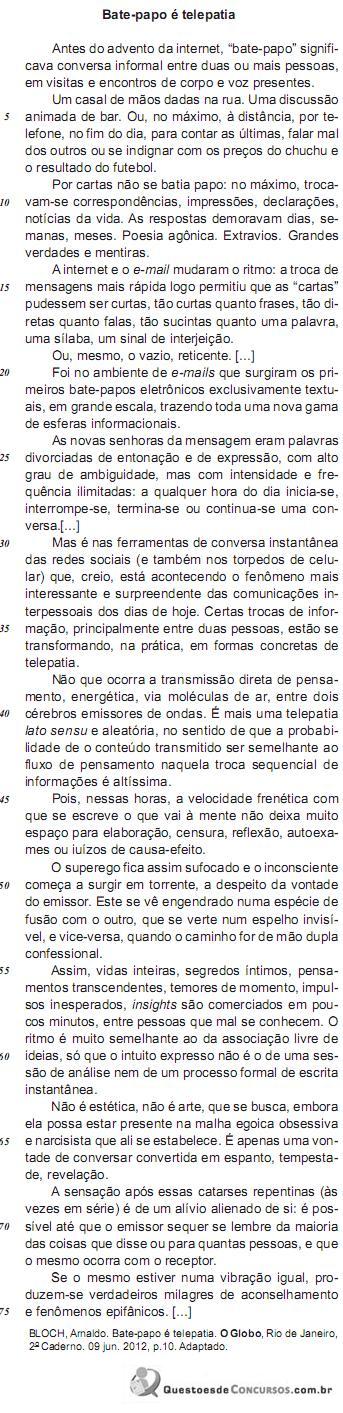
De acordo com a norma-padrão o pronome se pode ser deslocado para depois do verbo destacado em:
Ano: 2012
Banca:
CESGRANRIO
Órgão:
Innova
Provas:
CESGRANRIO - 2012 - Innova - Advogado Júnior
|
CESGRANRIO - 2012 - Innova - Contador Júnior |
CESGRANRIO - 2012 - Innova - Médico do Trabalho Júnior |
Q276485
Português
O verbo que está conjugado no mesmo tempo e modo de for, como no trecho “quando o caminho for de mão dupla confessional" (L. 53-54) é
Ano: 2012
Banca:
CESGRANRIO
Órgão:
Innova
Provas:
CESGRANRIO - 2012 - Innova - Advogado Júnior
|
CESGRANRIO - 2012 - Innova - Analista de Sistemas Júnior |
CESGRANRIO - 2012 - Innova - Administrador Júnior |
CESGRANRIO - 2012 - Innova - Contador Júnior |
CESGRANRIO - 2012 - Innova - Médico do Trabalho Júnior |
CESGRANRIO - 2012 - Innova - Engenheiro de Equipamento Júnior - Mecânica |
CESGRANRIO - 2012 - Innova - Engenheiro de Equipamento Júnior - Elétrica |
Q276484
Português
No texto, a expressão às vezes(L.68-69) apresenta o sinal indicativo de crase.
Na seguinte frase, o a deveria também apresentar esse sinal:
Ano: 2012
Banca:
CESGRANRIO
Órgão:
Innova
Provas:
CESGRANRIO - 2012 - Innova - Advogado Júnior
|
CESGRANRIO - 2012 - Innova - Analista de Sistemas Júnior |
CESGRANRIO - 2012 - Innova - Administrador Júnior |
CESGRANRIO - 2012 - Innova - Médico do Trabalho Júnior |
CESGRANRIO - 2012 - Innova - Engenheiro de Equipamento Júnior - Mecânica |
CESGRANRIO - 2012 - Innova - Engenheiro de Equipamento Júnior - Elétrica |
Q276481
Português
Dentre os trechos transcritos abaixo, qual deles apresenta, no texto, uma gradação decrescente?
Ano: 2012
Banca:
CESGRANRIO
Órgão:
Innova
Provas:
CESGRANRIO - 2012 - Innova - Advogado Júnior
|
CESGRANRIO - 2012 - Innova - Analista de Sistemas Júnior |
CESGRANRIO - 2012 - Innova - Administrador Júnior |
CESGRANRIO - 2012 - Innova - Contador Júnior |
CESGRANRIO - 2012 - Innova - Médico do Trabalho Júnior |
CESGRANRIO - 2012 - Innova - Engenheiro de Equipamento Júnior - Mecânica |
CESGRANRIO - 2012 - Innova - Engenheiro de Equipamento Júnior - Elétrica |
Q276480
Português
É comum que palavras sejam empregadas fora de seu sentido usual.
O seguinte trecho traz uma palavra que costuma ser usada com entidade humana, mas que foi empregada com entidade inanimada:
Ano: 2012
Banca:
CESGRANRIO
Órgão:
Innova
Provas:
CESGRANRIO - 2012 - Innova - Advogado Júnior
|
CESGRANRIO - 2012 - Innova - Analista de Sistemas Júnior |
CESGRANRIO - 2012 - Innova - Administrador Júnior |
CESGRANRIO - 2012 - Innova - Médico do Trabalho Júnior |
CESGRANRIO - 2012 - Innova - Engenheiro de Equipamento Júnior - Mecânica |
CESGRANRIO - 2012 - Innova - Engenheiro de Equipamento Júnior - Elétrica |
Q276479
Português
O texto faz uma distinção entre cartas e conversas em redes sociais, no sentido de que, entre outras características, cada um desses meios, respectivamente, apresenta
Ano: 2012
Banca:
CESGRANRIO
Órgão:
Innova
Provas:
CESGRANRIO - 2012 - Innova - Advogado Júnior
|
CESGRANRIO - 2012 - Innova - Analista de Sistemas Júnior |
CESGRANRIO - 2012 - Innova - Administrador Júnior |
CESGRANRIO - 2012 - Innova - Contador Júnior |
CESGRANRIO - 2012 - Innova - Médico do Trabalho Júnior |
CESGRANRIO - 2012 - Innova - Engenheiro de Equipamento Júnior - Mecânica |
CESGRANRIO - 2012 - Innova - Engenheiro de Equipamento Júnior - Elétrica |
Q276478
Português
O texto provoca reflexão acerca do sentido de telepatia.
No texto, o conceito de telepatia
Ano: 2012
Banca:
VUNESP
Órgão:
SPTrans
Provas:
VUNESP - 2012 - SPTrans - Analista de Gestão Pleno - Administração Geral
|
VUNESP - 2012 - SPTrans - Analista de Informática |
VUNESP - 2012 - SPTrans - Auditor Pleno |
VUNESP - 2012 - SPTrans - Analista de Marketing Pleno - Web Designer |
VUNESP - 2012 - SPTrans - Assistente Social |
VUNESP - 2012 - SPTrans - Analista de Gestão Pleno - Licitações e Contratos |
VUNESP - 2012 - SPTrans - Engenheiro Civil |
VUNESP - 2012 - SPTrans - Médico do trabalho |
VUNESP - 2012 - SPTrans - Analista de Comunicação Social Pleno |
VUNESP - 2012 - SPTrans - Analista de Gestão Pleno - Desenvolvimento de Recursos Humanos |
VUNESP - 2012 - SPTrans - Analista de Gestão Pleno - Cargos, Salários e Carreira |
VUNESP - 2012 - SPTrans - Arquiteto |
VUNESP - 2012 - SPTrans - Analista de Gestão Pleno - Contábil |
VUNESP - 2012 - SPTrans - Analista de Marketing Pleno |
Q274540
Raciocínio Lógico
Observe a sequência, que mantém sempre o mesmo padrão.

Na sequência, x, y e z representam números, sendo que x+y+z é igual a
Na sequência, x, y e z representam números, sendo que x+y+z é igual a
Ano: 2012
Banca:
VUNESP
Órgão:
SPTrans
Provas:
VUNESP - 2012 - SPTrans - Analista de Gestão Pleno - Administração Geral
|
VUNESP - 2012 - SPTrans - Analista de Informática |
VUNESP - 2012 - SPTrans - Auditor Pleno |
VUNESP - 2012 - SPTrans - Analista de Marketing Pleno - Web Designer |
VUNESP - 2012 - SPTrans - Assistente Social |
VUNESP - 2012 - SPTrans - Analista de Gestão Pleno - Licitações e Contratos |
VUNESP - 2012 - SPTrans - Engenheiro Civil |
VUNESP - 2012 - SPTrans - Médico do trabalho |
VUNESP - 2012 - SPTrans - Analista de Comunicação Social Pleno |
VUNESP - 2012 - SPTrans - Analista de Gestão Pleno - Desenvolvimento de Recursos Humanos |
VUNESP - 2012 - SPTrans - Arquiteto |
VUNESP - 2012 - SPTrans - Analista de Gestão Pleno - Contábil |
VUNESP - 2012 - SPTrans - Analista de Marketing Pleno |
Q274537
Raciocínio Lógico
Observe a figura.
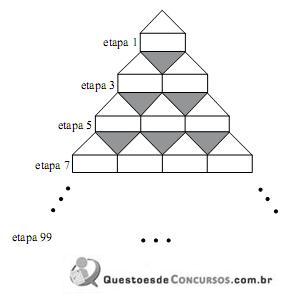
Mantendo-se o mesmo padrão, ao completar a etapa 99 da figura, o total de triângulos sombreados será igual à soma 1+2+3+4+5+...+n, com n igual a
Mantendo-se o mesmo padrão, ao completar a etapa 99 da figura, o total de triângulos sombreados será igual à soma 1+2+3+4+5+...+n, com n igual a
Ano: 2012
Banca:
VUNESP
Órgão:
SPTrans
Provas:
VUNESP - 2012 - SPTrans - Advogado Pleno - Trabalhista
|
VUNESP - 2012 - SPTrans - Advogado Pleno - Tributário |
VUNESP - 2012 - SPTrans - Analista de Gestão Pleno - Administração Geral |
VUNESP - 2012 - SPTrans - Analista de Informática |
VUNESP - 2012 - SPTrans - Auditor Pleno |
VUNESP - 2012 - SPTrans - Analista de Marketing Pleno - Web Designer |
VUNESP - 2012 - SPTrans - Assistente Social |
VUNESP - 2012 - SPTrans - Engenheiro Civil |
VUNESP - 2012 - SPTrans - Médico do trabalho |
VUNESP - 2012 - SPTrans - Analista de Comunicação Social Pleno |
VUNESP - 2012 - SPTrans - Analista de Gestão Pleno - Desenvolvimento de Recursos Humanos |
VUNESP - 2012 - SPTrans - Analista de Gestão Pleno - Cargos, Salários e Carreira |
VUNESP - 2012 - SPTrans - Arquiteto |
VUNESP - 2012 - SPTrans - Analista de Gestão Pleno - Contábil |
VUNESP - 2012 - SPTrans - Analista de Marketing Pleno |
Q274442
Português
Texto associado
Na era da internet, com seus “rsrsrs" e as “longas" mensagens
de 140 caracteres do Twitter, que lugar haveria para a
retórica, a invenção dos gregos clássicos para permitir que nas
democracias o bom cidadão pudesse defender seus pontos de
vista falando bem? Na semana passada, o julgamento do mensalão
no STF pôs em evidência os advogados dos réus. Eles
foram lá exercitar sua retórica, uma vez que as peças de defesa
já haviam sido escritas e enviadas aos ministros do tribunal. Os
defensores, com raras exceções, saíram-se muito mal no quesito
da retórica – que não é blá-blá-blá.
Quando assumiu o posto de presidente da Suprema Corte
dos Estados Unidos, Earl Warren perguntou a um colega mais
antigo em quem confiava plenamente o que ele deveria ler para
conseguir escrever suas sentenças no alto nível que as circunstâncias
exigiam. O colega de Warren, Hugo Black, respondeu:
“Basta ler Retórica, de Aristóteles".
Sábio conselho. Com a democracia, os gregos criaram esse
mecanismo de sustentação oral baseado na lógica e na honestidade
de pensamento a que chamaram de retórica. Os cidadãos
eram frequentemente obrigados a defender em público não
apenas ideias, mas sua propriedade e até a própria liberdade.
Aristóteles ensinou que persuadir uma audiência nada tem a ver
com eloquência. Isso é sofisma. O que separa um cidadão grego
dotado da retórica de um mero sofista? A retórica vencedora não
depende do dom da oratória, mas do valor moral do orador.
(Otávio Cabral e Carolina Melo. A retórica não é blá-blá-blá. Veja, 15.08.2012)
Considere as seguintes afirmações:
I. As aspas em “longas" (1.º parágrafo) indicam que a palavra está sendo empregada em sentido irônico.
II. As aspas em “rsrsrs" (1.º parágrafo) indicam que se trata de palavra estrangeira, razão pela qual é incorreto empregá-la.
III. As aspas em “Basta ler Retórica, de Aristóteles" (2.º parágrafo) indicam que se trata de uma citação.
Deve-se concluir que está correto o que se afirma em

 Conheça nossos planos