Questões de Concurso
Comentadas para professor - inglês
Foram encontradas 23.839 questões
Resolva questões gratuitamente!
Junte-se a mais de 4 milhões de concurseiros!


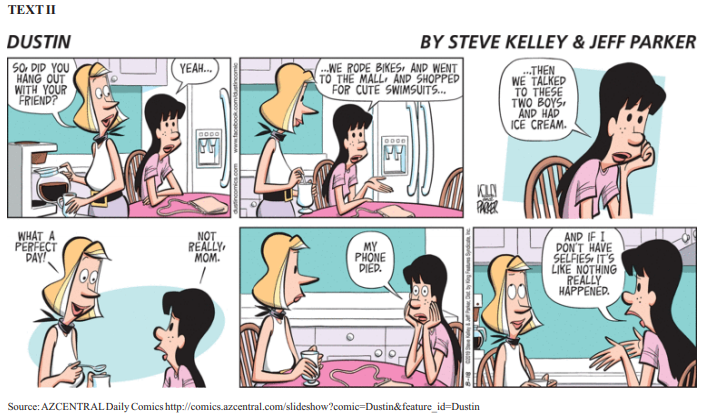
According to the comics, it is CORRECTto say that:
TEXT I
The teaching of English as a foreign language in the context of Brazilian regular schools: a retrospective and prospective view of policies and practices.
(Ricardo Luiz Teixeira de Almeida).
(…) A brief overview of the recent history of ELT in Brazilian regular schools
During the 1970s, the so-called audiolingual method, based on behaviorist and structuralist assumptions, was still considered the only scientific way of teaching a foreign language. Its emphasis on the oral skills and on the exhaustive repetition of structural exercises seemed to work well in the contexts of private language institutes. Those contexts were characterized by the gathering of small numbers of highly motivated students per class, a weekly time-table superior in the number of hours to the one adopted in regular schools, and plenty of audiovisual resources. Questionable in itself, both because of its results (which in time were revealed to be less efficient than believed, especially in terms of fluency) and its theoretical assumptions, the method ended up being adopted by regular schools due to its positive reputation at the time. The failure of the methodology in this context would soon become evident, generating extreme frustration both amongst teachers and students.
From the 1980s on, with the spread of ideas connected to the so-called communicative approach and the growth of English for Specific Purposes (ESP), the community of researchers and teachers interested in the context of regular schools started reviewing the assumptions and logic of English Language Teaching (ELT). Recognizing that each and every school discipline needs to justify its presence in the curriculum socially and educationally, this movement identified the skill of reading as the most relevant one for the students attending the majority of Brazilian regular schools. This understanding was achieved by considering not only the possibility of real use outside school, but also the role this approach could play in the achievement of other educational goals, such as the improvement of student's reading abilities in Portuguese as a mother tongue (MOITA LOPES, 1996)*. This movement reached its climax with the publication of the Brazilian National Curricular Parameters (PCN) for the teaching of foreign languages at basic education level by the end of the 1990s. The document recommended the focus on the teaching of reading within a view of language as discourse. However, it did not close the door on the teaching of any other skill, as long as the context made it possible and relevant.
It is important at this point to clarify a few things about the emergence of this educational policy. First of all, it was not formulated apart from the community of teachers and researchers and then imposed upon them. On the contrary, great names in Brazilian Applied Linguistics, such as Luiz Paulo da Moita Lopes and Maria Antonieta Celani among others, were involved in the formulation of the Parameters. Even more important than that, a lot of teachers, individually or collectively, with or without supervision, were already trying the focus on reading as an alternative to the failure of previous practices before the Parameters were elaborated. Two well-known examples are those from Rio de Janeiro and São Paulo during the late 1980s and early 1990s. In São Paulo, The Catholic University (PUCSP) became a national center for foreign language teacher education, through the development of a Brazilian ESP project focusing on reading (CELANI, 2005)**. In Rio de Janeiro, a discussion conducted by the city educational authorities and the teachers in public schools (concerning the contents and methodology of each school discipline), during the administrations of Saturnino Braga and Marcelo Alencar, led to the proposition that the focus on reading for foreign language teaching reflected the will of most teachers who participated in the discussion.
Another important characteristic of the Parameters that should not be overlooked is their emphasis on teacher's autonomy. This emphasis can be seen clearly in the fact that no content or method is imposed upon the teachers. What one can find are suggestions and relevant information for teachers to make their own decisions, taking into consideration the context within which they work. In other words, the Parameters do not force any teacher to limit their focus on the teaching of reading, if they believe they can go further than that.
In spite of all these positive points, since their publication, it is possible to identify a strong resistance to the focus on reading on the part of many teachers. The reasons for this resistance will be discussed in the following sections of this paper. […] (p.333-334)
*MOITA LOPES, Luiz Paulo da. Oficina de Lingüística Aplicada: a natureza social e educacional dos processos de ensino / aprendizagem de línguas. Campinas:
Mercado de Letras, 1996.
**CELANI, M. A. Introduction. In: CELANI, M. A. et al. ESPin Brazil: 25 years of evolution and reflection. Campinas-SP: Mercado de Letras, São Paulo: Educ, 2005.
p. 13-26.
(Adapted from: Revista Brasileira de Linguística Aplicada. vol.12. nº.2. Belo Horizonte. Apr./June 2012, p. 331-348. Available at:
http://www.scielo.br/scielo.php?script=sci_arttext&pid=S1984-63982012000200006 Accessed on April 15 , 2019)
TEXT I
The teaching of English as a foreign language in the context of Brazilian regular schools: a retrospective and prospective view of policies and practices.
(Ricardo Luiz Teixeira de Almeida).
(…) A brief overview of the recent history of ELT in Brazilian regular schools
During the 1970s, the so-called audiolingual method, based on behaviorist and structuralist assumptions, was still considered the only scientific way of teaching a foreign language. Its emphasis on the oral skills and on the exhaustive repetition of structural exercises seemed to work well in the contexts of private language institutes. Those contexts were characterized by the gathering of small numbers of highly motivated students per class, a weekly time-table superior in the number of hours to the one adopted in regular schools, and plenty of audiovisual resources. Questionable in itself, both because of its results (which in time were revealed to be less efficient than believed, especially in terms of fluency) and its theoretical assumptions, the method ended up being adopted by regular schools due to its positive reputation at the time. The failure of the methodology in this context would soon become evident, generating extreme frustration both amongst teachers and students.
From the 1980s on, with the spread of ideas connected to the so-called communicative approach and the growth of English for Specific Purposes (ESP), the community of researchers and teachers interested in the context of regular schools started reviewing the assumptions and logic of English Language Teaching (ELT). Recognizing that each and every school discipline needs to justify its presence in the curriculum socially and educationally, this movement identified the skill of reading as the most relevant one for the students attending the majority of Brazilian regular schools. This understanding was achieved by considering not only the possibility of real use outside school, but also the role this approach could play in the achievement of other educational goals, such as the improvement of student's reading abilities in Portuguese as a mother tongue (MOITA LOPES, 1996)*. This movement reached its climax with the publication of the Brazilian National Curricular Parameters (PCN) for the teaching of foreign languages at basic education level by the end of the 1990s. The document recommended the focus on the teaching of reading within a view of language as discourse. However, it did not close the door on the teaching of any other skill, as long as the context made it possible and relevant.
It is important at this point to clarify a few things about the emergence of this educational policy. First of all, it was not formulated apart from the community of teachers and researchers and then imposed upon them. On the contrary, great names in Brazilian Applied Linguistics, such as Luiz Paulo da Moita Lopes and Maria Antonieta Celani among others, were involved in the formulation of the Parameters. Even more important than that, a lot of teachers, individually or collectively, with or without supervision, were already trying the focus on reading as an alternative to the failure of previous practices before the Parameters were elaborated. Two well-known examples are those from Rio de Janeiro and São Paulo during the late 1980s and early 1990s. In São Paulo, The Catholic University (PUCSP) became a national center for foreign language teacher education, through the development of a Brazilian ESP project focusing on reading (CELANI, 2005)**. In Rio de Janeiro, a discussion conducted by the city educational authorities and the teachers in public schools (concerning the contents and methodology of each school discipline), during the administrations of Saturnino Braga and Marcelo Alencar, led to the proposition that the focus on reading for foreign language teaching reflected the will of most teachers who participated in the discussion.
Another important characteristic of the Parameters that should not be overlooked is their emphasis on teacher's autonomy. This emphasis can be seen clearly in the fact that no content or method is imposed upon the teachers. What one can find are suggestions and relevant information for teachers to make their own decisions, taking into consideration the context within which they work. In other words, the Parameters do not force any teacher to limit their focus on the teaching of reading, if they believe they can go further than that.
In spite of all these positive points, since their publication, it is possible to identify a strong resistance to the focus on reading on the part of many teachers. The reasons for this resistance will be discussed in the following sections of this paper. […] (p.333-334)
*MOITA LOPES, Luiz Paulo da. Oficina de Lingüística Aplicada: a natureza social e educacional dos processos de ensino / aprendizagem de línguas. Campinas:
Mercado de Letras, 1996.
**CELANI, M. A. Introduction. In: CELANI, M. A. et al. ESPin Brazil: 25 years of evolution and reflection. Campinas-SP: Mercado de Letras, São Paulo: Educ, 2005.
p. 13-26.
(Adapted from: Revista Brasileira de Linguística Aplicada. vol.12. nº.2. Belo Horizonte. Apr./June 2012, p. 331-348. Available at:
http://www.scielo.br/scielo.php?script=sci_arttext&pid=S1984-63982012000200006 Accessed on April 15 , 2019)
TEXT I
The teaching of English as a foreign language in the context of Brazilian regular schools: a retrospective and prospective view of policies and practices.
(Ricardo Luiz Teixeira de Almeida).
(…) A brief overview of the recent history of ELT in Brazilian regular schools
During the 1970s, the so-called audiolingual method, based on behaviorist and structuralist assumptions, was still considered the only scientific way of teaching a foreign language. Its emphasis on the oral skills and on the exhaustive repetition of structural exercises seemed to work well in the contexts of private language institutes. Those contexts were characterized by the gathering of small numbers of highly motivated students per class, a weekly time-table superior in the number of hours to the one adopted in regular schools, and plenty of audiovisual resources. Questionable in itself, both because of its results (which in time were revealed to be less efficient than believed, especially in terms of fluency) and its theoretical assumptions, the method ended up being adopted by regular schools due to its positive reputation at the time. The failure of the methodology in this context would soon become evident, generating extreme frustration both amongst teachers and students.
From the 1980s on, with the spread of ideas connected to the so-called communicative approach and the growth of English for Specific Purposes (ESP), the community of researchers and teachers interested in the context of regular schools started reviewing the assumptions and logic of English Language Teaching (ELT). Recognizing that each and every school discipline needs to justify its presence in the curriculum socially and educationally, this movement identified the skill of reading as the most relevant one for the students attending the majority of Brazilian regular schools. This understanding was achieved by considering not only the possibility of real use outside school, but also the role this approach could play in the achievement of other educational goals, such as the improvement of student's reading abilities in Portuguese as a mother tongue (MOITA LOPES, 1996)*. This movement reached its climax with the publication of the Brazilian National Curricular Parameters (PCN) for the teaching of foreign languages at basic education level by the end of the 1990s. The document recommended the focus on the teaching of reading within a view of language as discourse. However, it did not close the door on the teaching of any other skill, as long as the context made it possible and relevant.
It is important at this point to clarify a few things about the emergence of this educational policy. First of all, it was not formulated apart from the community of teachers and researchers and then imposed upon them. On the contrary, great names in Brazilian Applied Linguistics, such as Luiz Paulo da Moita Lopes and Maria Antonieta Celani among others, were involved in the formulation of the Parameters. Even more important than that, a lot of teachers, individually or collectively, with or without supervision, were already trying the focus on reading as an alternative to the failure of previous practices before the Parameters were elaborated. Two well-known examples are those from Rio de Janeiro and São Paulo during the late 1980s and early 1990s. In São Paulo, The Catholic University (PUCSP) became a national center for foreign language teacher education, through the development of a Brazilian ESP project focusing on reading (CELANI, 2005)**. In Rio de Janeiro, a discussion conducted by the city educational authorities and the teachers in public schools (concerning the contents and methodology of each school discipline), during the administrations of Saturnino Braga and Marcelo Alencar, led to the proposition that the focus on reading for foreign language teaching reflected the will of most teachers who participated in the discussion.
Another important characteristic of the Parameters that should not be overlooked is their emphasis on teacher's autonomy. This emphasis can be seen clearly in the fact that no content or method is imposed upon the teachers. What one can find are suggestions and relevant information for teachers to make their own decisions, taking into consideration the context within which they work. In other words, the Parameters do not force any teacher to limit their focus on the teaching of reading, if they believe they can go further than that.
In spite of all these positive points, since their publication, it is possible to identify a strong resistance to the focus on reading on the part of many teachers. The reasons for this resistance will be discussed in the following sections of this paper. […] (p.333-334)
*MOITA LOPES, Luiz Paulo da. Oficina de Lingüística Aplicada: a natureza social e educacional dos processos de ensino / aprendizagem de línguas. Campinas:
Mercado de Letras, 1996.
**CELANI, M. A. Introduction. In: CELANI, M. A. et al. ESPin Brazil: 25 years of evolution and reflection. Campinas-SP: Mercado de Letras, São Paulo: Educ, 2005.
p. 13-26.
(Adapted from: Revista Brasileira de Linguística Aplicada. vol.12. nº.2. Belo Horizonte. Apr./June 2012, p. 331-348. Available at:
http://www.scielo.br/scielo.php?script=sci_arttext&pid=S1984-63982012000200006 Accessed on April 15 , 2019)
I. Identificar os obstáculos e problemas a serem superados. II. Considerar estratégias realistas em termos do tempo e dos recursos. III. Planejar e implementar estratégias adotadas, procedendo por etapas, atendendo as necessidades, mobilizando atores e reavaliando a situação.
Quais estão corretas?
( ) Todas as crianças, sem exceção, frequentando salas de aula do ensino regular, em escolas de seus bairros. ( ) Escolas que reestruturam o seu currículo, seus métodos de ensino, seus métodos de avaliação e agrupamento de alunos garantem acesso e sucesso a todo tipo de crianças da comunidade. ( ) Professores que aceitam a responsabilidade de ensinar todas as crianças e que recebem total apoio do diretor, dos colegas e da comunidade.
A ordem correta de preenchimento dos parênteses, de cima para baixo, é:
I. Estatal quanto ao funcionamento. II. Democrática quanto à gestão. III. Pública quanto à destinação.
Quais estão corretas?
Assinale a alternativa que preenche, correta e respectivamente, as lacunas do trecho acima
Assinale a alternativa que preenche corretamente a lacuna do trecho acima.
I. De um lado, é essencial manter a relevância insubstituível da qualidade política em educação. II. De outro, é mister reconhecer ser preferível avaliação formal e quantitativa bem-feita a exacerbações ideológicas inconsequentes. III. Avaliações quantitativas e formais são tipicamente instrumento técnico, que nunca substituem a questão política em si, mas podem secundá-la em direções positivas.
Quais estão corretas?
Assinale a alternativa que preenche corretamente a lacuna do trecho acima.
Coluna 1 1. Nível 1. 2. Nível 2. 3. Nível 3.
Coluna 2 ( ) Habilitação Específica de Magistério de 2º grau. ( ) Habilitação Específica, obtida em curso Superior de graduação correspondente à Licenciatura Plena, ou Especialista e Pós-Graduados. ( ) Habilitação Específica de Grau Superior ao nível de Graduação, representada por Licenciatura de 1º Grau obtida em curso de curta duração.
A ordem correta de preenchimento dos parênteses, de cima para baixo, é:
Assinale a alternativa que preenche, correta e respectivamente, as lacunas do trecho acima.
 Conheça nossos planos