Foram encontradas 23.840 questões
Resolva questões gratuitamente!
Junte-se a mais de 4 milhões de concurseiros!


A Debate on Literature as a Teaching Material in FLT
Ferdows Aghagolzadeh
Department of General Linguistics, Faculty of Humanities, Tarbiat Modares University, Tehran,
Iran Farzaneh Tajabadi (Corresponding Author)
Department of General linguistics, Faculty of Humanities, Tarbiat Modares University, Tehran, Iran
Email: [email protected]
Abstract — Teaching materials play an important role in most foreign language teaching programs. The number of studies on this subject bears ample testimony to the significance given by scholars in this regard. This article is a review on some reasons that scholars propose for the use of literature as a language teaching material in foreign language (FL) classes and compares favors and disfavors ideas in this regard. Among a welter of reasons which have been proffered by a variety of authors and can be considered as the merits of literature in FLT, this study focuses on authenticity, cultural/incultural understanding, critical thinking and language skills and expand them further. This paper argues that teaching literature enhances students’ cultural understanding, facilitates critical thinking and improves language skills and all of these advantages caused by the authentic nature of literature.
Index Terms — literature, FLT, authenticity, critical thinking, cultural awareness, language skills
Introduction
Teaching materials play an important role in FL teaching programs. For this reason, teachers rely on a different range of materials to support their teaching and their students’ learning. In this regard, Seniro (2005) says “we need to have a clear pedagogic goal in mind: what precisely we want our students to learn from these materials” (p. 71). It is one of the self-evident things that, as a teacher of a Foreign Language, our main concern is to help learners acquire communicative competence. Savvidou (2004) points that communicative competence is more than acquiring mastery of structure and form, it also involves acquiring the ability to interpret discourse in all its social and cultural contexts. In this direction and in order to reach this lofty goal, Howard & Major (2004) propose ten guidelines for preparing teaching materials. They argue that these materials should: 1 - Be contextualized. 2 - Stimulate interaction and be generative in terms of language. 3 -Encourage learners to develop learning skills and strategies. 4 - Allow for a focus on form as well as function. 5 - Offer opportunities for integrated language use. 6 - Be authentic. 7 - Link to each other to develop a progression of skills, understanding and language items. 8- Be attractive. 9- Have appropriate instruction. 10- Be flexible. According to these different criteria, the main question is that if literature can be used as an appropriate material and if it can satisfy these factors. In this paper we try to show that literature is in agreement with these yardsticks.
Statement of problem
From time to time the need or value of teaching literature in the language class as a teaching material has been questioned. Using literature to teach second/foreign languages can be traced back to over one century ago, but in recent times (the middle of the 1980s) a renewed interest has emerged in the teaching of literature in the language class. This can be confirmed by seeing so many publications heralding the coming back of literature in language classes. Maley (2001) (cited in Khatib et al., 2011) argues that this attitude toward literature is due to a paucity of empirical research confirming the significance of literary input for language class. Notwithstanding the few controversial points regarding whether literature can be used to enhance the efficiency of language learning programs, the relevant literature abounds with the reasons why literary exploration can be beneficial in the language classroom. Researchers who advocate the use of literature to teach SL/FL list several benefits of it. For example, Lazar (1993) proposes six purposes or reasons for using literature in the language classroom as motivating material: access to cultural background, encouraging language acquisition, expanding students’ language awareness, developing students’ interpretative abilities and educating the whole person. Van (2009) also counts some advantages of using literature in the FL classroom as below: 1- It provides meaningful contexts; 2- It involves a profound range of vocabulary, dialogues and prose; 3- It appeals to imagination and enhances creativity; 4- It develops cultural awareness; 5- It encourages critical thinking; 6- It is in line with CLT (Communicative Language Teaching) principles. In sum, motivation, authenticity, cultural/intercultural awareness and globalization, intensive/extensive reading practice, sociolinguistic/pragmatic knowledge, grammar and vocabulary knowledge, language skills, emotional intelligence and critical thinking are the payoffs’ list of using literature in FL/SL classes (Khatib et al., 2011). However, some of these justifications or benefits are the subject of debate among scholars, and some experts have posited the possible potholes literature might cause in language class. However, Savvidou (2004) believes that the reasons why few experts often consider literature inappropriate to the language classroom may be found in the common beliefs held about literature and literary language, and these views reflect the historic separation between the study of language and the study of literature, which has led to the limited role of literature in the language classroom. Since scholars are not unanimous about this subject, the purpose of this paper is to compare the different viewpoints (favors and disfavors), to reach a rational conclusion about using literature as an appropriate teaching material in FL class.
Ideas and discussion
Among a welter of reasons which have been proffered by a variety of authors, this study focuses on authenticity, cultural/incultural understanding, critical thinking and language skills and attempts to expand them further.
A. Authenticity
Authenticity is a criterion considered highly essential in the current literature in FLT (Khatib, et.al., 2011). A brief look at FL textbook topic contents reveals that they are fictions in a variety of ways. In other words, they are often unreal in the sense of relevance to the learners. The artificial nature of the language and structures used makes them very unlike anything that the learner will encounter in the real world and very often they don’t reflect how the language is really used. Berado (2006) states: “one of the main reasons for using authentic materials in the classroom is once outside the safe, controlled language learning environment, the learner will not encounter the artificial language of classroom, but the real world and language how it is really used”. According to Wallace (1992), authentic texts are “real life texts, not written for pedagogic purposes” (p.145). Peacock (1997) says the purpose of producing this material is to fulfill some social purpose in the language community. Berado (2006) writes the sources of authentic materials that can be used in the FL class are infinite and proposes four factors worth taking into consideration when choosing authentic material for the classroom. These factors are: suitability of content, exploitability, readability and presentation. He believes that the main advantages of using authentic materials in the classroom include: 1 - Having a positive effect on student motivation; 2 - Giving authentic cultural information; 3 - Exposing students to real language; 4 - Relating more closely to students’ needs; 5 - Supporting a more creative approach to teaching. Cruz (2010) believes that literature as aesthetic recreation can be considered a much more “authentic” source and can inspire more authority in the use and enrichment of language. He says “literature can be regarded as a rich source of authentic material, because it conveys two features in its written text: one is “language in use‟, that is, the employment of linguistics by those who have mastered it into a fashion intended for native speakers; the second is an aesthetic representation of the spoken language, which is meant to recover or represent language within a certain cultural context”. Literature as the authentic material imparts the diverse forms and functions of written language (Hadaway, 2002). These are what makes us excited and willing to use authentic materials in EFL class, but opponents believe that while using them, it is inevitable that we face some problems. Martinez (2002) (cited in Berardo, 2006) writes the negative aspects of authentic materials are that they can be too culturally biased, often a good knowledge of cultural background is required when reading, as well as that too many structures are mixed, causing lower level problems when decoding the texts. If we summarize the focal points of this discussion, we can say that arguably more important than the provision of authentic texts is authenticity in terms of the tasks which learners are required to perform with them. From what was said we can conclude that the use of literary text as an authentic material, from the language teaching point of view, will be useful because these texts show how language works in contexts. Furthermore, they show how language should be used in which condition and situation.
Available at:<https://s3.amazonaws.com/academia.edu.
documents>
A Debate on Literature as a Teaching Material in FLT
Ferdows Aghagolzadeh
Department of General Linguistics, Faculty of Humanities, Tarbiat Modares University, Tehran,
Iran Farzaneh Tajabadi (Corresponding Author)
Department of General linguistics, Faculty of Humanities, Tarbiat Modares University, Tehran, Iran
Email: [email protected]
Abstract — Teaching materials play an important role in most foreign language teaching programs. The number of studies on this subject bears ample testimony to the significance given by scholars in this regard. This article is a review on some reasons that scholars propose for the use of literature as a language teaching material in foreign language (FL) classes and compares favors and disfavors ideas in this regard. Among a welter of reasons which have been proffered by a variety of authors and can be considered as the merits of literature in FLT, this study focuses on authenticity, cultural/incultural understanding, critical thinking and language skills and expand them further. This paper argues that teaching literature enhances students’ cultural understanding, facilitates critical thinking and improves language skills and all of these advantages caused by the authentic nature of literature.
Index Terms — literature, FLT, authenticity, critical thinking, cultural awareness, language skills
Introduction
Teaching materials play an important role in FL teaching programs. For this reason, teachers rely on a different range of materials to support their teaching and their students’ learning. In this regard, Seniro (2005) says “we need to have a clear pedagogic goal in mind: what precisely we want our students to learn from these materials” (p. 71). It is one of the self-evident things that, as a teacher of a Foreign Language, our main concern is to help learners acquire communicative competence. Savvidou (2004) points that communicative competence is more than acquiring mastery of structure and form, it also involves acquiring the ability to interpret discourse in all its social and cultural contexts. In this direction and in order to reach this lofty goal, Howard & Major (2004) propose ten guidelines for preparing teaching materials. They argue that these materials should: 1 - Be contextualized. 2 - Stimulate interaction and be generative in terms of language. 3 -Encourage learners to develop learning skills and strategies. 4 - Allow for a focus on form as well as function. 5 - Offer opportunities for integrated language use. 6 - Be authentic. 7 - Link to each other to develop a progression of skills, understanding and language items. 8- Be attractive. 9- Have appropriate instruction. 10- Be flexible. According to these different criteria, the main question is that if literature can be used as an appropriate material and if it can satisfy these factors. In this paper we try to show that literature is in agreement with these yardsticks.
Statement of problem
From time to time the need or value of teaching literature in the language class as a teaching material has been questioned. Using literature to teach second/foreign languages can be traced back to over one century ago, but in recent times (the middle of the 1980s) a renewed interest has emerged in the teaching of literature in the language class. This can be confirmed by seeing so many publications heralding the coming back of literature in language classes. Maley (2001) (cited in Khatib et al., 2011) argues that this attitude toward literature is due to a paucity of empirical research confirming the significance of literary input for language class. Notwithstanding the few controversial points regarding whether literature can be used to enhance the efficiency of language learning programs, the relevant literature abounds with the reasons why literary exploration can be beneficial in the language classroom. Researchers who advocate the use of literature to teach SL/FL list several benefits of it. For example, Lazar (1993) proposes six purposes or reasons for using literature in the language classroom as motivating material: access to cultural background, encouraging language acquisition, expanding students’ language awareness, developing students’ interpretative abilities and educating the whole person. Van (2009) also counts some advantages of using literature in the FL classroom as below: 1- It provides meaningful contexts; 2- It involves a profound range of vocabulary, dialogues and prose; 3- It appeals to imagination and enhances creativity; 4- It develops cultural awareness; 5- It encourages critical thinking; 6- It is in line with CLT (Communicative Language Teaching) principles. In sum, motivation, authenticity, cultural/intercultural awareness and globalization, intensive/extensive reading practice, sociolinguistic/pragmatic knowledge, grammar and vocabulary knowledge, language skills, emotional intelligence and critical thinking are the payoffs’ list of using literature in FL/SL classes (Khatib et al., 2011). However, some of these justifications or benefits are the subject of debate among scholars, and some experts have posited the possible potholes literature might cause in language class. However, Savvidou (2004) believes that the reasons why few experts often consider literature inappropriate to the language classroom may be found in the common beliefs held about literature and literary language, and these views reflect the historic separation between the study of language and the study of literature, which has led to the limited role of literature in the language classroom. Since scholars are not unanimous about this subject, the purpose of this paper is to compare the different viewpoints (favors and disfavors), to reach a rational conclusion about using literature as an appropriate teaching material in FL class.
Ideas and discussion
Among a welter of reasons which have been proffered by a variety of authors, this study focuses on authenticity, cultural/incultural understanding, critical thinking and language skills and attempts to expand them further.
A. Authenticity
Authenticity is a criterion considered highly essential in the current literature in FLT (Khatib, et.al., 2011). A brief look at FL textbook topic contents reveals that they are fictions in a variety of ways. In other words, they are often unreal in the sense of relevance to the learners. The artificial nature of the language and structures used makes them very unlike anything that the learner will encounter in the real world and very often they don’t reflect how the language is really used. Berado (2006) states: “one of the main reasons for using authentic materials in the classroom is once outside the safe, controlled language learning environment, the learner will not encounter the artificial language of classroom, but the real world and language how it is really used”. According to Wallace (1992), authentic texts are “real life texts, not written for pedagogic purposes” (p.145). Peacock (1997) says the purpose of producing this material is to fulfill some social purpose in the language community. Berado (2006) writes the sources of authentic materials that can be used in the FL class are infinite and proposes four factors worth taking into consideration when choosing authentic material for the classroom. These factors are: suitability of content, exploitability, readability and presentation. He believes that the main advantages of using authentic materials in the classroom include: 1 - Having a positive effect on student motivation; 2 - Giving authentic cultural information; 3 - Exposing students to real language; 4 - Relating more closely to students’ needs; 5 - Supporting a more creative approach to teaching. Cruz (2010) believes that literature as aesthetic recreation can be considered a much more “authentic” source and can inspire more authority in the use and enrichment of language. He says “literature can be regarded as a rich source of authentic material, because it conveys two features in its written text: one is “language in use‟, that is, the employment of linguistics by those who have mastered it into a fashion intended for native speakers; the second is an aesthetic representation of the spoken language, which is meant to recover or represent language within a certain cultural context”. Literature as the authentic material imparts the diverse forms and functions of written language (Hadaway, 2002). These are what makes us excited and willing to use authentic materials in EFL class, but opponents believe that while using them, it is inevitable that we face some problems. Martinez (2002) (cited in Berardo, 2006) writes the negative aspects of authentic materials are that they can be too culturally biased, often a good knowledge of cultural background is required when reading, as well as that too many structures are mixed, causing lower level problems when decoding the texts. If we summarize the focal points of this discussion, we can say that arguably more important than the provision of authentic texts is authenticity in terms of the tasks which learners are required to perform with them. From what was said we can conclude that the use of literary text as an authentic material, from the language teaching point of view, will be useful because these texts show how language works in contexts. Furthermore, they show how language should be used in which condition and situation.
Available at:<https://s3.amazonaws.com/academia.edu.
documents>
A Debate on Literature as a Teaching Material in FLT
Ferdows Aghagolzadeh
Department of General Linguistics, Faculty of Humanities, Tarbiat Modares University, Tehran,
Iran Farzaneh Tajabadi (Corresponding Author)
Department of General linguistics, Faculty of Humanities, Tarbiat Modares University, Tehran, Iran
Email: [email protected]
Abstract — Teaching materials play an important role in most foreign language teaching programs. The number of studies on this subject bears ample testimony to the significance given by scholars in this regard. This article is a review on some reasons that scholars propose for the use of literature as a language teaching material in foreign language (FL) classes and compares favors and disfavors ideas in this regard. Among a welter of reasons which have been proffered by a variety of authors and can be considered as the merits of literature in FLT, this study focuses on authenticity, cultural/incultural understanding, critical thinking and language skills and expand them further. This paper argues that teaching literature enhances students’ cultural understanding, facilitates critical thinking and improves language skills and all of these advantages caused by the authentic nature of literature.
Index Terms — literature, FLT, authenticity, critical thinking, cultural awareness, language skills
Introduction
Teaching materials play an important role in FL teaching programs. For this reason, teachers rely on a different range of materials to support their teaching and their students’ learning. In this regard, Seniro (2005) says “we need to have a clear pedagogic goal in mind: what precisely we want our students to learn from these materials” (p. 71). It is one of the self-evident things that, as a teacher of a Foreign Language, our main concern is to help learners acquire communicative competence. Savvidou (2004) points that communicative competence is more than acquiring mastery of structure and form, it also involves acquiring the ability to interpret discourse in all its social and cultural contexts. In this direction and in order to reach this lofty goal, Howard & Major (2004) propose ten guidelines for preparing teaching materials. They argue that these materials should: 1 - Be contextualized. 2 - Stimulate interaction and be generative in terms of language. 3 -Encourage learners to develop learning skills and strategies. 4 - Allow for a focus on form as well as function. 5 - Offer opportunities for integrated language use. 6 - Be authentic. 7 - Link to each other to develop a progression of skills, understanding and language items. 8- Be attractive. 9- Have appropriate instruction. 10- Be flexible. According to these different criteria, the main question is that if literature can be used as an appropriate material and if it can satisfy these factors. In this paper we try to show that literature is in agreement with these yardsticks.
Statement of problem
From time to time the need or value of teaching literature in the language class as a teaching material has been questioned. Using literature to teach second/foreign languages can be traced back to over one century ago, but in recent times (the middle of the 1980s) a renewed interest has emerged in the teaching of literature in the language class. This can be confirmed by seeing so many publications heralding the coming back of literature in language classes. Maley (2001) (cited in Khatib et al., 2011) argues that this attitude toward literature is due to a paucity of empirical research confirming the significance of literary input for language class. Notwithstanding the few controversial points regarding whether literature can be used to enhance the efficiency of language learning programs, the relevant literature abounds with the reasons why literary exploration can be beneficial in the language classroom. Researchers who advocate the use of literature to teach SL/FL list several benefits of it. For example, Lazar (1993) proposes six purposes or reasons for using literature in the language classroom as motivating material: access to cultural background, encouraging language acquisition, expanding students’ language awareness, developing students’ interpretative abilities and educating the whole person. Van (2009) also counts some advantages of using literature in the FL classroom as below: 1- It provides meaningful contexts; 2- It involves a profound range of vocabulary, dialogues and prose; 3- It appeals to imagination and enhances creativity; 4- It develops cultural awareness; 5- It encourages critical thinking; 6- It is in line with CLT (Communicative Language Teaching) principles. In sum, motivation, authenticity, cultural/intercultural awareness and globalization, intensive/extensive reading practice, sociolinguistic/pragmatic knowledge, grammar and vocabulary knowledge, language skills, emotional intelligence and critical thinking are the payoffs’ list of using literature in FL/SL classes (Khatib et al., 2011). However, some of these justifications or benefits are the subject of debate among scholars, and some experts have posited the possible potholes literature might cause in language class. However, Savvidou (2004) believes that the reasons why few experts often consider literature inappropriate to the language classroom may be found in the common beliefs held about literature and literary language, and these views reflect the historic separation between the study of language and the study of literature, which has led to the limited role of literature in the language classroom. Since scholars are not unanimous about this subject, the purpose of this paper is to compare the different viewpoints (favors and disfavors), to reach a rational conclusion about using literature as an appropriate teaching material in FL class.
Ideas and discussion
Among a welter of reasons which have been proffered by a variety of authors, this study focuses on authenticity, cultural/incultural understanding, critical thinking and language skills and attempts to expand them further.
A. Authenticity
Authenticity is a criterion considered highly essential in the current literature in FLT (Khatib, et.al., 2011). A brief look at FL textbook topic contents reveals that they are fictions in a variety of ways. In other words, they are often unreal in the sense of relevance to the learners. The artificial nature of the language and structures used makes them very unlike anything that the learner will encounter in the real world and very often they don’t reflect how the language is really used. Berado (2006) states: “one of the main reasons for using authentic materials in the classroom is once outside the safe, controlled language learning environment, the learner will not encounter the artificial language of classroom, but the real world and language how it is really used”. According to Wallace (1992), authentic texts are “real life texts, not written for pedagogic purposes” (p.145). Peacock (1997) says the purpose of producing this material is to fulfill some social purpose in the language community. Berado (2006) writes the sources of authentic materials that can be used in the FL class are infinite and proposes four factors worth taking into consideration when choosing authentic material for the classroom. These factors are: suitability of content, exploitability, readability and presentation. He believes that the main advantages of using authentic materials in the classroom include: 1 - Having a positive effect on student motivation; 2 - Giving authentic cultural information; 3 - Exposing students to real language; 4 - Relating more closely to students’ needs; 5 - Supporting a more creative approach to teaching. Cruz (2010) believes that literature as aesthetic recreation can be considered a much more “authentic” source and can inspire more authority in the use and enrichment of language. He says “literature can be regarded as a rich source of authentic material, because it conveys two features in its written text: one is “language in use‟, that is, the employment of linguistics by those who have mastered it into a fashion intended for native speakers; the second is an aesthetic representation of the spoken language, which is meant to recover or represent language within a certain cultural context”. Literature as the authentic material imparts the diverse forms and functions of written language (Hadaway, 2002). These are what makes us excited and willing to use authentic materials in EFL class, but opponents believe that while using them, it is inevitable that we face some problems. Martinez (2002) (cited in Berardo, 2006) writes the negative aspects of authentic materials are that they can be too culturally biased, often a good knowledge of cultural background is required when reading, as well as that too many structures are mixed, causing lower level problems when decoding the texts. If we summarize the focal points of this discussion, we can say that arguably more important than the provision of authentic texts is authenticity in terms of the tasks which learners are required to perform with them. From what was said we can conclude that the use of literary text as an authentic material, from the language teaching point of view, will be useful because these texts show how language works in contexts. Furthermore, they show how language should be used in which condition and situation.
Available at:<https://s3.amazonaws.com/academia.edu.
documents>
Instruction: Answer question based on the following text.
Matilda: an extra-ordinary bookworm! – Lesson Plan

Source: https://www.roalddahl.com/docs/MatildaLessonPlan201_1567179949.pdf
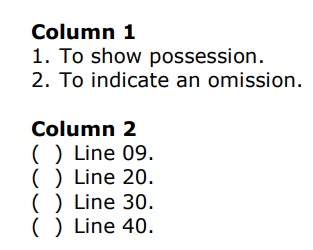
The correct order of filling in the parenthesis, from the top to the bottom, is:
I didn't tell _____ that I'd reached a breaking point in my relationship with screens.
Identify the best alternative that completes the context.
Read the sentence below.
I feel that being middle class is not what it once was and that we are all running in place as fast as we can to stay the same.
The bold item expresses:
Observe the following dialogue.
I knew if I ___ to Mr. Dayi, he would have surely helped me; but I ___ ashamed to speak with him.
Identify the best option that complete the context.
[…] free agency is one of the furthest things from your mind at the moment.
The bold superlative is related to:
Our stomachs are rumbling just thinking about all the lovely filling meals we eat throughout winter.
The bold clause indicates:
Apart from the church over the fountain, the council is under growing pressure to clean up mounting piles of rubbish and to fix thousands of monuments.
The bold item can be understood as:
He was angry when we enquired ____ his daughter.
Identify the best alternative that completes the context.
The German, who is being _____ home in Switzerland, turns 50 on Thursday.
Identify the best option that completes the context.
Police were called to investigate reports that children was threatened with a knife by a masked men who drove at them.
There are two mistakes in the context above related to:
The way we portrayed our women _____ a secondary-type role.
Indicate the best option that completes the context.
Why did you left your former job?
There is a mistake in the context above related to a/an:
Glad I made the right choice doe. Happy birthday angel.
Identify the antonym for “glad”.
There was no case that chastisement by the petitioner was beyond the child's powers. None of the witnesses stated that she cried or that she was in such a discomfort that she had to be taken home of endurance.
By the context, the bold item can be replaced by:
I- Uses verses and rhythmic writing; II- Uses imagery to paint a picture for the reader; III- Creates emotional detachments.
Identify the correct alternative.
Observe the paragraph below.
It was a rough ground, which was overgrown and covered in bamboo shoots 40 feet high, impossible to land on.
It may be correct to say that the ground was:
 Conheça nossos planos