Questões de Concurso
Comentadas para instituto rio branco
Foram encontradas 4.062 questões
Resolva questões gratuitamente!
Junte-se a mais de 4 milhões de concurseiros!


By using the expression “blazing a trail" (R.6), the authors inform the reader that Memory has opened a glowing and intense path as a result of her work.

In reference to the content of the text, its vocabulary and syntactic structure, decide whether the following statements are right (C) or wrong (E).
The repetition of single words and of phrases results in a
tiresome text, one in which the author tries to tell a story but is
stuck in descriptive language.
In reference to the content of the text, its vocabulary and syntactic structure, decide whether the following statements are right (C) or wrong (E).
In lines 4, 7 and 9, although with different syntactic functions,
the word it refers to the same thing: “the head of an enemy
which swung from the rafters” (l. 3 and 4).
In reference to the content of the text, its vocabulary and syntactic structure, decide whether the following statements are right (C) or wrong (E).
By being informed that Orlando had a “sullen face”
(l. 34 and 35), the reader learns that Orlando was a serious
and grave young man.
In reference to the content of the text, its vocabulary and syntactic structure, decide whether the following statements are right (C) or wrong (E).
The use of the words “dome” (R.54) and “temples” (R.55) has
the effect of creating a faint aura of saintliness and
religiousness about Orlando.
As far as Orlando’s physical features are concerned, decide whether the following statements are right (C) or wrong (E).
There was some fine, silky, soft hair both on his lips and
cheeks.
In relation to Orlando’s family, decide whether the following statements are right (C) or wrong (E).
Orlando’s father or his grandfather traversed vast expanses of
land beheading people of different races along the way.
According to the text, decide whether the following statements are right (C) or wrong (E).
Orlando cut a striking figure.
According to the text, decide whether the following statements are right (C) or wrong (E).
Orlando acquired, from an early age on, a disconcerting habit
of cross-dressing.
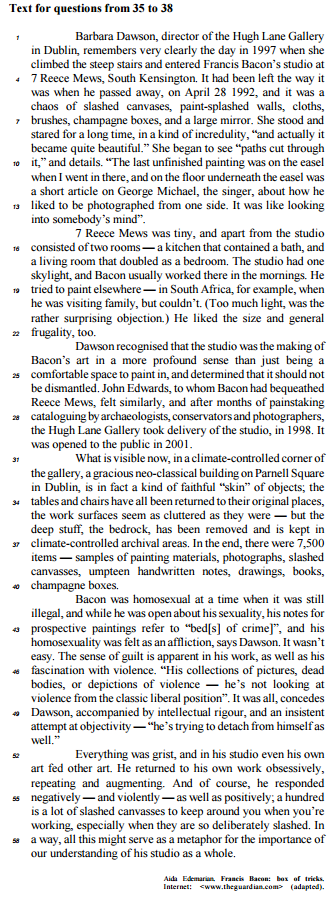
About the vocabulary the author uses in his text, decide whether the statements below are right (C) or wrong (E).
“prospective paintings” (l.43) can be understood as paintings
about which Bacon was still thinking or planning.
About the vocabulary the author uses in his text, decide whether the statements below are right (C) or wrong (E).
“umpteen” (l.39) could be correctly replaced by torn.

According to the information given in the text about Bacon’s personal life, his relationship with art, and his work, decide whether the statements below are right (C) or wrong (E).
Bacon makes a deliberate effort not to allow his personal life
to take central stage in his art.
According to the information given in the text about Bacon’s personal life, his relationship with art, and his work, decide whether the statements below are right (C) or wrong (E).
Heinous crimes provided the seeds for Bacon’s major works.

Each of the fragments from the text presented below is followed by a suggestion of rewriting. Decide whether the suggestion given maintains the meaning, coherence and grammar correction of the text (C) or not (E).
“make the necessary trade-offs to allow deadlocks to be
broken” (l. 33 and 34): strike a compromise as a way out of an
impasse
In relation to the content and the vocabulary of the text, decide whether the following statements are right (C) or wrong (E).
The expressions “two level games” (l.7) and “double-edged
diplomacy” (R.8) refer to a kind of diplomacy characterized by
the presence of two types of actors: political leaders and
technical diplomats.
In relation to the content and the vocabulary of the text, decide whether the following statements are right (C) or wrong (E).
As far as textual unity is concerned, “Yet” provides a transition
from the first to the second paragraphs, and establishes a
contrast between the ideas in each of them.
In reference to the text, decide whether the following statements are right (C) or wrong (E).
The text presents an opposition between club diplomacy and
network diplomacy, which are different and irreconcilable
ways of settling international conflicts.
In reference to the text, decide whether the following statements are right (C) or wrong (E).
The hierarchical structure of the diplomatic services in the 21st
century is remarkably different from that prevalent in the
previous centuries.
A segregação residencial é um dos mais expressivos processos espaciais que geram a fragmentação do espaço urbano. As áreas sociais são a sua manifestação espacial, a forma resultante do processo. Forma e processo levam a ver a cidade como um “mosaico social”. A partir da segregação das áreas sociais, originam-se inúmeras atividades econômicas espacialmente diferenciadas, como centros comerciais e áreas industriais. O inverso também é verdadeiro: a partir da concentração de indústrias na cidade, podem se formar bairros operários. A segregação residencial e as áreas sociais, por outro lado, estão na base de muitos movimentos sociais com foco no espaço.
R. L. Corrêa. Segregação residencial: classes sociais e espaço urbano. In: A cidade contemporânea. São Paulo: Contexto, 2013, p. 40-60 (com adaptações).
Com relação ao tema tratado no fragmento de texto acima, julgue (C ou E) o item que se segue.
Na cidade conurbada, as áreas de consumo de bens e serviços
não são as mesmas para todos, e o tempo de deslocamento até
elas é razão de diferenciação, o que facilita a elaboração de
uma representação de centralidade urbana que seja a base de
construção de identidades e de memória urbana.
A segregação residencial é um dos mais expressivos processos espaciais que geram a fragmentação do espaço urbano. As áreas sociais são a sua manifestação espacial, a forma resultante do processo. Forma e processo levam a ver a cidade como um “mosaico social”. A partir da segregação das áreas sociais, originam-se inúmeras atividades econômicas espacialmente diferenciadas, como centros comerciais e áreas industriais. O inverso também é verdadeiro: a partir da concentração de indústrias na cidade, podem se formar bairros operários. A segregação residencial e as áreas sociais, por outro lado, estão na base de muitos movimentos sociais com foco no espaço.
R. L. Corrêa. Segregação residencial: classes sociais e espaço urbano. In: A cidade contemporânea. São Paulo: Contexto, 2013, p. 40-60 (com adaptações).
Com relação ao tema tratado no fragmento de texto acima, julgue (C ou E) o item que se segue.
A segregação residencial resulta na minimização dos
movimentos sociais, por afastar a população pobre das áreas
centrais urbanas, e na maximização das representações das
diferentes áreas sociais.
 Conheça nossos planos