Questões Discursivas

Foram encontradas 39.550 questões

Resolva questões gratuitamente!

Junte-se a mais de 4 milhões de concurseiros!

Ano: 2024 Banca: FURB Órgão: FURB - SC Prova: FURB - 2024 - FURB - SC - Químico |
Q3550707 Química
Um químico precisa preparar 500 mL de uma solução aquosa de HCl 0,15 M, a partir de um frasco de HCl concentrado, cujo rótulo apresenta as seguintes informações:
Título/Dosagem = 37,0%. Densidade = 1,20 g/cm3. Massa molar = 36,5 g/mol.
Isso posto, qual a quantidade desse HCl concentrado terá que ser utilizada para o preparo dessa solução?
Alternativas
Ano: 2024 Banca: FURB Órgão: FURB - SC Prova: FURB - 2024 - FURB - SC - Químico |
Q3550706 Química
Considerando os princípios da espectroscopia de ressonância magnética nuclear (RMN) e os cuidados necessários durante o preparo das amostras para esse tipo de análise, analise as afirmações a seguir:
I.O solvente ideal para análise de RMN não deve conter hidrogênios, por esse motivo, os solventes deuterados de alta pureza isotópica são amplamente utilizados nesse tipo de análise.
II.A presença de impurezas ferromagnéticas pode causar o alargamento dos sinais devido à redução dos tempos de relaxação T2.
III.Para as análises de RMN de 13C, deve-se utilizar solventes enriquecidos no isótopo de 13C.
IV.A abundância isotópica do 1H é muito maior do que a abundância do isótopo de 13C, o que faz com que o RMN de 13C seja mais sensível e proporcione sinais mais intensos (maior relação sinal/ruído) em comparação com RMN de 1H.
É correto o que se afirma em:
Alternativas
Ano: 2024 Banca: FURB Órgão: FURB - SC Prova: FURB - 2024 - FURB - SC - Químico |
Q3550705 Química
Acerca do processo de fragmentação e dos rearranjos que ocorrem em espectrometria de massas, assinale a alternativa correta:
Alternativas
Ano: 2024 Banca: FURB Órgão: FURB - SC Prova: FURB - 2024 - FURB - SC - Químico |
Q3550704 Química

A figura a seguir representa um cromatograma oriundo de uma análise de cromatografia líquida de alta eficiência (CLAE). Considerando os valores de largura do pico esquerdo e direito medidos a 5% e 10% da altura do pico, calcule o fator de assimetria (Af ) e o fator de cauda (Tf ):
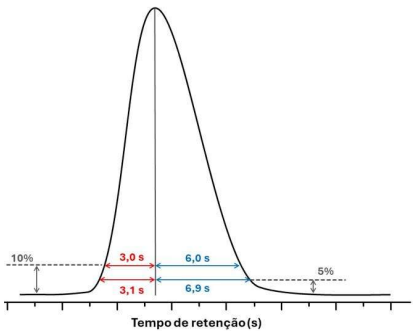

Imagem associada para resolução da questão


Assinale a alternativa correta:


Alternativas
Ano: 2024 Banca: FURB Órgão: FURB - SC Prova: FURB - 2024 - FURB - SC - Químico |
Q3550703 Química
Considere as afirmativas relacionadas à espectroscopia de massas. Registre V, para verdadeiras, e F, para falsas:
(__)A fragmentação por impacto eletrônico envolve a colisão dos íons com elétrons energéticos, resultando na quebra de ligações químicas na molécula. Os principais tipos de fragmentação incluem a perda de radicais, fragmentação de cadeia e rearranjo de íons.
(__)Com o espectro de massas, não é possível distinguir entre isômeros estruturais.
(__)A interpretação de espectros de massas de compostos desconhecidos pode ser desafiadora devido à presença de múltiplos picos, sobreposição de fragmentos e complexidade estrutural.
(__)O espectrômetro de massas é composto por dois componentes principais: um analisador de massa e um detector. O analisador de massa separa os íons com base em sua razão carga/massa e o detector registra e quantifica os íons que atingem o detector após a separação.
Assinale a opção que representa a sequência correta:
Alternativas
Q3550595 Inglês
 A phrasal verb is a combination of a verb and one or more particles (usually prepositions or adverbs) that together form a single semantic unit with a distinct meaning that may not be immediately obvious from the individual meanings of its parts. Phrasal verbs often have idiomatic or figurative meanings and are commonly used in English conversation and writing. They can convey a wide range of actions, emotions, and concepts. Observe the following columns. Associate the second column according to the first, which relates phrasal verbs with their definitions:
First column: phrasal verbs (1) Bear in mind. (2) Bring about. (3) Provide with.
Second column: definitions (__) To cause something to happen or to produce a particular result.
(__) To supply someone with something that they need or want.
(__) To remember or consider something; to keep something in one's thoughts.
Mark the option that presents the correct association between the columns: 
Alternativas
Q3550594 Inglês
When considering methodological approaches to teaching English as a second language, which of the following best aligns with communicative language teaching (CLT)?
The appropriate answer fills the gap in the following sentence: _____________ focuses on engaging learners in authentic language tasks to promote communication and language acquisition, making it the best fit for CLT principles.
Alternativas
Q3550593 Inglês
In English language teaching, understanding phonemes — the smallest units of sound that distinguish meaning — is crucial for learners to develop accurate pronunciation and enhance their overall oral communication skills. When delving into English phonetics, it's essential to grasp the distinction between voiced and voiceless consonants, which significantly impacts pronunciation and can influence in word differentiation. Observe the following statements about the text from question number one and choose the correct one:
Alternativas
Q3550592 Inglês
Examine the distinct characteristics and functional purposes of interactional and transactional conversations within interpersonal communication contexts. How do these conversation types differ in terms of structure, language use, and underlying goals, and what role do they play in fostering social relationships and achieving pragmatic outcomes? Choose the alternative that could better introduce a discussion about this topic: 
Alternativas
Q3550591 Inglês
Reported speech, a fundamental aspect of English grammar, involves conveying someone else's words or thoughts indirectly. It requires changes in pronouns, tenses, and sometimes word order. Now, consider the following statements:
I.In reported speech, the reporting verb can change from present tense to past tense when the reported statement is about a past event.
II.When reporting statements, modal verbs such as 'can' change to their past equivalents, such as 'could', to reflect the shift from direct to reported speech.
III.Reported speech often entails backshifting, where verb tenses shift back one tense in indirect speech compared to the original direct speech.
It is correct what is stated in:
Alternativas
Q3550590 Inglês
Associate the second column according to the first, which relates grammatical structures with examples of them:
First column: grammatical structures (1) Third Conditional. (2) Present Perfect. (3) Past Simple.
Second column: examples of the structures (__) He meticulously cataloged every detail of his journey in his journal.
(__) They have encountered myriad challenges during their entrepreneurial journey.
(__) If she had invested wisely, she would be luxuriously lounging on her private yacht by now.
Mark the option that presents the correct association between the columns:
Alternativas
Q3550589 Inglês
Consider the intricate nuances of language usage and cultural sensitivity in the context of international travel, particularly focusing on the subtle differences in vocabulary, tone, and nonverbal communication when interacting with locals in diverse linguistic environments. How do these linguistic considerations contribute to enriching travel experiences and fostering cross-cultural understanding? Choose T (true) for the statements that answer the question appropriately and F (false) for the statements that do not answer it correctly:
(__)Awareness of cultural norms and linguistic subtleties enhances travelers' ability to effectively communicate and navigate unfamiliar environments.
(__)Deepening one's understanding of local dialects and idiomatic expressions is irrelevant for travelers seeking authentic cultural experiences.
(__)Flexibility in language use allows travelers to adapt to diverse cultural contexts and build meaningful connections with locals during their journeys.
It is correct what is stated in:
Alternativas
Q3550588 Inglês
Read the following statements about necessary abilities to be developed by students of English as an additional/foreign language. Choose the correct one: 
Alternativas
Q3550587 Inglês
In English Language Teaching, some steps are involved in planning a communicative activity to enhance students' speaking skills. Observe four examples of those important steps:
1.Preceding the main speaking task, engaging learners in a preliminary activity designed to activate prior knowledge or evoke intellectual curiosity proves instrumental in priming them for the forthcoming linguistic challenge.
2.Selecting a communicative objective with deliberate intentionality serves as the foundational step in orchestrating a speaking activity geared towards enhancing students' linguistic proficiency.
3.Facilitating a whole-group discourse session wherein students partake in an expansive exchange of ideas and opinions not only hones their oral communication skills but also cultivates a collaborative learning environment.
4.Following the culmination of the speaking activity, providing constructive feedback to individual students regarding their performance offers invaluable insights for refinement and continuous improvement in their linguistic competence.
The appropriate sequence for developing a classroom activity focusing on communication is: 
Alternativas
Q3550586 Inglês
When preparing to travel abroad, it is important to bear in mind that you may need to face healthcare situations in English-speaking countries. Considering that, which of the following language skills related to health is most beneficial for English learners to acquire? Observe the following possible answers:
I.Basic Medical Vocabulary
II.Advanced Medical Terminology
III.Expressing Symptoms and Medical History
It is correct what is stated in:
Alternativas
Q3550585 Inglês
When aiming to engage teenagers in an English as an additional language classroom, which of the following strategies is most effective for promoting active participation and motivation?
Alternativas
Q3550584 Inglês
O texto seguinte servirá de base para responder à questão.

Technology in Language Education: Benefits and Barriers
A variety of e-learning technologies are available for use in educational programs. In many parts of the world, education ministries and universities have invested much effort into increasing the use of the web in all its forms (for example, e-books, simulations, text messaging, podcasting. wikis, and blogs) to meet the demands of competitive markets and to bring a variety of learning choices to their learners. It has been reported that the advent of new technology has a positive influence on both learners and teachers (Mansor 2001).
Researchers (Friggard 2002; Miner 2004; Timucin 2006) have demonstrated that technology boosts the development of teaching methods as well as students' knowledge. Lam and Lawrence (2002) claim that technology provides learners with regulation of their own learning process and easy access to information the teacher may not be able to provide. The potentially positive side of incorporating technology has encouraged foreign language educators to apply its advantages to enhance pedagogical practices. However, the integration of technology in the classroom cannot be devoid of problems. Several studies have documented the advantages of technology for language learning. While the advantages of technology use are often reported, it would be naive to expect technology use to transform language teaching or learning without first encountering and overcoming some barriers.
Findings from empirical research and the literature showed that technology integration in language teaching is advocated for a variety of reasons. Awareness of the barriers to and advantages of technology in enhancing teaching certainly has implications for teacher education. Further, teachers new to technology-based learning and teaching need to understand their changed roles and responsibilities in the new modality of learning and teaching. At the same time, teachers need to bear in mind that it is pedagogy, not technology that determines learning effectiveness. To make a successful transition from traditional pedagogy to technology-enriched instruction, teachers need to alter their teaching approaches to achieve effective teaching.

Based and adapted from 'RIASATI, Mohammad Javad; ALLAHYAR, Negah; TAN, Kok-Eng. Technology in language education: Benefits and barriers. Journal of education and practice, v. 3, n. 5, p. 25-30, 2012. 
Read the following statements about technology in language teaching:
I.Engagement, improvement in academic ability, and collaborative learning enhancement are some benefits that are expected when technology is involved in the teaching process.
II.Lowering learning anxiety level and lack of time are examples of the possible barriers mentioned in the text.
III.Among others, lack of access and lack of effective training are possible disadvantages of technology use to teach anything.
It is correct what is stated in:
Alternativas
Q3550583 Inglês
O texto seguinte servirá de base para responder à questão.

Technology in Language Education: Benefits and Barriers
A variety of e-learning technologies are available for use in educational programs. In many parts of the world, education ministries and universities have invested much effort into increasing the use of the web in all its forms (for example, e-books, simulations, text messaging, podcasting. wikis, and blogs) to meet the demands of competitive markets and to bring a variety of learning choices to their learners. It has been reported that the advent of new technology has a positive influence on both learners and teachers (Mansor 2001).
Researchers (Friggard 2002; Miner 2004; Timucin 2006) have demonstrated that technology boosts the development of teaching methods as well as students' knowledge. Lam and Lawrence (2002) claim that technology provides learners with regulation of their own learning process and easy access to information the teacher may not be able to provide. The potentially positive side of incorporating technology has encouraged foreign language educators to apply its advantages to enhance pedagogical practices. However, the integration of technology in the classroom cannot be devoid of problems. Several studies have documented the advantages of technology for language learning. While the advantages of technology use are often reported, it would be naive to expect technology use to transform language teaching or learning without first encountering and overcoming some barriers.
Findings from empirical research and the literature showed that technology integration in language teaching is advocated for a variety of reasons. Awareness of the barriers to and advantages of technology in enhancing teaching certainly has implications for teacher education. Further, teachers new to technology-based learning and teaching need to understand their changed roles and responsibilities in the new modality of learning and teaching. At the same time, teachers need to bear in mind that it is pedagogy, not technology that determines learning effectiveness. To make a successful transition from traditional pedagogy to technology-enriched instruction, teachers need to alter their teaching approaches to achieve effective teaching.

Based and adapted from 'RIASATI, Mohammad Javad; ALLAHYAR, Negah; TAN, Kok-Eng. Technology in language education: Benefits and barriers. Journal of education and practice, v. 3, n. 5, p. 25-30, 2012. 
According to the text, choose the correct alternative:
Alternativas
Q3550505 Engenharia Ambiental e Sanitária

É correto afirmar que o diâmetro interno mínimo dos condutos secundários é:

Alternativas
Q3550504 Engenharia Ambiental e Sanitária

Para planejar ou projetar um sistema de abastecimento de água, é necessário que se conheça o contingente populacional a ser atendido. Sobre as populações residente, flutuante e temporária, analise as afirmações a seguir:


I. População residente: aquela formada por pessoas que têm o domicílio como residência habitual, mesmo que ausente na data do censo por período inferior a doze meses.


II. População temporária: aquela que, proveniente de outras comunidades, transfere-se ocasionalmente para a área em estudo, impondo ao sistema de abastecimento de água consumo unitário equivalente ao da população residente.


III. População flutuante: aquela que, proveniente de outras comunidades, transfere-se para a área em estudo, impondo ao sistema de abastecimento de água consumo unitário inferior ao atribuído à população residente, enquanto presente na área em função das atividades que aí exerce.


É correto o que se afirmar em:

Alternativas
Respostas
16481: A
16482: X
16483: C
16484: D
16485: C
16486: A
16487: A
16488: A
16489: A
16490: C
16491: C
16492: C
16493: B
16494: E
16495: E
16496: B
16497: D
16498: B
16499: B
16500: E