Selecionar segmento
Estude com questões de diferentes segmentos
Atenção: Isso limpará todos os campos já preenchidos no filtro!
Foram encontradas 2.849 questões
Resolva questões gratuitamente!
Junte-se a mais de 4 milhões de concurseiros!


Q2055048
Linguística
Texto associado
I. AULA DE PORTUGUÊS
A linguagem
na ponta da língua,
tão fácil de falar
e de entender.
A linguagem
na superfície estrelada de letras,
sabe lá o que ela quer dizer?
Professor Carlos Góis, ele é quem sabe,
e vai desmatando
o amazonas de minha ignorância.
Figuras de gramática, esquipáticas,
atropelam-me, aturdem-me, sequestram-me.
Já esqueci a língua em que comia,
em que pedia para ir lá fora,
em que levava e dava pontapé,
a língua, breve língua entrecortada
do namoro com a prima.
O português são dois; o outro, mistério.
(Carlos Drummond de Andrade)
II. Um Professor de “agramática”
II. Um Professor de “agramática”
Descobri aos 13 anos que o que me dava prazer nas
leituras não era a beleza das frases, mas a doença
delas.
Comuniquei ao Padre Ezequiel, um meu Preceptor,
esse gosto esquisito.
Eu pensava que fosse um sujeito escaleno.
– Gostar de fazer defeitos na frase é muito saudável,
o Padre me disse.
Ele fez um limpamento em meus receios.
O Padre falou ainda: Manoel, isso não é doença,
pode muito que você carregue para o resto da vida
um certo gosto por nadas…
E se riu.
Você não é de bugre? – ele continuou.
Que sim, eu respondi.
Veja que bugre só pega por desvios, não anda em
estradas –
Pois é nos desvios que encontra as melhores surpresas
e os ariticuns maduros.
Há que apenas saber errar bem o seu idioma.
Esse Padre Ezequiel foi o meu primeiro professor de
agramática.
(Manoel de Barros)
Segundo o narrador do texto de Manoel de Barros (texto II), o Pe. Ezequiel foi o seu “primeiro professor de
agramática.” Partindo desse pressuposto, de acordo com os seus conhecimentos linguísticos, podemos
afirmar que aquele docente talvez estivesse vinculado a uma determinada corrente linguística, podendo ser
associado ao ensino da língua de forma:
Q2055047
Linguística
Texto associado
I. AULA DE PORTUGUÊS
A linguagem
na ponta da língua,
tão fácil de falar
e de entender.
A linguagem
na superfície estrelada de letras,
sabe lá o que ela quer dizer?
Professor Carlos Góis, ele é quem sabe,
e vai desmatando
o amazonas de minha ignorância.
Figuras de gramática, esquipáticas,
atropelam-me, aturdem-me, sequestram-me.
Já esqueci a língua em que comia,
em que pedia para ir lá fora,
em que levava e dava pontapé,
a língua, breve língua entrecortada
do namoro com a prima.
O português são dois; o outro, mistério.
(Carlos Drummond de Andrade)
II. Um Professor de “agramática”
II. Um Professor de “agramática”
Descobri aos 13 anos que o que me dava prazer nas
leituras não era a beleza das frases, mas a doença
delas.
Comuniquei ao Padre Ezequiel, um meu Preceptor,
esse gosto esquisito.
Eu pensava que fosse um sujeito escaleno.
– Gostar de fazer defeitos na frase é muito saudável,
o Padre me disse.
Ele fez um limpamento em meus receios.
O Padre falou ainda: Manoel, isso não é doença,
pode muito que você carregue para o resto da vida
um certo gosto por nadas…
E se riu.
Você não é de bugre? – ele continuou.
Que sim, eu respondi.
Veja que bugre só pega por desvios, não anda em
estradas –
Pois é nos desvios que encontra as melhores surpresas
e os ariticuns maduros.
Há que apenas saber errar bem o seu idioma.
Esse Padre Ezequiel foi o meu primeiro professor de
agramática.
(Manoel de Barros)
Para Koch & Travaglia, a coerência textual “[...] tem a ver com a boa formação em termos de interlocução
comunicativa, que determina não só a possibilidade de estabelecer o sentido do texto, mas também, com
frequência, qual sentido se estabelece.” (Coerência textual. 12ª ed. São Paulo: Contexto, 2001, p. 32).
Ampliando esse conceito, Van Dijk e Kintsch (Strategies in Discourse Comprehension. New York: Academics
Press, 1983) afirmam a existência de diversos tipos de coerência. A partir desses princípios, ao se analisar o
texto de Manoel de Barros (texto II), podemos afirmar que nele, preponderantemente, as relações
macroestruturais se dão através da:
Q2055046
Português
Texto associado
I. AULA DE PORTUGUÊS
A linguagem
na ponta da língua,
tão fácil de falar
e de entender.
A linguagem
na superfície estrelada de letras,
sabe lá o que ela quer dizer?
Professor Carlos Góis, ele é quem sabe,
e vai desmatando
o amazonas de minha ignorância.
Figuras de gramática, esquipáticas,
atropelam-me, aturdem-me, sequestram-me.
Já esqueci a língua em que comia,
em que pedia para ir lá fora,
em que levava e dava pontapé,
a língua, breve língua entrecortada
do namoro com a prima.
O português são dois; o outro, mistério.
(Carlos Drummond de Andrade)
II. Um Professor de “agramática”
II. Um Professor de “agramática”
Descobri aos 13 anos que o que me dava prazer nas
leituras não era a beleza das frases, mas a doença
delas.
Comuniquei ao Padre Ezequiel, um meu Preceptor,
esse gosto esquisito.
Eu pensava que fosse um sujeito escaleno.
– Gostar de fazer defeitos na frase é muito saudável,
o Padre me disse.
Ele fez um limpamento em meus receios.
O Padre falou ainda: Manoel, isso não é doença,
pode muito que você carregue para o resto da vida
um certo gosto por nadas…
E se riu.
Você não é de bugre? – ele continuou.
Que sim, eu respondi.
Veja que bugre só pega por desvios, não anda em
estradas –
Pois é nos desvios que encontra as melhores surpresas
e os ariticuns maduros.
Há que apenas saber errar bem o seu idioma.
Esse Padre Ezequiel foi o meu primeiro professor de
agramática.
(Manoel de Barros)
No poema de Drummond (texto I), pode-se afirmar que, entre outros temas, estabelece-se a relação entre
língua(gem), e que pode ser atestada quando a defrontamos com a definição proposta em alguns trabalhos
clássicos de linguístas famosos. Em razão disso, marque a alternativa que melhor definiria o
posicionamento do eu-lírico a respeito desse assunto:
Q2055045
Português
Texto associado
I. AULA DE PORTUGUÊS
A linguagem
na ponta da língua,
tão fácil de falar
e de entender.
A linguagem
na superfície estrelada de letras,
sabe lá o que ela quer dizer?
Professor Carlos Góis, ele é quem sabe,
e vai desmatando
o amazonas de minha ignorância.
Figuras de gramática, esquipáticas,
atropelam-me, aturdem-me, sequestram-me.
Já esqueci a língua em que comia,
em que pedia para ir lá fora,
em que levava e dava pontapé,
a língua, breve língua entrecortada
do namoro com a prima.
O português são dois; o outro, mistério.
(Carlos Drummond de Andrade)
II. Um Professor de “agramática”
II. Um Professor de “agramática”
Descobri aos 13 anos que o que me dava prazer nas
leituras não era a beleza das frases, mas a doença
delas.
Comuniquei ao Padre Ezequiel, um meu Preceptor,
esse gosto esquisito.
Eu pensava que fosse um sujeito escaleno.
– Gostar de fazer defeitos na frase é muito saudável,
o Padre me disse.
Ele fez um limpamento em meus receios.
O Padre falou ainda: Manoel, isso não é doença,
pode muito que você carregue para o resto da vida
um certo gosto por nadas…
E se riu.
Você não é de bugre? – ele continuou.
Que sim, eu respondi.
Veja que bugre só pega por desvios, não anda em
estradas –
Pois é nos desvios que encontra as melhores surpresas
e os ariticuns maduros.
Há que apenas saber errar bem o seu idioma.
Esse Padre Ezequiel foi o meu primeiro professor de
agramática.
(Manoel de Barros)
A partir da leitura dos textos (I) e (II), só NÃO podemos dizer que, em ambos, o ensino da língua portuguesa:
Q2055044
Linguística
Das várias concepções de gramática, temos aquela que considera “[...] a língua como um conjunto de
variedades utilizadas por uma sociedade de acordo com o exigido pela situação de interação comunicativa
em que o usuário da língua está engajado, percebe a gramática como o conjunto de regras que o falante de
fato aprendeu e das quais lança mão ao falar”.
(TRAVAGLIA, Luiz Carlos. Gramática e interação: uma proposta para o ensino de gramática no 1º e 2º graus. 4ª ed. São Paulo: Cortez, 1998, p. 28).
Dessa forma, de acordo com excerto acima, pode-se afirmar que Luiz Carlos Travaglia refere-se à:
(TRAVAGLIA, Luiz Carlos. Gramática e interação: uma proposta para o ensino de gramática no 1º e 2º graus. 4ª ed. São Paulo: Cortez, 1998, p. 28).
Dessa forma, de acordo com excerto acima, pode-se afirmar que Luiz Carlos Travaglia refere-se à:
Q2055043
Português
Texto associado
“A Linguística Textual trata o texto como um ato de comunicação unificado num complexo universo de
ações humanas. Por um lado, deve preservar a organização linear que é o tratamento estritamente
linguístico abordado no aspecto da coesão e, por outro, deve considerar a organização reticulada ou
tentacular, não linear portanto, dos níveis de sentido e intenções que realizam a coerência no aspecto
semântico e funções pragmáticas.”
(MARCUSCHI, LUIZ A. In: KOCH, Ingedore G. Villaça. A coesão textual. São Paulo: Contexto, 2001, p. 14).
A partir dos pressupostos estabelecidos pela Linguística Textual, passou-se a pesquisar quais os elementos
ou fatores responsáveis pela textualidade e que, segundo Beugrande & Dressler (Introduction to
Textlinguisticas, London, Longman, 1981), são em número de sete e que podem ser observados na matriz
de referência que objetiva avaliar as competências textuais nas redações do ENEM, conforme discriminados
no quadro abaixo:
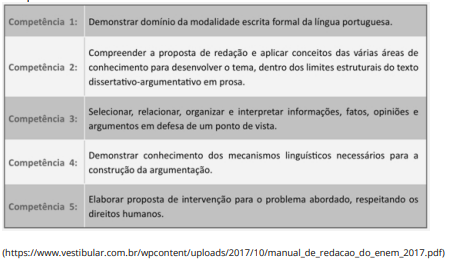
Dessa forma, podemos afirmar que os fatores de textualidade estão relacionados na matriz de referência do ENEM da seguinte forma:
I - A coerência está compreendida na competência 3, enquanto que a coesão é a competência 4. II - A informatividade e a intencionalidade estão relacionadas à competência 3, uma vez que aquela relaciona-se ao grau de previsibilidade do texto e esta busca selecionar argumentos em defesa de um ponto de vista, acerca de um tema proposto. III - A aceitabilidade pode ser observada em todas as competências. IV - A situacionalidade está relacionada à competência 1, enquanto que a intertextualidade pode ser observada nas competências 2 e 3.
Dessa forma, podemos afirmar que os fatores de textualidade estão relacionados na matriz de referência do ENEM da seguinte forma:
I - A coerência está compreendida na competência 3, enquanto que a coesão é a competência 4. II - A informatividade e a intencionalidade estão relacionadas à competência 3, uma vez que aquela relaciona-se ao grau de previsibilidade do texto e esta busca selecionar argumentos em defesa de um ponto de vista, acerca de um tema proposto. III - A aceitabilidade pode ser observada em todas as competências. IV - A situacionalidade está relacionada à competência 1, enquanto que a intertextualidade pode ser observada nas competências 2 e 3.
Q2055042
Português
Texto associado
“A Linguística Textual trata o texto como um ato de comunicação unificado num complexo universo de
ações humanas. Por um lado, deve preservar a organização linear que é o tratamento estritamente
linguístico abordado no aspecto da coesão e, por outro, deve considerar a organização reticulada ou
tentacular, não linear portanto, dos níveis de sentido e intenções que realizam a coerência no aspecto
semântico e funções pragmáticas.”
(MARCUSCHI, LUIZ A. In: KOCH, Ingedore G. Villaça. A coesão textual. São Paulo: Contexto, 2001, p. 14).
A respeito do excerto em destaque, julgue as afirmativas abaixo e marque a alternativa correta:
I - Marcuschi, em sua hipótese de trabalho [da linguística textual], toma como unidade básica, ou seja, como objeto particular de investigação, não mais a palavra ou a frase, mas sim o texto, por serem os textos a forma específica de manifestação da linguagem. II - Segundo Marcuschi, a maior mudança foi que se passou a tomar o texto como objeto central do ensino, isto é, a priorizar, nas aulas de língua portuguesa, as atividades de leitura e produção de textos, levando o aluno a refletir sobre o funcionamento da língua nas diversas situações de interação verbal, sobre o uso dos recursos que a língua lhes oferece para a concretização de suas propostas de sentido, bem como sobre a adequação dos textos a cada situação. III - Podemos inferir que, para Marcuschi, o texto é a simples soma das frases (e palavras) que o compõem, não se diferenciando entre si, uma vez que a diferença entre frase e texto é meramente de ordem quantitativa e não de ordem qualitativa.
I - Marcuschi, em sua hipótese de trabalho [da linguística textual], toma como unidade básica, ou seja, como objeto particular de investigação, não mais a palavra ou a frase, mas sim o texto, por serem os textos a forma específica de manifestação da linguagem. II - Segundo Marcuschi, a maior mudança foi que se passou a tomar o texto como objeto central do ensino, isto é, a priorizar, nas aulas de língua portuguesa, as atividades de leitura e produção de textos, levando o aluno a refletir sobre o funcionamento da língua nas diversas situações de interação verbal, sobre o uso dos recursos que a língua lhes oferece para a concretização de suas propostas de sentido, bem como sobre a adequação dos textos a cada situação. III - Podemos inferir que, para Marcuschi, o texto é a simples soma das frases (e palavras) que o compõem, não se diferenciando entre si, uma vez que a diferença entre frase e texto é meramente de ordem quantitativa e não de ordem qualitativa.
Q2055041
Português
“[...] na concepção interacional (dialógica) da língua, os sujeitos são vistos como atores/construtores sociais,
sujeitos ativos que – dialogicamente – se constroem e são construídos no texto, considerado o próprio lugar
da interação dos interlocutores.” (KOCH, Ingedore Villaça e ELIAS, Vanda Maria. Ler e compreender: os
sentidos do texto. p. 10-11). Desse modo, e de acordo com o foco na interação autor-texto-leitor, só NÃO
podemos afirmar que:
Q2055038
Português
“Frequentemente ouvimos falar – e também falamos – sobre a importância da leitura na nossa vida, sobre a
necessidade de se cultivar o hábito de leitura entre crianças e jovens, sobre o papel da escola na formação
de leitores competentes [...] Mas, no bojo dessa discussão, destacam-se questões como: o que é ler? Para
que ler? Como ler? Evidentemente, as perguntas poderão ser respondidas de diferentes modos, os quais
revelarão uma concepção de leitura decorrente da concepção de sujeito, de língua, de texto e de sentido
que se adote.
Sobre essa questão [...] a concepção de língua como representação do pensamento corresponde à de sujeito psicológico, individual, dono de suas vontades e ações. Trata-se de um sujeito visto como um ego que constrói uma representação mental e deseja que esta seja ‘captada’ pelo interlocutor da maneira como foi mentalizada.”
(KOCH, Ingedore Villaça e ELIAS, Vanda Maria. Ler e compreender: os sentidos do texto. p. 09-10)
Com base na leitura do texto e no que se refere à concepção de língua como representação do pensamento e de sujeito como senhor absoluto de suas ações e de seu dizer, só NÃO podemos afirmar que:
Sobre essa questão [...] a concepção de língua como representação do pensamento corresponde à de sujeito psicológico, individual, dono de suas vontades e ações. Trata-se de um sujeito visto como um ego que constrói uma representação mental e deseja que esta seja ‘captada’ pelo interlocutor da maneira como foi mentalizada.”
(KOCH, Ingedore Villaça e ELIAS, Vanda Maria. Ler e compreender: os sentidos do texto. p. 09-10)
Com base na leitura do texto e no que se refere à concepção de língua como representação do pensamento e de sujeito como senhor absoluto de suas ações e de seu dizer, só NÃO podemos afirmar que:
Q2055037
Português
Texto associado
“[...] o gramático e historiador português João de Barros escreveu, no século XVI, que o modelo de língua a
ser seguido deveria ser a língua dos ‘barões doutos’, isto é, dos homens da nobreza. Também o francês
Vaugelas, no século XVII, dizia que a língua-padrão tinha que se basear no uso ‘da parte mais sadia da Corte’.
E até hoje, na Inglaterra, a língua que deve servir de modelo se chama ‘Queen’s English’, o inglês da Rainha.
E ao findar o século XX, o gramático e filólogo brasileiro Evanildo Bechara dizia que devemos levar o aluno ‘a
falar melhor com os melhores’”. (BAGNO, Marcos et all. Língua materna: letramento, variação e ensino, p. 29. São Paulo: Parábola, 2002).
Marcos Bagno, no texto em destaque, discute a concepção tradicional do ensino da língua. A respeito disso,
julgue as afirmativas abaixo e marque a alternativa correta.
I - O ensino da língua opera com uma sucessão de reduções: língua, norma e gramática. II - A gramática é entendida como uma série de regras de funcionamento mecânico que devem ser seguidas à risca para dar um resultado perfeito e admissível. III - Por causa da concepção reducionista do ensino em língua, norma e gramática, como uma abstração arrancada de sua realidade social, histórica e cultural, é que podemos afirmar que existe uma distância muito grande entre as regras gramaticais descritas e prescritas pela norma-padrão tradicional.
I - O ensino da língua opera com uma sucessão de reduções: língua, norma e gramática. II - A gramática é entendida como uma série de regras de funcionamento mecânico que devem ser seguidas à risca para dar um resultado perfeito e admissível. III - Por causa da concepção reducionista do ensino em língua, norma e gramática, como uma abstração arrancada de sua realidade social, histórica e cultural, é que podemos afirmar que existe uma distância muito grande entre as regras gramaticais descritas e prescritas pela norma-padrão tradicional.
Q2055036
Linguística
Texto associado
“[...] o gramático e historiador português João de Barros escreveu, no século XVI, que o modelo de língua a
ser seguido deveria ser a língua dos ‘barões doutos’, isto é, dos homens da nobreza. Também o francês
Vaugelas, no século XVII, dizia que a língua-padrão tinha que se basear no uso ‘da parte mais sadia da Corte’.
E até hoje, na Inglaterra, a língua que deve servir de modelo se chama ‘Queen’s English’, o inglês da Rainha.
E ao findar o século XX, o gramático e filólogo brasileiro Evanildo Bechara dizia que devemos levar o aluno ‘a
falar melhor com os melhores’”. (BAGNO, Marcos et all. Língua materna: letramento, variação e ensino, p. 29. São Paulo: Parábola, 2002).
A respeito do excerto em destaque, julgue as afirmativas abaixo e marque a alternativa correta:
I - Há uma concepção, inferida no texto, de que a linguagem usada por essa certa “aristocracia” tornou-se o padrão, a norma, o molde ideal ao qual todos os demais usos da língua tinham de se ajustar. II - Essa concepção de língua baseia-se em visões de mundo pré-científicas e em estruturas sociais organizadas em sistemas mais democráticos, como era o caso da sociedade grega na Antiguidade Clássica, quando nasceu a Gramática Tradicional. III - Poderíamos resumir as ideias contidas no excerto com a seguinte afirmação: graças à impostura ideológica, o fato da maioria acaba sendo representativo da totalidade.
I - Há uma concepção, inferida no texto, de que a linguagem usada por essa certa “aristocracia” tornou-se o padrão, a norma, o molde ideal ao qual todos os demais usos da língua tinham de se ajustar. II - Essa concepção de língua baseia-se em visões de mundo pré-científicas e em estruturas sociais organizadas em sistemas mais democráticos, como era o caso da sociedade grega na Antiguidade Clássica, quando nasceu a Gramática Tradicional. III - Poderíamos resumir as ideias contidas no excerto com a seguinte afirmação: graças à impostura ideológica, o fato da maioria acaba sendo representativo da totalidade.
Q2055035
Português
Texto associado
Com base no texto abaixo, responda às questões 11 e 12:
“As línguas mudam todos os dias, evoluem, mas a essa mudança diacrônica se acrescenta uma outra,
sincrônica: pode-se perceber numa língua, continuamente, a coexistência de formas diferentes de um
mesmo significado.”
(CALVET, Louis-Jean. Sociolinguística: uma introdução crítica, p. 89-90. São Paulo: Parábola, 2002).
É bem conhecida a diferença entre a fonética e fonologia e sua aplicabilidade nas pesquisas acerca das
variantes linguísticas. Dessa forma, com base em seus conhecimentos a respeito desse assunto, julgue as
afirmativas abaixo e marque a alternativa correta.
I - Podemos afirmar que a fonética descreve a pronúncia efetiva dos sons da língua entre os falantes. Já a fonologia extrai dessas pronúncias uma estrutura abstrata que permite organizar os sons da língua. II - Podemos sintetizar as diferenças entre fonética e fonologia na dicotomia saussuriana entre língua e fala. Dessa forma, a fonética estaria ao lado da língua; a fonologia, ao lado da fala. III - A separação entre fonética e fonologia permite prever que, ao lado do fonema abstrato e invariante, suas realizações fonéticas podem apresentar, ao contrário, variantes. Isso nos permitiria saber se essas diferentes realizações são explicáveis por variáveis sociais ou se, ao contrário, permitem estruturar o grupo social.
I - Podemos afirmar que a fonética descreve a pronúncia efetiva dos sons da língua entre os falantes. Já a fonologia extrai dessas pronúncias uma estrutura abstrata que permite organizar os sons da língua. II - Podemos sintetizar as diferenças entre fonética e fonologia na dicotomia saussuriana entre língua e fala. Dessa forma, a fonética estaria ao lado da língua; a fonologia, ao lado da fala. III - A separação entre fonética e fonologia permite prever que, ao lado do fonema abstrato e invariante, suas realizações fonéticas podem apresentar, ao contrário, variantes. Isso nos permitiria saber se essas diferentes realizações são explicáveis por variáveis sociais ou se, ao contrário, permitem estruturar o grupo social.
Q2055034
Português
Texto associado
Com base no texto abaixo, responda às questões 11 e 12:
“As línguas mudam todos os dias, evoluem, mas a essa mudança diacrônica se acrescenta uma outra,
sincrônica: pode-se perceber numa língua, continuamente, a coexistência de formas diferentes de um
mesmo significado.”
(CALVET, Louis-Jean. Sociolinguística: uma introdução crítica, p. 89-90. São Paulo: Parábola, 2002).
A respeito do excerto em destaque, julgue as afirmativas abaixo e marque a alternativa correta:
I - As mudanças destacadas podem ser classificadas como variáveis geográficas, que são aquelas que podem ter pronúncias e léxicos iguais em diferentes pontos de território. II - Essas variáveis podem ter um sentido social, quando, em um mesmo ponto do território, uma diferença linguística é mais ou menos isomorfa de uma diferença social. III - Podemos entender por variável, o conjunto constituído pelos diferentes modos de realizar a mesma coisa (como um fonema, um signo); e por variante, cada uma das formas de realizar a mesma coisa.
I - As mudanças destacadas podem ser classificadas como variáveis geográficas, que são aquelas que podem ter pronúncias e léxicos iguais em diferentes pontos de território. II - Essas variáveis podem ter um sentido social, quando, em um mesmo ponto do território, uma diferença linguística é mais ou menos isomorfa de uma diferença social. III - Podemos entender por variável, o conjunto constituído pelos diferentes modos de realizar a mesma coisa (como um fonema, um signo); e por variante, cada uma das formas de realizar a mesma coisa.
Q2055033
Legislação Federal
Roberto, Tamires e Sabrina são candidatos hipotéticos
que participarão de um processo seletivo para os cursos
técnicos integrados ao ensino médio ofertados pelo
IFMT. Roberto cursou o ensino fundamental (do 1º ao 9º
ano) em escola pública, é branco e apresenta renda familiar bruta per capita de R$ 3.000,00. Tamires cursou o
primeiro ano do ensino fundamental em escola privada
e o restante (do 2ª ao 9ª ano) em escola pública, é autodeclarada preta e apresenta renda familiar bruta per capita de R$ 500,00. Sabrina cursou o ensino fundamental
(do 1ºao 9ºano) em escola pública, é autodeclarada parda, surda e apresenta renda familiar bruta per capita de
R$ 800,00. Considerando a Lei 12.711/2012, que trata da
reserva de vagas (cotas) para o ingresso nas universidades federais e nas instituições federais de ensino técnico
de nível médio, alterada pela 13.409/2016, regulamentada pelo Decreto 7.824/2017, alterado pelo Decreto
9.034/2017, e normatizada pela Portaria Normativa MEC
09/2017,assinale a alternativa correta:
Q2055025
Direito Administrativo
Considerando a Lei 8.112/1990, é correto afirmar:
Q2053080
Química
Alguns sais comportam-se como ácidos ou bases, ao reagirem com moléculas de água (reação de hidrólise)
e isso se torna importante para o entendimento do comportamento de algumas substâncias em meio
aquoso. Assinale a alternativa que apresenta um sal de caráter básico.
Q2053079
Química
Os ácidos e as bases são compostos importantes e estão presentes no cotidiano das pessoas, como nas
frutas: laranja, limão e abacaxi; em alimentos como o café; em medicamentos como leite de magnésia, além
de serem importantes na indústria, tais como o ácido sulfúrico e nítrico. Sobre esses compostos, marque a
alternativa INCORRETA.
Q2053078
Química
O ácido nítrico é o segundo mais utilizado na indústria química, depois do ácido sulfúrico. É utilizado na
fabricação do salitre, fertilizantes, corantes, fibras sintéticas, entretanto, é mais usado na fabricação de
explosivos, tais como dinamite e trinitrotolueno. Um professor, ao realizar uma análise química, preparou
uma solução deste ácido, adicionando 200 mL de água destilada em um balão volumétrico de 500 mL, e em
seguida 20 mL de ácido nítrico concentrado (pureza = 70% e densidade = 1,51 g cm3), completando o
volume restante com água até o menisco. Assinale a alternativa que corresponde à concentração
aproximadamente (mol L-1) da solução preparada pelo professor.
Dados: H = 1,0 g mol-1; N = 14,0 g mol-1; O = 16,0 g mol-1.
Dados: H = 1,0 g mol-1; N = 14,0 g mol-1; O = 16,0 g mol-1.
Q2053077
Química
O eteno (etileno) é um hidrocarboneto produzido pelas frutas, sendo responsável pelo seu
amadurecimento. Em virtude disso, alguns supermercados têm utilizado esse gás para acelerar o
amadurecimento das frutas que comercializam. Dentre as várias aplicações desse composto, ele pode ser
utilizado para produzir o tetrafluoreto de carbono, conforme a reação a seguir, a 298k e 1atm:
C2H4(g) + 6 F2(g) → 2 CF4(g) + 4 HF(g)
A partir das entalpias de formação (∆Hof) abaixo:
H2(g) + F2(g) → 2 HF(g) ∆Hof = - 537,6 kJ C(s) + 2 F2(g) → CF4(g) ∆Hof = - 680 kJ 2 C(s) + 2 H2(g) → C2H4(g) ∆Hof = + 52,3 kJ
BROWN, T. L.; LEMAY JR., H. E.; BURSTEN, B. E. Química, a Ciência Central. Tradutor Robson Matos, São Paulo: Pearson Prentice Hall, 2005, 5ª impressão em 2010.
Marque a alternativa que corresponde ao valor de variação de entalpia (∆Hor ) da reação do etileno com o gás flúor.
C2H4(g) + 6 F2(g) → 2 CF4(g) + 4 HF(g)
A partir das entalpias de formação (∆Hof) abaixo:
H2(g) + F2(g) → 2 HF(g) ∆Hof = - 537,6 kJ C(s) + 2 F2(g) → CF4(g) ∆Hof = - 680 kJ 2 C(s) + 2 H2(g) → C2H4(g) ∆Hof = + 52,3 kJ
BROWN, T. L.; LEMAY JR., H. E.; BURSTEN, B. E. Química, a Ciência Central. Tradutor Robson Matos, São Paulo: Pearson Prentice Hall, 2005, 5ª impressão em 2010.
Marque a alternativa que corresponde ao valor de variação de entalpia (∆Hor ) da reação do etileno com o gás flúor.
Q2053076
Química
A tabela periódica é uma ferramenta de fundamental importância para os químicos e está presente em
praticamente todas as salas de aulas. Os elementos são organizados nela, em ordem crescente de número
atômico, em períodos e grupos, de acordo com suas propriedades. Sobre a tabela, analise os itens a seguir:
I - Os elementos são classificados como representativos (elétrons de valência nos subníveis s ou p) e metais de transição (externa – elétrons de valência no subnivel d; interna – elétrons de valência no subnível f) e isso pode ser observado por meio da distribuição eletrônica. II - Dos 118 elementos presentes nas tabelas periódicas atuais, à temperatura ambiente, a grande maioria são sólidos e somente dois são líquidos: mercúrio e iodo. III - Os elementos fósforo (grupo 15) e cloro (grupo 17) combinam-se por ligações covalentes, formando o pentacloreto de fósforo. Esse composto apresenta geometria pirâmide trigonal e reage violentamente com a água, tendo como um dos produtos o ácido clorídrico. IV - De forma geral, os valores de energia de ionização e afinidade eletrônica, aumentam da esquerda para a direita nos períodos e de cima para baixo nos grupos. V - Os elementos estão presentes, no nosso cotidiano, podendo ser utilizados para a produção de materiais e desempenhar várias funções. A maioria das moléculas que constituem o corpo humano consiste predominantemente de seis elementos, sendo: C, H, O, N, P e Se.
Assinale a alternativa correta.
I - Os elementos são classificados como representativos (elétrons de valência nos subníveis s ou p) e metais de transição (externa – elétrons de valência no subnivel d; interna – elétrons de valência no subnível f) e isso pode ser observado por meio da distribuição eletrônica. II - Dos 118 elementos presentes nas tabelas periódicas atuais, à temperatura ambiente, a grande maioria são sólidos e somente dois são líquidos: mercúrio e iodo. III - Os elementos fósforo (grupo 15) e cloro (grupo 17) combinam-se por ligações covalentes, formando o pentacloreto de fósforo. Esse composto apresenta geometria pirâmide trigonal e reage violentamente com a água, tendo como um dos produtos o ácido clorídrico. IV - De forma geral, os valores de energia de ionização e afinidade eletrônica, aumentam da esquerda para a direita nos períodos e de cima para baixo nos grupos. V - Os elementos estão presentes, no nosso cotidiano, podendo ser utilizados para a produção de materiais e desempenhar várias funções. A maioria das moléculas que constituem o corpo humano consiste predominantemente de seis elementos, sendo: C, H, O, N, P e Se.
Assinale a alternativa correta.

 Conheça nossos planos