Questões de Concurso
Comentadas para esaf
Foram encontradas 8.037 questões
Resolva questões gratuitamente!
Junte-se a mais de 4 milhões de concurseiros!


Ano: 2006
Banca:
ESAF
Órgão:
CGU
Prova:
ESAF - 2006 - CGU - Analista de Finanças e Controle - Comum a todos - Prova 1 |
Q2343
Administração Pública
Escolha a opção que descreve corretamente três disfunções do tipo ideal de burocracia de Weber.
Ano: 2006
Banca:
ESAF
Órgão:
CGU
Prova:
ESAF - 2006 - CGU - Analista de Finanças e Controle - Comum a todos - Prova 1 |
Q2342
Administração Geral
Escolha a opção incorreta.
Ano: 2006
Banca:
ESAF
Órgão:
CGU
Prova:
ESAF - 2006 - CGU - Analista de Finanças e Controle - Comum a todos - Prova 1 |
Q2341
Administração Geral
O processo administrativo compõe-se de quatro funções básicas. Indique a opção correta.
Ano: 2006
Banca:
ESAF
Órgão:
CGU
Prova:
ESAF - 2006 - CGU - Analista de Finanças e Controle - Comum a todos - Prova 1 |
Q2340
Administração Pública
Escolha a opção que completa corretamente a frase a seguir:
Falar em efi ciência no âmbito do modelo gerencial da administração pública significa ............
Falar em efi ciência no âmbito do modelo gerencial da administração pública significa ............
Ano: 2006
Banca:
ESAF
Órgão:
CGU
Prova:
ESAF - 2006 - CGU - Analista de Finanças e Controle - Comum a todos - Prova 1 |
Q2339
Gestão de Pessoas
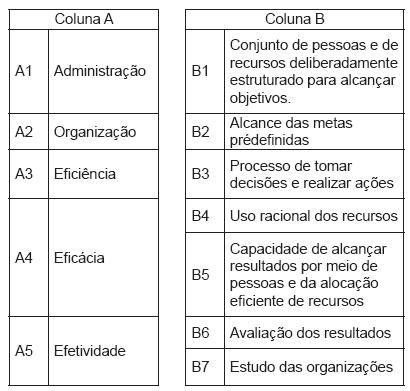
Correlacione a coluna A com a coluna B e escolha a opção correta.
Ano: 2006
Banca:
ESAF
Órgão:
CGU
Prova:
ESAF - 2006 - CGU - Analista de Finanças e Controle - Comum a todos - Prova 1 |
Q2328
Inglês
Texto associado
Read the text below which is entitled "Congress Caps
another Disappointing Year" in order to answer questions
27 to 30.
Congress Caps another Disappointing Year
Source: www.aaas.org
4th January 2006 (Adapted)
On December 30, nearly three months into the fi scal
year, President Bush signed the last two Fiscal Year
2006 appropriations bills into law, bringing the FY 2006
appropriation process to a close. The American Association
for the Advancement of Science (AAAS) estimates that the
federal Research & Development (R&D) portfolio totals
$134.8 billion in 2006, a $2.2 billion or 1.7 percent increase.
But 97 percent of the increase goes to just two specifi c
areas: defense weapons development and human space
exploration technologies. Funding for all other federal
R&D programs collectively will barely increase, and will fall
nearly 2 percent after adjusting for infl ation. Leaving out
large federal investments in development, congressional
appropriations for basic and applied research total $57.0
billion, an increase of $1.0 billion or 1.8 percent over
2005. But NASA applied research on human space fl ight
technologies accounts for a majority of the increase,
leaving most agency research portfolios with modest
increases falling short of infl ation, or cuts. Many fl agship
federal science agencies have disappointing budgets in
2006.
another Disappointing Year" in order to answer questions
27 to 30.
Congress Caps another Disappointing Year
Source: www.aaas.org
4th January 2006 (Adapted)
On December 30, nearly three months into the fi scal
year, President Bush signed the last two Fiscal Year
2006 appropriations bills into law, bringing the FY 2006
appropriation process to a close. The American Association
for the Advancement of Science (AAAS) estimates that the
federal Research & Development (R&D) portfolio totals
$134.8 billion in 2006, a $2.2 billion or 1.7 percent increase.
But 97 percent of the increase goes to just two specifi c
areas: defense weapons development and human space
exploration technologies. Funding for all other federal
R&D programs collectively will barely increase, and will fall
nearly 2 percent after adjusting for infl ation. Leaving out
large federal investments in development, congressional
appropriations for basic and applied research total $57.0
billion, an increase of $1.0 billion or 1.8 percent over
2005. But NASA applied research on human space fl ight
technologies accounts for a majority of the increase,
leaving most agency research portfolios with modest
increases falling short of infl ation, or cuts. Many fl agship
federal science agencies have disappointing budgets in
2006.
The text concludes that
Ano: 2006
Banca:
ESAF
Órgão:
CGU
Prova:
ESAF - 2006 - CGU - Analista de Finanças e Controle - Comum a todos - Prova 1 |
Q2327
Inglês
Texto associado
Read the text below which is entitled "Congress Caps
another Disappointing Year" in order to answer questions
27 to 30.
Congress Caps another Disappointing Year
Source: www.aaas.org
4th January 2006 (Adapted)
On December 30, nearly three months into the fi scal
year, President Bush signed the last two Fiscal Year
2006 appropriations bills into law, bringing the FY 2006
appropriation process to a close. The American Association
for the Advancement of Science (AAAS) estimates that the
federal Research & Development (R&D) portfolio totals
$134.8 billion in 2006, a $2.2 billion or 1.7 percent increase.
But 97 percent of the increase goes to just two specifi c
areas: defense weapons development and human space
exploration technologies. Funding for all other federal
R&D programs collectively will barely increase, and will fall
nearly 2 percent after adjusting for infl ation. Leaving out
large federal investments in development, congressional
appropriations for basic and applied research total $57.0
billion, an increase of $1.0 billion or 1.8 percent over
2005. But NASA applied research on human space fl ight
technologies accounts for a majority of the increase,
leaving most agency research portfolios with modest
increases falling short of infl ation, or cuts. Many fl agship
federal science agencies have disappointing budgets in
2006.
another Disappointing Year" in order to answer questions
27 to 30.
Congress Caps another Disappointing Year
Source: www.aaas.org
4th January 2006 (Adapted)
On December 30, nearly three months into the fi scal
year, President Bush signed the last two Fiscal Year
2006 appropriations bills into law, bringing the FY 2006
appropriation process to a close. The American Association
for the Advancement of Science (AAAS) estimates that the
federal Research & Development (R&D) portfolio totals
$134.8 billion in 2006, a $2.2 billion or 1.7 percent increase.
But 97 percent of the increase goes to just two specifi c
areas: defense weapons development and human space
exploration technologies. Funding for all other federal
R&D programs collectively will barely increase, and will fall
nearly 2 percent after adjusting for infl ation. Leaving out
large federal investments in development, congressional
appropriations for basic and applied research total $57.0
billion, an increase of $1.0 billion or 1.8 percent over
2005. But NASA applied research on human space fl ight
technologies accounts for a majority of the increase,
leaving most agency research portfolios with modest
increases falling short of infl ation, or cuts. Many fl agship
federal science agencies have disappointing budgets in
2006.
The increases given to most agency research portfolios are said to have been
Ano: 2006
Banca:
ESAF
Órgão:
CGU
Prova:
ESAF - 2006 - CGU - Analista de Finanças e Controle - Comum a todos - Prova 1 |
Q2326
Inglês
Texto associado
Read the text below which is entitled "Congress Caps
another Disappointing Year" in order to answer questions
27 to 30.
Congress Caps another Disappointing Year
Source: www.aaas.org
4th January 2006 (Adapted)
On December 30, nearly three months into the fi scal
year, President Bush signed the last two Fiscal Year
2006 appropriations bills into law, bringing the FY 2006
appropriation process to a close. The American Association
for the Advancement of Science (AAAS) estimates that the
federal Research & Development (R&D) portfolio totals
$134.8 billion in 2006, a $2.2 billion or 1.7 percent increase.
But 97 percent of the increase goes to just two specifi c
areas: defense weapons development and human space
exploration technologies. Funding for all other federal
R&D programs collectively will barely increase, and will fall
nearly 2 percent after adjusting for infl ation. Leaving out
large federal investments in development, congressional
appropriations for basic and applied research total $57.0
billion, an increase of $1.0 billion or 1.8 percent over
2005. But NASA applied research on human space fl ight
technologies accounts for a majority of the increase,
leaving most agency research portfolios with modest
increases falling short of infl ation, or cuts. Many fl agship
federal science agencies have disappointing budgets in
2006.
another Disappointing Year" in order to answer questions
27 to 30.
Congress Caps another Disappointing Year
Source: www.aaas.org
4th January 2006 (Adapted)
On December 30, nearly three months into the fi scal
year, President Bush signed the last two Fiscal Year
2006 appropriations bills into law, bringing the FY 2006
appropriation process to a close. The American Association
for the Advancement of Science (AAAS) estimates that the
federal Research & Development (R&D) portfolio totals
$134.8 billion in 2006, a $2.2 billion or 1.7 percent increase.
But 97 percent of the increase goes to just two specifi c
areas: defense weapons development and human space
exploration technologies. Funding for all other federal
R&D programs collectively will barely increase, and will fall
nearly 2 percent after adjusting for infl ation. Leaving out
large federal investments in development, congressional
appropriations for basic and applied research total $57.0
billion, an increase of $1.0 billion or 1.8 percent over
2005. But NASA applied research on human space fl ight
technologies accounts for a majority of the increase,
leaving most agency research portfolios with modest
increases falling short of infl ation, or cuts. Many fl agship
federal science agencies have disappointing budgets in
2006.
The author points out that "Funding for all other federal R&D programs collectively will barely increase", which means it will
Ano: 2006
Banca:
ESAF
Órgão:
CGU
Prova:
ESAF - 2006 - CGU - Analista de Finanças e Controle - Comum a todos - Prova 1 |
Q2325
Inglês
Texto associado
Read the text below which is entitled "Congress Caps
another Disappointing Year" in order to answer questions
27 to 30.
Congress Caps another Disappointing Year
Source: www.aaas.org
4th January 2006 (Adapted)
On December 30, nearly three months into the fi scal
year, President Bush signed the last two Fiscal Year
2006 appropriations bills into law, bringing the FY 2006
appropriation process to a close. The American Association
for the Advancement of Science (AAAS) estimates that the
federal Research & Development (R&D) portfolio totals
$134.8 billion in 2006, a $2.2 billion or 1.7 percent increase.
But 97 percent of the increase goes to just two specifi c
areas: defense weapons development and human space
exploration technologies. Funding for all other federal
R&D programs collectively will barely increase, and will fall
nearly 2 percent after adjusting for infl ation. Leaving out
large federal investments in development, congressional
appropriations for basic and applied research total $57.0
billion, an increase of $1.0 billion or 1.8 percent over
2005. But NASA applied research on human space fl ight
technologies accounts for a majority of the increase,
leaving most agency research portfolios with modest
increases falling short of infl ation, or cuts. Many fl agship
federal science agencies have disappointing budgets in
2006.
another Disappointing Year" in order to answer questions
27 to 30.
Congress Caps another Disappointing Year
Source: www.aaas.org
4th January 2006 (Adapted)
On December 30, nearly three months into the fi scal
year, President Bush signed the last two Fiscal Year
2006 appropriations bills into law, bringing the FY 2006
appropriation process to a close. The American Association
for the Advancement of Science (AAAS) estimates that the
federal Research & Development (R&D) portfolio totals
$134.8 billion in 2006, a $2.2 billion or 1.7 percent increase.
But 97 percent of the increase goes to just two specifi c
areas: defense weapons development and human space
exploration technologies. Funding for all other federal
R&D programs collectively will barely increase, and will fall
nearly 2 percent after adjusting for infl ation. Leaving out
large federal investments in development, congressional
appropriations for basic and applied research total $57.0
billion, an increase of $1.0 billion or 1.8 percent over
2005. But NASA applied research on human space fl ight
technologies accounts for a majority of the increase,
leaving most agency research portfolios with modest
increases falling short of infl ation, or cuts. Many fl agship
federal science agencies have disappointing budgets in
2006.
According to the author, the area of defense weapons development
Ano: 2006
Banca:
ESAF
Órgão:
CGU
Prova:
ESAF - 2006 - CGU - Analista de Finanças e Controle - Comum a todos - Prova 1 |
Q2324
Inglês
Texto associado
Read the text below which is entitled "A modest proposal"
in order to answer questions 24 to 26.
A modest proposal
Source: www.economist.com
14 Dec 2005 (Adapted)
What on earth is the European Union budget for? It
is too small (taking up just over 1% of EU-wide GDP) to
have any serious effect. To judge by the wrangling before
this week's EU summit in Brussels, it has become mostly
an opportunity for countries to air their pet grievances
and to demand their money back. If there is a deal on the
budget this week, it will be an agreement reached for its
own sake, because EU leaders cannot bear to be blamed
for yet another summit failure. And if there is no deal, it will
similarly be a disagreement for its own sake - because
France rather likes the idea of putting Britain, which holds
the rotating EU presidency, in the dock for one more
fi nancial fi asco.
Yet if there was ever a good moment to think hard
about how the budget might be better designed to
advance the Union's stated aims, it ought to be now. The
"fi nancial perspective" is negotiated once every six years.
That ought to create enough time to step back a bit and
consider some fi rst principles. The present negotiation
is also the fi rst since French and Dutch voters rejected
the EU constitution this summer, creating another good
opportunity to ask whether the club is still spending its
money on the right things. What would a budget look like if
it took the EU's goals at all seriously?
in order to answer questions 24 to 26.
A modest proposal
Source: www.economist.com
14 Dec 2005 (Adapted)
What on earth is the European Union budget for? It
is too small (taking up just over 1% of EU-wide GDP) to
have any serious effect. To judge by the wrangling before
this week's EU summit in Brussels, it has become mostly
an opportunity for countries to air their pet grievances
and to demand their money back. If there is a deal on the
budget this week, it will be an agreement reached for its
own sake, because EU leaders cannot bear to be blamed
for yet another summit failure. And if there is no deal, it will
similarly be a disagreement for its own sake - because
France rather likes the idea of putting Britain, which holds
the rotating EU presidency, in the dock for one more
fi nancial fi asco.
Yet if there was ever a good moment to think hard
about how the budget might be better designed to
advance the Union's stated aims, it ought to be now. The
"fi nancial perspective" is negotiated once every six years.
That ought to create enough time to step back a bit and
consider some fi rst principles. The present negotiation
is also the fi rst since French and Dutch voters rejected
the EU constitution this summer, creating another good
opportunity to ask whether the club is still spending its
money on the right things. What would a budget look like if
it took the EU's goals at all seriously?
In relation to the "fi nancial perspective" mentioned in paragraph 2,
Ano: 2006
Banca:
ESAF
Órgão:
CGU
Prova:
ESAF - 2006 - CGU - Analista de Finanças e Controle - Comum a todos - Prova 1 |
Q2323
Inglês
Texto associado
Read the text below which is entitled "A modest proposal"
in order to answer questions 24 to 26.
A modest proposal
Source: www.economist.com
14 Dec 2005 (Adapted)
What on earth is the European Union budget for? It
is too small (taking up just over 1% of EU-wide GDP) to
have any serious effect. To judge by the wrangling before
this week's EU summit in Brussels, it has become mostly
an opportunity for countries to air their pet grievances
and to demand their money back. If there is a deal on the
budget this week, it will be an agreement reached for its
own sake, because EU leaders cannot bear to be blamed
for yet another summit failure. And if there is no deal, it will
similarly be a disagreement for its own sake - because
France rather likes the idea of putting Britain, which holds
the rotating EU presidency, in the dock for one more
fi nancial fi asco.
Yet if there was ever a good moment to think hard
about how the budget might be better designed to
advance the Union's stated aims, it ought to be now. The
"fi nancial perspective" is negotiated once every six years.
That ought to create enough time to step back a bit and
consider some fi rst principles. The present negotiation
is also the fi rst since French and Dutch voters rejected
the EU constitution this summer, creating another good
opportunity to ask whether the club is still spending its
money on the right things. What would a budget look like if
it took the EU's goals at all seriously?
in order to answer questions 24 to 26.
A modest proposal
Source: www.economist.com
14 Dec 2005 (Adapted)
What on earth is the European Union budget for? It
is too small (taking up just over 1% of EU-wide GDP) to
have any serious effect. To judge by the wrangling before
this week's EU summit in Brussels, it has become mostly
an opportunity for countries to air their pet grievances
and to demand their money back. If there is a deal on the
budget this week, it will be an agreement reached for its
own sake, because EU leaders cannot bear to be blamed
for yet another summit failure. And if there is no deal, it will
similarly be a disagreement for its own sake - because
France rather likes the idea of putting Britain, which holds
the rotating EU presidency, in the dock for one more
fi nancial fi asco.
Yet if there was ever a good moment to think hard
about how the budget might be better designed to
advance the Union's stated aims, it ought to be now. The
"fi nancial perspective" is negotiated once every six years.
That ought to create enough time to step back a bit and
consider some fi rst principles. The present negotiation
is also the fi rst since French and Dutch voters rejected
the EU constitution this summer, creating another good
opportunity to ask whether the club is still spending its
money on the right things. What would a budget look like if
it took the EU's goals at all seriously?
In paragraph 1, the author refers to "the wrangling before this week's EU summit", which denotes an atmosphere which is
Ano: 2006
Banca:
ESAF
Órgão:
CGU
Prova:
ESAF - 2006 - CGU - Analista de Finanças e Controle - Comum a todos - Prova 1 |
Q2322
Inglês
Texto associado
Read the text below which is entitled "A modest proposal"
in order to answer questions 24 to 26.
A modest proposal
Source: www.economist.com
14 Dec 2005 (Adapted)
What on earth is the European Union budget for? It
is too small (taking up just over 1% of EU-wide GDP) to
have any serious effect. To judge by the wrangling before
this week's EU summit in Brussels, it has become mostly
an opportunity for countries to air their pet grievances
and to demand their money back. If there is a deal on the
budget this week, it will be an agreement reached for its
own sake, because EU leaders cannot bear to be blamed
for yet another summit failure. And if there is no deal, it will
similarly be a disagreement for its own sake - because
France rather likes the idea of putting Britain, which holds
the rotating EU presidency, in the dock for one more
fi nancial fi asco.
Yet if there was ever a good moment to think hard
about how the budget might be better designed to
advance the Union's stated aims, it ought to be now. The
"fi nancial perspective" is negotiated once every six years.
That ought to create enough time to step back a bit and
consider some fi rst principles. The present negotiation
is also the fi rst since French and Dutch voters rejected
the EU constitution this summer, creating another good
opportunity to ask whether the club is still spending its
money on the right things. What would a budget look like if
it took the EU's goals at all seriously?
in order to answer questions 24 to 26.
A modest proposal
Source: www.economist.com
14 Dec 2005 (Adapted)
What on earth is the European Union budget for? It
is too small (taking up just over 1% of EU-wide GDP) to
have any serious effect. To judge by the wrangling before
this week's EU summit in Brussels, it has become mostly
an opportunity for countries to air their pet grievances
and to demand their money back. If there is a deal on the
budget this week, it will be an agreement reached for its
own sake, because EU leaders cannot bear to be blamed
for yet another summit failure. And if there is no deal, it will
similarly be a disagreement for its own sake - because
France rather likes the idea of putting Britain, which holds
the rotating EU presidency, in the dock for one more
fi nancial fi asco.
Yet if there was ever a good moment to think hard
about how the budget might be better designed to
advance the Union's stated aims, it ought to be now. The
"fi nancial perspective" is negotiated once every six years.
That ought to create enough time to step back a bit and
consider some fi rst principles. The present negotiation
is also the fi rst since French and Dutch voters rejected
the EU constitution this summer, creating another good
opportunity to ask whether the club is still spending its
money on the right things. What would a budget look like if
it took the EU's goals at all seriously?
According to the text, the European Union budget
Ano: 2006
Banca:
ESAF
Órgão:
CGU
Prova:
ESAF - 2006 - CGU - Analista de Finanças e Controle - Comum a todos - Prova 1 |
Q2321
Inglês
Texto associado
Read the text below entitled "Job Outlook" in order to
answer questions 21 to 23.
Job Outlook
Source: www.bls.gov
20th Dec 2005 (Adapted)
Competition for budget analyst jobs is expected over
the 2004-14 projection period. Candidates with a master's
degree should have the best job opportunities. Familiarity
with computer fi nancial software packages also should
enhance a jobseeker's employment prospects.
Employment of budget analysts is expected to
grow about as fast as the average for all occupations
through 2014. Employment growth will be driven by the
continuing demand for sound fi nancial analysis in both the
public and the private sectors. In addition to employment
growth, many job openings will result from the need to
replace experienced budget analysts who transfer to other
occupations or leave the labor force.
answer questions 21 to 23.
Job Outlook
Source: www.bls.gov
20th Dec 2005 (Adapted)
Competition for budget analyst jobs is expected over
the 2004-14 projection period. Candidates with a master's
degree should have the best job opportunities. Familiarity
with computer fi nancial software packages also should
enhance a jobseeker's employment prospects.
Employment of budget analysts is expected to
grow about as fast as the average for all occupations
through 2014. Employment growth will be driven by the
continuing demand for sound fi nancial analysis in both the
public and the private sectors. In addition to employment
growth, many job openings will result from the need to
replace experienced budget analysts who transfer to other
occupations or leave the labor force.
In paragraph 2, the text mentions the rise in
Ano: 2006
Banca:
ESAF
Órgão:
CGU
Prova:
ESAF - 2006 - CGU - Analista de Finanças e Controle - Comum a todos - Prova 1 |
Q2320
Inglês
Texto associado
Read the text below entitled "Job Outlook" in order to
answer questions 21 to 23.
Job Outlook
Source: www.bls.gov
20th Dec 2005 (Adapted)
Competition for budget analyst jobs is expected over
the 2004-14 projection period. Candidates with a master's
degree should have the best job opportunities. Familiarity
with computer fi nancial software packages also should
enhance a jobseeker's employment prospects.
Employment of budget analysts is expected to
grow about as fast as the average for all occupations
through 2014. Employment growth will be driven by the
continuing demand for sound fi nancial analysis in both the
public and the private sectors. In addition to employment
growth, many job openings will result from the need to
replace experienced budget analysts who transfer to other
occupations or leave the labor force.
answer questions 21 to 23.
Job Outlook
Source: www.bls.gov
20th Dec 2005 (Adapted)
Competition for budget analyst jobs is expected over
the 2004-14 projection period. Candidates with a master's
degree should have the best job opportunities. Familiarity
with computer fi nancial software packages also should
enhance a jobseeker's employment prospects.
Employment of budget analysts is expected to
grow about as fast as the average for all occupations
through 2014. Employment growth will be driven by the
continuing demand for sound fi nancial analysis in both the
public and the private sectors. In addition to employment
growth, many job openings will result from the need to
replace experienced budget analysts who transfer to other
occupations or leave the labor force.
In paragraph 2, the author refers to "the continuing demand for sound fi nancial analysis in both the public and the private sectors." Therefore, this analysis should be
Ano: 2006
Banca:
ESAF
Órgão:
CGU
Prova:
ESAF - 2006 - CGU - Analista de Finanças e Controle - Comum a todos - Prova 1 |
Q2319
Inglês
Texto associado
Read the text below entitled "Job Outlook" in order to
answer questions 21 to 23.
Job Outlook
Source: www.bls.gov
20th Dec 2005 (Adapted)
Competition for budget analyst jobs is expected over
the 2004-14 projection period. Candidates with a master's
degree should have the best job opportunities. Familiarity
with computer fi nancial software packages also should
enhance a jobseeker's employment prospects.
Employment of budget analysts is expected to
grow about as fast as the average for all occupations
through 2014. Employment growth will be driven by the
continuing demand for sound fi nancial analysis in both the
public and the private sectors. In addition to employment
growth, many job openings will result from the need to
replace experienced budget analysts who transfer to other
occupations or leave the labor force.
answer questions 21 to 23.
Job Outlook
Source: www.bls.gov
20th Dec 2005 (Adapted)
Competition for budget analyst jobs is expected over
the 2004-14 projection period. Candidates with a master's
degree should have the best job opportunities. Familiarity
with computer fi nancial software packages also should
enhance a jobseeker's employment prospects.
Employment of budget analysts is expected to
grow about as fast as the average for all occupations
through 2014. Employment growth will be driven by the
continuing demand for sound fi nancial analysis in both the
public and the private sectors. In addition to employment
growth, many job openings will result from the need to
replace experienced budget analysts who transfer to other
occupations or leave the labor force.
In paragraph 1, the author
Ano: 2006
Banca:
ESAF
Órgão:
CGU
Prova:
ESAF - 2006 - CGU - Analista de Finanças e Controle - Comum a todos - Prova 1 |
Q2318
Português
Texto associado
Leia o seguinte texto para responder às questões 19 e
20.
As normas jurídicas embasadas nos valores éticos e que
traduzem os procedimentos e as vivências mais fortes
e consolidados da coletividade tendem a ter a adesão
espontânea da maioria das pessoas que nelas se sentem
representadas. É o sentimento de identidade nacional,
de pátria, sem o qual a coesão social se esgarça e abre
as portas para o caminho do individualismo, do salve-se
quem puder, da corrupção, da violência. A consolidação
desse sentimento pressupõe, além das leis, uma ação
constante, coordenada pelo Estado, com a participação
da sociedade, dos organismos intermediários e das
famílias, num processo de educação cívica, nacional,
patriótica.
(Adaptado de Patrus Ananias, Civilização pelo Estado,
Correio Braziliense, 9 de janeiro de 2005)
20.
As normas jurídicas embasadas nos valores éticos e que
traduzem os procedimentos e as vivências mais fortes
e consolidados da coletividade tendem a ter a adesão
espontânea da maioria das pessoas que nelas se sentem
representadas. É o sentimento de identidade nacional,
de pátria, sem o qual a coesão social se esgarça e abre
as portas para o caminho do individualismo, do salve-se
quem puder, da corrupção, da violência. A consolidação
desse sentimento pressupõe, além das leis, uma ação
constante, coordenada pelo Estado, com a participação
da sociedade, dos organismos intermediários e das
famílias, num processo de educação cívica, nacional,
patriótica.
(Adaptado de Patrus Ananias, Civilização pelo Estado,
Correio Braziliense, 9 de janeiro de 2005)
Julgue as seguintes afi rmações a respeito das relações de concordância entre os termos do texto:
I. A fl exão de plural em "traduzem"(l.2) justifi ca-se pelo plural em "valores éticos"(l.1).
II. Porque no termo "os procedimentos e as vivências" (l.2), há a inclusão de nome masculino, o termo "consolidados"(l.3) precisa ser fl exionado no masculino.
III. O emprego do feminino plural em "nelas"(l.4) justifi ca-se pelo feminino plural de "pessoas"(l.4)
IV. O pronome indicativo de indeterminação de sujeito em "salve-se"(l.7) exige que o verbo seja fl exionado no singular.
A quantidade de itens corretos é
I. A fl exão de plural em "traduzem"(l.2) justifi ca-se pelo plural em "valores éticos"(l.1).
II. Porque no termo "os procedimentos e as vivências" (l.2), há a inclusão de nome masculino, o termo "consolidados"(l.3) precisa ser fl exionado no masculino.
III. O emprego do feminino plural em "nelas"(l.4) justifi ca-se pelo feminino plural de "pessoas"(l.4)
IV. O pronome indicativo de indeterminação de sujeito em "salve-se"(l.7) exige que o verbo seja fl exionado no singular.
A quantidade de itens corretos é
Ano: 2006
Banca:
ESAF
Órgão:
CGU
Prova:
ESAF - 2006 - CGU - Analista de Finanças e Controle - Comum a todos - Prova 1 |
Q2317
Português
Texto associado
Leia o seguinte texto para responder às questões 19 e
20.
As normas jurídicas embasadas nos valores éticos e que
traduzem os procedimentos e as vivências mais fortes
e consolidados da coletividade tendem a ter a adesão
espontânea da maioria das pessoas que nelas se sentem
representadas. É o sentimento de identidade nacional,
de pátria, sem o qual a coesão social se esgarça e abre
as portas para o caminho do individualismo, do salve-se
quem puder, da corrupção, da violência. A consolidação
desse sentimento pressupõe, além das leis, uma ação
constante, coordenada pelo Estado, com a participação
da sociedade, dos organismos intermediários e das
famílias, num processo de educação cívica, nacional,
patriótica.
(Adaptado de Patrus Ananias, Civilização pelo Estado,
Correio Braziliense, 9 de janeiro de 2005)
20.
As normas jurídicas embasadas nos valores éticos e que
traduzem os procedimentos e as vivências mais fortes
e consolidados da coletividade tendem a ter a adesão
espontânea da maioria das pessoas que nelas se sentem
representadas. É o sentimento de identidade nacional,
de pátria, sem o qual a coesão social se esgarça e abre
as portas para o caminho do individualismo, do salve-se
quem puder, da corrupção, da violência. A consolidação
desse sentimento pressupõe, além das leis, uma ação
constante, coordenada pelo Estado, com a participação
da sociedade, dos organismos intermediários e das
famílias, num processo de educação cívica, nacional,
patriótica.
(Adaptado de Patrus Ananias, Civilização pelo Estado,
Correio Braziliense, 9 de janeiro de 2005)
Considere tanto a correção gramatical quanto a coerência textual para julgar como falsas (F) ou verdadeiras (V) as seguintes possibilidades de continuidade para o texto:
( ) Apesar das nossas diferenças e divergências, todos os compatriotas de boa vontade somos irmãos no sonho e no trabalho de construir uma nação à altura dos nossos melhores sentimentos.
( ) Por isso, a fragilidade da condição humana revela que a história da humanidade é sempre a história das pessoas inseridas na comunidade política: na hegemonia de nações economicamente mais consolidadas.
( ) Se, por um lado, egoísmo e instinto natural buscam ao rompimento das relações de coesão nacional e reforçar o individualismo, por outro nossos valores éticos consolidados almejam construir uma nação democrática e justa.
( ) Quando se evidenciou a incapacidade do sistema de globalização planejar em uma perspectiva mais ampla e elevada dos vínculos humanos e os confl itos sociais buscou-se um outro sucedâneo para o Estado.
A seqüência obtida é
( ) Apesar das nossas diferenças e divergências, todos os compatriotas de boa vontade somos irmãos no sonho e no trabalho de construir uma nação à altura dos nossos melhores sentimentos.
( ) Por isso, a fragilidade da condição humana revela que a história da humanidade é sempre a história das pessoas inseridas na comunidade política: na hegemonia de nações economicamente mais consolidadas.
( ) Se, por um lado, egoísmo e instinto natural buscam ao rompimento das relações de coesão nacional e reforçar o individualismo, por outro nossos valores éticos consolidados almejam construir uma nação democrática e justa.
( ) Quando se evidenciou a incapacidade do sistema de globalização planejar em uma perspectiva mais ampla e elevada dos vínculos humanos e os confl itos sociais buscou-se um outro sucedâneo para o Estado.
A seqüência obtida é
Ano: 2006
Banca:
ESAF
Órgão:
CGU
Prova:
ESAF - 2006 - CGU - Analista de Finanças e Controle - Comum a todos - Prova 1 |
Q2313
Português
Texto associado
Leia o texto abaixo para responder às questões 14 e 15.
Uma das condições principais da pós-modernidade
é o fato de ninguém poder ou dever discuti-la como
condição histórico-geográfi ca. Com efeito, nunca é
fácil elaborar uma avaliação crítica de uma situação
avassaladoramente presente. Os termos do debate,
da descrição e da representação são, com freqüência,
tão circunscritos que parece não haver como escapar
de interpretações que não sejam auto-referenciais.
É convencional nestes dias, por exemplo, descartar
toda sugestão de que a "economia" (como quer que se
entenda essa palavra vaga) possa ser determinante da
vida cultural, mesmo "em última instância". O estranho
na produção cultural pós-moderna é o ponto até o qual
a mera procura de lucros é determinante em primeira
instância.
(David Harvey, Condição pós-moderna, p. 301, com adaptações)
Uma das condições principais da pós-modernidade
é o fato de ninguém poder ou dever discuti-la como
condição histórico-geográfi ca. Com efeito, nunca é
fácil elaborar uma avaliação crítica de uma situação
avassaladoramente presente. Os termos do debate,
da descrição e da representação são, com freqüência,
tão circunscritos que parece não haver como escapar
de interpretações que não sejam auto-referenciais.
É convencional nestes dias, por exemplo, descartar
toda sugestão de que a "economia" (como quer que se
entenda essa palavra vaga) possa ser determinante da
vida cultural, mesmo "em última instância". O estranho
na produção cultural pós-moderna é o ponto até o qual
a mera procura de lucros é determinante em primeira
instância.
(David Harvey, Condição pós-moderna, p. 301, com adaptações)
Avalie as seguintes afirmações a respeito das estruturas lingüísticas do texto para assinalar a opção correta.
I. O singular do verbo da primeira oração do texto deve-se à expressão "Uma das"(l.1); se, em seu lugar, fossem empregados termos que mantivessem o sujeito no plural, como por exemplo, Entre as, o verbo deveria ser fl exionado necessariamente no plural.
II. Na linha 7, a opção pelo verbo "parece", iniciando a oração, exige o emprego de uma forma impessoal de verbo no seu desenvolvimento; daí o uso de singular em "não haver como escapar"(l.7).
III. O emprego da preposição de é obrigatória antes do pronome relativo "que" (primeira ocorrência da linha 10, pois aí se inicia uma oração subordinada que completa a idéia de "sugestão"(l.10).
IV. A palavra "mesmo"(l.12), empregada com valor adverbial de ainda que, sugere que o autor antecipa uma rejeição ao argumento que explicita na oração anterior.
A quantidade de itens corretos é
I. O singular do verbo da primeira oração do texto deve-se à expressão "Uma das"(l.1); se, em seu lugar, fossem empregados termos que mantivessem o sujeito no plural, como por exemplo, Entre as, o verbo deveria ser fl exionado necessariamente no plural.
II. Na linha 7, a opção pelo verbo "parece", iniciando a oração, exige o emprego de uma forma impessoal de verbo no seu desenvolvimento; daí o uso de singular em "não haver como escapar"(l.7).
III. O emprego da preposição de é obrigatória antes do pronome relativo "que" (primeira ocorrência da linha 10, pois aí se inicia uma oração subordinada que completa a idéia de "sugestão"(l.10).
IV. A palavra "mesmo"(l.12), empregada com valor adverbial de ainda que, sugere que o autor antecipa uma rejeição ao argumento que explicita na oração anterior.
A quantidade de itens corretos é
Ano: 2006
Banca:
ESAF
Órgão:
CGU
Prova:
ESAF - 2006 - CGU - Analista de Finanças e Controle - Comum a todos - Prova 1 |
Q2312
Português
Texto associado
Leia o texto abaixo para responder às questões 14 e 15.
Uma das condições principais da pós-modernidade
é o fato de ninguém poder ou dever discuti-la como
condição histórico-geográfi ca. Com efeito, nunca é
fácil elaborar uma avaliação crítica de uma situação
avassaladoramente presente. Os termos do debate,
da descrição e da representação são, com freqüência,
tão circunscritos que parece não haver como escapar
de interpretações que não sejam auto-referenciais.
É convencional nestes dias, por exemplo, descartar
toda sugestão de que a "economia" (como quer que se
entenda essa palavra vaga) possa ser determinante da
vida cultural, mesmo "em última instância". O estranho
na produção cultural pós-moderna é o ponto até o qual
a mera procura de lucros é determinante em primeira
instância.
(David Harvey, Condição pós-moderna, p. 301, com adaptações)
Uma das condições principais da pós-modernidade
é o fato de ninguém poder ou dever discuti-la como
condição histórico-geográfi ca. Com efeito, nunca é
fácil elaborar uma avaliação crítica de uma situação
avassaladoramente presente. Os termos do debate,
da descrição e da representação são, com freqüência,
tão circunscritos que parece não haver como escapar
de interpretações que não sejam auto-referenciais.
É convencional nestes dias, por exemplo, descartar
toda sugestão de que a "economia" (como quer que se
entenda essa palavra vaga) possa ser determinante da
vida cultural, mesmo "em última instância". O estranho
na produção cultural pós-moderna é o ponto até o qual
a mera procura de lucros é determinante em primeira
instância.
(David Harvey, Condição pós-moderna, p. 301, com adaptações)
Assinale a relação lógica que não se depreende do texto.
Ano: 2006
Banca:
ESAF
Órgão:
CGU
Prova:
ESAF - 2006 - CGU - Analista de Finanças e Controle - Comum a todos - Prova 1 |
Q2311
Português
Assinale a substituição que provoca erro gramatical.
O Plano de Prevenção e Combate ao Desmatamento na Amazônia Legal, implantado pelo Governo Federal em 2003, fez cair o(1) desmatamento na região em 31% no último ano. Imagens de satélite do Instituto Nacional de Pesquisas Espaciais (Inpe) mostram que a área desmatada despencou de 27.200 km2 a 18.900 km2. A queda ocorreu nos nove estados da Amazônia Legal, sobretudo Pará, Mato Grosso e Rondônia, considerados críticos. A redução foi igualmente signifi cativa no entorno da BR-163 (rodovia Cuiabá-Santarém), sob regime(2) severo de fi scalização. Os dados resultaram(3) da comparação do desmatamento no período de agosto de 2004 a julho de 2005 com igual período anterior. O resultado indica o acerto das(4) políticas públicas em curso e que envolvem fi scalização, ordenamento fundiário e territorial, criação de áreas protegidas (foram criados 85 km2 de unidades de conservação em áreas de confl ito, homologados 93 mil km2 de terras indígenas e criados 3,76 mil km2 de projetos de assentamentos sustentáveis), além da previsão de investimentos em infra-estrutura e conversão da atividade econômica na região, com vistas à substituição da(5) extração predatória pelo desenvolvimento sustentável da fl oresta.
O Plano de Prevenção e Combate ao Desmatamento na Amazônia Legal, implantado pelo Governo Federal em 2003, fez cair o(1) desmatamento na região em 31% no último ano. Imagens de satélite do Instituto Nacional de Pesquisas Espaciais (Inpe) mostram que a área desmatada despencou de 27.200 km2 a 18.900 km2. A queda ocorreu nos nove estados da Amazônia Legal, sobretudo Pará, Mato Grosso e Rondônia, considerados críticos. A redução foi igualmente signifi cativa no entorno da BR-163 (rodovia Cuiabá-Santarém), sob regime(2) severo de fi scalização. Os dados resultaram(3) da comparação do desmatamento no período de agosto de 2004 a julho de 2005 com igual período anterior. O resultado indica o acerto das(4) políticas públicas em curso e que envolvem fi scalização, ordenamento fundiário e territorial, criação de áreas protegidas (foram criados 85 km2 de unidades de conservação em áreas de confl ito, homologados 93 mil km2 de terras indígenas e criados 3,76 mil km2 de projetos de assentamentos sustentáveis), além da previsão de investimentos em infra-estrutura e conversão da atividade econômica na região, com vistas à substituição da(5) extração predatória pelo desenvolvimento sustentável da fl oresta.

 Conheça nossos planos