Foram encontradas 8.920 questões
Resolva questões gratuitamente!
Junte-se a mais de 4 milhões de concurseiros!


I. Dealing with IA technologies.
II. Disciplinary content knowledge.
III. Pedagogical knowledge.
IV. Research publication.
V. Translation skills.
TEXT 1
The Decolonial Option in English Teaching: Can the Subaltern Act?
In this reflective article that straddles the personal and the professional, the author shares his critical thoughts on the impact of the steady stream of discourse on the native speaker/nonnative speaker (NS/NNS) inequity in the field of TESOL. His contention is that more than a quarter century of the discoursal output has not in any significant way altered the ground reality of NNS subordination. Therefore, he further contends, it is legitimate to ask what the discourse has achieved, where it has fallen short, why it has fallen short, and what needs to be done. Drawing insights from the works of Gramsci (1971) on hegemony and subalternity, and Mignolo (2010) on decoloniality, the author characterizes the NNS community as a subaltern community and argues that, if it wishes to effectively disrupt the hegemonic power structure, the only option open to it is a decolonial option which demands resultoriented action, not just “intellectual elaboration.” Accordingly, he presents the contours of a five-point plan of action for the consideration of the subaltern community. He claims that only a collective, concerted, and coordinated set of actions carries the potential to shake the foundation of the hegemonic power structure and move the subaltern community forward.
Excerpt extracted and adapted from: KUMARAVADIVELU, Bala. The decolonial option in English teaching: Can the subaltern act? TESOL Quarterly, [S.l.], v. 50, n. 1, p. 66–85, 2016. DOI: 10.1002/tesq.202. Available in: https://doi.org/10.1002/tesq.202.
TEXT 1
The Decolonial Option in English Teaching: Can the Subaltern Act?
In this reflective article that straddles the personal and the professional, the author shares his critical thoughts on the impact of the steady stream of discourse on the native speaker/nonnative speaker (NS/NNS) inequity in the field of TESOL. His contention is that more than a quarter century of the discoursal output has not in any significant way altered the ground reality of NNS subordination. Therefore, he further contends, it is legitimate to ask what the discourse has achieved, where it has fallen short, why it has fallen short, and what needs to be done. Drawing insights from the works of Gramsci (1971) on hegemony and subalternity, and Mignolo (2010) on decoloniality, the author characterizes the NNS community as a subaltern community and argues that, if it wishes to effectively disrupt the hegemonic power structure, the only option open to it is a decolonial option which demands resultoriented action, not just “intellectual elaboration.” Accordingly, he presents the contours of a five-point plan of action for the consideration of the subaltern community. He claims that only a collective, concerted, and coordinated set of actions carries the potential to shake the foundation of the hegemonic power structure and move the subaltern community forward.
Excerpt extracted and adapted from: KUMARAVADIVELU, Bala. The decolonial option in English teaching: Can the subaltern act? TESOL Quarterly, [S.l.], v. 50, n. 1, p. 66–85, 2016. DOI: 10.1002/tesq.202. Available in: https://doi.org/10.1002/tesq.202.
TEXT 1
The Decolonial Option in English Teaching: Can the Subaltern Act?
In this reflective article that straddles the personal and the professional, the author shares his critical thoughts on the impact of the steady stream of discourse on the native speaker/nonnative speaker (NS/NNS) inequity in the field of TESOL. His contention is that more than a quarter century of the discoursal output has not in any significant way altered the ground reality of NNS subordination. Therefore, he further contends, it is legitimate to ask what the discourse has achieved, where it has fallen short, why it has fallen short, and what needs to be done. Drawing insights from the works of Gramsci (1971) on hegemony and subalternity, and Mignolo (2010) on decoloniality, the author characterizes the NNS community as a subaltern community and argues that, if it wishes to effectively disrupt the hegemonic power structure, the only option open to it is a decolonial option which demands resultoriented action, not just “intellectual elaboration.” Accordingly, he presents the contours of a five-point plan of action for the consideration of the subaltern community. He claims that only a collective, concerted, and coordinated set of actions carries the potential to shake the foundation of the hegemonic power structure and move the subaltern community forward.
Excerpt extracted and adapted from: KUMARAVADIVELU, Bala. The decolonial option in English teaching: Can the subaltern act? TESOL Quarterly, [S.l.], v. 50, n. 1, p. 66–85, 2016. DOI: 10.1002/tesq.202. Available in: https://doi.org/10.1002/tesq.202.
TEXT 1
The Decolonial Option in English Teaching: Can the Subaltern Act?
In this reflective article that straddles the personal and the professional, the author shares his critical thoughts on the impact of the steady stream of discourse on the native speaker/nonnative speaker (NS/NNS) inequity in the field of TESOL. His contention is that more than a quarter century of the discoursal output has not in any significant way altered the ground reality of NNS subordination. Therefore, he further contends, it is legitimate to ask what the discourse has achieved, where it has fallen short, why it has fallen short, and what needs to be done. Drawing insights from the works of Gramsci (1971) on hegemony and subalternity, and Mignolo (2010) on decoloniality, the author characterizes the NNS community as a subaltern community and argues that, if it wishes to effectively disrupt the hegemonic power structure, the only option open to it is a decolonial option which demands resultoriented action, not just “intellectual elaboration.” Accordingly, he presents the contours of a five-point plan of action for the consideration of the subaltern community. He claims that only a collective, concerted, and coordinated set of actions carries the potential to shake the foundation of the hegemonic power structure and move the subaltern community forward.
Excerpt extracted and adapted from: KUMARAVADIVELU, Bala. The decolonial option in English teaching: Can the subaltern act? TESOL Quarterly, [S.l.], v. 50, n. 1, p. 66–85, 2016. DOI: 10.1002/tesq.202. Available in: https://doi.org/10.1002/tesq.202.
TEXT 1
The Decolonial Option in English Teaching: Can the Subaltern Act?
In this reflective article that straddles the personal and the professional, the author shares his critical thoughts on the impact of the steady stream of discourse on the native speaker/nonnative speaker (NS/NNS) inequity in the field of TESOL. His contention is that more than a quarter century of the discoursal output has not in any significant way altered the ground reality of NNS subordination. Therefore, he further contends, it is legitimate to ask what the discourse has achieved, where it has fallen short, why it has fallen short, and what needs to be done. Drawing insights from the works of Gramsci (1971) on hegemony and subalternity, and Mignolo (2010) on decoloniality, the author characterizes the NNS community as a subaltern community and argues that, if it wishes to effectively disrupt the hegemonic power structure, the only option open to it is a decolonial option which demands resultoriented action, not just “intellectual elaboration.” Accordingly, he presents the contours of a five-point plan of action for the consideration of the subaltern community. He claims that only a collective, concerted, and coordinated set of actions carries the potential to shake the foundation of the hegemonic power structure and move the subaltern community forward.
Excerpt extracted and adapted from: KUMARAVADIVELU, Bala. The decolonial option in English teaching: Can the subaltern act? TESOL Quarterly, [S.l.], v. 50, n. 1, p. 66–85, 2016. DOI: 10.1002/tesq.202. Available in: https://doi.org/10.1002/tesq.202.
TEXT 1
The Decolonial Option in English Teaching: Can the Subaltern Act?
In this reflective article that straddles the personal and the professional, the author shares his critical thoughts on the impact of the steady stream of discourse on the native speaker/nonnative speaker (NS/NNS) inequity in the field of TESOL. His contention is that more than a quarter century of the discoursal output has not in any significant way altered the ground reality of NNS subordination. Therefore, he further contends, it is legitimate to ask what the discourse has achieved, where it has fallen short, why it has fallen short, and what needs to be done. Drawing insights from the works of Gramsci (1971) on hegemony and subalternity, and Mignolo (2010) on decoloniality, the author characterizes the NNS community as a subaltern community and argues that, if it wishes to effectively disrupt the hegemonic power structure, the only option open to it is a decolonial option which demands resultoriented action, not just “intellectual elaboration.” Accordingly, he presents the contours of a five-point plan of action for the consideration of the subaltern community. He claims that only a collective, concerted, and coordinated set of actions carries the potential to shake the foundation of the hegemonic power structure and move the subaltern community forward.
Excerpt extracted and adapted from: KUMARAVADIVELU, Bala. The decolonial option in English teaching: Can the subaltern act? TESOL Quarterly, [S.l.], v. 50, n. 1, p. 66–85, 2016. DOI: 10.1002/tesq.202. Available in: https://doi.org/10.1002/tesq.202.
I. NS are considered a subaltern professional group in comparison with NNS.
II. NNS could be considered an emerging elite within TESOL.
III. NNS are usually seen as a marginalized or subaltern community.
IV. NNS are a group resistant to change. V. The inequity between NS and NNS is a temporary phenomenon in education.
Now, select the CORRECT alternative, whose statement(s) is/are true:
TEXT 1
The Decolonial Option in English Teaching: Can the Subaltern Act?
In this reflective article that straddles the personal and the professional, the author shares his critical thoughts on the impact of the steady stream of discourse on the native speaker/nonnative speaker (NS/NNS) inequity in the field of TESOL. His contention is that more than a quarter century of the discoursal output has not in any significant way altered the ground reality of NNS subordination. Therefore, he further contends, it is legitimate to ask what the discourse has achieved, where it has fallen short, why it has fallen short, and what needs to be done. Drawing insights from the works of Gramsci (1971) on hegemony and subalternity, and Mignolo (2010) on decoloniality, the author characterizes the NNS community as a subaltern community and argues that, if it wishes to effectively disrupt the hegemonic power structure, the only option open to it is a decolonial option which demands resultoriented action, not just “intellectual elaboration.” Accordingly, he presents the contours of a five-point plan of action for the consideration of the subaltern community. He claims that only a collective, concerted, and coordinated set of actions carries the potential to shake the foundation of the hegemonic power structure and move the subaltern community forward.
Excerpt extracted and adapted from: KUMARAVADIVELU, Bala. The decolonial option in English teaching: Can the subaltern act? TESOL Quarterly, [S.l.], v. 50, n. 1, p. 66–85, 2016. DOI: 10.1002/tesq.202. Available in: https://doi.org/10.1002/tesq.202.
TEXT 1
The Decolonial Option in English Teaching: Can the Subaltern Act?
In this reflective article that straddles the personal and the professional, the author shares his critical thoughts on the impact of the steady stream of discourse on the native speaker/nonnative speaker (NS/NNS) inequity in the field of TESOL. His contention is that more than a quarter century of the discoursal output has not in any significant way altered the ground reality of NNS subordination. Therefore, he further contends, it is legitimate to ask what the discourse has achieved, where it has fallen short, why it has fallen short, and what needs to be done. Drawing insights from the works of Gramsci (1971) on hegemony and subalternity, and Mignolo (2010) on decoloniality, the author characterizes the NNS community as a subaltern community and argues that, if it wishes to effectively disrupt the hegemonic power structure, the only option open to it is a decolonial option which demands resultoriented action, not just “intellectual elaboration.” Accordingly, he presents the contours of a five-point plan of action for the consideration of the subaltern community. He claims that only a collective, concerted, and coordinated set of actions carries the potential to shake the foundation of the hegemonic power structure and move the subaltern community forward.
Excerpt extracted and adapted from: KUMARAVADIVELU, Bala. The decolonial option in English teaching: Can the subaltern act? TESOL Quarterly, [S.l.], v. 50, n. 1, p. 66–85, 2016. DOI: 10.1002/tesq.202. Available in: https://doi.org/10.1002/tesq.202.
I. Compreender acontecimentos históricos, relações de poder e processos e mecanismos de transformação e manutenção das estruturas sociais, políticas, econômicas e culturais ao longo do tempo e em diferentes espaços, a fim de analisar, posicionar-se e intervir no mundo contemporâneo.
II. Produzir, avaliar e utilizar tecnologias digitais de informação e comunicação de modo crítico, ético e responsável, compreendendo seus significados para os diferentes grupos ou estratos sociais.
III. Abordar a transição do medievo à modernidade, a expansão marítima, as sociedades ameríndias e africanas, a escravidão moderna e as colônias na América, desenvolvendo aptidão de análise, discussão e contextualização.
É CORRETO o que se afirma em:
À luz dessa imagem, podemos afirmar que ela:

Fonte: Disponível em: https://memorialdaresistenciasp.org.br/evento/oficina-projeto-resisto10/
I. O AI-1 foi publicado em 9 de abril de 1964. Por meio dele, os militares cassaram mandatos, suspenderam os direitos políticos de opositores por dez anos, instituíram eleições indiretas para a Presidência da República e fortaleceram o Poder Executivo federal.
II. Em dezembro de 1968, o presidente Costa e Silva decretou o AI-5. Por meio desse ato, fechou o Congresso Nacional e suspendeu os direitos políticos e constitucionais individuais, incluindo o habeas corpus, o que possibilitou a realização de prisões sistemáticas.
III. No governo Médici, foi adotada uma política voltada ao crescimento econômico. Como efeito imediato, houve geração de empregos e crescimento acelerado do Produto Interno Bruto (PIB), que, em 1973, chegou a registrar aumento de 14%. Em consequência, a ditadura passou a difundir a ideia de que o país vivia um “milagre econômico”.
É CORRETO o que se afirma em:
Proceda à análise da imagem apresentada a seguir:
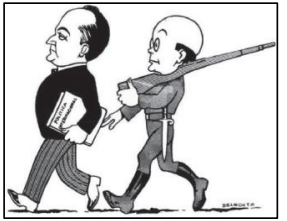
Fonte: Disponível em: https://digital.bbm.usp.br/handle/bbm/1.
A charge que retrata Vargas acompanhado por Juca Pato, personagem recorrente nas ilustrações de Belmonte, faz referência a um episódio emblemático da trajetória política brasileira. A imagem pode estar relacionada:
Fonte: APRENDENDO com o inimigo. Revista de História da Biblioteca Nacional, ano 7, n. 76, jan. 2012, p. 30.
I. Considerando o conteúdo abordado no texto, analise atentamente as afirmativas a seguir:
II. A Blitzkrieg, ou guerra-relâmpago, foi a estratégia utilizada pela Alemanha para conquistar o maior número de países em menor intervalo de tempo.
III. Vargas declarou guerra ao Eixo, em 1942. Soldados da Força Expedicionária Brasileira (FEB) foram enviados à Europa para lutar na guerra. Apesar do pouco preparo e da falta de suprimentos, eles participaram de campanhas vitoriosas, como a tomada do Monte Castelo, na Itália.
IV. Após sucessivas vitórias do Eixo, em 1940 Adolf Hitler colocou em prática a chamada Operação Barbarossa, concebida como estratégia de aliança militar com a União Soviética, reafirmando e fortalecendo o Pacto Molotov-Ribbentrop firmado com Josef Stálin, com vistas à divisão cooperativa dos territórios do Leste Europeu.
É CORRETO o que se afirma em:
Proceda à análise crítica da charge a seguir:

Fonte: Disponível em: https://moderna.com.br/escolapublica/pnld/historia/viver-historia-com-leandro-karnal/html?volume=2/.
A propósito do processo de Independência e em consonância com a charge supramencionada, examine atentamente as proposições elencadas a seguir e atribua a V aquelas que se revelarem VERDADEIRAS, e a F as que se mostrarem FALSAS
( ) A mão de obra conheceu súbita inflexão estrutural com a ruptura de 1822, sendo prontamente desarticulados os arranjos laborais de matriz lusa e instaurado um regime de feição contratual e protoindustrial. A economia desvencilhou-se do antigo paradigma agroexportador, transmutando-se, com inusitada celeridade, em um sistema multifacetado e de acentuada densidade manufatureira, alicerçado na dinamização endógena do mercado interno. No plano político, o nascente Império adotou postura de inequívoca desvinculação em relação à órbita britânica, refutando tratados, convenções e influxos normativos exógenos, de modo a resguardar a inteireza de sua soberania decisória e a plenitude de sua autonomia econômica.
( ) Ao longo da diacronia histórica, o 7 de setembro de 1822 transfigurou-se em efeméride matricial da identidade nacional brasileira, alçando-se à condição de signo fundador da memória cívica. Para além das construções imagéticas que cristalizam o episódio, sobressaem artefatos monumentalizadores — a exemplo do erigido no Parque da Independência — cuja materialidade simbólica chancela e perpetua uma hermenêutica idealizante e acentuadamente heroificadora do itinerário emancipatório.
( ) O personagem Armandinho recorre a um artifício irônico de elevada carga crítica para insinuar que o Brasil não apenas sofreu a exploração econômica perpetrada pela metrópole portuguesa, mas que, já no decurso do período colonial, teria permanecido juridicamente vinculado e formalmente subjugado às diretrizes político-administrativas emanadas de outras potências europeias, as quais teriam arrogado para si prerrogativas de natureza legislativa, passando a intervir de modo direto e deliberado na orientação dos desígnios econômicos da colônia.
( ) A Independência revelou-se permeada por limitações estruturais, uma vez que não promoveu transformações substanciais na organização social vigente. Ademais, o Brasil não logrou autonomia econômica efetiva, pois, ao desvincular-se da órbita portuguesa, passou à esfera de influência do Reino Unido. Tal reordenamento não implicou ruptura com as bases materiais herdados do período colonial, mantendo-se incólumes a estrutura latifundiária e a centralidade do trabalho compulsório. Desse modo, a emancipação política coexistiu com a preservação de mecanismos de dependência externa, que condicionaram os rumos financeiros, comerciais e diplomáticos do nascente Império.
Assinale a sequência CORRETA:

 Conheça nossos planos