Selecionar segmento
Estude com questões de diferentes segmentos
Atenção: Isso limpará todos os campos já preenchidos no filtro!
Foram encontradas 2.890 questões
Resolva questões gratuitamente!
Junte-se a mais de 4 milhões de concurseiros!


Ano: 2025
Banca:
Creative Group
Órgão:
Prefeitura de Marcos Parente - PI
Prova:
Creative Group - 2025 - Prefeitura de Marcos Parente - PI - Professor do Segundo Ciclo do Fundamental - Disciplina Inglês |
Q4176427
Inglês
Texto associado
Read the text and answer the three following questions
Best Part (feat. H.E.R.)
Daniel Caesar
You don't know, babe
When you hold me
And kiss me slowly
It's the sweetest thing
And it don't change
If I had it my way
You would know that you are
You're the coffee that I need in the morning
You're my sunshine in the rain when it's pouring
Won't you give yourself to me?
Give it all, oh
I just wanna see
I just wanna see how beautiful you are
You know that I see it
I know you're a star
Where you go, I'll follow
No matter how far
If life is a movie
Oh, you're the best part, oh
You're the best part, oh
Best part
It's this sunrise
And those brown eyes, yes
You're the one that I desire
When we wake up
And then we make love
It makes me feel so nice
You're my water when I'm stuck in the desert
You're the Tylenol I take when my head hurts
You're the sunshine on my life
I just wanna see how beautiful you are
You know that I see it
I know you're a star
Where you go, I'll follow
No matter how far
If life is a movie
Then you're the best part, oh
You're the best part, oh
Best part
If you love me, won't you say something?
If you love me, won't you, won't you
If you love me, won't you say something?
If you love me, won't you
Love me, won't yo
Fonte: https://www.letras.mus.br/daniel-caesar/best-part/
In the chorus “If life is a movie / Then you're the best
part”, it is correct to interpret that:
Ano: 2025
Banca:
Creative Group
Órgão:
Prefeitura de Marcos Parente - PI
Prova:
Creative Group - 2025 - Prefeitura de Marcos Parente - PI - Professor do Segundo Ciclo do Fundamental - Disciplina Inglês |
Q4176426
Inglês
Texto associado
Read the text and answer the three following questions
Best Part (feat. H.E.R.)
Daniel Caesar
You don't know, babe
When you hold me
And kiss me slowly
It's the sweetest thing
And it don't change
If I had it my way
You would know that you are
You're the coffee that I need in the morning
You're my sunshine in the rain when it's pouring
Won't you give yourself to me?
Give it all, oh
I just wanna see
I just wanna see how beautiful you are
You know that I see it
I know you're a star
Where you go, I'll follow
No matter how far
If life is a movie
Oh, you're the best part, oh
You're the best part, oh
Best part
It's this sunrise
And those brown eyes, yes
You're the one that I desire
When we wake up
And then we make love
It makes me feel so nice
You're my water when I'm stuck in the desert
You're the Tylenol I take when my head hurts
You're the sunshine on my life
I just wanna see how beautiful you are
You know that I see it
I know you're a star
Where you go, I'll follow
No matter how far
If life is a movie
Then you're the best part, oh
You're the best part, oh
Best part
If you love me, won't you say something?
If you love me, won't you, won't you
If you love me, won't you say something?
If you love me, won't you
Love me, won't yo
Fonte: https://www.letras.mus.br/daniel-caesar/best-part/
In the verses “You're the coffee that I need in the morning / You're my sunshine in the rain when it's pouring”,
the singer uses metaphors to express that:
Ano: 2025
Banca:
Creative Group
Órgão:
Prefeitura de Marcos Parente - PI
Prova:
Creative Group - 2025 - Prefeitura de Marcos Parente - PI - Professor do Segundo Ciclo do Fundamental - Disciplina Inglês |
Q4176425
Inglês
MY FATHER, THE ASTRONAUT
If the moon was Europe, my father was an astronaut who died on his
way to the moon.
My father, the failed moonwalker, blinded by space.
My father, the
Black cosmonaut, frenzied
by thirst. My father who heard the voice of God, clear as the call to
prayer, suspended in that dark desert.
My father who wore a spacesuit slashed by longing, spinning towards
the vast desolate.
On a night when the angels have drawn back their wings, you may
glimpse my father
hurtling through space, his body carried by gravity’s absence, blood
collecting in his head,
his tears pink, gelatinous clots, unable to fall. (2022, Warsan Shire. From: Bless the Daughter Raised by a Voice in Her Head Publisher: Penguin Random house)
In light of the the excerpt from “My Father, the Astronaut” by Warsan Shire, which of the following single words most aptly encapsulates the overarching emotional and symbolic tenor of the passage?
If the moon was Europe, my father was an astronaut who died on his
way to the moon.
My father, the failed moonwalker, blinded by space.
My father, the
Black cosmonaut, frenzied
by thirst. My father who heard the voice of God, clear as the call to
prayer, suspended in that dark desert.
My father who wore a spacesuit slashed by longing, spinning towards
the vast desolate.
On a night when the angels have drawn back their wings, you may
glimpse my father
hurtling through space, his body carried by gravity’s absence, blood
collecting in his head,
his tears pink, gelatinous clots, unable to fall. (2022, Warsan Shire. From: Bless the Daughter Raised by a Voice in Her Head Publisher: Penguin Random house)
In light of the the excerpt from “My Father, the Astronaut” by Warsan Shire, which of the following single words most aptly encapsulates the overarching emotional and symbolic tenor of the passage?
Ano: 2025
Banca:
Creative Group
Órgão:
Prefeitura de Marcos Parente - PI
Prova:
Creative Group - 2025 - Prefeitura de Marcos Parente - PI - Professor do Segundo Ciclo do Fundamental - Disciplina Inglês |
Q4176424
Inglês
Read the excerpt below:
“Do not underestimate others, nor idolize them too much. Be polite, but not perfect. Do things you never imagined before. Do not lie, but do not reveal the whole truth. Dance alone when no one is watching. Have fun while your wolf has not arrived.”— Martha Medeiros
Considering that the metaphor “your wolf” can represent the inevitability of death, it is correct to affirm that:
“Do not underestimate others, nor idolize them too much. Be polite, but not perfect. Do things you never imagined before. Do not lie, but do not reveal the whole truth. Dance alone when no one is watching. Have fun while your wolf has not arrived.”— Martha Medeiros
Considering that the metaphor “your wolf” can represent the inevitability of death, it is correct to affirm that:
Ano: 2025
Banca:
Creative Group
Órgão:
Prefeitura de Marcos Parente - PI
Prova:
Creative Group - 2025 - Prefeitura de Marcos Parente - PI - Professor do Segundo Ciclo do Fundamental - Disciplina Inglês |
Q4176423
Inglês
Read the sentences below and choose the option that
correctly identifies the type of conditional used.
Sentence: “If he hadn’t ignored the weather warnings, he wouldn’t be stuck at the airport now.”Based on standard conditional forms, this sentence is:
Sentence: “If he hadn’t ignored the weather warnings, he wouldn’t be stuck at the airport now.”Based on standard conditional forms, this sentence is:
Ano: 2025
Banca:
Creative Group
Órgão:
Prefeitura de Marcos Parente - PI
Prova:
Creative Group - 2025 - Prefeitura de Marcos Parente - PI - Professor do Segundo Ciclo do Fundamental - Disciplina Inglês |
Q4176422
Linguística
In the comic strip, Calvin repeatedly asks his mother
for permission using the modal verb “can”, proposing increasingly unreasonable actions (e.g., setting
fire to his mattress, riding his tricycle on the roof).
His mother denies every request with the same formulaic response: “No, Calvin.” After a series of absurd questions, Calvin finally asks for something reasonable: a cookie. The mother again refuses with
“No, Calvin,” leading Calvin to conclude, “She’s on
to me.”
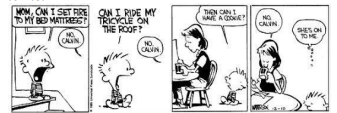
Based on a pragmatic and discourse-analysis perspective, which statement BEST explains the mother’s response pattern and Calvin’s final inference?
Based on a pragmatic and discourse-analysis perspective, which statement BEST explains the mother’s response pattern and Calvin’s final inference?
Ano: 2025
Banca:
Creative Group
Órgão:
Prefeitura de Marcos Parente - PI
Prova:
Creative Group - 2025 - Prefeitura de Marcos Parente - PI - Professor do Segundo Ciclo do Fundamental - Disciplina Inglês |
Q4176421
Linguística
“We have defined a sentence as a string of words. A
given sentence always consists of the same words,
and in the same order. Any change in the words, or
in their order, makes a different sentence.” Based on
the statement “Accent and voice quality belong
strictly to the utterance, not to the sentence uttered,”
it is possible to conclude that:
Ano: 2025
Banca:
Creative Group
Órgão:
Prefeitura de Marcos Parente - PI
Prova:
Creative Group - 2025 - Prefeitura de Marcos Parente - PI - Professor do Segundo Ciclo do Fundamental - Disciplina Inglês |
Q4176420
Pedagogia
Read the excerpt below:
“Teacher of language has received the knowledge of linguistic theory to teach language. Linguistics has been used as one of the disciplines which contribute to the theory of language teaching.
The knowledge of linguistic theory has been used as a device to help the language teacher.” Source: Middle-East Journal of Scientific Research 15 (8): Author: Ali Akbar Khansir – Applied Linguistics and English Language Teaching. The discussion emphasizes that Linguistics provides theoretical foundations that support language teachers in understanding linguistic structure, selecting methods, and developing appropriate teaching materials. It also states that the teacher’s role is not to teach theoretical linguistics, but to apply linguistic principles in the classroom. Based on these ideas, analyze the statements below:
I. The global expansion of English increasesthe need for teachers to master linguistic knowledge that supports intercultural communication and effective lesson planning.
II. It is argued that linguists and language teachers perform the same professional role, since both work directly with the scientific description of language.
III. Linguistics, although not offering ready-made teaching methods, provides theoretical principles that help teachers understand how language works and produce suitable learning materials.
IV. Applied Linguistics also includes the study of teaching methods and error-correction strategies related to language learning.
Choose the correct alternative.
“Teacher of language has received the knowledge of linguistic theory to teach language. Linguistics has been used as one of the disciplines which contribute to the theory of language teaching.
The knowledge of linguistic theory has been used as a device to help the language teacher.” Source: Middle-East Journal of Scientific Research 15 (8): Author: Ali Akbar Khansir – Applied Linguistics and English Language Teaching. The discussion emphasizes that Linguistics provides theoretical foundations that support language teachers in understanding linguistic structure, selecting methods, and developing appropriate teaching materials. It also states that the teacher’s role is not to teach theoretical linguistics, but to apply linguistic principles in the classroom. Based on these ideas, analyze the statements below:
I. The global expansion of English increasesthe need for teachers to master linguistic knowledge that supports intercultural communication and effective lesson planning.
II. It is argued that linguists and language teachers perform the same professional role, since both work directly with the scientific description of language.
III. Linguistics, although not offering ready-made teaching methods, provides theoretical principles that help teachers understand how language works and produce suitable learning materials.
IV. Applied Linguistics also includes the study of teaching methods and error-correction strategies related to language learning.
Choose the correct alternative.
Ano: 2025
Banca:
Creative Group
Órgão:
Prefeitura de Marcos Parente - PI
Prova:
Creative Group - 2025 - Prefeitura de Marcos Parente - PI - Professor do Segundo Ciclo do Fundamental - Disciplina Inglês |
Q4176419
Inglês
Modal verbs in English express different functions
such as logical possibility, ability, necessity, and permission. Considering these uses, choose the alternative
in which the modal verb is correctly used according to
its function.
Ano: 2025
Banca:
Creative Group
Órgão:
Prefeitura de Marcos Parente - PI
Prova:
Creative Group - 2025 - Prefeitura de Marcos Parente - PI - Professor do Segundo Ciclo do Fundamental - Disciplina História |
Q4176318
História
Ao longo da história, grandes pandemias provocaram rupturas e reorganizações profundas nas sociedades. A Peste Negra, no século XIV, reduziu drasticamente a população europeia, alterando relações
de trabalho e estimulando mudanças estruturais no
feudalismo. No início do século XX, a Gripe Espanhola espalhou-se rapidamente pelo mundo em meio
aos deslocamentos da Primeira Guerra Mundial, revelando fragilidades dos sistemas de saúde e estimulando avanços em políticas sanitárias. No século
XXI, a pandemia de COVID-19 colocou novamente
em evidência desigualdades sociais, limites dos modelos econômicos globais e a centralidade da ciência
na formulação de políticas públicas. Baseando-se esses processos históricos e suas repercussões, assinale
a alternativa correta.
Ano: 2025
Banca:
Creative Group
Órgão:
Prefeitura de Marcos Parente - PI
Prova:
Creative Group - 2025 - Prefeitura de Marcos Parente - PI - Professor do Segundo Ciclo do Fundamental - Disciplina História |
Q4176317
História
Analise as afirmativas a seguir, relacionadas a diferentes períodos da História do Brasil:
I. No período colonial, a economia açucareira estruturou-se no modelo de plantation, caracterizado pela grande propriedade, uso intensivo de mão de obra escravizada e produção voltada ao mercado externo, o que reforçou a dependência econômica em relação à metrópole e a inserção subordinada no comércio atlântico.
II. Durante o Segundo Reinado, a política do “café com leite” consolidou-se como prática eleitoral baseada na alternância de poder entre as oligarquias de São Paulo e Minas Gerais, mecanismo que garantiu estabilidade política e baixo nível de conflitos sociais.
III. A Era Vargas representou uma ruptura no padrão de relação entre Estado e economia, com fortalecimento da industrialização, criação de legislações trabalhistas e ampliação da presença estatal, embora mantendo práticas autoritárias, especialmente no Estado Novo.
IV. Na Ditadura Militar (1964-1985), a política econômica oscilou entre fases de forte crescimento, como durante o chamado “milagre econômico”, e períodos de crise, marcados por inflação, endividamento externo e deterioração do poder de compra da população.
Pode-se afirmar que:
I. No período colonial, a economia açucareira estruturou-se no modelo de plantation, caracterizado pela grande propriedade, uso intensivo de mão de obra escravizada e produção voltada ao mercado externo, o que reforçou a dependência econômica em relação à metrópole e a inserção subordinada no comércio atlântico.
II. Durante o Segundo Reinado, a política do “café com leite” consolidou-se como prática eleitoral baseada na alternância de poder entre as oligarquias de São Paulo e Minas Gerais, mecanismo que garantiu estabilidade política e baixo nível de conflitos sociais.
III. A Era Vargas representou uma ruptura no padrão de relação entre Estado e economia, com fortalecimento da industrialização, criação de legislações trabalhistas e ampliação da presença estatal, embora mantendo práticas autoritárias, especialmente no Estado Novo.
IV. Na Ditadura Militar (1964-1985), a política econômica oscilou entre fases de forte crescimento, como durante o chamado “milagre econômico”, e períodos de crise, marcados por inflação, endividamento externo e deterioração do poder de compra da população.
Pode-se afirmar que:
Ano: 2025
Banca:
Creative Group
Órgão:
Prefeitura de Marcos Parente - PI
Prova:
Creative Group - 2025 - Prefeitura de Marcos Parente - PI - Professor do Segundo Ciclo do Fundamental - Disciplina História |
Q4176316
História
O governo Geisel, foi lançado um plano que buscava
avançar a substituição de importações e redefinir a
estratégia de desenvolvimento do país, sucedendo o
plano criado no governo Médici. O nome desse plano
é:
Ano: 2025
Banca:
Creative Group
Órgão:
Prefeitura de Marcos Parente - PI
Prova:
Creative Group - 2025 - Prefeitura de Marcos Parente - PI - Professor do Segundo Ciclo do Fundamental - Disciplina História |
Q4176315
História
O movimento ocorrido no final do século XVIII,
marcado pela circulação de ideias iluministas entre
membros da elite mineira, muitos deles estudantes
da Universidade de Coimbra e influenciados por
contatos internacionais, como Thomas Jefferson.
Esse movimento, que buscava mudanças políticas
inspiradas na Europa e na América do Norte, é conhecido como:
Ano: 2025
Banca:
Creative Group
Órgão:
Prefeitura de Marcos Parente - PI
Prova:
Creative Group - 2025 - Prefeitura de Marcos Parente - PI - Professor do Segundo Ciclo do Fundamental - Disciplina História |
Q4176314
História
No debate historiográfico sobre as relações entre Estado e sociedade no Brasil colonial, Boris Fausto
apresenta duas interpretações opostas: uma que enfatiza a centralidade do Estado português como
força dominante e outra que destaca a supremacia
local dos grandes proprietários rurais. Sobre essas
duas leituras, assinale a alternativa correta.
Ano: 2025
Banca:
Creative Group
Órgão:
Prefeitura de Marcos Parente - PI
Prova:
Creative Group - 2025 - Prefeitura de Marcos Parente - PI - Professor do Segundo Ciclo do Fundamental - Disciplina História |
Q4176313
História
Os diversos grupos sociais que participaram da Revolução Francesa possuíam projetos políticos distintos para o futuro da França. A partir de 1792, esses
conflitos se intensificaram dentro da Convenção Nacional, especialmente entre girondinos, jacobinos e a
chamada “Montanha”. Considerando esse contexto
e as transformações implementadas no período, assinale a alternativa correta.
Ano: 2025
Banca:
Creative Group
Órgão:
Prefeitura de Marcos Parente - PI
Prova:
Creative Group - 2025 - Prefeitura de Marcos Parente - PI - Professor do Segundo Ciclo do Fundamental - Disciplina História |
Q4176312
História
No contexto das civilizações do Mediterrâneo Antigo, diferentes sociedades desenvolveram formas
particulares de organização política, econômica e
religiosa. Entre elas, destaca-se a civilização egípcia,
cuja estrutura estatal se articulava em torno da figura do faraó. Baseando-se nas características desse
sistema e suas implicações sociais, assinale a alternativa correta.
Ano: 2025
Banca:
Creative Group
Órgão:
Prefeitura de Marcos Parente - PI
Prova:
Creative Group - 2025 - Prefeitura de Marcos Parente - PI - Professor do Segundo Ciclo do Fundamental - Disciplina História |
Q4176311
História
Acerca dos deslocamentos populacionais entre os séculos XVI e XVIII, a formação de novos Estados, o
papel das rotas comerciais e a multiplicação das diásporas africanas e europeias, assinale a alternativa
correta sobre a relação entre tais movimentos e as
transformações sociopolíticas no continente africano no período.
Ano: 2025
Banca:
Creative Group
Órgão:
Prefeitura de Marcos Parente - PI
Prova:
Creative Group - 2025 - Prefeitura de Marcos Parente - PI - Professor do Segundo Ciclo do Fundamental - Disciplina História |
Q4176310
História
Leia o trecho a seguir:
“A descrição dá início a uma tópica ainda hoje frequente no país, que entende a conquista como um ‘encontro pacífico’, a despeito das diferenças políticas, culturais e linguísticas. Essa nova gente capturou a curiosidade de Caminha: ‘A feição deles é serem pardos, um tanto avermelhados, de bons rostos e bons narizes, bem-feitos. Andam nus, sem nenhuma cobertura. Nem fazem mais caso de cobrir nem mostrar suas vergonhas, e estão acerca disso com tanta inocência como têm em mostrar o rosto’. O escrivão se espanta com suas ‘peles vermelhas e cabelos escorregadios’, e ademais com o fato de serem bonitos de corpo e alma. Começava com essa percepção certa ladainha de vida longa, que construiu a imagem de um ‘bom selvagem’ brasileiro […].Evidentemente deslumbrado, o relato de Caminha inaugurava, também, outro mito recorrente. O da natureza pacífica, de uma conquista sem violência, uma comunhão que unificou a todos, num mesmo coração e religião. [...] por mais que o tempo mostrasse o oposto: genocídio de um lado, conquista de outro.”
STARLING, Heloísa; SCHWARCZ, Lilia. Brasil: uma biografia. São Paulo: Companhia das Letras, 2015.
Relacionando o trecho com os conhecimentos históricos sobre a formação da colonização portuguesa na América, assinale a alternativa que expressa como o trecho dialoga com as interpretações historiográficas acerca do “encontro” entre portugueses e populações indígenas.
“A descrição dá início a uma tópica ainda hoje frequente no país, que entende a conquista como um ‘encontro pacífico’, a despeito das diferenças políticas, culturais e linguísticas. Essa nova gente capturou a curiosidade de Caminha: ‘A feição deles é serem pardos, um tanto avermelhados, de bons rostos e bons narizes, bem-feitos. Andam nus, sem nenhuma cobertura. Nem fazem mais caso de cobrir nem mostrar suas vergonhas, e estão acerca disso com tanta inocência como têm em mostrar o rosto’. O escrivão se espanta com suas ‘peles vermelhas e cabelos escorregadios’, e ademais com o fato de serem bonitos de corpo e alma. Começava com essa percepção certa ladainha de vida longa, que construiu a imagem de um ‘bom selvagem’ brasileiro […].Evidentemente deslumbrado, o relato de Caminha inaugurava, também, outro mito recorrente. O da natureza pacífica, de uma conquista sem violência, uma comunhão que unificou a todos, num mesmo coração e religião. [...] por mais que o tempo mostrasse o oposto: genocídio de um lado, conquista de outro.”
STARLING, Heloísa; SCHWARCZ, Lilia. Brasil: uma biografia. São Paulo: Companhia das Letras, 2015.
Relacionando o trecho com os conhecimentos históricos sobre a formação da colonização portuguesa na América, assinale a alternativa que expressa como o trecho dialoga com as interpretações historiográficas acerca do “encontro” entre portugueses e populações indígenas.
Ano: 2025
Banca:
Creative Group
Órgão:
Prefeitura de Marcos Parente - PI
Prova:
Creative Group - 2025 - Prefeitura de Marcos Parente - PI - Professor do Segundo Ciclo do Fundamental - Disciplina História |
Q4176309
História
A colonização espanhola no continente americano
apresentou modelos distintos conforme as características das regiões ocupadas. Conforme esses distintos modelos, infere-se que:
Ano: 2025
Banca:
Creative Group
Órgão:
Prefeitura de Marcos Parente - PI
Prova:
Creative Group - 2025 - Prefeitura de Marcos Parente - PI - Professor do Segundo Ciclo do Fundamental - Disciplina Geografia |
Q4176268
Geografia
Relacione:
Coluna I – Domínios
1. Amazônico 2. Cerrado 3. Caatinga 4. Mares de Morros
Coluna II – Interferências antrópicas
( ) Irrigação inadequada que provoca salinização, desmatamento sem manejo adequado e casos de desertificação antrópica.
( ) Avanço da fronteira agrícola e pecuária, instalação de hidrelétricas e conflitos ligados ao extrativismo, mineração e demarcação de terras.
( ) Pecuária e agricultura intensivas (soja, café, algodão) e erosão associada ao manejo inadequado do solo, impulsionadas pela interiorização populacional.
( ) Exploração histórica do pau-brasil, cana-de-açúcar e café, seguida de forte urbanização, industrialização e alta vulnerabilidade a erosões e movimentos de massa.
Assinale a alternativa que apresenta a sequência correta da Coluna II, de cima para baixo:
Coluna I – Domínios
1. Amazônico 2. Cerrado 3. Caatinga 4. Mares de Morros
Coluna II – Interferências antrópicas
( ) Irrigação inadequada que provoca salinização, desmatamento sem manejo adequado e casos de desertificação antrópica.
( ) Avanço da fronteira agrícola e pecuária, instalação de hidrelétricas e conflitos ligados ao extrativismo, mineração e demarcação de terras.
( ) Pecuária e agricultura intensivas (soja, café, algodão) e erosão associada ao manejo inadequado do solo, impulsionadas pela interiorização populacional.
( ) Exploração histórica do pau-brasil, cana-de-açúcar e café, seguida de forte urbanização, industrialização e alta vulnerabilidade a erosões e movimentos de massa.
Assinale a alternativa que apresenta a sequência correta da Coluna II, de cima para baixo:

 Conheça nossos planos