Questões de Concurso
Para fuvest
Foram encontradas 6.431 questões
Resolva questões gratuitamente!
Junte-se a mais de 4 milhões de concurseiros!


Ano: 2025
Banca:
FUVEST
Órgão:
HCFMUSP
Prova:
FUVEST - 2025 - HCFMUSP - Residência Médica - Áreas de Atuação - Psiquiatria da Infância e Adolescência |
Q4214010
Psiquiatria
Rafaela, 16 anos de idade, é levada pela mãe à consulta com
queixas de recusa escolar, crises de choro matinais
associados a sintomas de ansiedade intensa. Quando
questionada, a paciente relata preocupação frequente de que
algo ruim aconteça com seus pais (doença, ferimentos,
desastres ou morte) ou consigo mesma (perder-se, ser
sequestrada, sofrer um acidente, ficar doente). Acha que os
sintomas se intensificaram após a morte da avó materna há
um ano. Antes de apresentar recusa escolar, a paciente tinha
bom rendimento escolar, referia poucos amigos, mas não
relatava situações de conflitos com colegas. Quando
questionada, diz que é caseira, que gosta de ficar com a
família, e refere que nunca dormiu fora de casa (na casa de
amigos ou parentes), e nunca viajou sem os pais. Está
preocupada porque em breve terá uma viagem de estudo do
meio com a escola. Com base no caso descrito, assinale a
alternativa correta.
Ano: 2025
Banca:
FUVEST
Órgão:
HCFMUSP
Prova:
FUVEST - 2025 - HCFMUSP - Residência Médica - Áreas de Atuação - Psiquiatria da Infância e Adolescência |
Q4214009
Psiquiatria
“Ele não tem Transtorno de Oposição Desafiante (TOD), ele é
assim por causa dos pais que não dão limite”. Sobre essa fala
que expõe a problemática de diagnósticos na infância e
adolescência, assinale a alternativa correta.
Ano: 2025
Banca:
FUVEST
Órgão:
HCFMUSP
Prova:
FUVEST - 2025 - HCFMUSP - Residência Médica - Áreas de Atuação - Psiquiatria da Infância e Adolescência |
Q4214008
Psiquiatria
Lucas, de 8 anos de idade, foi levado à UBS por sua mãe,
devido a preocupações em relação ao comportamento do filho
e possíveis impactos em seu desenvolvimento. Segundo a
mãe, diariamente o filho se recusa a obedecer, tem
dificuldade em aceitar limites, é respondão, discute com
adultos, perde a paciência e se descontrola com facilidade. A
mãe diz que tenta colocar limites, coloca-o de castigo, no
entanto, Lucas culpa os outros por seus erros e não muda o
seu comportamento. A mãe acha que estes comportamentos
começaram por volta dos 5 anos de idade e se intensificaram
nos últimos 12 meses. Na escola, o comportamento de Lucas
é semelhante, e a mãe observa prejuízos no relacionamento
do filho com professores e colegas. Ela mostra-se cansada,
conta que cuida do filho sozinha e percebe um desgaste
importante na relação entre os dois. Além disso, tem estado
mais nervosa, nos últimos meses, pois está passando por
situação financeira difícil, desde que ficou desempregada.
Tem tido dificuldade, inclusive, para comprar alimentos.
Assinale a alternativa correta.
Ano: 2025
Banca:
FUVEST
Órgão:
HCFMUSP
Prova:
FUVEST - 2025 - HCFMUSP - Residência Médica - Áreas de Atuação - Psiquiatria da Infância e Adolescência |
Q4214007
Psiquiatria
Sobre o transtorno afetivo bipolar (TAB), assinale a alternativa
correta.
Ano: 2025
Banca:
FUVEST
Órgão:
HCFMUSP
Prova:
FUVEST - 2025 - HCFMUSP - Residência Médica - Áreas de Atuação - Psiquiatria da Infância e Adolescência |
Q4214006
Psiquiatria
Henrique, 10 anos de idade, foi encaminhado ao ambulatório
de psiquiatria infantil por dificuldades comportamentais e
escolares. Segundo a mãe, desde os primeiros anos
escolares, Henrique é inquieto e desatento. Frequentemente,
se acidenta, perde objetos e tem dificuldade de manter o foco
em atividades, mesmo quando motivado. Professores relatam
que ele levanta diversas vezes da cadeira, interrompe os
colegas e fala em momentos inapropriados. Além disso,
desde a idade pré-escolar, Henrique apresenta episódios
frequentes de explosões de raiva, geralmente em resposta a
frustrações banais, como ser contrariado ou perder em jogos.
As explosões envolvem gritos, palavrões, bater portas e, por
vezes, agressividade física. Esses episódios ocorrem ao
menos quatro vezes por semana, principalmente em casa, e
são desproporcionais à situação por sua intensidade e
duração. Além disso, entre os episódios, Henrique mantém um
humor persistentemente irritável. Costuma ficar emburrado
com facilidade para se envolver em conflitos com colegas e
adultos. Os quais, muitas vezes ocorrem por comportamentos
provocativos apresentados por Henrique. A mãe nega
episódios de euforia, grandiosidade ou períodos de sono
reduzido. Com base no caso apresentado, assinale a
alternativa correta.
Ano: 2025
Banca:
FUVEST
Órgão:
HCFMUSP
Prova:
FUVEST - 2025 - HCFMUSP - Residência Médica - Áreas de Atuação - Psiquiatria da Infância e Adolescência |
Q4214005
Psiquiatria
Paciente foi encaminhado para avaliação, devido sinais de
agitação importante, queixas frequentes sobre
comportamento na escola e comportamento opositor em casa.
Pais suspeitam de que possa ter transtorno de déficit de
atenção e hiperatividade, e trazem relatório de avaliação
neuropsicológica feito recentemente. Este relatório diz:
“De acordo com a escala WISC-IV, seu QI global situou-se na faixa superior quando comparado a indivíduos da mesma idade (QIT: 124 pts.). Além disso, o paciente apresentou recursos preservado em relação a resolução de problemas pela via verbal/compreensão verbal (IF: 138 pts.), situada na faixa muito superior e, de forma discrepante, a velocidade de processamento das informações (IF: 111 pts.), as habilidades de planejamento, organização e integração das informações/organização perceptual (IF: 110 pts.), situaram na faixa média-superior e a memória operacional/processos atencionais (IF: 106 pts.), situou-se na faixa média, quando comparado a indivíduos da mesma idade”.
Considerando o caso clínico descrito, assinale a alternativa correta.
“De acordo com a escala WISC-IV, seu QI global situou-se na faixa superior quando comparado a indivíduos da mesma idade (QIT: 124 pts.). Além disso, o paciente apresentou recursos preservado em relação a resolução de problemas pela via verbal/compreensão verbal (IF: 138 pts.), situada na faixa muito superior e, de forma discrepante, a velocidade de processamento das informações (IF: 111 pts.), as habilidades de planejamento, organização e integração das informações/organização perceptual (IF: 110 pts.), situaram na faixa média-superior e a memória operacional/processos atencionais (IF: 106 pts.), situou-se na faixa média, quando comparado a indivíduos da mesma idade”.
Considerando o caso clínico descrito, assinale a alternativa correta.
Ano: 2025
Banca:
FUVEST
Órgão:
HCFMUSP
Prova:
FUVEST - 2025 - HCFMUSP - Residência Médica - Áreas de Atuação - Psiquiatria da Infância e Adolescência |
Q4214004
Psiquiatria
Em relação ao desenvolvimento humano e a psicopatologia
desenvolvimental, assinale a alternativa correta.
Ano: 2025
Banca:
FUVEST
Órgão:
HCFMUSP
Prova:
FUVEST - 2025 - HCFMUSP - Residência Médica - Áreas de Atuação - Psiquiatria da Infância e Adolescência |
Q4214003
Estatística
Um estudo realizado com dados de uma coorte comunitária
de crianças de São Paulo e Porto Alegre (n=2511), investigou
o uso ao longo da vida de serviços de saúde mental entre
crianças diagnosticadas com transtornos mentais. Os
resultados mostraram que, entre as crianças diagnosticadas
com transtorno mental (N=651), 81,0% (IC 95%=76,6% -
84,7%) não receberam nenhum tratamento de saúde mental
ao longo da vida (descritas a seguir como “não atendidas”).
Entre as crianças que receberam tratamento (descritas a
seguir como “atendidas”), a duração média do tratamento
entre aqueles que receberam medicação e aqueles que
receberam psicoterapia foi de 25,8 meses (IC 95% = 17,1–
34,4) e 22,7 meses (IC 95% = 16,5–29,2), respectivamente.
A Tabela 1 mostra a relação entre as características da criança e da família e o acesso a serviços de saúde mental entre crianças diagnosticadas com transtorno mental.
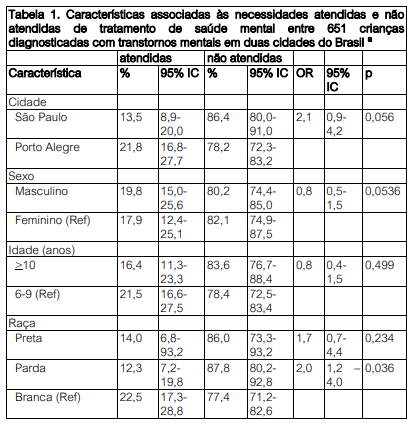
De acordo com os dados apresentados, assinale a alternativa correta.
A Tabela 1 mostra a relação entre as características da criança e da família e o acesso a serviços de saúde mental entre crianças diagnosticadas com transtorno mental.
De acordo com os dados apresentados, assinale a alternativa correta.
Ano: 2025
Banca:
FUVEST
Órgão:
HCFMUSP
Prova:
FUVEST - 2025 - HCFMUSP - Residência Médica - Áreas de Atuação - Psiquiatria da Infância e Adolescência |
Q4214002
Psiquiatria
Sobre os transtornos alimentares na infância e adolescência,
assinale a alternativa correta.
Ano: 2025
Banca:
FUVEST
Órgão:
HCFMUSP
Prova:
FUVEST - 2025 - HCFMUSP - Residência Médica - Áreas de Atuação - Psiquiatria da Infância e Adolescência |
Q4214001
Psiquiatria
Joana, 5 anos de idade, vive com a mesma família adotiva há
1 ano, após histórico de institucionalização prolongada por
negligência grave nos primeiros anos de vida. A equipe da
escola relata que Joana é bastante afetiva, mas notam que a
criança aborda adultos desconhecidos com extrema
familiaridade, tenta abraçá-los, senta-se no colo e busca
contato físico de forma inapropriada. Assim como é capaz de
sair com um estranho sem hesitação. A mãe acha que a filha
tem comportamentos que parecem refletir uma busca por
atenção. A mãe fica preocupada, pois percebe que estes
comportamentos impactam negativamente na relação que a
filha estabelece com os adultos e com outras crianças, tem
receio de que este contato indiscriminado com a estranhos
possa expor a filha a situações de risco e abusos. Assinale a
alternativa correta.
Ano: 2025
Banca:
FUVEST
Órgão:
HCFMUSP
Prova:
FUVEST - 2025 - HCFMUSP - Residência Médica - Áreas de Atuação - Psiquiatria da Infância e Adolescência |
Q4214000
Psiquiatria
Ana, 7 anos de idade, com diagnóstico de transtorno do
espectro autista (nível 2 de suporte) e ausência de deficiência
intelectual, iniciou acompanhamento em um CAPS infanto-juvenil (CAPSij). Ela frequenta escola regular com apoio de
mediadora, mas apresenta dificuldade em comunicação
social e regulação emocional. A equipe do CAPSij discute a
construção de um Plano Terapêutico Singular (PTS). De
acordo com o Instrutivo Técnico da Rede de Atenção
Psicossocial, assinale a alternativa correta.
Ano: 2025
Banca:
FUVEST
Órgão:
HCFMUSP
Prova:
FUVEST - 2025 - HCFMUSP - Residência Médica - Áreas de Atuação - Psiquiatria da Infância e Adolescência |
Q4213999
Psiquiatria
O transtorno de déficit de atenção e hiperatividade (TDAH) é
um transtorno comum caracterizado por desatenção,
hiperatividade e impulsividade. Em muitos casos, é uma
condição associada a prejuízos funcionais significativos.
Nesse contexto, dados epidemiológicos são fundamentais
para a compreensão do transtorno e elaboração de políticas
que ajudem a mitigar o impacto do TDAH. Em relação ao
TDAH, é correto afirmar:
Ano: 2025
Banca:
FUVEST
Órgão:
HCFMUSP
Prova:
FUVEST - 2025 - HCFMUSP - Residência Médica - Áreas de Atuação - Psiquiatria da Infância e Adolescência |
Q4213998
Psiquiatria
André, 22 anos de idade, procurou atendimento psiquiátrico
por achar que tem TDAH. Durante a consulta, relata que tem
percebido dificuldades crescentes na faculdade, incluindo
desatenção nas aulas, e tendência à procrastinação. Relata,
também, sensação constante de inquietude mental,
dificuldade em organizar tarefas e compromissos mesmo com
uso de aplicativos e listas. Nos últimos meses, tem se sentido
mais ansioso e com mais dificuldade para finalizar tarefas e
cumprir prazos. Refere uso de álcool e cocaína. Quando
questionado sobre sua infância, conta que era levado, não
gostava de estudar, dava trabalho para os professores e para
sua mãe, que precisava acompanhar de perto os seus
estudos. Apesar disso, era considerado “inteligente e criativo”
e nunca foi reprovado. Considerando seus conhecimentos e o
caso apresentado, assinale a alternativa correta.
Ano: 2025
Banca:
FUVEST
Órgão:
HCFMUSP
Prova:
FUVEST - 2025 - HCFMUSP - Residência Médica - Áreas de Atuação - Psiquiatria da Infância e Adolescência |
Q4213997
Psiquiatria
Qual informação sobre a etiologia do Transtorno Alimentar
Restritivo / Evitativo (TARE) seria mais precisa para orientar
uma família sobre os fatores que contribuem para o
transtorno?
Ano: 2025
Banca:
FUVEST
Órgão:
HCFMUSP
Prova:
FUVEST - 2025 - HCFMUSP - Residência Médica - Áreas de Atuação - Psiquiatria da Infância e Adolescência |
Q4213996
Estatística
Uma meta-análise foi conduzida para avaliar a eficácia do
medicamento A no tratamento da depressão em crianças e
adolescentes, com base em 10 ensaios clínicos controlados
randomizados duplo-cego independentes. Os tamanhos de
efeito foram expressos como diferenças médias padronizadas
(DMP) e analisados utilizando o modelo de efeitos aleatórios.
O efeito combinado estimado foi de DMP = -0,25 (IC95%: -0,51
a -0,34). A análise de heterogeneidade indicou baixa variação
entre os estudos, com Q = 9,32 (p = 0,41), I² = 3,5%, e Tau² =
0,0006. Na descrição dos resultados, os autores incluíram o
gráfico a seguir:
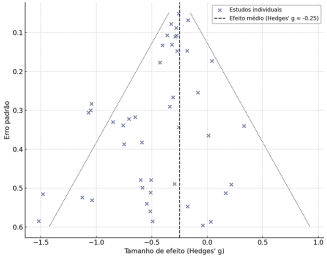
Com base nas informações fornecidas sobre o estudo, assinale a alternativa correta.
Com base nas informações fornecidas sobre o estudo, assinale a alternativa correta.
Ano: 2025
Banca:
FUVEST
Órgão:
HCFMUSP
Prova:
FUVEST - 2025 - HCFMUSP - Residência Médica - Áreas de Atuação - Psiquiatria da Infância e Adolescência |
Q4213995
Psiquiatria
Lucas, 12 anos de idade, é levado pelos pais à consulta com
queixa de comportamentos repetitivos. Desde os 7 anos de
idade, apresenta movimentos repetitivos como piscar os olhos,
movimentos bruscos de cabeça e limpeza da garganta, os quais
variam de intensidade e se agravam com estresse. Nos últimos
dois anos, passou a apresentar comportamentos repetitivos mais
complexos, como tocar superfícies em sequência e refazer
movimentos corporais para que ambos os lados do corpo sintam
a mesma coisa. Relata que precisa realizar essas ações para
evitar que “algo ruim aconteça”, como um familiar adoecer.
Atualmente, os comportamentos que faz para “evitar que algo
ruim aconteça” se intensificaram e Lucas gasta um tempo
significativo com rituais de simetria e verificação. Os sintomas têm
causado sofrimento emocional e impacto no rendimento escolar.
Considerando o caso descrito, assinale a alternativa que
descreve o diagnóstico e a conduta de forma mais adequada.
Ano: 2025
Banca:
FUVEST
Órgão:
HCFMUSP
Prova:
FUVEST - 2025 - HCFMUSP - Residência Médica - Áreas de Atuação - Psiquiatria da Infância e Adolescência |
Q4213994
Psiquiatria
Sobre o transtorno obsessivo-compulsivo (TOC), assinale a
alternativa correta.
Ano: 2025
Banca:
FUVEST
Órgão:
HCFMUSP
Prova:
FUVEST - 2025 - HCFMUSP - Residência Médica - Áreas de Atuação - Psiquiatria da Infância e Adolescência |
Q4213993
Psiquiatria
Mariana, 17 anos de idade, está em tratamento há 6 meses,
com diagnóstico de Transtorno de Personalidade Borderline
(TPB), preenchendo 7 dos 9 critérios do DSM-5. Ela participa
de um tratamento especializado em psicoterapia (Terapia
Comportamental Dialética -DBT), porém com aderência
irregular e baixo aproveitamento. A psicoterapeuta relata que
Mariana apresenta extrema dificuldade em focar nas sessões,
seguir as tarefas de casa e generalizar o uso das habilidades
aprendidas, atribuindo o insucesso a uma “falta de atenção e
organização que a impede de aprender”. A paciente tem
histórico de longa data de dificuldades escolares, com
múltiplos relatórios mencionando “desatenção e inquietude”
desde a infância, e um diagnóstico prévio de Transtorno
Oposição Desafiante (TOD). Não há uso de substâncias
psicoativas ou sinais de mania e hipomania no histórico da
paciente. Diante do impasse terapêutico, qual é o plano de
manejo mais adequado para o caso?
Ano: 2025
Banca:
FUVEST
Órgão:
HCFMUSP
Prova:
FUVEST - 2025 - HCFMUSP - Residência Médica - Áreas de Atuação - Psiquiatria da Infância e Adolescência |
Q4213992
Psiquiatria
Sobre os transtornos de personalidade, assinale a
alternativa correta.
Ano: 2025
Banca:
FUVEST
Órgão:
HCFMUSP
Prova:
FUVEST - 2025 - HCFMUSP - Residência Médica - Áreas de Atuação - Psiquiatria da Infância e Adolescência |
Q4213991
Psiquiatria
Os transtornos de ansiedade são transtornos mentais comuns
na população geral e representam um importante problema de
saúde pública. Com base nas evidências epidemiológicas
disponíveis sobre os transtornos de ansiedade, assinale a
alternativa correta.

 Conheça nossos planos