Questões de Concurso
Para cespe / cebraspe
Foram encontradas 363.840 questões
Resolva questões gratuitamente!
Junte-se a mais de 4 milhões de concurseiros!


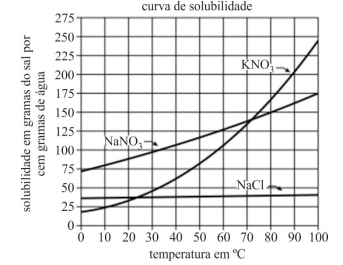
O coeficiente de solubilidade indica a quantidade de soluto que é possível solubilizar, em dada temperatura, em uma quantidade de solvente. O gráfico acima representa as curvas de solubilidade de três substâncias: NaNO3, NaCl e KNO3. A partir desse gráfico, é correto concluir que
A metilamina (H3C─NH2) é uma substância solúvel em água e que se encontra no estado gasoso nas condições normais de temperatura e pressão (CNTP). Ela é a responsável pelo odor desagradável de alguns peixes. Quando essa substância está em solução aquosa, estabelece-se o equilíbrio iônico abaixo.

Com base nas informações do texto, é correto afirmar que o odor desagradável fica mais intenso quando se adiciona a essa solução
O metanol é um combustível de alto desempenho que produz um fogo praticamente invisível, já que não forma fuligem. Ele pode ser obtido de acordo com a equação abaixo.

Considere que, em um recipiente fechado de 2 L, tenham sido colocados inicialmente 8 mol de CO e 8 mol de H2. Após a reação atingir o equilíbrio químico, constatou-se a presença de 3 mol de metanol no frasco. Nesse caso, é correto inferir que a constante de equilíbrio para essa reação, na temperatura do experimento, é
A reação de combustão da glicose, também chamada de
respiração, produz gás carbônico e água. Esse é um importante
processo metabólico, porque fornece energia para as células e
garante o bom funcionamento do organismo. Considere as
seguintes entalpias-padrão de formação  a 25 °C.
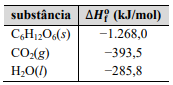
Com base nessas informações, é correto concluir que a variação de entalpia envolvida na queima de 1 mol de glicose é
O refrigerante é uma bebida gaseificada, livre de álcool, que caiu no gosto da maioria dos brasileiros. Essa bebida, que surgiu em 1676 em Paris, possui em sua composição principalmente água, gás carbônico, sumo de frutas ou extrato vegetal, corantes e açúcares ou edulcorantes. Suas primeiras versões eram feitas exclusivamente por farmacêuticos, já que estes possuíam grandes conhecimentos em química.
Internet: <www.saeqaufsc.com>(com adaptações).
Julgue os itens a seguir a partir do texto precedente.
I Tanto a água como o gás carbônico são classificados como óxidos ácidos.
II O gás carbônico, também conhecido como dióxido de carbono, ao reagir com água forma ácido carbônico.
III A água possui caráter exclusivamente básico.
IV Água e dióxido de carbono podem ser utilizados para corrigir a acidez do solo.
Está(ão) certo(s) apenas o(s) item(ns)
 ocorre
devido
ocorre
devido 
 Conheça nossos planos