Questões de Concurso
Sobre inglês
Foram encontradas 25.431 questões
Resolva questões gratuitamente!
Junte-se a mais de 4 milhões de concurseiros!


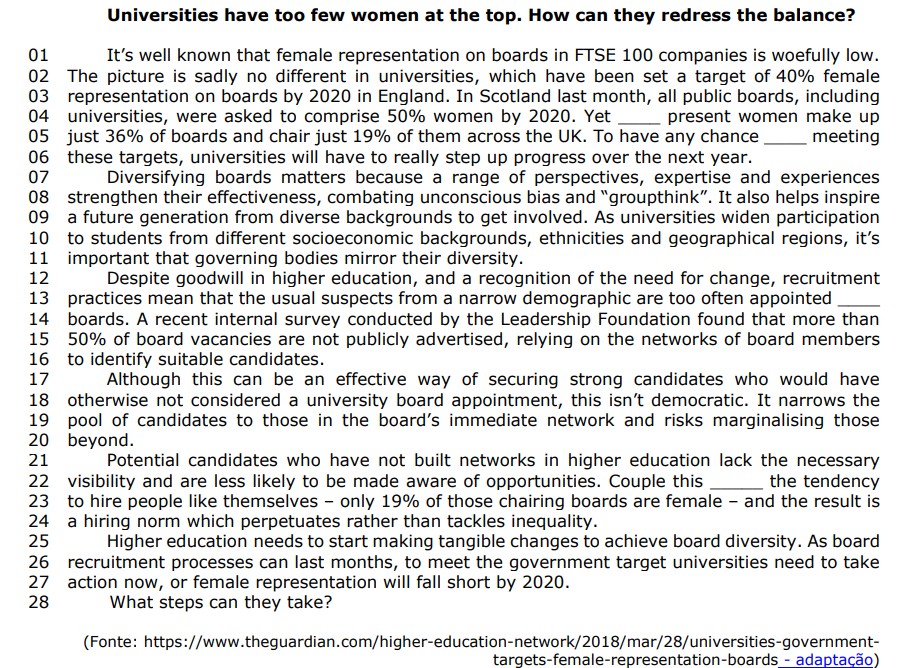
I. “The picture is sadly no different in universities” (l.02). II. “more than 50% of board vacancies are not publicly advertised” (l.14-15). III. “this isn’t democratic” (l.18).
Which of them show(s) the author’s position regarding the topic of the article?
Resumos relacionados
Advérbios e conjunções em inglês para concursos públicos
O estudo de advérbios e conjunções na língua inglesa é fundamental para quem deseja se destacar em provas de concursos públicos. Esses elementos desempenham papéis essenciais na construção de frases, influenciando diretamente o sentido e a coesão textual, habilidades bastante exigidas nas questões de interpretação e compreensão de textos em inglês.
Artigos (Articles) em inglês: uso em concursos públicos
Artigos (Articles) são palavras essenciais na gramática da língua inglesa, usadas para indicar se um substantivo está sendo mencionado de forma específica ou geral. Eles desempenham papel fundamental em provas de concursos, pois ajudam na compreensão e interpretação dos textos, além de serem frequentemente cobrados em questões envolvendo uso correto de estruturas gramaticais.
( ) The verb risk, as in ‘risks marginalizing those beyond’ (l.19-20), when followed by a verb, can be followed only by an –ing form. ( ) The verb start, as in ‘start making tangible changes’ (l.25), when followed by a verb, can be followed only by an –ing form. ( ) The verb need, as in ‘need to take action’ (l.26-27), when followed by a verb, can be followed only by a to-infinitive.
The correct order, top-down, is:
Column 1 1. Adverb. 2. Adjective. 3. Noun. 4. Verb.
Column 2 ( ) known (l.01). ( ) sadly (l.02). ( ) chair (l.05). ( ) unconscious (l.08). ( ) need (l.12). ( ) likely (l.22).
The correct order, top-down, is:
I. ‘It’ (l.08) refers to ‘diversifying boards’ (l.07) II. ‘This’ (l.17) refers to ‘goodwill in higher education’ (l.12) III. ‘It’ (l.18) refers to ‘university board appointment’ (l.18)
Which ones are correct?
I. The word ‘woefully’ (l.01) can be substituted by ‘incredibly’ without changing the meaning of the sentence. II. ‘Yet’ (l.04) means ‘nevertheless’. III. ‘Narrow’ (l.13) cannot be substituted by ‘broad’ without changing the meaning of the sentence.
Which ones are correct?
Answer the question based on the following text.
• Not all girls like _____ guys - some actually like skinny fellas. • The ____ memes are always the best. • The woman had _____ cats.
The correct order of filling in the blanks is:
Answer the question based on the following text.
“…said the dictionary. The dictionary will be offering UK state schools free access to the OED online (l.27-28).
To avoid the repetition of ‘the dictionary’, it would be necessary to:
I. Change the second occurrence of ‘The dictionary’ to ‘which’. II. Change the full stop to a comma. III. Convert the second sentence to passive voice.
Which ones are correct?
Answer the question based on the following text.
( ) Young people’s language today (l.05). ( ) there’s something (l.13). ( ) Bare things poppin’ off (l.20).
The correct order of filling in the parenthesis, from the top to the bottom, is:
Answer the question based on the following text.
Answer the question based on the following text.
( ) It is an example of the type 1 conditional. ( ) It refers to the present time, and it refers to something that is possible and real. ( ) If we change the sentence to the type 3 conditional, the if clause verb tense would be the present perfect and the main clause verb tense would be the perfect continuous.
The correct order of filling in the parenthesis, from the top to the bottom, is:
Answer the question based on the following text.
I. Line 03. II. Line 04. III. Line 10. IV. Line 14.
In which ones ‘that’ begins a clause that acts as the object of a verb?
Answer the question based on the following text.
I. is an adjective. II. should be translated as ‘corrente’. III. could be replaced by ‘real’.
Which ones are INCORRECT?
Answer the question based on the following text.
I. Lexicographers are used to _____ and _____ language change.” (l.12-13), the blanks should be filled in by ‘observing’ and ‘recording’
BECAUSE
II. We use ‘be used to’ to talk about habits or repeated actions in the past which we don't do in the present.
Considering the sentences above,
Answer the question based on the following text.
I. ‘Get to grips with’ means ‘begin to understand’. II. ‘slippery’ means literally that the word cannot be hold firmly. III. The best translation would be “segurar as gírias estranhas dos adolescentes”.
Which ones are correct?

 Conheça nossos planos