Foram encontradas 25.438 questões
Resolva questões gratuitamente!
Junte-se a mais de 4 milhões de concurseiros!


Leia as afirmativas a seguir:
I. Na frase “he eats him out of house and home”, o verbo 'eats' pode ser melhor traduzido como reformar.
II. O trecho a seguir, em inglês, está corretamente grafado: to have im kypimg (guardar, custodiar).
Marque a alternativa CORRETA:
Leia as afirmativas a seguir:
I. Estão corretas a grafia e a tradução do seguinte trecho, em inglês: to take leave (despedir-se, partir).
II. Estão corretas a grafia e a tradução do seguinte trecho, em inglês: to keep smiling (não desanimar, sorrir sempre).
Marque a alternativa CORRETA:
Leia as afirmativas a seguir:
I. Está correta a grafia do trecho a seguir: I bought hin of.
II. No trecho "to be crawling with" ocorre um verbo cujo significado é "gerenciar" ou "comandar".
Marque a alternativa CORRETA:
Resumos relacionados
Advérbios e conjunções em inglês para concursos públicos
O estudo de advérbios e conjunções na língua inglesa é fundamental para quem deseja se destacar em provas de concursos públicos. Esses elementos desempenham papéis essenciais na construção de frases, influenciando diretamente o sentido e a coesão textual, habilidades bastante exigidas nas questões de interpretação e compreensão de textos em inglês.
Artigos (Articles) em inglês: uso em concursos públicos
Artigos (Articles) são palavras essenciais na gramática da língua inglesa, usadas para indicar se um substantivo está sendo mencionado de forma específica ou geral. Eles desempenham papel fundamental em provas de concursos, pois ajudam na compreensão e interpretação dos textos, além de serem frequentemente cobrados em questões envolvendo uso correto de estruturas gramaticais.
Analise um plano de aula sobre a leitura fílmica do curta metragem “For The Birds” ministrada aos alunos do 9º ano do turno matutino na disciplina língua inglesa.
Plano de Aula
Sinopse: O curta For the birds, produzido pela Pixar, é mais um caso de produção voltada ao público infanto-juvenil que pode ser inspirador para o mundo adulto. Em seus poucos minutos de projeção sem diálogos, tem como elementos vitais a tolerância e a diversidade, retratando o preconceito que temos com pessoas diferentes de nós. Os pássaros rejeitam o outro de espécie diferente, mas no final tomam uma boa lição.
Objetivo: Trabalhar o preconceito contra o diferente através da leitura fílmica do curta metragem “For The Birds”, exibido no YouTube.
Material utilizado: celular, projetor e o curta metragem “For The Birds”.
I. Pre Viewing Questions:
1. What kind of movies do you like?
2.Have you ever watched any short film? If yes, which one?
II. Comprehension Questions:
1. Who are the characters?
2. Where is the scene?
3. What happened in the scenes you have just seen?
Teacher carry out a discussion with the students about these questions, helping them to answer these questions. She/He call students’ attention to prejudice against the different ones.
III. Post Viewing Questions:
Show the short film again and ask students, in small groups, to create a dialog where the Big Bird is included and role play it.
Sobre o plano de aula apresentado, considerando os pressupostos dos Parâmetros Curriculares Nacional de língua estrangeira, analise as assertivas e identifique com V as verdadeiras e com F as falsas.
( ) A interação é assimétrica.
( ) Há envolvimento discursivo dos alunos.
( ) Neste plano de aula, as tarefas não integram as dimensões internacional, linguística e cognitiva.
( ) Os conhecimentos prévios dos alunos são levados em consideração na elaboração do plano de aula.
A alternativa que contém a sequência correta, de cima para baixo, é
Considerando o fragmento do texto 3 “Ao mesmo tempo, a ênfase posta pelo autor na qualidade das
ferramentas de tradução automática parece, por enquanto, excessiva” e “De todo modo, é duvidoso
que esse tipo de recurso elimine a necessidade humana de comunicação imediata que conduz à eleição
mais ou menos espontânea de uma língua franca” (linhas 13-18), de acordo com os Parâmetros
Curriculares Nacional da Língua Estrangeira, é correto afirmar que
“A prática secular no Brasil privilegia o estudo da língua pela língua, muita forma gramatical que se
enfeixa num colar de conhecimentos desaplicados, que se vão de nossa memória sem aviso prévio”
(ALMEIDA FILHO, 2003). Sobre o ensino da língua inglesa, nesse contexto, é correto afirmar que
Analise a figura 5.
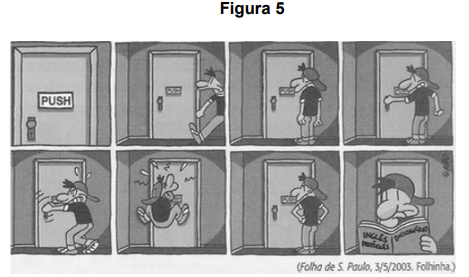
A tirinha apresentada na figura 5 revela o não cumprimento do direito educacional à aprendizagem de
língua estrangeira, concomitantemente à língua materna, previsto nos Parâmetros Curriculares
Nacionais da Língua Estrangeira, portanto fere ao pressuposto básico
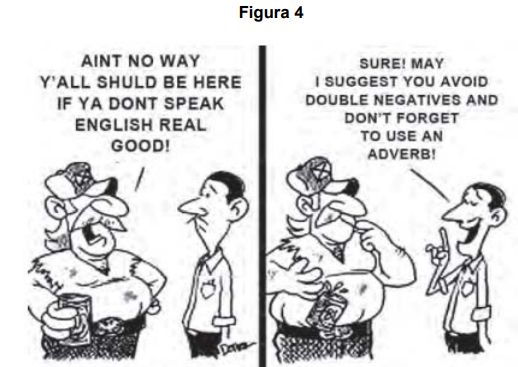
DONAR. Disponível em: <http://politicalgraffiti.wordpress.com>. Acesso em: 17 ago. 2011.
Considerando a relação entre linguagem e sociedade, analise o diálogo presente na charge (figura 4)
e assinale a alternativa que está em consonância com o que é descrito nos PCN de Língua Inglesa
sobre este tópico.
TEXT 8
“As far as practical conditions and educational relevance are concerned, virtually no major change has occurred in order to justify reframing our teaching. However, in what concerns social relevance, it is undeniable that the growth of the Internet has provided a new context for the use of the English language outside schools. For that reason, it is my belief that skills other than reading may now be taught in our classes without representing a return to a rationale that is alien to our schools. The teaching of writing in the context of Internet genres and practices is definitely necessary, if we want our students to have their own voice, becoming able to project their own local identities in global contexts.”
ALMEIDA, R. L. T. The teaching of English as a foreign language in the context of Brazilian regular schools: a retrospective and prospective view of policies and practices. Revista Brasileira de Linguística Aplicada, Belo Horizonte, v. 12, n. 2, 2012, p. 347.
The same word may belong to different word classes. In text 8, for example, the word "alien" is an adjective, but it could also be a noun in another context.
Select the group of words below in which there is ONE element that belongs to only one word class.
TEXT 8
“As far as practical conditions and educational relevance are concerned, virtually no major change has occurred in order to justify reframing our teaching. However, in what concerns social relevance, it is undeniable that the growth of the Internet has provided a new context for the use of the English language outside schools. For that reason, it is my belief that skills other than reading may now be taught in our classes without representing a return to a rationale that is alien to our schools. The teaching of writing in the context of Internet genres and practices is definitely necessary, if we want our students to have their own voice, becoming able to project their own local identities in global contexts.”
ALMEIDA, R. L. T. The teaching of English as a foreign language in the context of Brazilian regular schools: a retrospective and prospective view of policies and practices. Revista Brasileira de Linguística Aplicada, Belo Horizonte, v. 12, n. 2, 2012, p. 347.
Read the sentences below and decide which ones are in accordance with the ideas presented in the text. Mark the most adequate answer A-D.
I. The internet has introduced a new relevance for learning a foreign language.
II. Practical conditions and educational relevance have justified changes to teaching.
III. The use of the English language outside schools has always been considered relevant.
IV. The author claims that reading should be the focus of teaching English in schools.
V. Producing internet related texts may be a way to empower our students.
The correct option is
TEXT 7
“This, then, is the site of resistance, change, adaptation and reformulation. It is akin to what Canagarajah (1999) in his discussion of resistance to the global spread of English describes as a ‘resistance perspective’, highlighting the ways in which postcolonial subjects ‘may find ways to negotiate, alter and oppose political structures, and reconstruct their languages, cultures and identities to their advantage. The intention is not to reject English, but to reconstitute it in more inclusive, ethical and democratic terms.”
PENNYCOOK, A. Global Englishes and Transcultural Flows. New York: Routledge, 2007, p. 29.
The sentence that best preserves the meaning of the following excerpt “The intention is not to reject English,
but to reconstitute it.” is:
TEXT 6
“Probably the best-known and most often cited dimension of the WE (World Englishes) paradigm is the model of concentric circles: the ‘norm-providing’ inner circle, where English is spoken as a native language (ENL), the ‘norm-developing’ outer circle, where it is a second language (ESL), and the ‘norm-dependent’ expanding circle, where it is a foreign language (EFL). Although only ‘tentatively labelled’ (Kachru, 1985, p.12) in earlier versions, it has been claimed more recently that ‘the circles model is valid in the senses of earlier historical and political contexts, the dynamic diachronic advance of English around the world, and the functions and standards to which its users relate English in its many current global incarnations’ (Kachru and Nelson, 1996, p. 78).”
PENNYCOOK, A. Global Englishes and Transcultural Flows. New York: Routledge, 2007, p. 21.
According to the text, it is possible to say that the “circles model” established by Kachru
TEXT 5
“In other words, there are those among us who argue that the future of English is dependent on the likelihood or otherwise of the U.S. continuing to play its hegemonic role in world affairs. Since that possibility seems uncertain to many, especially in view of the much-talked-of ascendancy of emergent economies, many are of the opinion that English will soon lose much of its current glitter and cease to be what it is today, namely a world language. And there are those amongst us who further speculate that, in fifty or a hundred years’ time, we will all have acquired fluency in, say, Mandarin, or, if we haven’t, will be longing to learn it. […] Consider the following argument: a language such as English can only be claimed to have attained an international status to the very extent it has ceased to be national, i.e., the exclusive property of this or that nation in particular (Widdowson). In other words, the U.K. or the U.S.A. or whosoever cannot have it both ways. If they do concede that English is today a world language, then it only behooves them to also recognize that it is not their exclusive property, as painful as this might indeed turn out to be. In other words, it is part of the price they have to pay for seeing their language elevated to the status of a world language. Now, the key word here is “elevated”. It is precisely in the process of getting elevated to a world status that English or what I insist on referring to as the “World English” goes through a process of metamorphosis.”
RAJAGOPALAN, K. The identity of "World English”. New Challenges in Language and Literature. Belo Horizonte: FALE/UFMG, 2009, p. 99-100.
Ellipsis and substitution can be used as resources for avoiding repetition.
There are examples of ellipsis and substitution in the excerpt “And there are those amongst us who further speculate that, in fifty or a hundred years’ time, we will all have acquired fluency in, say, Mandarin, or, if we haven’t, will be longing to learn it.”.
Mark the alternative that contains an example of ellipsis only.
TEXT 5
“In other words, there are those among us who argue that the future of English is dependent on the likelihood or otherwise of the U.S. continuing to play its hegemonic role in world affairs. Since that possibility seems uncertain to many, especially in view of the much-talked-of ascendancy of emergent economies, many are of the opinion that English will soon lose much of its current glitter and cease to be what it is today, namely a world language. And there are those amongst us who further speculate that, in fifty or a hundred years’ time, we will all have acquired fluency in, say, Mandarin, or, if we haven’t, will be longing to learn it. […] Consider the following argument: a language such as English can only be claimed to have attained an international status to the very extent it has ceased to be national, i.e., the exclusive property of this or that nation in particular (Widdowson). In other words, the U.K. or the U.S.A. or whosoever cannot have it both ways. If they do concede that English is today a world language, then it only behooves them to also recognize that it is not their exclusive property, as painful as this might indeed turn out to be. In other words, it is part of the price they have to pay for seeing their language elevated to the status of a world language. Now, the key word here is “elevated”. It is precisely in the process of getting elevated to a world status that English or what I insist on referring to as the “World English” goes through a process of metamorphosis.”
RAJAGOPALAN, K. The identity of "World English”. New Challenges in Language and Literature. Belo Horizonte: FALE/UFMG, 2009, p. 99-100.
TEXT 5
“In other words, there are those among us who argue that the future of English is dependent on the likelihood or otherwise of the U.S. continuing to play its hegemonic role in world affairs. Since that possibility seems uncertain to many, especially in view of the much-talked-of ascendancy of emergent economies, many are of the opinion that English will soon lose much of its current glitter and cease to be what it is today, namely a world language. And there are those amongst us who further speculate that, in fifty or a hundred years’ time, we will all have acquired fluency in, say, Mandarin, or, if we haven’t, will be longing to learn it. […] Consider the following argument: a language such as English can only be claimed to have attained an international status to the very extent it has ceased to be national, i.e., the exclusive property of this or that nation in particular (Widdowson). In other words, the U.K. or the U.S.A. or whosoever cannot have it both ways. If they do concede that English is today a world language, then it only behooves them to also recognize that it is not their exclusive property, as painful as this might indeed turn out to be. In other words, it is part of the price they have to pay for seeing their language elevated to the status of a world language. Now, the key word here is “elevated”. It is precisely in the process of getting elevated to a world status that English or what I insist on referring to as the “World English” goes through a process of metamorphosis.”
RAJAGOPALAN, K. The identity of "World English”. New Challenges in Language and Literature. Belo Horizonte: FALE/UFMG, 2009, p. 99-100.
TEXT 4
“It must be fairly obvious from the discussion in the foregoing paragraphs that the very concept of ‘World Englishes’ throws a number of challenges at all those of us who are in one way or another involved in it. For ELT professionals all over the world, it means, among other things, having to take a fresh look at many of the things that have been taken for granted for long.
Consider, for instance, the following. World English is not the mother-tongue of anyone – and this includes even those who used to rejoice in their status as the ‘native-speakers’ of their own varieties of English. This is so because World English is a language that is in the making and, from the looks of it is bound to remain so for the foreseeable future. Incidentally, any temptation to consider World English a pidgin would be totally misguided in that it is not a make-shift language, nor one that is progressing towards a full-fledged language in its own right. Nor, for that matter, is it gathering a new generation of native speakers. Rather, it is resistant to the very terminology that the linguists resort to in describing conventional ‘natural’ languages.”
RAJAGOPALAN, K. The identity of "World English”: New Challenges in Language and Literature. Belo Horizonte: FALE/UFMG, 2009, p.104.
TEXT 4
“It must be fairly obvious from the discussion in the foregoing paragraphs that the very concept of ‘World Englishes’ throws a number of challenges at all those of us who are in one way or another involved in it. For ELT professionals all over the world, it means, among other things, having to take a fresh look at many of the things that have been taken for granted for long.
Consider, for instance, the following. World English is not the mother-tongue of anyone – and this includes even those who used to rejoice in their status as the ‘native-speakers’ of their own varieties of English. This is so because World English is a language that is in the making and, from the looks of it is bound to remain so for the foreseeable future. Incidentally, any temptation to consider World English a pidgin would be totally misguided in that it is not a make-shift language, nor one that is progressing towards a full-fledged language in its own right. Nor, for that matter, is it gathering a new generation of native speakers. Rather, it is resistant to the very terminology that the linguists resort to in describing conventional ‘natural’ languages.”
RAJAGOPALAN, K. The identity of "World English”: New Challenges in Language and Literature. Belo Horizonte: FALE/UFMG, 2009, p.104.
TEXT 3
“Despite the contemporary calling of the speech/textual genre conceptions to deal with privations in the educational system (ROJO, 2008), the treatment given to genre, especially in theories operating with the notion of textual genre, has mainly focused on genre’s stable characteristics and on the development of competencies/capacities that lead to the comprehension and production of the oral and written genres circulating in the social world.
One of the implications of this kind of treatment for the literacy practices at school has considerably often been the genre displacement from micro and macrolinguistic contexts that interact in meaning construction to abstractly focus on the stable characteristics defining news, comics, recipes, editorial, blogs etc. Another, and maybe more serious, unfolding is that since it doesn’t look at how genres mingle and hybridize with other genres and semiosis in processes of constant (re)designing meanings, such a treatment can end up contributing to the mere (re)production of genres legitimized by school, leaving little or no space at all for the innovations and destabilization that mingling and transgression processes print to texts in contemporaneity and, as a consequence, for a critical position in relation to meanings constructed in the margins of what school validates as acceptable literacy practices.”
OLIVEIRA, M. B. F.; SZUNDI, P. T. C. Multiliteracies Practices at School: for a responsive education to contemporaneity.
Bakhtiniana, São Paulo, v. 9, n. 2, Jul./Dec. 2014, p. 206,207.
TEXT 3
“Despite the contemporary calling of the speech/textual genre conceptions to deal with privations in the educational system (ROJO, 2008), the treatment given to genre, especially in theories operating with the notion of textual genre, has mainly focused on genre’s stable characteristics and on the development of competencies/capacities that lead to the comprehension and production of the oral and written genres circulating in the social world.
One of the implications of this kind of treatment for the literacy practices at school has considerably often been the genre displacement from micro and macrolinguistic contexts that interact in meaning construction to abstractly focus on the stable characteristics defining news, comics, recipes, editorial, blogs etc. Another, and maybe more serious, unfolding is that since it doesn’t look at how genres mingle and hybridize with other genres and semiosis in processes of constant (re)designing meanings, such a treatment can end up contributing to the mere (re)production of genres legitimized by school, leaving little or no space at all for the innovations and destabilization that mingling and transgression processes print to texts in contemporaneity and, as a consequence, for a critical position in relation to meanings constructed in the margins of what school validates as acceptable literacy practices.”
OLIVEIRA, M. B. F.; SZUNDI, P. T. C. Multiliteracies Practices at School: for a responsive education to contemporaneity.
Bakhtiniana, São Paulo, v. 9, n. 2, Jul./Dec. 2014, p. 206,207.
TEXT 2
“In spite of sharing Fairclough’s (1995/2010) view that the pedagogy of multiliteracies is situated in a critical language awareness perspective since its constructions parts from the problematization of work, citizenship and lifeworlds relations in the new global capitalism to propose the (re)design of meanings so as to account for the multiplicity of semiosis and lifestyles in contemporaneity, we can still notice that, in several aspects, the pedagogy designed by the New London Group legitimize some of the orders of discourse from this same capitalism it criticizes. Such a legitimation appears, for instance, in the comparison between teachers and managers used to define the notion of designer. It can also be noticed in the emphasis the Group places on the preparation for the labor market, even though the development of a metalanguage able to raise critical awareness about every practice is also emphasized. It is also worthwhile to highlight that the pedagogy of multiliteracies was thought as an educational alternative to respond to the “dramatic global economic change” we have been going through “as new business and management theories and practices emerge across the developed world” (NEW LONDON GROUP, 2000, p.10). Within this context, the fact of the multiliteracies pedagogy be constructed in the clash between legitimatizing and problematizing crystallized literacy practices from this developed world in the search of alternative life and educational designs becomes comprehensible.”
OLIVEIRA, M. B. F.; SZUNDI, P. T. C. Multiliteracies Practices at School: for a responsive education to contemporaneity.
Bakhtiniana, São Paulo, v. 9, n. 2, Jul./Dec. 2014, p. 202, 203.
According to the text, we may say that

 Conheça nossos planos