Foram encontradas 25.454 questões
Resolva questões gratuitamente!
Junte-se a mais de 4 milhões de concurseiros!


I. Dealing with IA technologies.
II. Disciplinary content knowledge.
III. Pedagogical knowledge.
IV. Research publication.
V. Translation skills.
TEXT 1
The Decolonial Option in English Teaching: Can the Subaltern Act?
In this reflective article that straddles the personal and the professional, the author shares his critical thoughts on the impact of the steady stream of discourse on the native speaker/nonnative speaker (NS/NNS) inequity in the field of TESOL. His contention is that more than a quarter century of the discoursal output has not in any significant way altered the ground reality of NNS subordination. Therefore, he further contends, it is legitimate to ask what the discourse has achieved, where it has fallen short, why it has fallen short, and what needs to be done. Drawing insights from the works of Gramsci (1971) on hegemony and subalternity, and Mignolo (2010) on decoloniality, the author characterizes the NNS community as a subaltern community and argues that, if it wishes to effectively disrupt the hegemonic power structure, the only option open to it is a decolonial option which demands resultoriented action, not just “intellectual elaboration.” Accordingly, he presents the contours of a five-point plan of action for the consideration of the subaltern community. He claims that only a collective, concerted, and coordinated set of actions carries the potential to shake the foundation of the hegemonic power structure and move the subaltern community forward.
Excerpt extracted and adapted from: KUMARAVADIVELU, Bala. The decolonial option in English teaching: Can the subaltern act? TESOL Quarterly, [S.l.], v. 50, n. 1, p. 66–85, 2016. DOI: 10.1002/tesq.202. Available in: https://doi.org/10.1002/tesq.202.
TEXT 1
The Decolonial Option in English Teaching: Can the Subaltern Act?
In this reflective article that straddles the personal and the professional, the author shares his critical thoughts on the impact of the steady stream of discourse on the native speaker/nonnative speaker (NS/NNS) inequity in the field of TESOL. His contention is that more than a quarter century of the discoursal output has not in any significant way altered the ground reality of NNS subordination. Therefore, he further contends, it is legitimate to ask what the discourse has achieved, where it has fallen short, why it has fallen short, and what needs to be done. Drawing insights from the works of Gramsci (1971) on hegemony and subalternity, and Mignolo (2010) on decoloniality, the author characterizes the NNS community as a subaltern community and argues that, if it wishes to effectively disrupt the hegemonic power structure, the only option open to it is a decolonial option which demands resultoriented action, not just “intellectual elaboration.” Accordingly, he presents the contours of a five-point plan of action for the consideration of the subaltern community. He claims that only a collective, concerted, and coordinated set of actions carries the potential to shake the foundation of the hegemonic power structure and move the subaltern community forward.
Excerpt extracted and adapted from: KUMARAVADIVELU, Bala. The decolonial option in English teaching: Can the subaltern act? TESOL Quarterly, [S.l.], v. 50, n. 1, p. 66–85, 2016. DOI: 10.1002/tesq.202. Available in: https://doi.org/10.1002/tesq.202.
TEXT 1
The Decolonial Option in English Teaching: Can the Subaltern Act?
In this reflective article that straddles the personal and the professional, the author shares his critical thoughts on the impact of the steady stream of discourse on the native speaker/nonnative speaker (NS/NNS) inequity in the field of TESOL. His contention is that more than a quarter century of the discoursal output has not in any significant way altered the ground reality of NNS subordination. Therefore, he further contends, it is legitimate to ask what the discourse has achieved, where it has fallen short, why it has fallen short, and what needs to be done. Drawing insights from the works of Gramsci (1971) on hegemony and subalternity, and Mignolo (2010) on decoloniality, the author characterizes the NNS community as a subaltern community and argues that, if it wishes to effectively disrupt the hegemonic power structure, the only option open to it is a decolonial option which demands resultoriented action, not just “intellectual elaboration.” Accordingly, he presents the contours of a five-point plan of action for the consideration of the subaltern community. He claims that only a collective, concerted, and coordinated set of actions carries the potential to shake the foundation of the hegemonic power structure and move the subaltern community forward.
Excerpt extracted and adapted from: KUMARAVADIVELU, Bala. The decolonial option in English teaching: Can the subaltern act? TESOL Quarterly, [S.l.], v. 50, n. 1, p. 66–85, 2016. DOI: 10.1002/tesq.202. Available in: https://doi.org/10.1002/tesq.202.
TEXT 1
The Decolonial Option in English Teaching: Can the Subaltern Act?
In this reflective article that straddles the personal and the professional, the author shares his critical thoughts on the impact of the steady stream of discourse on the native speaker/nonnative speaker (NS/NNS) inequity in the field of TESOL. His contention is that more than a quarter century of the discoursal output has not in any significant way altered the ground reality of NNS subordination. Therefore, he further contends, it is legitimate to ask what the discourse has achieved, where it has fallen short, why it has fallen short, and what needs to be done. Drawing insights from the works of Gramsci (1971) on hegemony and subalternity, and Mignolo (2010) on decoloniality, the author characterizes the NNS community as a subaltern community and argues that, if it wishes to effectively disrupt the hegemonic power structure, the only option open to it is a decolonial option which demands resultoriented action, not just “intellectual elaboration.” Accordingly, he presents the contours of a five-point plan of action for the consideration of the subaltern community. He claims that only a collective, concerted, and coordinated set of actions carries the potential to shake the foundation of the hegemonic power structure and move the subaltern community forward.
Excerpt extracted and adapted from: KUMARAVADIVELU, Bala. The decolonial option in English teaching: Can the subaltern act? TESOL Quarterly, [S.l.], v. 50, n. 1, p. 66–85, 2016. DOI: 10.1002/tesq.202. Available in: https://doi.org/10.1002/tesq.202.
TEXT 1
The Decolonial Option in English Teaching: Can the Subaltern Act?
In this reflective article that straddles the personal and the professional, the author shares his critical thoughts on the impact of the steady stream of discourse on the native speaker/nonnative speaker (NS/NNS) inequity in the field of TESOL. His contention is that more than a quarter century of the discoursal output has not in any significant way altered the ground reality of NNS subordination. Therefore, he further contends, it is legitimate to ask what the discourse has achieved, where it has fallen short, why it has fallen short, and what needs to be done. Drawing insights from the works of Gramsci (1971) on hegemony and subalternity, and Mignolo (2010) on decoloniality, the author characterizes the NNS community as a subaltern community and argues that, if it wishes to effectively disrupt the hegemonic power structure, the only option open to it is a decolonial option which demands resultoriented action, not just “intellectual elaboration.” Accordingly, he presents the contours of a five-point plan of action for the consideration of the subaltern community. He claims that only a collective, concerted, and coordinated set of actions carries the potential to shake the foundation of the hegemonic power structure and move the subaltern community forward.
Excerpt extracted and adapted from: KUMARAVADIVELU, Bala. The decolonial option in English teaching: Can the subaltern act? TESOL Quarterly, [S.l.], v. 50, n. 1, p. 66–85, 2016. DOI: 10.1002/tesq.202. Available in: https://doi.org/10.1002/tesq.202.
TEXT 1
The Decolonial Option in English Teaching: Can the Subaltern Act?
In this reflective article that straddles the personal and the professional, the author shares his critical thoughts on the impact of the steady stream of discourse on the native speaker/nonnative speaker (NS/NNS) inequity in the field of TESOL. His contention is that more than a quarter century of the discoursal output has not in any significant way altered the ground reality of NNS subordination. Therefore, he further contends, it is legitimate to ask what the discourse has achieved, where it has fallen short, why it has fallen short, and what needs to be done. Drawing insights from the works of Gramsci (1971) on hegemony and subalternity, and Mignolo (2010) on decoloniality, the author characterizes the NNS community as a subaltern community and argues that, if it wishes to effectively disrupt the hegemonic power structure, the only option open to it is a decolonial option which demands resultoriented action, not just “intellectual elaboration.” Accordingly, he presents the contours of a five-point plan of action for the consideration of the subaltern community. He claims that only a collective, concerted, and coordinated set of actions carries the potential to shake the foundation of the hegemonic power structure and move the subaltern community forward.
Excerpt extracted and adapted from: KUMARAVADIVELU, Bala. The decolonial option in English teaching: Can the subaltern act? TESOL Quarterly, [S.l.], v. 50, n. 1, p. 66–85, 2016. DOI: 10.1002/tesq.202. Available in: https://doi.org/10.1002/tesq.202.
I. NS are considered a subaltern professional group in comparison with NNS.
II. NNS could be considered an emerging elite within TESOL.
III. NNS are usually seen as a marginalized or subaltern community.
IV. NNS are a group resistant to change. V. The inequity between NS and NNS is a temporary phenomenon in education.
Now, select the CORRECT alternative, whose statement(s) is/are true:
TEXT 1
The Decolonial Option in English Teaching: Can the Subaltern Act?
In this reflective article that straddles the personal and the professional, the author shares his critical thoughts on the impact of the steady stream of discourse on the native speaker/nonnative speaker (NS/NNS) inequity in the field of TESOL. His contention is that more than a quarter century of the discoursal output has not in any significant way altered the ground reality of NNS subordination. Therefore, he further contends, it is legitimate to ask what the discourse has achieved, where it has fallen short, why it has fallen short, and what needs to be done. Drawing insights from the works of Gramsci (1971) on hegemony and subalternity, and Mignolo (2010) on decoloniality, the author characterizes the NNS community as a subaltern community and argues that, if it wishes to effectively disrupt the hegemonic power structure, the only option open to it is a decolonial option which demands resultoriented action, not just “intellectual elaboration.” Accordingly, he presents the contours of a five-point plan of action for the consideration of the subaltern community. He claims that only a collective, concerted, and coordinated set of actions carries the potential to shake the foundation of the hegemonic power structure and move the subaltern community forward.
Excerpt extracted and adapted from: KUMARAVADIVELU, Bala. The decolonial option in English teaching: Can the subaltern act? TESOL Quarterly, [S.l.], v. 50, n. 1, p. 66–85, 2016. DOI: 10.1002/tesq.202. Available in: https://doi.org/10.1002/tesq.202.
TEXT 1
The Decolonial Option in English Teaching: Can the Subaltern Act?
In this reflective article that straddles the personal and the professional, the author shares his critical thoughts on the impact of the steady stream of discourse on the native speaker/nonnative speaker (NS/NNS) inequity in the field of TESOL. His contention is that more than a quarter century of the discoursal output has not in any significant way altered the ground reality of NNS subordination. Therefore, he further contends, it is legitimate to ask what the discourse has achieved, where it has fallen short, why it has fallen short, and what needs to be done. Drawing insights from the works of Gramsci (1971) on hegemony and subalternity, and Mignolo (2010) on decoloniality, the author characterizes the NNS community as a subaltern community and argues that, if it wishes to effectively disrupt the hegemonic power structure, the only option open to it is a decolonial option which demands resultoriented action, not just “intellectual elaboration.” Accordingly, he presents the contours of a five-point plan of action for the consideration of the subaltern community. He claims that only a collective, concerted, and coordinated set of actions carries the potential to shake the foundation of the hegemonic power structure and move the subaltern community forward.
Excerpt extracted and adapted from: KUMARAVADIVELU, Bala. The decolonial option in English teaching: Can the subaltern act? TESOL Quarterly, [S.l.], v. 50, n. 1, p. 66–85, 2016. DOI: 10.1002/tesq.202. Available in: https://doi.org/10.1002/tesq.202.
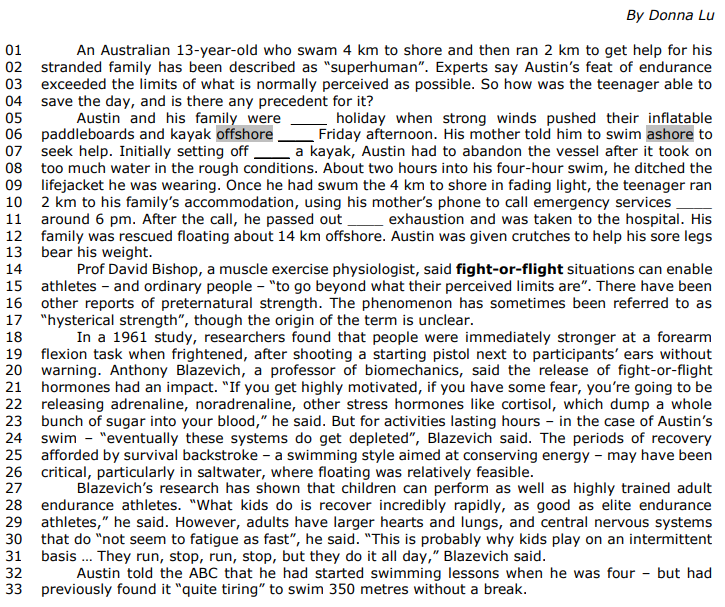
( ) In the sentence “An Australian 13-year-old who swam 4 km to shore” (l. 01), the relative pronoun “who” could be replaced by “that” without changing the meaning.
( ) The sentence “In a 1961 study, researchers found that people were immediately stronger” (l. 18) could be rewritten using the present perfect tense without any change in meaning.
( ) In the sentence “Once he had swum the 4 km to shore in fading light” (l. 09), the verb tense used expresses an action completed before another action in the past.
( ) In the sentence “His family was rescued floating about 14 km offshore” (l. 11-12), the verb form indicates an action performed by the subject “his family”.
The correct order of filling in the parentheses, from top to bottom, is:
“However, adults have larger hearts and lungs, and central nervous systems that do ‘not seem to fatigue as fast’, he said.” (l. 29-30).

 Conheça nossos planos