Foram encontradas 25.429 questões
Resolva questões gratuitamente!
Junte-se a mais de 4 milhões de concurseiros!


(_) Look at those hawks in the sky. (_) These are my books. (_) Is these hotel nice?
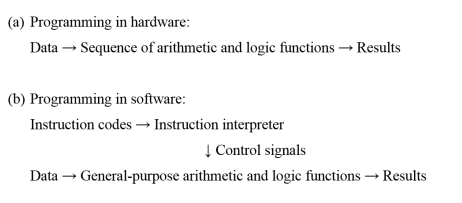
De acordo com o texto, as duas abordagens
• Since the beginning of the millennium, we have been seeing aggressive deployment of broadband Internet access to homes; • The increasing ubiquity of high-speed public Wi-Fi networks and medium-speed Internet access is not only making it possible to remain constantly connected while on the move, but also enabling new location-specific applications; • Online social networks have created massive people networks on top of the Internet; • Online service providers have deployed their own extensive private networks; • Many Internet commerce companies are now running their applications in the “cloud”.
De acordo com o texto, o desenvolvimento que merece atenção especial é:
The words that correctly complete the sentence are
INSTRUCTION: Read the comic strip to answer question.

Available at: https://www.gocomics.com/peanuts/1970/01/26. Accessed on: Oct. 10, 2022.
INSTRUCTION: Read the comic strip to answer question.
Available at: https://www.gocomics.com/peanuts/1970/01/26. Accessed on: Oct. 10, 2022.
[…]
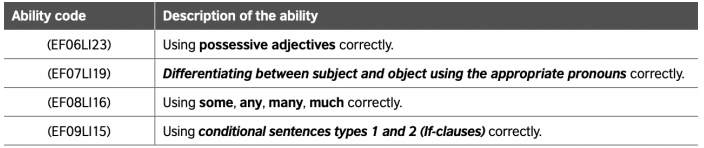
Available at: https://www.britishcouncil.org.br/sites/default/files/leitura_critica_bncc_-_en_-_v4_final.pdf. [Fragment]. Accessed on: Oct. 10, 2022.
The BNCC abilities listed above are examples of ones which reinforce the use of basic skills and systemic knowledge of the English language. In the English teaching context, it is strongly recommended that English teachers mainly help students
Text CB2A2
Anyone who has interacted with superbot ChatGPT or image generator DALL-E might be wondering what the future of artificial intelligence (AI) holds for humanity.
ChatGPT is an AI program that generates text in a very human-like manner when asked questions. Just ask DALL-E or similar programs to create a picture of a French bulldog driving a pink convertible and voila: you’ll see several versions in seconds.
Science fiction in the mid-20th century created good-natured AI such as the computer on Star Trek helping the Enterprise crew, as well as its evil twin set on destroying its creators like HAL in Arthur C. Clarke’s famous book (or Stanley Kubrick’s 1968 film adaptation) 2001: A Space Odyssey. In 2023, however, we’re surrounded by AI that’s far more mundane than those examples. The virtual assistant in your smartphone, the airline chatbot and the robot vacuum cleaning your floors don’t seem to have any aspirations to rise above humanity and have been designed to help us.
We should be prepared for bigger things to come than games, better chatbots or photo generators. Connectivity is key: think of AI as a general-purpose innovation like electricity that powers and connects other technologies, including sensors, robots, genomic devices and 3D printers. AI’s use will only intensify and accelerate as faster computing technology is developed, along with greater sensors capturing data, often called the Internet of Things (IoT). In the future, AI will be interwoven in virtually every aspect of commercial and personal activities.
Peter Marber. Artificial Intelligence: Why Should We Care?.
Internet:
Considering the linguistic and semantic aspects of text CB2A2, judge the following item.
In the second sentence of the last paragraph, if the phrase
“Connectivity is key” were rewritten as “The key to
connectivity is”, there would be no difference in the meaning
of the sentence.
Text CB2A2
Anyone who has interacted with superbot ChatGPT or image generator DALL-E might be wondering what the future of artificial intelligence (AI) holds for humanity.
ChatGPT is an AI program that generates text in a very human-like manner when asked questions. Just ask DALL-E or similar programs to create a picture of a French bulldog driving a pink convertible and voila: you’ll see several versions in seconds.
Science fiction in the mid-20th century created good-natured AI such as the computer on Star Trek helping the Enterprise crew, as well as its evil twin set on destroying its creators like HAL in Arthur C. Clarke’s famous book (or Stanley Kubrick’s 1968 film adaptation) 2001: A Space Odyssey. In 2023, however, we’re surrounded by AI that’s far more mundane than those examples. The virtual assistant in your smartphone, the airline chatbot and the robot vacuum cleaning your floors don’t seem to have any aspirations to rise above humanity and have been designed to help us.
We should be prepared for bigger things to come than games, better chatbots or photo generators. Connectivity is key: think of AI as a general-purpose innovation like electricity that powers and connects other technologies, including sensors, robots, genomic devices and 3D printers. AI’s use will only intensify and accelerate as faster computing technology is developed, along with greater sensors capturing data, often called the Internet of Things (IoT). In the future, AI will be interwoven in virtually every aspect of commercial and personal activities.
Peter Marber. Artificial Intelligence: Why Should We Care?.
Internet:
Considering the linguistic and semantic aspects of text CB2A2, judge the following item.
The adverb “virtually”, as used in the last sentence of text,
means nearly.
Text CB2A2
Anyone who has interacted with superbot ChatGPT or image generator DALL-E might be wondering what the future of artificial intelligence (AI) holds for humanity.
ChatGPT is an AI program that generates text in a very human-like manner when asked questions. Just ask DALL-E or similar programs to create a picture of a French bulldog driving a pink convertible and voila: you’ll see several versions in seconds.
Science fiction in the mid-20th century created good-natured AI such as the computer on Star Trek helping the Enterprise crew, as well as its evil twin set on destroying its creators like HAL in Arthur C. Clarke’s famous book (or Stanley Kubrick’s 1968 film adaptation) 2001: A Space Odyssey. In 2023, however, we’re surrounded by AI that’s far more mundane than those examples. The virtual assistant in your smartphone, the airline chatbot and the robot vacuum cleaning your floors don’t seem to have any aspirations to rise above humanity and have been designed to help us.
We should be prepared for bigger things to come than games, better chatbots or photo generators. Connectivity is key: think of AI as a general-purpose innovation like electricity that powers and connects other technologies, including sensors, robots, genomic devices and 3D printers. AI’s use will only intensify and accelerate as faster computing technology is developed, along with greater sensors capturing data, often called the Internet of Things (IoT). In the future, AI will be interwoven in virtually every aspect of commercial and personal activities.
Peter Marber. Artificial Intelligence: Why Should We Care?.
Internet:
Considering the linguistic and semantic aspects of text CB2A2, judge the following item.
The word “wonder”, in the first paragraph, is used here in the
sense of “decide”.
Text CB2A2
Anyone who has interacted with superbot ChatGPT or image generator DALL-E might be wondering what the future of artificial intelligence (AI) holds for humanity.
ChatGPT is an AI program that generates text in a very human-like manner when asked questions. Just ask DALL-E or similar programs to create a picture of a French bulldog driving a pink convertible and voila: you’ll see several versions in seconds.
Science fiction in the mid-20th century created good-natured AI such as the computer on Star Trek helping the Enterprise crew, as well as its evil twin set on destroying its creators like HAL in Arthur C. Clarke’s famous book (or Stanley Kubrick’s 1968 film adaptation) 2001: A Space Odyssey. In 2023, however, we’re surrounded by AI that’s far more mundane than those examples. The virtual assistant in your smartphone, the airline chatbot and the robot vacuum cleaning your floors don’t seem to have any aspirations to rise above humanity and have been designed to help us.
We should be prepared for bigger things to come than games, better chatbots or photo generators. Connectivity is key: think of AI as a general-purpose innovation like electricity that powers and connects other technologies, including sensors, robots, genomic devices and 3D printers. AI’s use will only intensify and accelerate as faster computing technology is developed, along with greater sensors capturing data, often called the Internet of Things (IoT). In the future, AI will be interwoven in virtually every aspect of commercial and personal activities.
Peter Marber. Artificial Intelligence: Why Should We Care?.
Internet:
Judge the following item according to the information given in text CB2A2.
Interaction with existing AI prompts questions about the
future of humanity.
“Separatist fighters in Indonesia’s restive Papua region have captured a pilot from New Zealand and are holding him hostage after setting fire to his plane, the group said in a statement.”
“This time it was Edgardo Greco, 63, who was apprehended in Saint-Etienne, France, where he was working under the alias Paolo Dimitrio as a pizzaiolo at the Caffe Rossini Italian restaurant.”
“We have six kids that have been transported into different hospitals in Montreal and Laval, but unfortunately we have two other kids that died as a result of the accident,”
“With the rapid development _____ modern technology, the space _____ information confrontation is no longer limited _____ land, sea, and the low altitude. Near space has also become a new battlefield _____ modern warfare and an important part of the national security system,”
“China has paid close attention _____ other countries’ developments _____ this region, which has been hailed _____ Chinese military experts _____ “a new front for militarization” and “an important field of competition among the world’s military powers.”.”
( ) Barking up the wrong tree ( ) Bite off more than you can chew ( ) Costs an arm and a leg ( ) Comparing apples to oranges
I - To be mistaken, to be looking for solutions in the wrong place. II - Very expensive. III - Comparing two things that cannot be compared. IV - Take on a project that you cannot finish.

 Conheça nossos planos