🎯 Saiba o que estudar

Avançado com Treinador a partir de R$ 0,76/dia

Questões de Concurso Sobre inglês

Questões Discursivas

Foram encontradas 25.462 questões

Resolva questões gratuitamente!

Junte-se a mais de 4 milhões de concurseiros!

Ano: 2026 Banca: IF-PI Órgão: IF-PI Prova: IF-PI - 2026 - IF-PI - Professor EBTT - Ingles |
Q4014461 Inglês
In the process of syllabus design for English for Specific Purposes (ESP), the "Target Situation Analysis" (TSA) functions as a fundamental diagnostic tool. Beyond simple vocabulary identification, a robust TSA is conducted in this framework to:
DUDLEY-EVANS, T.; ST JOHN, M. J. Developments in English for Specific Purposes: A multi-disciplinary approach. Cambridge: Cambridge University Press, 1998.
Alternativas
Ano: 2026 Banca: IF-PI Órgão: IF-PI Prova: IF-PI - 2026 - IF-PI - Professor EBTT - Ingles |
Q4014460 Inglês
Match the ESP theoretical concepts (Column I) with their respective pedagogical focuses (Column II), according to the framework by Hutchinson & Waters:
HUTCHINSON, T.; WATERS, A. English for Specific Purposes: A learning-centred approach. Cambridge: Cambridge University Press, 1987.

Column I
(1) Language-centered approach.
(2) Skills centered approach
(3) Learning-centered approach.

Column II
(   ) Focuses on the learner's cognitive processes and mental paths to acquire knowledge. 
(   )  Focuses on the underlying thinking processes and strategies required for professional tasks.
(   ) Focuses primarily on the linguistic features and lexical items of the target situation.

Choose the alternative below that presents the correct sequence from top to bottom:
Alternativas
Ano: 2026 Banca: IF-PI Órgão: IF-PI Prova: IF-PI - 2026 - IF-PI - Professor EBTT - Ingles |
Q4014459 Inglês
The integration of Generative Artificial Intelligence (AI) in English Language Teaching (ELT) has introduced the concept of "AI Literacy." In a pedagogical approach that seeks to move beyond the mere substitution of traditional tasks, a teacher encourages students to use AI to generate multiple versions of a technical abstract and then critically compare them for stylistic nuances and factual accuracy. According to the principles of digital literacies in the AI era, this practice primarily aims to:
Alternativas
Ano: 2026 Banca: IF-PI Órgão: IF-PI Prova: IF-PI - 2026 - IF-PI - Professor EBTT - Ingles |
Q4014458 Inglês

GenAI and the Future of Literacy


The integration of Generative Artificial Intelligence (GenAI) in education has sparked a debate about the evolution of writing. According to The Guardian (2024), while some fear the erosion of basic skills, a pedagogical approach that seeks to move beyond the mere substitution of traditional tasks focuses on "AI Literacy." In this framework, teachers encourage students to use AI to generate multiple versions of a technical abstract and then critically compare them for stylistic nuances and factual accuracy. This practice primarily aims to develop students' critical evaluative skills and their ability to act as "human-in-the-loop" editors, ensuring that technology serves as a cognitive scaff old rather than a replacement for human agency.


THE GUARDIAN. GenAI and the Newsroom. Londres, 15 ago. 2024. Disponível em: https://www.theguardian.com. Acesso em: 05 fev. 2026.

Based on the text regarding "AI Literacy" and the integration of GenAI in education, analyze the following statements as True (T) or False (F):
(   ) The "AI Literacy" framework focuses on the complete substitution of traditional writing tasks by automated AI tools.
(   ) Critical comparison of AI-generated texts aims to enhance students' ability to identify stylistic nuances and factual errors.
(   ) The pedagogical approach described encourages students to act as passive recipients of machine-generated content.
(   )  The "human-in-the-loop" model ensures that human agency remains central to the writing and editing process.
(   ) "Cognitive scaffolding" in this context implies that AI should eventually replace the need for human evaluative skills.
Choose the alternative that presents the correct sequence - from top to bottom:
Alternativas
Ano: 2026 Banca: IF-PI Órgão: IF-PI Prova: IF-PI - 2026 - IF-PI - Professor EBTT - Ingles |
Q4014457 Inglês

The Role of Materials in ESP


In the ESP context, the use of authentic materials is not an end in itself, but a means to an end. Such materials are selected because they provide the 'carrier content'—the technical or professional information - through which the 'real content' (the target language structures and skills) is practiced. According to Dudley-Evans and St John, the authenticity of the task is often more important than the authenticity of the text itself. By using a technical manual in an 'Agroecology' course, the instructor ensures that the classroom environment mirrors the communicative demands of the students' future professional lives."


DUDLEY-EVANS, T.; ST JOHN, M. J. Developments in English for Specific Purposes: a multi-disciplinary approach. Cambridge: Cambridge University Press, 1998. p. 115.

A teacher selects a technical manual for an "Agroecology" course. According to the framework established by Dudley-Evans and St John (1998), the primary justification for this choice is that:
Alternativas
Ano: 2026 Banca: IF-PI Órgão: IF-PI Prova: IF-PI - 2026 - IF-PI - Professor EBTT - Ingles |
Q4014455 Inglês
A teacher uses the flipped classroom model for a lesson on "Technical Manuals," where students watch video tutorials at home and use class time for collaborative problem-solving. This practice:
Alternativas
Ano: 2026 Banca: IF-PI Órgão: IF-PI Prova: IF-PI - 2026 - IF-PI - Professor EBTT - Ingles |
Q4014454 Inglês
Within the framework of Computer-Assisted Language Learning (CALL), the distinction between communication modes is essential for instructional design. According to the structural properties of digital interaction, "Asynchronous Communication" is characterized by:
KERN, R. Technology and language learning. In: SIMPSON, J. (Ed.). The Routledge Handbook of Applied Linguistics. London: Routledge, 2011.
Alternativas
Ano: 2026 Banca: IF-PI Órgão: IF-PI Prova: IF-PI - 2026 - IF-PI - Professor EBTT - Ingles |
Q4014453 Inglês
 Read the text below and answer question.

ESP is not a matter of teaching 'specialized varieties' of English. The fact that some language features may be more statistically common in a particular context does not create a new form of language. Rather, ESP is an approach to language learning which is based on learner need. The foundation of ESP lies in the question: 'Why does this learner need to learn a foreign language?'. Consequently, the design of a syllabus for a Civil Engineering module must prioritize the communicative demands of the professional field over general linguistic abstraction."

HUTCHINSON, T.; WATERS, A. English for Specific Purposes: a learning-centered approach. Cambridge: Cambridge University Press, 1987. p. 19.
A professor at a Federal Institute is designing an English module for "Civil Engineering" students. Based on the principles of Hutchinson and Waters, presented in the text, the selection of materials for this course should primarily reflect which underlying ESP principle?
Alternativas
Q4014341 Inglês
Read text I and then answer the question below.


TEXT I


“Through the Law Enforcement Officers Killed and Assaulted (LEOKA) Data Collection, the FBI provides data and training that helps keep law enforcement officers safe as they protect the nation’s communities. The goal is to provide relevant, high quality, potentially lifesaving information to law enforcement agencies focusing on why an incident occurred, as opposed to what occurred during the incident, with the hope of preventing future incidents. The data collected is analyzed by the LEOKA team and the results are incorporated into the officer safety awareness training the FBI provides for partner agencies. 


LEOKA’S Three-Tier Approach

LEOKA has a three-tier approach in order to fulfill its mission and promote officer safety awareness to the law enforcement community nationwide:


▪ Data collection: Data on line-of-duty deaths and assaults are collected from participating agencies across the country through the FBI’s Uniform Crime Reporting (UCR) Program, and the recent expansion of the data collection methods are providing even more facts that can be studied by experts and officer safety trainers in order to tailor training to real world circumstances. The data are also published annually in the Bureau’s Law Enforcement Officers Killed and Assaulted report.

▪ Research: Over the years, researchers led by the LEOKA Data Collection have been conducting indepth research using UCR data collected regarding incidents in which officers are killed or assaulted. The published research gives officers a sharper understanding of what types of scenarios and circumstances have resulted in fatalities and assaults. These articles and publications also contain information obtained through extensive interviews with officers and offenders involved in critical incidents to develop lessons learned, trends and curriculum development for the FBI’s Officer Safety Awareness Training (OSAT).

▪ Training: The objective of the Bureau’s OSAT, which has been provided to thousands of our law enforcement partners in the U.S. and abroad, is to assist law enforcement managers, trainers, and personnel with identifying issues and circumstances that may contribute to officer deaths and assaults and help prevent them. Data has shown an increase in ambushes on our nation’s law enforcement officers. As a result, LEOKA trainers are studying the data with the purpose of shaping future training to help reverse this trend with information and education.


LEOKA Criteria

The data collected under the auspices of the LEOKA Data Collection involves law enforcement officers who meet a certain set of criteria established by the FBI.

General Criteria

The publishable data pertains to felonious deaths, accidental deaths, and assaults of duly sworn city, university and college, county, state, tribal, and federal law enforcement officers who, at the time of the incident, met the following criteria:


▪ Wore/carried a badge (ordinarily)

▪ Carried a firearm (ordinarily)

▪ Were duly sworn and had full arrest powers

▪ Were members of a law enforcement agency

▪ Were acting in an official capacity, whether on or off duty, at the time of the incident

▪ If killed, the deaths were directly related to the injuries received during the incidentes.” 


Source (adapted): Federal Bureau of Investigation - FBI. Available at: https://www.fbi.gov/how-we-can-help-you/more-fbiservices-and-information/ucr/leoka Accessed on: September 08, 2025. 
All the alternatives match the meaning of the word “awareness” as used in the sentence, EXCEPT:

“The data collected is analyzed by the LEOKA team and the results are incorporated into the officer safety awareness training the FBI provides for partner agencies.” 
Alternativas
Q4014340 Inglês
Read text I and then answer the question below.


TEXT I


“Through the Law Enforcement Officers Killed and Assaulted (LEOKA) Data Collection, the FBI provides data and training that helps keep law enforcement officers safe as they protect the nation’s communities. The goal is to provide relevant, high quality, potentially lifesaving information to law enforcement agencies focusing on why an incident occurred, as opposed to what occurred during the incident, with the hope of preventing future incidents. The data collected is analyzed by the LEOKA team and the results are incorporated into the officer safety awareness training the FBI provides for partner agencies. 


LEOKA’S Three-Tier Approach

LEOKA has a three-tier approach in order to fulfill its mission and promote officer safety awareness to the law enforcement community nationwide:


▪ Data collection: Data on line-of-duty deaths and assaults are collected from participating agencies across the country through the FBI’s Uniform Crime Reporting (UCR) Program, and the recent expansion of the data collection methods are providing even more facts that can be studied by experts and officer safety trainers in order to tailor training to real world circumstances. The data are also published annually in the Bureau’s Law Enforcement Officers Killed and Assaulted report.

▪ Research: Over the years, researchers led by the LEOKA Data Collection have been conducting indepth research using UCR data collected regarding incidents in which officers are killed or assaulted. The published research gives officers a sharper understanding of what types of scenarios and circumstances have resulted in fatalities and assaults. These articles and publications also contain information obtained through extensive interviews with officers and offenders involved in critical incidents to develop lessons learned, trends and curriculum development for the FBI’s Officer Safety Awareness Training (OSAT).

▪ Training: The objective of the Bureau’s OSAT, which has been provided to thousands of our law enforcement partners in the U.S. and abroad, is to assist law enforcement managers, trainers, and personnel with identifying issues and circumstances that may contribute to officer deaths and assaults and help prevent them. Data has shown an increase in ambushes on our nation’s law enforcement officers. As a result, LEOKA trainers are studying the data with the purpose of shaping future training to help reverse this trend with information and education.


LEOKA Criteria

The data collected under the auspices of the LEOKA Data Collection involves law enforcement officers who meet a certain set of criteria established by the FBI.

General Criteria

The publishable data pertains to felonious deaths, accidental deaths, and assaults of duly sworn city, university and college, county, state, tribal, and federal law enforcement officers who, at the time of the incident, met the following criteria:


▪ Wore/carried a badge (ordinarily)

▪ Carried a firearm (ordinarily)

▪ Were duly sworn and had full arrest powers

▪ Were members of a law enforcement agency

▪ Were acting in an official capacity, whether on or off duty, at the time of the incident

▪ If killed, the deaths were directly related to the injuries received during the incidentes.” 


Source (adapted): Federal Bureau of Investigation - FBI. Available at: https://www.fbi.gov/how-we-can-help-you/more-fbiservices-and-information/ucr/leoka Accessed on: September 08, 2025. 
Choose the alternative that best matches the meaning of the word “badge” as used in the sentence:

Wore/carried a badge (ordinarily).”
Alternativas
Q4014339 Inglês
Read text I and then answer the question below.


TEXT I


“Through the Law Enforcement Officers Killed and Assaulted (LEOKA) Data Collection, the FBI provides data and training that helps keep law enforcement officers safe as they protect the nation’s communities. The goal is to provide relevant, high quality, potentially lifesaving information to law enforcement agencies focusing on why an incident occurred, as opposed to what occurred during the incident, with the hope of preventing future incidents. The data collected is analyzed by the LEOKA team and the results are incorporated into the officer safety awareness training the FBI provides for partner agencies. 


LEOKA’S Three-Tier Approach

LEOKA has a three-tier approach in order to fulfill its mission and promote officer safety awareness to the law enforcement community nationwide:


▪ Data collection: Data on line-of-duty deaths and assaults are collected from participating agencies across the country through the FBI’s Uniform Crime Reporting (UCR) Program, and the recent expansion of the data collection methods are providing even more facts that can be studied by experts and officer safety trainers in order to tailor training to real world circumstances. The data are also published annually in the Bureau’s Law Enforcement Officers Killed and Assaulted report.

▪ Research: Over the years, researchers led by the LEOKA Data Collection have been conducting indepth research using UCR data collected regarding incidents in which officers are killed or assaulted. The published research gives officers a sharper understanding of what types of scenarios and circumstances have resulted in fatalities and assaults. These articles and publications also contain information obtained through extensive interviews with officers and offenders involved in critical incidents to develop lessons learned, trends and curriculum development for the FBI’s Officer Safety Awareness Training (OSAT).

▪ Training: The objective of the Bureau’s OSAT, which has been provided to thousands of our law enforcement partners in the U.S. and abroad, is to assist law enforcement managers, trainers, and personnel with identifying issues and circumstances that may contribute to officer deaths and assaults and help prevent them. Data has shown an increase in ambushes on our nation’s law enforcement officers. As a result, LEOKA trainers are studying the data with the purpose of shaping future training to help reverse this trend with information and education.


LEOKA Criteria

The data collected under the auspices of the LEOKA Data Collection involves law enforcement officers who meet a certain set of criteria established by the FBI.

General Criteria

The publishable data pertains to felonious deaths, accidental deaths, and assaults of duly sworn city, university and college, county, state, tribal, and federal law enforcement officers who, at the time of the incident, met the following criteria:


▪ Wore/carried a badge (ordinarily)

▪ Carried a firearm (ordinarily)

▪ Were duly sworn and had full arrest powers

▪ Were members of a law enforcement agency

▪ Were acting in an official capacity, whether on or off duty, at the time of the incident

▪ If killed, the deaths were directly related to the injuries received during the incidentes.” 


Source (adapted): Federal Bureau of Investigation - FBI. Available at: https://www.fbi.gov/how-we-can-help-you/more-fbiservices-and-information/ucr/leoka Accessed on: September 08, 2025. 
According to the text, the publishable data from the LEOKA Data Collection refers to law enforcement officers who were killed or assaulted and who, at the time of the incident, were, EXCEPT:
Alternativas
Q4014338 Inglês
Read text I and then answer the question below.


TEXT I


“Through the Law Enforcement Officers Killed and Assaulted (LEOKA) Data Collection, the FBI provides data and training that helps keep law enforcement officers safe as they protect the nation’s communities. The goal is to provide relevant, high quality, potentially lifesaving information to law enforcement agencies focusing on why an incident occurred, as opposed to what occurred during the incident, with the hope of preventing future incidents. The data collected is analyzed by the LEOKA team and the results are incorporated into the officer safety awareness training the FBI provides for partner agencies. 


LEOKA’S Three-Tier Approach

LEOKA has a three-tier approach in order to fulfill its mission and promote officer safety awareness to the law enforcement community nationwide:


▪ Data collection: Data on line-of-duty deaths and assaults are collected from participating agencies across the country through the FBI’s Uniform Crime Reporting (UCR) Program, and the recent expansion of the data collection methods are providing even more facts that can be studied by experts and officer safety trainers in order to tailor training to real world circumstances. The data are also published annually in the Bureau’s Law Enforcement Officers Killed and Assaulted report.

▪ Research: Over the years, researchers led by the LEOKA Data Collection have been conducting indepth research using UCR data collected regarding incidents in which officers are killed or assaulted. The published research gives officers a sharper understanding of what types of scenarios and circumstances have resulted in fatalities and assaults. These articles and publications also contain information obtained through extensive interviews with officers and offenders involved in critical incidents to develop lessons learned, trends and curriculum development for the FBI’s Officer Safety Awareness Training (OSAT).

▪ Training: The objective of the Bureau’s OSAT, which has been provided to thousands of our law enforcement partners in the U.S. and abroad, is to assist law enforcement managers, trainers, and personnel with identifying issues and circumstances that may contribute to officer deaths and assaults and help prevent them. Data has shown an increase in ambushes on our nation’s law enforcement officers. As a result, LEOKA trainers are studying the data with the purpose of shaping future training to help reverse this trend with information and education.


LEOKA Criteria

The data collected under the auspices of the LEOKA Data Collection involves law enforcement officers who meet a certain set of criteria established by the FBI.

General Criteria

The publishable data pertains to felonious deaths, accidental deaths, and assaults of duly sworn city, university and college, county, state, tribal, and federal law enforcement officers who, at the time of the incident, met the following criteria:


▪ Wore/carried a badge (ordinarily)

▪ Carried a firearm (ordinarily)

▪ Were duly sworn and had full arrest powers

▪ Were members of a law enforcement agency

▪ Were acting in an official capacity, whether on or off duty, at the time of the incident

▪ If killed, the deaths were directly related to the injuries received during the incidentes.” 


Source (adapted): Federal Bureau of Investigation - FBI. Available at: https://www.fbi.gov/how-we-can-help-you/more-fbiservices-and-information/ucr/leoka Accessed on: September 08, 2025. 
According to Text I, what is the FBI’s main aim with “LEOKA Data Collection”?
Alternativas
Q4014144 Inglês
One of the most widely read books in modern times is Dale Carnegie’s How to Win Friends and Influence People. The popular self-help work offers advice on how to manage people and bring them around to your way of thinking. The influential figures of ancient history had no such manual to guide them, especially those leaders who ruled the world’s earliest civilizations. They had to learn on the job. What worked for an innovative female pharaoh in Egypt was not necessarily the secret to success for the first Roman emperor or a groundbreaking Chinese philosopher.
Patricia S. Daniels. The most influential figures of ancient history.
National Geographic, Washington D.C., p. 5, 2016 (adapted).


Judge the following item based on the previous text.
The word "groundbreaking", as used at the end of the text, can be replaced with pioneering without this changing the overall meaning of the sentence. 
Alternativas
Q4014143 Inglês
One of the most widely read books in modern times is Dale Carnegie’s How to Win Friends and Influence People. The popular self-help work offers advice on how to manage people and bring them around to your way of thinking. The influential figures of ancient history had no such manual to guide them, especially those leaders who ruled the world’s earliest civilizations. They had to learn on the job. What worked for an innovative female pharaoh in Egypt was not necessarily the secret to success for the first Roman emperor or a groundbreaking Chinese philosopher.
Patricia S. Daniels. The most influential figures of ancient history.
National Geographic, Washington D.C., p. 5, 2016 (adapted).


Judge the following item based on the previous text.
When the author of the text states that ancient leaders had to "learn on the job", she means that they received formal instructions while applying theory in practice. 
Alternativas
Q4014142 Inglês
One of the most widely read books in modern times is Dale Carnegie’s How to Win Friends and Influence People. The popular self-help work offers advice on how to manage people and bring them around to your way of thinking. The influential figures of ancient history had no such manual to guide them, especially those leaders who ruled the world’s earliest civilizations. They had to learn on the job. What worked for an innovative female pharaoh in Egypt was not necessarily the secret to success for the first Roman emperor or a groundbreaking Chinese philosopher.
Patricia S. Daniels. The most influential figures of ancient history.
National Geographic, Washington D.C., p. 5, 2016 (adapted).


Judge the following item based on the previous text.
In the sentence "One of the most widely read books in modern times", the verb "read" is in the present simple tense, indicating an action that is currently happening.
Alternativas
Q4014141 Inglês
One of the most widely read books in modern times is Dale Carnegie’s How to Win Friends and Influence People. The popular self-help work offers advice on how to manage people and bring them around to your way of thinking. The influential figures of ancient history had no such manual to guide them, especially those leaders who ruled the world’s earliest civilizations. They had to learn on the job. What worked for an innovative female pharaoh in Egypt was not necessarily the secret to success for the first Roman emperor or a groundbreaking Chinese philosopher.
Patricia S. Daniels. The most influential figures of ancient history.
National Geographic, Washington D.C., p. 5, 2016 (adapted).


Judge the following item based on the previous text.
It can be inferred from the text that the Dale Carnegie’s book provides the same strategies that were used by ancient leaders.
Alternativas
Q4014140 Inglês
One of the most widely read books in modern times is Dale Carnegie’s How to Win Friends and Influence People. The popular self-help work offers advice on how to manage people and bring them around to your way of thinking. The influential figures of ancient history had no such manual to guide them, especially those leaders who ruled the world’s earliest civilizations. They had to learn on the job. What worked for an innovative female pharaoh in Egypt was not necessarily the secret to success for the first Roman emperor or a groundbreaking Chinese philosopher.
Patricia S. Daniels. The most influential figures of ancient history.
National Geographic, Washington D.C., p. 5, 2016 (adapted).


Judge the following item based on the previous text.
Replacing the expression "bring them around to your way of thinking" with force them to accept your opinion changes the original meaning of the sentence. 
Alternativas
Q4013507 Inglês

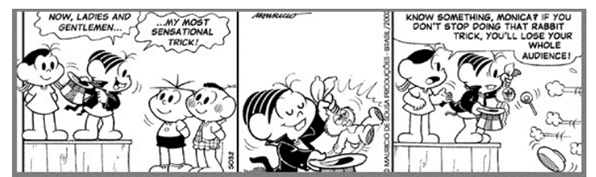
Q36_40.png (596×177)


Disponível em: https://colorindonuvens.com/blog/2012/05/31/hq-monicas-gang-aprenda-ingles-turma-monica/Acesso em: 30 outubro 2025

Qual a forma de singular para os substantivos "ladies" e "gentlemen"?
Alternativas
Q4013506 Inglês

Q36_40.png (596×177)


Disponível em: https://colorindonuvens.com/blog/2012/05/31/hq-monicas-gang-aprenda-ingles-turma-monica/Acesso em: 30 outubro 2025

Com base nas orações proferidas por Magali, no terceiro quadrinho, "If you don't stop doing that rabbit trick, you'll lose your audience", os tempos verbais na língua inglesa presentes em cada oração são, respectivamente,
Alternativas
Q4013505 Inglês

Q36_40.png (596×177)


Disponível em: https://colorindonuvens.com/blog/2012/05/31/hq-monicas-gang-aprenda-ingles-turma-monica/Acesso em: 30 outubro 2025

No terceiro quadrinho, a expressão "if' pertence a qual classe gramatical?
Alternativas
Respostas
841: A
842: D
843: B
844: B
845: E
846: C
847: A
848: B
849: D
850: B
851: C
852: C
853: C
854: E
855: E
856: E
857: C
858: A
859: E
860: C