Foram encontradas 25.501 questões
Resolva questões gratuitamente!
Junte-se a mais de 4 milhões de concurseiros!


I.In reported speech, the reporting verb can change from present tense to past tense when the reported statement is about a past event.
II.When reporting statements, modal verbs such as 'can' change to their past equivalents, such as 'could', to reflect the shift from direct to reported speech.
III.Reported speech often entails backshifting, where verb tenses shift back one tense in indirect speech compared to the original direct speech.
It is correct what is stated in:
Resumos relacionados
Advérbios e conjunções em inglês para concursos públicos
O estudo de advérbios e conjunções na língua inglesa é fundamental para quem deseja se destacar em provas de concursos públicos. Esses elementos desempenham papéis essenciais na construção de frases, influenciando diretamente o sentido e a coesão textual, habilidades bastante exigidas nas questões de interpretação e compreensão de textos em inglês.
Artigos (Articles) em inglês: uso em concursos públicos
Artigos (Articles) são palavras essenciais na gramática da língua inglesa, usadas para indicar se um substantivo está sendo mencionado de forma específica ou geral. Eles desempenham papel fundamental em provas de concursos, pois ajudam na compreensão e interpretação dos textos, além de serem frequentemente cobrados em questões envolvendo uso correto de estruturas gramaticais.
First column: grammatical structures (1) Third Conditional. (2) Present Perfect. (3) Past Simple.
Second column: examples of the structures (__) He meticulously cataloged every detail of his journey in his journal.
(__) They have encountered myriad challenges during their entrepreneurial journey.
(__) If she had invested wisely, she would be luxuriously lounging on her private yacht by now.
Mark the option that presents the correct association between the columns:
(__)Awareness of cultural norms and linguistic subtleties enhances travelers' ability to effectively communicate and navigate unfamiliar environments.
(__)Deepening one's understanding of local dialects and idiomatic expressions is irrelevant for travelers seeking authentic cultural experiences.
(__)Flexibility in language use allows travelers to adapt to diverse cultural contexts and build meaningful connections with locals during their journeys.
It is correct what is stated in:
1.Preceding the main speaking task, engaging learners in a preliminary activity designed to activate prior knowledge or evoke intellectual curiosity proves instrumental in priming them for the forthcoming linguistic challenge.
2.Selecting a communicative objective with deliberate intentionality serves as the foundational step in orchestrating a speaking activity geared towards enhancing students' linguistic proficiency.
3.Facilitating a whole-group discourse session wherein students partake in an expansive exchange of ideas and opinions not only hones their oral communication skills but also cultivates a collaborative learning environment.
4.Following the culmination of the speaking activity, providing constructive feedback to individual students regarding their performance offers invaluable insights for refinement and continuous improvement in their linguistic competence.
The appropriate sequence for developing a classroom activity focusing on communication is:
I.Basic Medical Vocabulary
II.Advanced Medical Terminology
III.Expressing Symptoms and Medical History
It is correct what is stated in:
I.Engagement, improvement in academic ability, and collaborative learning enhancement are some benefits that are expected when technology is involved in the teaching process.
II.Lowering learning anxiety level and lack of time are examples of the possible barriers mentioned in the text.
III.Among others, lack of access and lack of effective training are possible disadvantages of technology use to teach anything.
It is correct what is stated in:
Text 7
From EFL to ELF in Brazil: what the Brazilian education guidelines suggest.
At the beginning of the text devoted to English language teaching in the BNCC, it is made clear that the notion of an increasingly globalized, plural social world is fundamental to shed light on the relevance of learning the English language. According to the document,
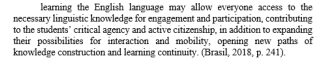
Based on this formative assessment, the BNCC lists three important functions of English language teaching (henceforward ELT): (1) to review the relations between language, territory and culture; (2) to broaden the understanding of literacy; and (3) to situate the English language in its lingua franca status.
Before delving into the first function of ELT, a brief, clear definition of English as a lingua franca (henceforward ELF) is necessary. Jenkins (2012, p. 486) states that ‘it is a means of communication between people who come from different first language backgrounds.’ In this sense, any English speaker can be an ELF speaker, be they native users of English or not. She also adds that ‘ELF is not a language variety in the traditional sense of the term.’
The first ELT function described in the BNCC is in line with Jenkins’s view of ELF.

This quote argues that treating English as a lingua franca validates the uses of the language by speakers from places where English is neither the first language (L1) nor an official language, which is the case of Brazilian users of English. The BNCC also contributes to the ownership debate concerning the English language, which has been brought to the fore by Widdowson (1994), who points out that native speakers of English who live in the US or the UK no longer ‘own’ the language. Given the fact that English has become an international language, he argues that ‘no nation can have custody over it’ (Widdowson, 1994, p. 385).
FRANCO, C. P. Teaching English as a Lingua Franca in Brazil: insights into materials writing. In: International Journal of English Linguistics; Vol. 11, No. 3; 2021. P. 62-63
Text 7
From EFL to ELF in Brazil: what the Brazilian education guidelines suggest.
At the beginning of the text devoted to English language teaching in the BNCC, it is made clear that the notion of an increasingly globalized, plural social world is fundamental to shed light on the relevance of learning the English language. According to the document,
Based on this formative assessment, the BNCC lists three important functions of English language teaching (henceforward ELT): (1) to review the relations between language, territory and culture; (2) to broaden the understanding of literacy; and (3) to situate the English language in its lingua franca status.
Before delving into the first function of ELT, a brief, clear definition of English as a lingua franca (henceforward ELF) is necessary. Jenkins (2012, p. 486) states that ‘it is a means of communication between people who come from different first language backgrounds.’ In this sense, any English speaker can be an ELF speaker, be they native users of English or not. She also adds that ‘ELF is not a language variety in the traditional sense of the term.’
The first ELT function described in the BNCC is in line with Jenkins’s view of ELF.
This quote argues that treating English as a lingua franca validates the uses of the language by speakers from places where English is neither the first language (L1) nor an official language, which is the case of Brazilian users of English. The BNCC also contributes to the ownership debate concerning the English language, which has been brought to the fore by Widdowson (1994), who points out that native speakers of English who live in the US or the UK no longer ‘own’ the language. Given the fact that English has become an international language, he argues that ‘no nation can have custody over it’ (Widdowson, 1994, p. 385).
FRANCO, C. P. Teaching English as a Lingua Franca in Brazil: insights into materials writing. In: International Journal of English Linguistics; Vol. 11, No. 3; 2021. P. 62-63
Text 6
The sociolinguistics of English as Lingua Franca (EFL) pronunciation.
As far as sociolinguistics is concerned, the first task is to problematise the notion of standard accent. Essentially there is no such thing as a ‘standard’ accent, merely prestige accents, primarily RP and General American English (GA), stigmatised accents both native and (more often) non-native (see Lippi-Green, 1997; Bonfiglio, 2002), and a range of variously tolerated regional and social accents between the two extremes. The so-called BritishEnglish standard accent (RP) is claimed nowadays to be used by a mere fraction of British Native Speakers (NSs), possibly only three per cent in its unmodified form (see Trudgill, 2002: 171). The vast majority of NSs of English speak with regionallyand/or socially-modified accents, whether tolerated or stigmatised. Clearly, then, the RP accent cannot be ‘standard’ in the sense of being a widely-used norm. Instead, ‘standard’ refers accent-wise to a level of pronunciation assumed by many to be better in some way than the others, and is thus standard only in the sense of a level of excellence to be aspired to. Excellence, however, is not something that can be measured linguistically: it is not intrinsic to an accent, but merely reflects the value judgements of the elitist group who habitually use it or would if they could.
It should be a matter for teachers and their learners to decide whether they wish to subscribe to the (linguistically-unsound) belief in the superiority of RP. In some communication contexts an RP accent will undoubtedly provide them with a social advantage. This is more likely to be the case if learners intend to use their English to communicate and blend in largely with NSs, especially if the communication will take place in NS countries. Even here, though, their awareness should be raised to the fact that the majority of NSs with whom they communicate will not have an RP accent. At the most, it will probably be regionallymodified RP. On the other hand, having been apprised of the facts of sociolinguistic variation, learners may prefer to project their own (L2) regional and social identity through their accent. In this case their goal is more likely to be an accent that retains a clear trace of their L1, provided that it does not threaten the intelligibility of their pronunciation in their target (probably ELF) communication contexts.
JENKINS, J. Teaching Pronunciation for English as a Lingua Franca: A Sociopolitical Perspective. In GNUTZMANN, C.; INTEMANN, F. (Org.) The Globalization of English and the English Language Classroom. Oxford: OUP, 2005. p. 145-158.
Text 6
The sociolinguistics of English as Lingua Franca (EFL) pronunciation.
As far as sociolinguistics is concerned, the first task is to problematise the notion of standard accent. Essentially there is no such thing as a ‘standard’ accent, merely prestige accents, primarily RP and General American English (GA), stigmatised accents both native and (more often) non-native (see Lippi-Green, 1997; Bonfiglio, 2002), and a range of variously tolerated regional and social accents between the two extremes. The so-called BritishEnglish standard accent (RP) is claimed nowadays to be used by a mere fraction of British Native Speakers (NSs), possibly only three per cent in its unmodified form (see Trudgill, 2002: 171). The vast majority of NSs of English speak with regionallyand/or socially-modified accents, whether tolerated or stigmatised. Clearly, then, the RP accent cannot be ‘standard’ in the sense of being a widely-used norm. Instead, ‘standard’ refers accent-wise to a level of pronunciation assumed by many to be better in some way than the others, and is thus standard only in the sense of a level of excellence to be aspired to. Excellence, however, is not something that can be measured linguistically: it is not intrinsic to an accent, but merely reflects the value judgements of the elitist group who habitually use it or would if they could.
It should be a matter for teachers and their learners to decide whether they wish to subscribe to the (linguistically-unsound) belief in the superiority of RP. In some communication contexts an RP accent will undoubtedly provide them with a social advantage. This is more likely to be the case if learners intend to use their English to communicate and blend in largely with NSs, especially if the communication will take place in NS countries. Even here, though, their awareness should be raised to the fact that the majority of NSs with whom they communicate will not have an RP accent. At the most, it will probably be regionallymodified RP. On the other hand, having been apprised of the facts of sociolinguistic variation, learners may prefer to project their own (L2) regional and social identity through their accent. In this case their goal is more likely to be an accent that retains a clear trace of their L1, provided that it does not threaten the intelligibility of their pronunciation in their target (probably ELF) communication contexts.
JENKINS, J. Teaching Pronunciation for English as a Lingua Franca: A Sociopolitical Perspective. In GNUTZMANN, C.; INTEMANN, F. (Org.) The Globalization of English and the English Language Classroom. Oxford: OUP, 2005. p. 145-158.
Text 6
The sociolinguistics of English as Lingua Franca (EFL) pronunciation.
As far as sociolinguistics is concerned, the first task is to problematise the notion of standard accent. Essentially there is no such thing as a ‘standard’ accent, merely prestige accents, primarily RP and General American English (GA), stigmatised accents both native and (more often) non-native (see Lippi-Green, 1997; Bonfiglio, 2002), and a range of variously tolerated regional and social accents between the two extremes. The so-called BritishEnglish standard accent (RP) is claimed nowadays to be used by a mere fraction of British Native Speakers (NSs), possibly only three per cent in its unmodified form (see Trudgill, 2002: 171). The vast majority of NSs of English speak with regionallyand/or socially-modified accents, whether tolerated or stigmatised. Clearly, then, the RP accent cannot be ‘standard’ in the sense of being a widely-used norm. Instead, ‘standard’ refers accent-wise to a level of pronunciation assumed by many to be better in some way than the others, and is thus standard only in the sense of a level of excellence to be aspired to. Excellence, however, is not something that can be measured linguistically: it is not intrinsic to an accent, but merely reflects the value judgements of the elitist group who habitually use it or would if they could.
It should be a matter for teachers and their learners to decide whether they wish to subscribe to the (linguistically-unsound) belief in the superiority of RP. In some communication contexts an RP accent will undoubtedly provide them with a social advantage. This is more likely to be the case if learners intend to use their English to communicate and blend in largely with NSs, especially if the communication will take place in NS countries. Even here, though, their awareness should be raised to the fact that the majority of NSs with whom they communicate will not have an RP accent. At the most, it will probably be regionallymodified RP. On the other hand, having been apprised of the facts of sociolinguistic variation, learners may prefer to project their own (L2) regional and social identity through their accent. In this case their goal is more likely to be an accent that retains a clear trace of their L1, provided that it does not threaten the intelligibility of their pronunciation in their target (probably ELF) communication contexts.
JENKINS, J. Teaching Pronunciation for English as a Lingua Franca: A Sociopolitical Perspective. In GNUTZMANN, C.; INTEMANN, F. (Org.) The Globalization of English and the English Language Classroom. Oxford: OUP, 2005. p. 145-158.
Text 6
The sociolinguistics of English as Lingua Franca (EFL) pronunciation.
As far as sociolinguistics is concerned, the first task is to problematise the notion of standard accent. Essentially there is no such thing as a ‘standard’ accent, merely prestige accents, primarily RP and General American English (GA), stigmatised accents both native and (more often) non-native (see Lippi-Green, 1997; Bonfiglio, 2002), and a range of variously tolerated regional and social accents between the two extremes. The so-called BritishEnglish standard accent (RP) is claimed nowadays to be used by a mere fraction of British Native Speakers (NSs), possibly only three per cent in its unmodified form (see Trudgill, 2002: 171). The vast majority of NSs of English speak with regionallyand/or socially-modified accents, whether tolerated or stigmatised. Clearly, then, the RP accent cannot be ‘standard’ in the sense of being a widely-used norm. Instead, ‘standard’ refers accent-wise to a level of pronunciation assumed by many to be better in some way than the others, and is thus standard only in the sense of a level of excellence to be aspired to. Excellence, however, is not something that can be measured linguistically: it is not intrinsic to an accent, but merely reflects the value judgements of the elitist group who habitually use it or would if they could.
It should be a matter for teachers and their learners to decide whether they wish to subscribe to the (linguistically-unsound) belief in the superiority of RP. In some communication contexts an RP accent will undoubtedly provide them with a social advantage. This is more likely to be the case if learners intend to use their English to communicate and blend in largely with NSs, especially if the communication will take place in NS countries. Even here, though, their awareness should be raised to the fact that the majority of NSs with whom they communicate will not have an RP accent. At the most, it will probably be regionallymodified RP. On the other hand, having been apprised of the facts of sociolinguistic variation, learners may prefer to project their own (L2) regional and social identity through their accent. In this case their goal is more likely to be an accent that retains a clear trace of their L1, provided that it does not threaten the intelligibility of their pronunciation in their target (probably ELF) communication contexts.
JENKINS, J. Teaching Pronunciation for English as a Lingua Franca: A Sociopolitical Perspective. In GNUTZMANN, C.; INTEMANN, F. (Org.) The Globalization of English and the English Language Classroom. Oxford: OUP, 2005. p. 145-158.
Text 5
What should feedback be mainly on: language? content? organization?
The problem
When a student submits a piece of original writing, the most important thing about it is arguably its content: whether the ideas or events that are written about are significant and interesting. Then there is the organization and presentation: whether the ideas are arranged in a way that is easy to follow and pleasing to read. Finally, there is the question of language forms: whether the grammar, vocabulary, spelling and punctuation is of an acceptable standard of accuracy.
Many teachers are aware that content and organization are important, but find themselves relating mainly to language forms in their feedback, conveying the implicit message that these are what matters. This is for various reasons:
1. Mistakes in spelling or grammar catch the eye and seem to demand to be corrected; they are very difficult to ignore.
2. Students also want their language mistakes to be corrected. (Ask them! And see Leki, 1991.)
3. Language mistakes are far more easily and quickly diagnosed and corrected than ones of content and organization.
Advice
We should, I think, correct language mistakes; our problem is how to do so without conveying the message that these are the only, or main, basis for evaluation of a piece of writing. One possibility is to note corrections within the body of the text, and devote comments at the end to matters of content and organization, followed by the evaluation. Alternatively, we may correct mistakes and make suggestions as to content and organization, but not evaluate; and give the evaluation only on the basis of the rewritten, polished version.
UR, Penny. A Course in Language Teaching - Practice and Theory. Cambridge: Cambridge University Press, 2009, p.170.
Text 5
What should feedback be mainly on: language? content? organization?
The problem
When a student submits a piece of original writing, the most important thing about it is arguably its content: whether the ideas or events that are written about are significant and interesting. Then there is the organization and presentation: whether the ideas are arranged in a way that is easy to follow and pleasing to read. Finally, there is the question of language forms: whether the grammar, vocabulary, spelling and punctuation is of an acceptable standard of accuracy.
Many teachers are aware that content and organization are important, but find themselves relating mainly to language forms in their feedback, conveying the implicit message that these are what matters. This is for various reasons:
1. Mistakes in spelling or grammar catch the eye and seem to demand to be corrected; they are very difficult to ignore.
2. Students also want their language mistakes to be corrected. (Ask them! And see Leki, 1991.)
3. Language mistakes are far more easily and quickly diagnosed and corrected than ones of content and organization.
Advice
We should, I think, correct language mistakes; our problem is how to do so without conveying the message that these are the only, or main, basis for evaluation of a piece of writing. One possibility is to note corrections within the body of the text, and devote comments at the end to matters of content and organization, followed by the evaluation. Alternatively, we may correct mistakes and make suggestions as to content and organization, but not evaluate; and give the evaluation only on the basis of the rewritten, polished version.
UR, Penny. A Course in Language Teaching - Practice and Theory. Cambridge: Cambridge University Press, 2009, p.170.
Text 4
Help students to learn vocabulary in context
The best internalization of vocabulary comes from encounters (comprehension or production) with words within the context of surrounding discourse. Data from linguistic corpora can provide real-world actual language that has been printed or spoken. Rather than isolating words and/or focusing on dictionary definitions, learners can benefit from attending to vocabulary within a communicative framework in which items appear. Students will then associate new words with a meaningful context to which they apply. For example, for a beginning level of students, pictures, realia, and gestures can be used to describe meaning in context. For a more advanced level of students, encourage them to consult online corpora (e.g., the British National Corpus, or the Corpus of Contemporary American English: COCA) to gain knowledge of patterned sequences, particularly collocations or words that go together (Liu & Jiang, 2009).
Encourage students to develop word-learning strategies
Included in the discussion of teaching reading were such strategies as guessing vocabulary in context. A number of clues are available to learners to develop word-attack strategies.
Considering that only a small fraction of the word list can be covered inside the classroom, it is necessary for students to develop effective strategies for learning vocabulary on their own. Word-learning strategies refer to “the planned approaches that a word-learner takes as an agent of his or her own word learning” (Zimmerman, 2014, p. 297). Once they encounter unknown words, they can try to figure out how the words are used by asking questions such as:
• Is the word countable or uncountable?
• Is there a particular preposition that follows it?
• Is it a formal word?
• Does it have positive or negative connotations? (Zimmerman, 2014, p. 298)
An effective way to encourage word-learning is to urge students to use vocabulary notebooks to enter new words, and to review them daily, once they identify their learning goals. Studies show that in order to understand television shows learners need to know about 3,000 word families and have knowledge of proper nouns (Web & Rodgers, 2009). If they wish to read novels and newspapers comfortably, they need to have a vocabulary size of 8,000–9,000 word families (Nation, 2006). The fact that increasing vocabulary size will influence the degree to which they can understand and use language may motivate them to be determined to expand their vocabulary notebooks.
Unfortunately, professional pendulums have a disturbing way of swinging too far one way or the other, and sometimes the only way we can get enough perspective to see these overly long arcs is through hindsight. Hindsight has now taught us that there was some overreaction to the almost exclusive attention that grammar and vocabulary received in the first two-thirds of the twentieth century. So-called “natural” approaches in which grammar was considered damaging were equally overreactive. Advocating the “absorption” of grammar and vocabulary with no overt attention whatsoever to language forms went too far. We now seem to have a healthy respect for the place of form-focused instruction — attention to those basic “bits and pieces” of a language — in an interactive curriculum. And now we can pursue the business of finding better and better techniques for getting these bits and pieces into the communicative repertoires of our learners.
BROWN, H. D.; LEE, H.. Teaching by Principles: An Interactive Approach to Language Pedagogy. Fourth Edition. New York: Longman. 2015.

 Conheça nossos planos