Questões de Concurso
Sobre advérbios e conjunções | adverbs and conjunctions em inglês
Foram encontradas 771 questões
Resolva questões gratuitamente!
Junte-se a mais de 4 milhões de concurseiros!


Billy Hope foolishly used his Money in the Bank contract to choose a match.
The comment adverb “foolishly” indicates:
Read the following sentence.
He also asked _______________ sheep his father was caring for and if his father needed his help.
Choose the best option that completes the context above.
Read intently the context above.
A new study reveals that wasps are largely disliked by the public, _____ bees are highly appreciated.
Choose the best conjunction that completes the sentence.
Observe the sentence below.
Did you sit in your living room at a comfortable temperature ___ it was freezing outside?
Identify the best conjunction that completes the context.
News trom China
Outcry as Chinese school makes iPads compulsory
Apple produets are incredibly popular in China, but not everyone can afford them A school in northern China has been criticised for enforcing iPad learning as part of its new curriculum, it's reported.
According to China Economic Daily, the Danfeng High School in Shaanxi province recently issued a notice saying that, “as part of a teaching requirement, students are required to bring their own iPad” when they start the new school year in September. Stafftold the paper that using an iPad would “improve classroom efficiency”, and that the school would manage an internet firewall, so that parents would not have to worry about students using the device for other means.
However, China Economic Daily says that after criticism from parents, who felt that it would be an “unnecessary financial burden”, headmaster Yao Hushan said that having an iPad was no longer a mandatory requirement. Mr Yao added that children who don't have a device could still enrol, but that he recommended students bring an iPad as part of a “process of promoting the digital classroom”.
The incident led to lively discussion on the Sina Weibo social media platform. “Those parents that can't afford one will have to sell a kidney!” one user quipped.
Others expressed concerns about the health implications of long-term electronic device use. “I worry about their Vision,” one user said, and another said they would all become “short-sighted and have to wear glasses.”
But others felt that it was a good move in line with new modem ways of teaching. “They are affordable for the average family,” one said, “they don't necessarily need to buy the latest model.”
Reporting by KerryAllen
Taken from: www.bbc.com/news/blogs-news-from-elsewhere
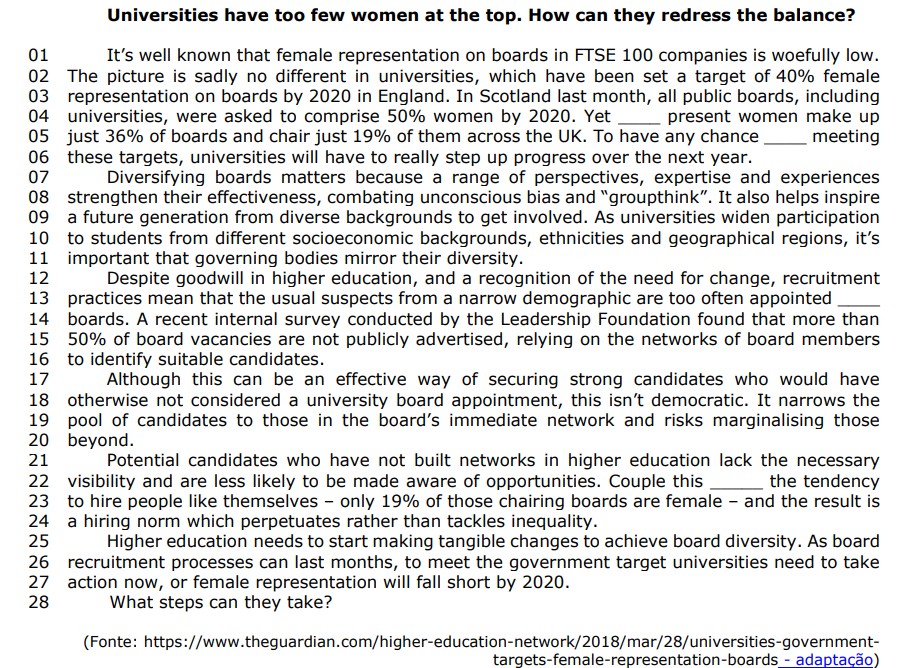
Column 1 1. Adverb. 2. Adjective. 3. Noun. 4. Verb.
Column 2 ( ) known (l.01). ( ) sadly (l.02). ( ) chair (l.05). ( ) unconscious (l.08). ( ) need (l.12). ( ) likely (l.22).
The correct order, top-down, is:

I. It’s classified as a noun. II. It’s compound noun formed by an adverb and a verb. III. The stress is on the second word.
Which ones are INCORRECT?

• highly (l.08). • delivery (l.09). • monthly (l.26).
I. All words follow the same spelling rule. II. All words are adverbs. III. The suffix added changes adjectives into adverbs.
Which ones are INCORRECT?

• It is an adverb. • It is followed by an adjective. • It is part of a to-infinitive verb. • It is the subject of the sentences.
Nice to meet you
One of the things you learn when studying English is how to present yourself and most people learn phrases such as “How do you do?” or “Hi, my name is…”. However, one thing that language teachers don’t explain is that British people very rarely use these expressions. British people are not very good at introductions in informal situations. They are not sure what to say or what do with their hands. Whereas Brazilians or Americans will confidently extend their hands to people they meet at parties or social situations, English people prefer just to smile.
Expressions like “Hello, I’m John Smith”, “Hi, my name is…” are only used when we have to identify ourselves; for example when we go to an appointment at the dentist’s or the hairdresser’s, or if we’re telephoning someone to ask for information about ourselves.
Dialogues in school books where English teenagers present themselves to each other on the first day of school are pure fantasy. In informal social situations, British people prefer to stay chatting about something neutral like the weather, or else they use humour to break the ice. When the conversation has progressed, or even just before leaving, you can say, “I’m Ann, by the way.”, or “I didn’t catch your name”. If you meet the person again you can say, “Hello again” or, more colloquially, “Hi ya”, which stands for “Hello, nice to see you again”.
In the case of formal meetings or business situations, many language courses teach the expression “How do you do?” – to which you should answer “How do you do?”. This phrase is also recommended by the website ediplomat.com and Drett’, the famous specialist publisher that has a range of guides on British etiquette. I have said “How do you do” in my entire life and no one has never said that to me! In today’s Britain this expression is best reserved for extremely formal situations. It is, however, something that people over 60 might say, so if your elderly boss or professor uses this expression with you, then it’s polite to answer in the same way
 The fair trade movement, which aims
ensure that fair prices are paid to producers in
developing countries, is one of the true global success
stories recent decades. The International
Fairtrade Certification Mark, a guarantee that producers are getting a fair price, has become one of the
most recognizable logos the world, which
91 percent of customers associate positive
values. When the logo first appeared in the UK, the
country where the largest number of fair-trade products are sold, nobody expected that the number of
certified products would grow from only 3 to over
4,500 in just 18 years. In 2011, people around the
world spent more than 6.5 billion US dollars on fair-
-trade certified goods, signifying a 12 percent increase
in sales from the previous year. This was at a time
when most market segments in the developed world
were still shrinking or stagnating from the after effects
of the 2008 banking crisis. Over 1.2 million farmers
and workers living in 66 countries benefit from fair-
-trade certification by being able to sell their products
at competitive prices, to ensure sustainability.
The fair trade movement, which aims
ensure that fair prices are paid to producers in
developing countries, is one of the true global success
stories recent decades. The International
Fairtrade Certification Mark, a guarantee that producers are getting a fair price, has become one of the
most recognizable logos the world, which
91 percent of customers associate positive
values. When the logo first appeared in the UK, the
country where the largest number of fair-trade products are sold, nobody expected that the number of
certified products would grow from only 3 to over
4,500 in just 18 years. In 2011, people around the
world spent more than 6.5 billion US dollars on fair-
-trade certified goods, signifying a 12 percent increase
in sales from the previous year. This was at a time
when most market segments in the developed world
were still shrinking or stagnating from the after effects
of the 2008 banking crisis. Over 1.2 million farmers
and workers living in 66 countries benefit from fair-
-trade certification by being able to sell their products
at competitive prices, to ensure sustainability.
 Fair-trade initiatives have been growing steadily since the late 1960s, when the fair trade
movement started with only a handful of committed
individuals in the West who believed there was an
alternative to the exploitation of farmers and workers
in the developing world. Fair trade ensures fair prices
for suppliers, as well as payment of a premium that
can be reinvested in the local communities (for example, in schools or sanitation) or in improving productivity. In India, for instance, a group of rice farmers used
the premium to buy farm machinery, which meant a
30 percent improvement in production.
Fair-trade initiatives have been growing steadily since the late 1960s, when the fair trade
movement started with only a handful of committed
individuals in the West who believed there was an
alternative to the exploitation of farmers and workers
in the developing world. Fair trade ensures fair prices
for suppliers, as well as payment of a premium that
can be reinvested in the local communities (for example, in schools or sanitation) or in improving productivity. In India, for instance, a group of rice farmers used
the premium to buy farm machinery, which meant a
30 percent improvement in production.
 As consumers look for, and recognize, the logo
and purchase fair-trade products, they put
pressure on companies and governments to do more
for global welfare. They also put pressure on supermarkets to sell fair-trade goods at the same price as
conventional products, shifting the extra costs involved from consumers to the corporations that collect
the profits.
As consumers look for, and recognize, the logo
and purchase fair-trade products, they put
pressure on companies and governments to do more
for global welfare. They also put pressure on supermarkets to sell fair-trade goods at the same price as
conventional products, shifting the extra costs involved from consumers to the corporations that collect
the profits.
 Critics of the fair trade movement say it is still
not doing enough. They stress that the key to
long-term development is not in small local improvements, but in moving the developing world from
the production of raw materials into processing them,
which can bring in greater profit. There are already some signs of this happening. A group of tea growers
in Kenya recently set up a processing factory to deliver the final products directly to their customers in
the West. By switching from the export of raw tea to
boxed fair-trade products, they achieved 500 percent
higher profits.
Critics of the fair trade movement say it is still
not doing enough. They stress that the key to
long-term development is not in small local improvements, but in moving the developing world from
the production of raw materials into processing them,
which can bring in greater profit. There are already some signs of this happening. A group of tea growers
in Kenya recently set up a processing factory to deliver the final products directly to their customers in
the West. By switching from the export of raw tea to
boxed fair-trade products, they achieved 500 percent
higher profits.
 It is important to realize that, despite all of its
benefits, the fair trade movement has its limitations. Some of the poorest farmers can’t afford to pay
the certification fees required for each fair-trade initiative, while others work for big, multinational employers that are excluded from participating. Fair trade is
certainly a step in the right direction, but there is a lot
more we must continue to do in order to help people
in the world’s poorest regions.
It is important to realize that, despite all of its
benefits, the fair trade movement has its limitations. Some of the poorest farmers can’t afford to pay
the certification fees required for each fair-trade initiative, while others work for big, multinational employers that are excluded from participating. Fair trade is
certainly a step in the right direction, but there is a lot
more we must continue to do in order to help people
in the world’s poorest regions.“A group of tea growers in Kenya recently set up a processing factory to deliver the final products directly to their customers in the West. By switching from the export of raw tea to boxed fair-trade products, they achieved 500 percent higher profits.”
The underlined words are examples of:
Choose the best option to complete the following dialog:
A: My car is __________ yours. Even though, it is __________ comfortable.
B: I don’t; agree. Your car is __________ mine.
Marque a alternativa CORRETA:
Marque a alternativa CORRETA:
Marque a alternativa CORRETA:
III. Uma postura tradicional de avaliação inclui discutir resultados e estabelecer uma postura democrática.
Marque a alternativa CORRETA:
Marque a alternativa CORRETA:
Marque a alternativa CORRETA:

 Conheça nossos planos