Questões de Concurso
Sobre inglês
Foram encontradas 25.448 questões
Resolva questões gratuitamente!
Junte-se a mais de 4 milhões de concurseiros!


Leia o texto para responder à questão.
It has been common in second language teaching to stress the role of interference – that is, the interfering effects of the native language on the target (the second) language. It is of course not surprising that this process has been so singled out, for native language interference is surely the most immediately noticeable source of error among second language learners. The saliency of interference has been so strong that some have viewed second language learning as exclusively involving the overcoming of the effects of the native language. It is clear from learning theory that a person will use whatever previous experience he or she has had with language to facilitate the second language learning process. The native language is an obvious set of prior experiences. For example, a French native speaker might say in English, “I am in New York since January,” a perfectly logical transfer of the comparable French sentence “Je suis a New York depuis Janvier.” Because of the negative transfer of the French verb form to English, the French system has, in this case, interfered with the person’s production of a correct English form.
(Brown, D. 1994. Principles of Language
Learning and Teaching. Adaptado)
Leia o texto para responder à questão.
Some History of English... in two words
In 1582, Richard Mulcaster, headmaster of the Merchant Tailors’ school1 wrote that “our English tung is of small reatch, it stretcheth no further than this Iland of ours”. It didn’t stay that way. Today, English is spoken by more than a billion people all over the world. It is a colourful, vibrant and diverse tongue, that long has picked up words from the many languages with which its speakers have come into contact.
One such word is Dictionary. It is a borrowing from medieval Latin dictionarius liber “book of words”; it first appeared in English in the 16th century, along with numerous adoptions from Latin and Greek.
Dr Johnson’s Dictionary of the English Language (1755), although the most famous, is not the earliest; the first English dictionary was Robert Cawdrey’s Table Alphabeticall (1604). Unlike a modern desk dictionary, Cawdrey set out to gloss only the most unfamiliar words, such as deambulate, pactation, and refractarie – whose meanings would have caused problems for those not educated in Latin and Greek.
Another such word is Emoji2 , originally developed in Japan in the 1990s for use by teenagers on their pagers; the word emoji derives from the Japanese e “picture” + moji “character, letter”. Its successful integration into English has been helped by its similarity to words with the e-“electronic” prefix, such as e-mail and e-book. E-communication is a form of writing that resembles casual conversation more than formal prose, often situated in real time with a known recipient, but lacking the extra-linguistic cues such as facial expression, tone of voice, hand gestures, that help to convey attitude in face-toface interactions, and users are finding creative new ways to employ emojis.
(https://theconversation.com/Adaptado. Acesso em 18.08.2015)
1 a public school for 11-18 year olds, founded in 1561 in London just for boys back then.
2 iconic, visual representation of an idea, entity, feeling, status or event used alongside or instead of words in digital messaging. The plural form in English is either emoji or emojis.
Leia o texto para responder à questão.
Some History of English... in two words
In 1582, Richard Mulcaster, headmaster of the Merchant Tailors’ school1 wrote that “our English tung is of small reatch, it stretcheth no further than this Iland of ours”. It didn’t stay that way. Today, English is spoken by more than a billion people all over the world. It is a colourful, vibrant and diverse tongue, that long has picked up words from the many languages with which its speakers have come into contact.
One such word is Dictionary. It is a borrowing from medieval Latin dictionarius liber “book of words”; it first appeared in English in the 16th century, along with numerous adoptions from Latin and Greek.
Dr Johnson’s Dictionary of the English Language (1755), although the most famous, is not the earliest; the first English dictionary was Robert Cawdrey’s Table Alphabeticall (1604). Unlike a modern desk dictionary, Cawdrey set out to gloss only the most unfamiliar words, such as deambulate, pactation, and refractarie – whose meanings would have caused problems for those not educated in Latin and Greek.
Another such word is Emoji2 , originally developed in Japan in the 1990s for use by teenagers on their pagers; the word emoji derives from the Japanese e “picture” + moji “character, letter”. Its successful integration into English has been helped by its similarity to words with the e-“electronic” prefix, such as e-mail and e-book. E-communication is a form of writing that resembles casual conversation more than formal prose, often situated in real time with a known recipient, but lacking the extra-linguistic cues such as facial expression, tone of voice, hand gestures, that help to convey attitude in face-toface interactions, and users are finding creative new ways to employ emojis.
(https://theconversation.com/Adaptado. Acesso em 18.08.2015)
1 a public school for 11-18 year olds, founded in 1561 in London just for boys back then.
2 iconic, visual representation of an idea, entity, feeling, status or event used alongside or instead of words in digital messaging. The plural form in English is either emoji or emojis.
Resumos relacionados
Advérbios e conjunções em inglês para concursos públicos
O estudo de advérbios e conjunções na língua inglesa é fundamental para quem deseja se destacar em provas de concursos públicos. Esses elementos desempenham papéis essenciais na construção de frases, influenciando diretamente o sentido e a coesão textual, habilidades bastante exigidas nas questões de interpretação e compreensão de textos em inglês.
Artigos (Articles) em inglês: uso em concursos públicos
Artigos (Articles) são palavras essenciais na gramática da língua inglesa, usadas para indicar se um substantivo está sendo mencionado de forma específica ou geral. Eles desempenham papel fundamental em provas de concursos, pois ajudam na compreensão e interpretação dos textos, além de serem frequentemente cobrados em questões envolvendo uso correto de estruturas gramaticais.
Leia o texto para responder à questão.
Some History of English... in two words
In 1582, Richard Mulcaster, headmaster of the Merchant Tailors’ school1 wrote that “our English tung is of small reatch, it stretcheth no further than this Iland of ours”. It didn’t stay that way. Today, English is spoken by more than a billion people all over the world. It is a colourful, vibrant and diverse tongue, that long has picked up words from the many languages with which its speakers have come into contact.
One such word is Dictionary. It is a borrowing from medieval Latin dictionarius liber “book of words”; it first appeared in English in the 16th century, along with numerous adoptions from Latin and Greek.
Dr Johnson’s Dictionary of the English Language (1755), although the most famous, is not the earliest; the first English dictionary was Robert Cawdrey’s Table Alphabeticall (1604). Unlike a modern desk dictionary, Cawdrey set out to gloss only the most unfamiliar words, such as deambulate, pactation, and refractarie – whose meanings would have caused problems for those not educated in Latin and Greek.
Another such word is Emoji2 , originally developed in Japan in the 1990s for use by teenagers on their pagers; the word emoji derives from the Japanese e “picture” + moji “character, letter”. Its successful integration into English has been helped by its similarity to words with the e-“electronic” prefix, such as e-mail and e-book. E-communication is a form of writing that resembles casual conversation more than formal prose, often situated in real time with a known recipient, but lacking the extra-linguistic cues such as facial expression, tone of voice, hand gestures, that help to convey attitude in face-toface interactions, and users are finding creative new ways to employ emojis.
(https://theconversation.com/Adaptado. Acesso em 18.08.2015)
1 a public school for 11-18 year olds, founded in 1561 in London just for boys back then.
2 iconic, visual representation of an idea, entity, feeling, status or event used alongside or instead of words in digital messaging. The plural form in English is either emoji or emojis.
Leia o texto para responder à questão.
Some History of English... in two words
In 1582, Richard Mulcaster, headmaster of the Merchant Tailors’ school1 wrote that “our English tung is of small reatch, it stretcheth no further than this Iland of ours”. It didn’t stay that way. Today, English is spoken by more than a billion people all over the world. It is a colourful, vibrant and diverse tongue, that long has picked up words from the many languages with which its speakers have come into contact.
One such word is Dictionary. It is a borrowing from medieval Latin dictionarius liber “book of words”; it first appeared in English in the 16th century, along with numerous adoptions from Latin and Greek.
Dr Johnson’s Dictionary of the English Language (1755), although the most famous, is not the earliest; the first English dictionary was Robert Cawdrey’s Table Alphabeticall (1604). Unlike a modern desk dictionary, Cawdrey set out to gloss only the most unfamiliar words, such as deambulate, pactation, and refractarie – whose meanings would have caused problems for those not educated in Latin and Greek.
Another such word is Emoji2 , originally developed in Japan in the 1990s for use by teenagers on their pagers; the word emoji derives from the Japanese e “picture” + moji “character, letter”. Its successful integration into English has been helped by its similarity to words with the e-“electronic” prefix, such as e-mail and e-book. E-communication is a form of writing that resembles casual conversation more than formal prose, often situated in real time with a known recipient, but lacking the extra-linguistic cues such as facial expression, tone of voice, hand gestures, that help to convey attitude in face-toface interactions, and users are finding creative new ways to employ emojis.
(https://theconversation.com/Adaptado. Acesso em 18.08.2015)
1 a public school for 11-18 year olds, founded in 1561 in London just for boys back then.
2 iconic, visual representation of an idea, entity, feeling, status or event used alongside or instead of words in digital messaging. The plural form in English is either emoji or emojis.
Leia o texto para responder à questão.
Some History of English... in two words
In 1582, Richard Mulcaster, headmaster of the Merchant Tailors’ school1 wrote that “our English tung is of small reatch, it stretcheth no further than this Iland of ours”. It didn’t stay that way. Today, English is spoken by more than a billion people all over the world. It is a colourful, vibrant and diverse tongue, that long has picked up words from the many languages with which its speakers have come into contact.
One such word is Dictionary. It is a borrowing from medieval Latin dictionarius liber “book of words”; it first appeared in English in the 16th century, along with numerous adoptions from Latin and Greek.
Dr Johnson’s Dictionary of the English Language (1755), although the most famous, is not the earliest; the first English dictionary was Robert Cawdrey’s Table Alphabeticall (1604). Unlike a modern desk dictionary, Cawdrey set out to gloss only the most unfamiliar words, such as deambulate, pactation, and refractarie – whose meanings would have caused problems for those not educated in Latin and Greek.
Another such word is Emoji2 , originally developed in Japan in the 1990s for use by teenagers on their pagers; the word emoji derives from the Japanese e “picture” + moji “character, letter”. Its successful integration into English has been helped by its similarity to words with the e-“electronic” prefix, such as e-mail and e-book. E-communication is a form of writing that resembles casual conversation more than formal prose, often situated in real time with a known recipient, but lacking the extra-linguistic cues such as facial expression, tone of voice, hand gestures, that help to convey attitude in face-toface interactions, and users are finding creative new ways to employ emojis.
(https://theconversation.com/Adaptado. Acesso em 18.08.2015)
1 a public school for 11-18 year olds, founded in 1561 in London just for boys back then.
2 iconic, visual representation of an idea, entity, feeling, status or event used alongside or instead of words in digital messaging. The plural form in English is either emoji or emojis.
Leia o texto para responder à questão.
Some History of English... in two words
In 1582, Richard Mulcaster, headmaster of the Merchant Tailors’ school1 wrote that “our English tung is of small reatch, it stretcheth no further than this Iland of ours”. It didn’t stay that way. Today, English is spoken by more than a billion people all over the world. It is a colourful, vibrant and diverse tongue, that long has picked up words from the many languages with which its speakers have come into contact.
One such word is Dictionary. It is a borrowing from medieval Latin dictionarius liber “book of words”; it first appeared in English in the 16th century, along with numerous adoptions from Latin and Greek.
Dr Johnson’s Dictionary of the English Language (1755), although the most famous, is not the earliest; the first English dictionary was Robert Cawdrey’s Table Alphabeticall (1604). Unlike a modern desk dictionary, Cawdrey set out to gloss only the most unfamiliar words, such as deambulate, pactation, and refractarie – whose meanings would have caused problems for those not educated in Latin and Greek.
Another such word is Emoji2 , originally developed in Japan in the 1990s for use by teenagers on their pagers; the word emoji derives from the Japanese e “picture” + moji “character, letter”. Its successful integration into English has been helped by its similarity to words with the e-“electronic” prefix, such as e-mail and e-book. E-communication is a form of writing that resembles casual conversation more than formal prose, often situated in real time with a known recipient, but lacking the extra-linguistic cues such as facial expression, tone of voice, hand gestures, that help to convey attitude in face-toface interactions, and users are finding creative new ways to employ emojis.
(https://theconversation.com/Adaptado. Acesso em 18.08.2015)
1 a public school for 11-18 year olds, founded in 1561 in London just for boys back then.
2 iconic, visual representation of an idea, entity, feeling, status or event used alongside or instead of words in digital messaging. The plural form in English is either emoji or emojis.
Mark each one as True (T) or False (F), then choose the correct sequence.
I. ( ) The singer uses metaphors such as “coffee in the morning” and “sunshine in the rain” to express emotional comfort and affection.
II. ( ) When he says “Where you go, I’ll follow,” the singer suggests unconditional commitment to the person he loves.
III. ( ) The lyric “You're the Tylenol I take when my head hurts” is meant to describe the partner as a source of emotional relief.
IV. ( ) The song presents the relationship as fragile and temporary, emphasizing loss and separation.
Choose the correct sequence:
If the moon was Europe, my father was an astronaut who died on his
way to the moon.
My father, the failed moonwalker, blinded by space.
My father, the
Black cosmonaut, frenzied
by thirst. My father who heard the voice of God, clear as the call to
prayer, suspended in that dark desert.
My father who wore a spacesuit slashed by longing, spinning towards
the vast desolate.
On a night when the angels have drawn back their wings, you may
glimpse my father
hurtling through space, his body carried by gravity’s absence, blood
collecting in his head,
his tears pink, gelatinous clots, unable to fall. (2022, Warsan Shire. From: Bless the Daughter Raised by a Voice in Her Head Publisher: Penguin Random house)
In light of the the excerpt from “My Father, the Astronaut” by Warsan Shire, which of the following single words most aptly encapsulates the overarching emotional and symbolic tenor of the passage?
“Do not underestimate others, nor idolize them too much. Be polite, but not perfect. Do things you never imagined before. Do not lie, but do not reveal the whole truth. Dance alone when no one is watching. Have fun while your wolf has not arrived.”— Martha Medeiros
Considering that the metaphor “your wolf” can represent the inevitability of death, it is correct to affirm that:
Sentence: “If he hadn’t ignored the weather warnings, he wouldn’t be stuck at the airport now.”Based on standard conditional forms, this sentence is:
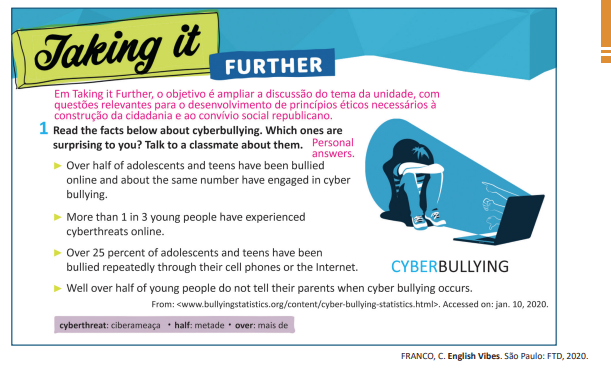


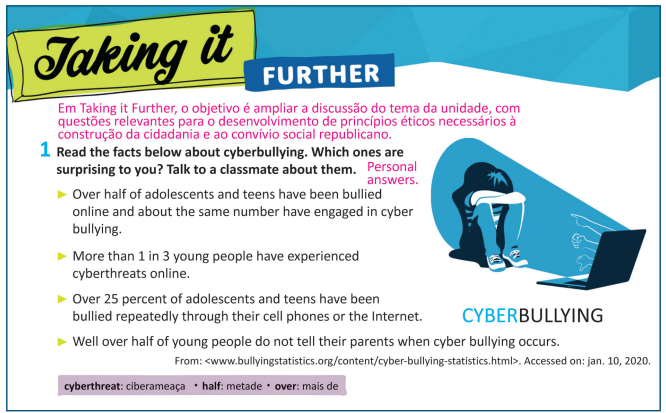
FRANCO, C. English Vibes. São Paulo: FTD, 2020.
(__)Na frase 'The solution was heated to 100°C', o agente da ação (by phrase) é omitido porque é irrelevante ou desconhecido, focando o processo científico e não o pesquisador.
(__)A transformação da ativa 'Did the team verify the data?' para a passiva resulta em 'Was the data verified by the team?', exigindo o ajuste da concordância verbal caso 'data' seja tratado como plural (latim original), embora o uso como singular seja comum hoje.
(__)O uso da voz passiva é desencorajado em todos os gêneros textuais modernos, incluindo relatórios técnicos, devido à influência do 'Plain English', que exige sempre a voz ativa.
(__)Construções como 'It is believed that...' ou 'It is thought that...' são exemplos de passiva impessoal, comuns em textos acadêmicos para introduzir consensos ou hipóteses sem atribuir autoria direta.
Após análise, assinale a alternativa que apresenta a sequência correta dos itens acima, de cima para baixo:

 Conheça nossos planos