Foram encontradas 1.047 questões

Resolva questões gratuitamente!

Junte-se a mais de 4 milhões de concurseiros!

Q2064454 Inglês

Text I

Nurturing Multimodalism


    […]

   New learning collaborations call on the teacher as learner, and the learner as teacher. The teacher is a lifelong learner; this is simply more apparent in the Information Age. In instances of best practice, collaborative learning partnerships are forged between and among teachers for strategic, bottom-up, in-house professional development. This allows teachers to share in reflective, on-going, contextualized learning, tailored to their collective knowledge. This sharing also includes the learner as teacher. ELT typically employs learner-centered activities: these can include learners sharing their knowledge of strategic digital literacies with others in the classrooms.

   The digital universe, so threatening to adult notions of socially sanctioned literacies, is intuitive to children, who have been socialized into it, and for whom digital literacies are exploratory play. Adults may find new ways of communicating digitally to be quite baffling and confronting of our communicative expertise; children do not. Instant messaging systems, such as MSN, AOL, ICQ, for example, provide as natural a medium for communicating to them as telephones did for the baby-boomer generation. It is not fair for the teacher to treat Information and Communication Technologies as auxiliary communication with learners for whom it is mainstream and primary.

    Learning spaces are important. Although teachers seldom have much individual say in the layout of teaching spaces, collaborative relationships may help to encourage integrated digitization, where computers are not segregated in laboratories but are interspersed throughout the school environment. In digitally infused curricula, postmodern literacies do not supplant but complement modern literacies, so that access to information is driven by purpose and content rather than by the media available.


Adapted from: LOTHERINGTON, H. From literacy to multiliteracies in ELT. In: CUMMINS, J.; DAVISON, C. (Eds.) International Handbook of English Language Teaching. New York: Springer, 2007, p. 820. Available at: https://www.researchgate.net/publication/226802846_From_Literacy_to_Multiliter acies_in_ELT 

As regards Text I, analyse the assertions below:
I. In recent collaborative teaching, learners and teachers may exchange roles. II. The goals of digitally oriented curricula should conform to the media at hand. III. It is quite straining for children to get a grasp of digital communication.
Choose the correct answer:
Alternativas
Q2064453 Inglês

Text I

Nurturing Multimodalism


    […]

   New learning collaborations call on the teacher as learner, and the learner as teacher. The teacher is a lifelong learner; this is simply more apparent in the Information Age. In instances of best practice, collaborative learning partnerships are forged between and among teachers for strategic, bottom-up, in-house professional development. This allows teachers to share in reflective, on-going, contextualized learning, tailored to their collective knowledge. This sharing also includes the learner as teacher. ELT typically employs learner-centered activities: these can include learners sharing their knowledge of strategic digital literacies with others in the classrooms.

   The digital universe, so threatening to adult notions of socially sanctioned literacies, is intuitive to children, who have been socialized into it, and for whom digital literacies are exploratory play. Adults may find new ways of communicating digitally to be quite baffling and confronting of our communicative expertise; children do not. Instant messaging systems, such as MSN, AOL, ICQ, for example, provide as natural a medium for communicating to them as telephones did for the baby-boomer generation. It is not fair for the teacher to treat Information and Communication Technologies as auxiliary communication with learners for whom it is mainstream and primary.

    Learning spaces are important. Although teachers seldom have much individual say in the layout of teaching spaces, collaborative relationships may help to encourage integrated digitization, where computers are not segregated in laboratories but are interspersed throughout the school environment. In digitally infused curricula, postmodern literacies do not supplant but complement modern literacies, so that access to information is driven by purpose and content rather than by the media available.


Adapted from: LOTHERINGTON, H. From literacy to multiliteracies in ELT. In: CUMMINS, J.; DAVISON, C. (Eds.) International Handbook of English Language Teaching. New York: Springer, 2007, p. 820. Available at: https://www.researchgate.net/publication/226802846_From_Literacy_to_Multiliter acies_in_ELT 

Based on Text I, mark the statements below as TRUE (T) or FALSE (F).
( ) In the digital era, modern literacies have been swept away by postmodern perspectives. ( ) Learners are to be stimulated to share their digital knowledge with teacher and peers. ( ) A digitally infused curriculum requires a restricted area in the school for working with computers.
The statements are, respectively,

Alternativas
Q2031059 Inglês
     

      There are still many unknowns with respect to how blockchain will impact the audit and assurance profession, including the speed with which it will do so. Blockchain is already impacting Certified Public Accountant (CPA) auditors of those organizations using blockchain to record transactions and the rate of adoption is expected to continue to increase. However, in the immediate future, blockchain technology will not replace financial reporting and financial statement auditing. Financial statements reflect management assertions, including estimates, many of which cannot be easily summarized or calculated in a blockchain.
           Furthermore, the process of an independent audit of financial statements enhances the trust that is crucial for the effective functioning of the capital markets system. Any erosion of this trust may damage an entity’s reputation, stock price and shareholder value, and can result in fines, penalties, or loss of assets. Users of financial statements expect CPA auditors to perform an independent audit of the financial statements using their professional skepticism. CPA auditors conclude whether they have obtained reasonable assurance that the financial statements of an entity, taken as a whole, are free from material misstatement, whether due to fraud or error. A blockchain is unlikely to replace these judgments by a financial statement auditor.
       That said, CPA auditors need to monitor developments in blockchain technology—it will impact clients’ information technology systems. CPA auditors will need to be conversant with the basics of blockchain technology and work with experts to audit the complex technical risks associated with blockchain.
         In addition, CPA auditors should be aware of opportunities to leverage their clients' adoption of blockchain technology to improve data gathering during the audit. They should also consider whether blockchain technology will allow them to create automated audit routines. The auditing profession must embrace and "lean in" to the opportunities and challenges from widespread blockchain adoption. CPA auditors and assurance providers are encouraged to monitor developments in blockchain technology because they have an opportunity to evolve, learn, and capitalize on their already proven ability to adapt to the needs of a rapidly changing business world.

(Adapted from https://www2.deloitte.com/za/en/pages/audit/articles/impact-ofblockchain-in-accounting.html)
When the author argues that “the process of an independent audit of financial statements enhances the trust that is crucial for the effective functioning of the capital markets system” (2nd paragraph), he implies this trust is
Alternativas
Q2031058 Inglês
     

      There are still many unknowns with respect to how blockchain will impact the audit and assurance profession, including the speed with which it will do so. Blockchain is already impacting Certified Public Accountant (CPA) auditors of those organizations using blockchain to record transactions and the rate of adoption is expected to continue to increase. However, in the immediate future, blockchain technology will not replace financial reporting and financial statement auditing. Financial statements reflect management assertions, including estimates, many of which cannot be easily summarized or calculated in a blockchain.
           Furthermore, the process of an independent audit of financial statements enhances the trust that is crucial for the effective functioning of the capital markets system. Any erosion of this trust may damage an entity’s reputation, stock price and shareholder value, and can result in fines, penalties, or loss of assets. Users of financial statements expect CPA auditors to perform an independent audit of the financial statements using their professional skepticism. CPA auditors conclude whether they have obtained reasonable assurance that the financial statements of an entity, taken as a whole, are free from material misstatement, whether due to fraud or error. A blockchain is unlikely to replace these judgments by a financial statement auditor.
       That said, CPA auditors need to monitor developments in blockchain technology—it will impact clients’ information technology systems. CPA auditors will need to be conversant with the basics of blockchain technology and work with experts to audit the complex technical risks associated with blockchain.
         In addition, CPA auditors should be aware of opportunities to leverage their clients' adoption of blockchain technology to improve data gathering during the audit. They should also consider whether blockchain technology will allow them to create automated audit routines. The auditing profession must embrace and "lean in" to the opportunities and challenges from widespread blockchain adoption. CPA auditors and assurance providers are encouraged to monitor developments in blockchain technology because they have an opportunity to evolve, learn, and capitalize on their already proven ability to adapt to the needs of a rapidly changing business world.

(Adapted from https://www2.deloitte.com/za/en/pages/audit/articles/impact-ofblockchain-in-accounting.html)
The first sentence of the last paragraph offers a(n)
Alternativas
Q2031057 Inglês
     

      There are still many unknowns with respect to how blockchain will impact the audit and assurance profession, including the speed with which it will do so. Blockchain is already impacting Certified Public Accountant (CPA) auditors of those organizations using blockchain to record transactions and the rate of adoption is expected to continue to increase. However, in the immediate future, blockchain technology will not replace financial reporting and financial statement auditing. Financial statements reflect management assertions, including estimates, many of which cannot be easily summarized or calculated in a blockchain.
           Furthermore, the process of an independent audit of financial statements enhances the trust that is crucial for the effective functioning of the capital markets system. Any erosion of this trust may damage an entity’s reputation, stock price and shareholder value, and can result in fines, penalties, or loss of assets. Users of financial statements expect CPA auditors to perform an independent audit of the financial statements using their professional skepticism. CPA auditors conclude whether they have obtained reasonable assurance that the financial statements of an entity, taken as a whole, are free from material misstatement, whether due to fraud or error. A blockchain is unlikely to replace these judgments by a financial statement auditor.
       That said, CPA auditors need to monitor developments in blockchain technology—it will impact clients’ information technology systems. CPA auditors will need to be conversant with the basics of blockchain technology and work with experts to audit the complex technical risks associated with blockchain.
         In addition, CPA auditors should be aware of opportunities to leverage their clients' adoption of blockchain technology to improve data gathering during the audit. They should also consider whether blockchain technology will allow them to create automated audit routines. The auditing profession must embrace and "lean in" to the opportunities and challenges from widespread blockchain adoption. CPA auditors and assurance providers are encouraged to monitor developments in blockchain technology because they have an opportunity to evolve, learn, and capitalize on their already proven ability to adapt to the needs of a rapidly changing business world.

(Adapted from https://www2.deloitte.com/za/en/pages/audit/articles/impact-ofblockchain-in-accounting.html)
“Furthermore” in “Furthermore, the process of an independent audit of financial statements enhances the trust” (2nd paragraph) can be replaced without change of meaning by
Alternativas
Q2031056 Inglês
     

      There are still many unknowns with respect to how blockchain will impact the audit and assurance profession, including the speed with which it will do so. Blockchain is already impacting Certified Public Accountant (CPA) auditors of those organizations using blockchain to record transactions and the rate of adoption is expected to continue to increase. However, in the immediate future, blockchain technology will not replace financial reporting and financial statement auditing. Financial statements reflect management assertions, including estimates, many of which cannot be easily summarized or calculated in a blockchain.
           Furthermore, the process of an independent audit of financial statements enhances the trust that is crucial for the effective functioning of the capital markets system. Any erosion of this trust may damage an entity’s reputation, stock price and shareholder value, and can result in fines, penalties, or loss of assets. Users of financial statements expect CPA auditors to perform an independent audit of the financial statements using their professional skepticism. CPA auditors conclude whether they have obtained reasonable assurance that the financial statements of an entity, taken as a whole, are free from material misstatement, whether due to fraud or error. A blockchain is unlikely to replace these judgments by a financial statement auditor.
       That said, CPA auditors need to monitor developments in blockchain technology—it will impact clients’ information technology systems. CPA auditors will need to be conversant with the basics of blockchain technology and work with experts to audit the complex technical risks associated with blockchain.
         In addition, CPA auditors should be aware of opportunities to leverage their clients' adoption of blockchain technology to improve data gathering during the audit. They should also consider whether blockchain technology will allow them to create automated audit routines. The auditing profession must embrace and "lean in" to the opportunities and challenges from widespread blockchain adoption. CPA auditors and assurance providers are encouraged to monitor developments in blockchain technology because they have an opportunity to evolve, learn, and capitalize on their already proven ability to adapt to the needs of a rapidly changing business world.

(Adapted from https://www2.deloitte.com/za/en/pages/audit/articles/impact-ofblockchain-in-accounting.html)
The word “unlikely” in “A blockchain is unlikely to replace these judgments” (2nd paragraph) implies
Alternativas
Q2031055 Inglês
     

      There are still many unknowns with respect to how blockchain will impact the audit and assurance profession, including the speed with which it will do so. Blockchain is already impacting Certified Public Accountant (CPA) auditors of those organizations using blockchain to record transactions and the rate of adoption is expected to continue to increase. However, in the immediate future, blockchain technology will not replace financial reporting and financial statement auditing. Financial statements reflect management assertions, including estimates, many of which cannot be easily summarized or calculated in a blockchain.
           Furthermore, the process of an independent audit of financial statements enhances the trust that is crucial for the effective functioning of the capital markets system. Any erosion of this trust may damage an entity’s reputation, stock price and shareholder value, and can result in fines, penalties, or loss of assets. Users of financial statements expect CPA auditors to perform an independent audit of the financial statements using their professional skepticism. CPA auditors conclude whether they have obtained reasonable assurance that the financial statements of an entity, taken as a whole, are free from material misstatement, whether due to fraud or error. A blockchain is unlikely to replace these judgments by a financial statement auditor.
       That said, CPA auditors need to monitor developments in blockchain technology—it will impact clients’ information technology systems. CPA auditors will need to be conversant with the basics of blockchain technology and work with experts to audit the complex technical risks associated with blockchain.
         In addition, CPA auditors should be aware of opportunities to leverage their clients' adoption of blockchain technology to improve data gathering during the audit. They should also consider whether blockchain technology will allow them to create automated audit routines. The auditing profession must embrace and "lean in" to the opportunities and challenges from widespread blockchain adoption. CPA auditors and assurance providers are encouraged to monitor developments in blockchain technology because they have an opportunity to evolve, learn, and capitalize on their already proven ability to adapt to the needs of a rapidly changing business world.

(Adapted from https://www2.deloitte.com/za/en/pages/audit/articles/impact-ofblockchain-in-accounting.html)
As regards the author’s opinion, analyse the assertions below.
I. Auditors should try to keep abreast of the latest developments in technology.
II. CPA auditors’ skepticism is an asset to the profession.
III. Those involved in auditing seems to be rather refractory to change.
Alternativas
Q2031054 Inglês
     

      There are still many unknowns with respect to how blockchain will impact the audit and assurance profession, including the speed with which it will do so. Blockchain is already impacting Certified Public Accountant (CPA) auditors of those organizations using blockchain to record transactions and the rate of adoption is expected to continue to increase. However, in the immediate future, blockchain technology will not replace financial reporting and financial statement auditing. Financial statements reflect management assertions, including estimates, many of which cannot be easily summarized or calculated in a blockchain.
           Furthermore, the process of an independent audit of financial statements enhances the trust that is crucial for the effective functioning of the capital markets system. Any erosion of this trust may damage an entity’s reputation, stock price and shareholder value, and can result in fines, penalties, or loss of assets. Users of financial statements expect CPA auditors to perform an independent audit of the financial statements using their professional skepticism. CPA auditors conclude whether they have obtained reasonable assurance that the financial statements of an entity, taken as a whole, are free from material misstatement, whether due to fraud or error. A blockchain is unlikely to replace these judgments by a financial statement auditor.
       That said, CPA auditors need to monitor developments in blockchain technology—it will impact clients’ information technology systems. CPA auditors will need to be conversant with the basics of blockchain technology and work with experts to audit the complex technical risks associated with blockchain.
         In addition, CPA auditors should be aware of opportunities to leverage their clients' adoption of blockchain technology to improve data gathering during the audit. They should also consider whether blockchain technology will allow them to create automated audit routines. The auditing profession must embrace and "lean in" to the opportunities and challenges from widespread blockchain adoption. CPA auditors and assurance providers are encouraged to monitor developments in blockchain technology because they have an opportunity to evolve, learn, and capitalize on their already proven ability to adapt to the needs of a rapidly changing business world.

(Adapted from https://www2.deloitte.com/za/en/pages/audit/articles/impact-ofblockchain-in-accounting.html)
Based on the text, mark the statements below as True (T) or False (F).
( ) The effects of blockchain technology in auditing nowadays are quite clear.
( ) It will be necessary for CPA auditors to acquaint themselves with the fundamentals of blockchain and to team up with specialists to gauge technical hazards.
( ) The interest in blockchain technology is already dwindling.

The statements are, respectively
Alternativas
Q4105042 Inglês
O calado máximo de um navio, ao ser preenchido um formulário em inglês, deve ser informado no campo cujo texto é 
Alternativas
Q4105041 Inglês
Durante a preparação para a partida de um navio, o contramestre recebeu a seguinte informação:
“Requirements of the several countries vary regarding clearance of a ship”
Esta mensagem informa que as exigências dos países podem variar, em relação
Alternativas
Q2016710 Inglês
Activities for raising awareness of diversity

    Our first goal as language teachers is always to encourage our learners to make use of their developing language. Giving them a genuine communicative purpose and making it personal to them are two good ways of achieving this. For students beginning their journey to greater self-awareness, teachers could devise an inventory of learning skills for them to rate themselves on. This could include items such as ‘I keep my notes in order’, ‘I always make a note of homework and the date it should be done’ or whatever is appropriate to their level. Students could rate themselves privately, but then discuss with other students which ones they find most challenging, exchanging tips about how they could improve these aspects of learning. From these discussions, it will probably become clear that some students have already got good study strategies in place, even if some of them seem a little unusual. Revisiting the checklist later in the course helps learners to reflect on how they have improved and what they still need to work on. […]

    Making use of materials that include a diverse range of characters is another great way of initiating discussion and raising awareness of the issues. There may be no explicit mention made in the text of this diversity, thereby sending the implicit message that this is just how the world is. Students may see characters that they can relate to more easily, and feel more included generally. Other materials, such as the ‘Adventures on Inkling Island’ comic strips, explicitly showcase the daily challenges and talents of neurodiverse people, demonstrating that being different can be a strength in some situations.

    A powerful way of enabling people to understand how it might feel to be in the minority on a daily basis, whether in terms of physical abilities or cognitive function, is to set up experiential activities which challenge the participants to perform unusual tasks in conditions that make their usual way of working impossible. As well as being a fun way of introducing the topic for further discussion, these activities are usually very memorable and drive home the message that – in the vast majority of cases – lack of success in academic tasks is not due to laziness or stupidity.


Adapted from: https://www.teachingenglish.org.uk/article/raising-awarenessdiversity-language-classroom 
In the phrase “due to laziness or stupidity” (3rd paragraph), the preposition can be replaced without change of meaning by
Alternativas
Q2016709 Inglês
Activities for raising awareness of diversity

    Our first goal as language teachers is always to encourage our learners to make use of their developing language. Giving them a genuine communicative purpose and making it personal to them are two good ways of achieving this. For students beginning their journey to greater self-awareness, teachers could devise an inventory of learning skills for them to rate themselves on. This could include items such as ‘I keep my notes in order’, ‘I always make a note of homework and the date it should be done’ or whatever is appropriate to their level. Students could rate themselves privately, but then discuss with other students which ones they find most challenging, exchanging tips about how they could improve these aspects of learning. From these discussions, it will probably become clear that some students have already got good study strategies in place, even if some of them seem a little unusual. Revisiting the checklist later in the course helps learners to reflect on how they have improved and what they still need to work on. […]

    Making use of materials that include a diverse range of characters is another great way of initiating discussion and raising awareness of the issues. There may be no explicit mention made in the text of this diversity, thereby sending the implicit message that this is just how the world is. Students may see characters that they can relate to more easily, and feel more included generally. Other materials, such as the ‘Adventures on Inkling Island’ comic strips, explicitly showcase the daily challenges and talents of neurodiverse people, demonstrating that being different can be a strength in some situations.

    A powerful way of enabling people to understand how it might feel to be in the minority on a daily basis, whether in terms of physical abilities or cognitive function, is to set up experiential activities which challenge the participants to perform unusual tasks in conditions that make their usual way of working impossible. As well as being a fun way of introducing the topic for further discussion, these activities are usually very memorable and drive home the message that – in the vast majority of cases – lack of success in academic tasks is not due to laziness or stupidity.


Adapted from: https://www.teachingenglish.org.uk/article/raising-awarenessdiversity-language-classroom 
The syllable stress pattern of the word “characters” is the same as in 
Alternativas
Q2016708 Inglês
Activities for raising awareness of diversity

    Our first goal as language teachers is always to encourage our learners to make use of their developing language. Giving them a genuine communicative purpose and making it personal to them are two good ways of achieving this. For students beginning their journey to greater self-awareness, teachers could devise an inventory of learning skills for them to rate themselves on. This could include items such as ‘I keep my notes in order’, ‘I always make a note of homework and the date it should be done’ or whatever is appropriate to their level. Students could rate themselves privately, but then discuss with other students which ones they find most challenging, exchanging tips about how they could improve these aspects of learning. From these discussions, it will probably become clear that some students have already got good study strategies in place, even if some of them seem a little unusual. Revisiting the checklist later in the course helps learners to reflect on how they have improved and what they still need to work on. […]

    Making use of materials that include a diverse range of characters is another great way of initiating discussion and raising awareness of the issues. There may be no explicit mention made in the text of this diversity, thereby sending the implicit message that this is just how the world is. Students may see characters that they can relate to more easily, and feel more included generally. Other materials, such as the ‘Adventures on Inkling Island’ comic strips, explicitly showcase the daily challenges and talents of neurodiverse people, demonstrating that being different can be a strength in some situations.

    A powerful way of enabling people to understand how it might feel to be in the minority on a daily basis, whether in terms of physical abilities or cognitive function, is to set up experiential activities which challenge the participants to perform unusual tasks in conditions that make their usual way of working impossible. As well as being a fun way of introducing the topic for further discussion, these activities are usually very memorable and drive home the message that – in the vast majority of cases – lack of success in academic tasks is not due to laziness or stupidity.


Adapted from: https://www.teachingenglish.org.uk/article/raising-awarenessdiversity-language-classroom 
The modal in “how it might feel to be in the minority” (3rd paragraph) indicates
Alternativas
Q2016707 Inglês
Activities for raising awareness of diversity

    Our first goal as language teachers is always to encourage our learners to make use of their developing language. Giving them a genuine communicative purpose and making it personal to them are two good ways of achieving this. For students beginning their journey to greater self-awareness, teachers could devise an inventory of learning skills for them to rate themselves on. This could include items such as ‘I keep my notes in order’, ‘I always make a note of homework and the date it should be done’ or whatever is appropriate to their level. Students could rate themselves privately, but then discuss with other students which ones they find most challenging, exchanging tips about how they could improve these aspects of learning. From these discussions, it will probably become clear that some students have already got good study strategies in place, even if some of them seem a little unusual. Revisiting the checklist later in the course helps learners to reflect on how they have improved and what they still need to work on. […]

    Making use of materials that include a diverse range of characters is another great way of initiating discussion and raising awareness of the issues. There may be no explicit mention made in the text of this diversity, thereby sending the implicit message that this is just how the world is. Students may see characters that they can relate to more easily, and feel more included generally. Other materials, such as the ‘Adventures on Inkling Island’ comic strips, explicitly showcase the daily challenges and talents of neurodiverse people, demonstrating that being different can be a strength in some situations.

    A powerful way of enabling people to understand how it might feel to be in the minority on a daily basis, whether in terms of physical abilities or cognitive function, is to set up experiential activities which challenge the participants to perform unusual tasks in conditions that make their usual way of working impossible. As well as being a fun way of introducing the topic for further discussion, these activities are usually very memorable and drive home the message that – in the vast majority of cases – lack of success in academic tasks is not due to laziness or stupidity.


Adapted from: https://www.teachingenglish.org.uk/article/raising-awarenessdiversity-language-classroom 
The expression “drive home the message” (3nd paragraph) means
Alternativas
Q2016706 Inglês
Activities for raising awareness of diversity

    Our first goal as language teachers is always to encourage our learners to make use of their developing language. Giving them a genuine communicative purpose and making it personal to them are two good ways of achieving this. For students beginning their journey to greater self-awareness, teachers could devise an inventory of learning skills for them to rate themselves on. This could include items such as ‘I keep my notes in order’, ‘I always make a note of homework and the date it should be done’ or whatever is appropriate to their level. Students could rate themselves privately, but then discuss with other students which ones they find most challenging, exchanging tips about how they could improve these aspects of learning. From these discussions, it will probably become clear that some students have already got good study strategies in place, even if some of them seem a little unusual. Revisiting the checklist later in the course helps learners to reflect on how they have improved and what they still need to work on. […]

    Making use of materials that include a diverse range of characters is another great way of initiating discussion and raising awareness of the issues. There may be no explicit mention made in the text of this diversity, thereby sending the implicit message that this is just how the world is. Students may see characters that they can relate to more easily, and feel more included generally. Other materials, such as the ‘Adventures on Inkling Island’ comic strips, explicitly showcase the daily challenges and talents of neurodiverse people, demonstrating that being different can be a strength in some situations.

    A powerful way of enabling people to understand how it might feel to be in the minority on a daily basis, whether in terms of physical abilities or cognitive function, is to set up experiential activities which challenge the participants to perform unusual tasks in conditions that make their usual way of working impossible. As well as being a fun way of introducing the topic for further discussion, these activities are usually very memorable and drive home the message that – in the vast majority of cases – lack of success in academic tasks is not due to laziness or stupidity.


Adapted from: https://www.teachingenglish.org.uk/article/raising-awarenessdiversity-language-classroom 
The word “little” in the sentence “even if some of them seem a little unusual.” (1st paragraph) is used in the same way as in
Alternativas
Q2016705 Inglês
Activities for raising awareness of diversity

    Our first goal as language teachers is always to encourage our learners to make use of their developing language. Giving them a genuine communicative purpose and making it personal to them are two good ways of achieving this. For students beginning their journey to greater self-awareness, teachers could devise an inventory of learning skills for them to rate themselves on. This could include items such as ‘I keep my notes in order’, ‘I always make a note of homework and the date it should be done’ or whatever is appropriate to their level. Students could rate themselves privately, but then discuss with other students which ones they find most challenging, exchanging tips about how they could improve these aspects of learning. From these discussions, it will probably become clear that some students have already got good study strategies in place, even if some of them seem a little unusual. Revisiting the checklist later in the course helps learners to reflect on how they have improved and what they still need to work on. […]

    Making use of materials that include a diverse range of characters is another great way of initiating discussion and raising awareness of the issues. There may be no explicit mention made in the text of this diversity, thereby sending the implicit message that this is just how the world is. Students may see characters that they can relate to more easily, and feel more included generally. Other materials, such as the ‘Adventures on Inkling Island’ comic strips, explicitly showcase the daily challenges and talents of neurodiverse people, demonstrating that being different can be a strength in some situations.

    A powerful way of enabling people to understand how it might feel to be in the minority on a daily basis, whether in terms of physical abilities or cognitive function, is to set up experiential activities which challenge the participants to perform unusual tasks in conditions that make their usual way of working impossible. As well as being a fun way of introducing the topic for further discussion, these activities are usually very memorable and drive home the message that – in the vast majority of cases – lack of success in academic tasks is not due to laziness or stupidity.


Adapted from: https://www.teachingenglish.org.uk/article/raising-awarenessdiversity-language-classroom 
The underlined word in “make use of their developing language” (1st paragraph) is a(n) 
Alternativas
Q2016704 Inglês

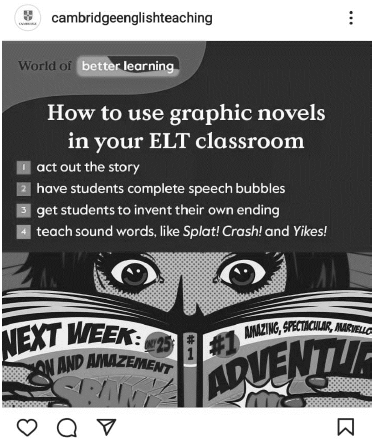
Fonte: Instagram #cambridgeenglishteaching


“Like” in the fourth item is used to indicate an
Alternativas
Q2016703 Inglês

Fonte: Instagram #cambridgeenglishteaching


The word “bubbles” can also be used when describing the effects of
Alternativas
Q2016702 Inglês

Fonte: Instagram #cambridgeenglishteaching


In viewing this Instagram photo, the teacher will realize that items 2 and 3 involve mostly

Alternativas
Q2016701 Inglês

The text below refers to question that follow it.



https://br.pinterest.com/pin/211669251227515501/

In this comic strip, the adverb “somehow” is used to
Alternativas
Respostas
561: A
562: B
563: E
564: B
565: D
566: B
567: C
568: A
569: E
570: A
571: D
572: E
573: A
574: C
575: E
576: D
577: D
578: C
579: C
580: D