Foram encontradas 181 questões

Resolva questões gratuitamente!

Junte-se a mais de 4 milhões de concurseiros!

Q3541318 Inglês
During the school year, Ms. Taylor, an English teacher, gives her students a short quiz before starting a new grammar topic to identify what they already know. She also provides continuous feedback on their performance during writing tasks and, at the end of each unit, she assigns a final test to determine their level of achievement and assign grades.
Considering the situation described select the alternative that shows the correct match between the assessment practices and their respective functions.
Alternativas
Q3541317 Inglês
A Brazilian English teacher has been hired to teach a group of experienced doctors who are preparing for a professional development program in an English-speaking country. These professionals will mainly need to understand technical literature in their field and participate in conferences.
In relation to the scenario presented and the principles of English for Specific Purposes (ESP), it is correct to state that:
Alternativas
Q3541316 Inglês
Considering the integrated teaching of the four language skills – reading, listening, writing, and speaking – in communicative approaches to English language teaching, select the correct alternative. 
Alternativas
Q3541315 Inglês
Homographs and homophones are common in the English language and often cause confusion among learners. About it, judge the following statements on the subject as True (T) or False (F), and then mark the alternative with the correct sequence.

( ) Homographs are words that are spelled the same but may have different meanings and, in some cases, different pronunciations.
( ) Homophones are words that sound the same but may differ in spelling and meaning.
( ) The word “can” is an example of a homograph.
( ) “Peace” and “piece” are examples of homophones.
( ) The word “bark” is an example of a homophone.
Alternativas
Q3541314 Inglês
According to the Brazilian document “Base Nacional Comum Curricular” (BNCC), regarding English as a lingua franca, select the correct alternative.
Alternativas
Q3541313 Inglês

Text VI


TUDO SALA DE AULA. Portal educacional com recursos didáticos para professores da Educação Básica. Available at: https://www.tudosaladeaula.com. Accessed on: Mar. 21, 2025. 

In relation to the elements from the comic strip, Text VI, consider the following statements.

I. In the utterance “I don’t understand women”, the word “women” is the plural form of woman, and is classified as an irregular noun whose plural is formed by mutation, in other words, a change in the vowel of the singular form. Other examples of plural nouns formed by mutation include “man/men”, “tooth/teeth”, and “mouse/mice”.

II. In the clause “that’s always worked”, replacing the verb “worked” with the phrasal verb “given up” would preserve the original meaning of the sentence, as both expressions convey the idea of successful effort or effectiveness over time.

III. The term "yeah" is a conjunction that expresses surprise or disbelief, commonly used in formal written English to indicate hesitation or irony.

IV. In “I’ll pretend I do”, the term “do” refers to “understand women” and is used to avoid unnecessary repetition.

V. In the clause “Yeah, that’s always worked”, the apostrophe+s (´s) is a contraction of the verb “to be” in the present tense (that is), forming a structure that indicates an action that began in the past and continues into the present.


Mark the alternative in which the statements are correct. 
Alternativas
Q3541312 Inglês

Text VI


TUDO SALA DE AULA. Portal educacional com recursos didáticos para professores da Educação Básica. Available at: https://www.tudosaladeaula.com. Accessed on: Mar. 21, 2025. 

In the context of the comic strip, Text VI, it is possible to infer that the human:
Alternativas
Q3541311 Inglês
Text V


Literacy as a Multidimensional Concept


   An emphasis on the development of literacy as a fluid concept (Knobel and Lankshear, 2014) is one of the most recent advances in twenty-first-century education. To conceptualize literacy, the ability of the learner to make use of language takes precedence in typical Western educational systems. However, as Kern highlights, “literacy is more than a set of academic skills” (2000, 23). It varies depending on the social context and is embedded in cultural practice (Paesani et al. 2016).

   Therefore, in order to define it, we must take into consideration the set of resources, sociocultural practices and competences––beyond reading and writing––that enable student interaction, critical thinking, the drawing of conclusions and the application of knowledge to curricular areas and realworld situations (New London Group 1996; Kern 2000; American Association of School Librarians (AASL) 2011; Cooper et al. 2012; Kucer 2014; Paesani et al. 2016; Reyes-Torres 2018; Warner and Dupuy 2018). As such, the multimodal training approach that we propose for the FL class stems from Kern’s notion of literacy, first, “as a process of creating and transforming knowledge” (2000, 29), and second, “as a matter of engaging in the ever-developing process of using reading and writing as tools for thinking and learning, in order to expand one’s understanding of oneself and the world” (40). This involves paying careful attention to language, while also developing a critical awareness of the relationships between texts, images, discourse conventions and sociocultural and digital contexts.

   In sum, and in consonance with Kern and other scholars such as the NLG (1996), Steve Kucer (2014), Maria Brisk (2015), Paesani et al. (2016) and Shari Tishman (2018), we define literacy as a dynamic and multidimensional concept whose main aim is to provide twenty-first-century learners with the language skills, visual thinking strategies and dialogic attitudes that are necessary to develop the knowledge that allows them to grasp and evaluate information, organize ideas, exchange perspectives, construct meaning and reflect critically on a variety of sociocultural contexts. In order to foster such a multidimensional approach to literacy in EFL and implement it as an organizing principle (Kress 2010; Serafini 2014), it is necessary that teachers become acquainted with the three dimensions that both Kern (2000) and Kucer (2014) acknowledge as the key components: a) cognitive; b) conceptual; and c) sociocultural. 

   These dimensions constitute a field of forces that complement one another and are equally important in the process of both teaching and learning, and they also illustrate the multiple facets and fluid nature of literacy.


Adapted from: FERNÁNDEZ, Teresa; REYES-TORRES, Agustín; FERNÁNDEZ, Pilar. A multimodal approach to foster the multiliteracies pedagogy in the English as a Foreign Language context. ATLANTIS: Journal of the Spanish Association of AngloAmerican Studies, vol. 42, no. 1, pp. 94–119, 2020. Available at: https://www.atlantisjournal.org/index.php/atlantis/article/view/741. Accessed on: Mar. 21, 2025.
Regarding the expression “these dimensions” in the passage: “These dimensions constitute a field of forces that complement one another and are equally important in the process of both teaching and learning, anda they also illustrate the multiple facets and fluid nature of literacy”, select the correct alternative.
Alternativas
Q3541310 Inglês
Text V


Literacy as a Multidimensional Concept


   An emphasis on the development of literacy as a fluid concept (Knobel and Lankshear, 2014) is one of the most recent advances in twenty-first-century education. To conceptualize literacy, the ability of the learner to make use of language takes precedence in typical Western educational systems. However, as Kern highlights, “literacy is more than a set of academic skills” (2000, 23). It varies depending on the social context and is embedded in cultural practice (Paesani et al. 2016).

   Therefore, in order to define it, we must take into consideration the set of resources, sociocultural practices and competences––beyond reading and writing––that enable student interaction, critical thinking, the drawing of conclusions and the application of knowledge to curricular areas and realworld situations (New London Group 1996; Kern 2000; American Association of School Librarians (AASL) 2011; Cooper et al. 2012; Kucer 2014; Paesani et al. 2016; Reyes-Torres 2018; Warner and Dupuy 2018). As such, the multimodal training approach that we propose for the FL class stems from Kern’s notion of literacy, first, “as a process of creating and transforming knowledge” (2000, 29), and second, “as a matter of engaging in the ever-developing process of using reading and writing as tools for thinking and learning, in order to expand one’s understanding of oneself and the world” (40). This involves paying careful attention to language, while also developing a critical awareness of the relationships between texts, images, discourse conventions and sociocultural and digital contexts.

   In sum, and in consonance with Kern and other scholars such as the NLG (1996), Steve Kucer (2014), Maria Brisk (2015), Paesani et al. (2016) and Shari Tishman (2018), we define literacy as a dynamic and multidimensional concept whose main aim is to provide twenty-first-century learners with the language skills, visual thinking strategies and dialogic attitudes that are necessary to develop the knowledge that allows them to grasp and evaluate information, organize ideas, exchange perspectives, construct meaning and reflect critically on a variety of sociocultural contexts. In order to foster such a multidimensional approach to literacy in EFL and implement it as an organizing principle (Kress 2010; Serafini 2014), it is necessary that teachers become acquainted with the three dimensions that both Kern (2000) and Kucer (2014) acknowledge as the key components: a) cognitive; b) conceptual; and c) sociocultural. 

   These dimensions constitute a field of forces that complement one another and are equally important in the process of both teaching and learning, and they also illustrate the multiple facets and fluid nature of literacy.


Adapted from: FERNÁNDEZ, Teresa; REYES-TORRES, Agustín; FERNÁNDEZ, Pilar. A multimodal approach to foster the multiliteracies pedagogy in the English as a Foreign Language context. ATLANTIS: Journal of the Spanish Association of AngloAmerican Studies, vol. 42, no. 1, pp. 94–119, 2020. Available at: https://www.atlantisjournal.org/index.php/atlantis/article/view/741. Accessed on: Mar. 21, 2025.
In relation to the term “whose” in the sentence: “We define literacy as a dynamic and multidimensional concept whose main aim is to provide twenty-first-century learners with the language skills [...]”, select the correct alternative.
Alternativas
Q3541309 Inglês
Text V


Literacy as a Multidimensional Concept


   An emphasis on the development of literacy as a fluid concept (Knobel and Lankshear, 2014) is one of the most recent advances in twenty-first-century education. To conceptualize literacy, the ability of the learner to make use of language takes precedence in typical Western educational systems. However, as Kern highlights, “literacy is more than a set of academic skills” (2000, 23). It varies depending on the social context and is embedded in cultural practice (Paesani et al. 2016).

   Therefore, in order to define it, we must take into consideration the set of resources, sociocultural practices and competences––beyond reading and writing––that enable student interaction, critical thinking, the drawing of conclusions and the application of knowledge to curricular areas and realworld situations (New London Group 1996; Kern 2000; American Association of School Librarians (AASL) 2011; Cooper et al. 2012; Kucer 2014; Paesani et al. 2016; Reyes-Torres 2018; Warner and Dupuy 2018). As such, the multimodal training approach that we propose for the FL class stems from Kern’s notion of literacy, first, “as a process of creating and transforming knowledge” (2000, 29), and second, “as a matter of engaging in the ever-developing process of using reading and writing as tools for thinking and learning, in order to expand one’s understanding of oneself and the world” (40). This involves paying careful attention to language, while also developing a critical awareness of the relationships between texts, images, discourse conventions and sociocultural and digital contexts.

   In sum, and in consonance with Kern and other scholars such as the NLG (1996), Steve Kucer (2014), Maria Brisk (2015), Paesani et al. (2016) and Shari Tishman (2018), we define literacy as a dynamic and multidimensional concept whose main aim is to provide twenty-first-century learners with the language skills, visual thinking strategies and dialogic attitudes that are necessary to develop the knowledge that allows them to grasp and evaluate information, organize ideas, exchange perspectives, construct meaning and reflect critically on a variety of sociocultural contexts. In order to foster such a multidimensional approach to literacy in EFL and implement it as an organizing principle (Kress 2010; Serafini 2014), it is necessary that teachers become acquainted with the three dimensions that both Kern (2000) and Kucer (2014) acknowledge as the key components: a) cognitive; b) conceptual; and c) sociocultural. 

   These dimensions constitute a field of forces that complement one another and are equally important in the process of both teaching and learning, and they also illustrate the multiple facets and fluid nature of literacy.


Adapted from: FERNÁNDEZ, Teresa; REYES-TORRES, Agustín; FERNÁNDEZ, Pilar. A multimodal approach to foster the multiliteracies pedagogy in the English as a Foreign Language context. ATLANTIS: Journal of the Spanish Association of AngloAmerican Studies, vol. 42, no. 1, pp. 94–119, 2020. Available at: https://www.atlantisjournal.org/index.php/atlantis/article/view/741. Accessed on: Mar. 21, 2025.
In “This involves paying careful attention to language, while also developing a critical awareness of the relationships between texts, images, discourse conventions and sociocultural and digital contexts”, select the correct alternative regarding the highlighted term “careful”.
Alternativas
Q3541308 Inglês
Text V


Literacy as a Multidimensional Concept


   An emphasis on the development of literacy as a fluid concept (Knobel and Lankshear, 2014) is one of the most recent advances in twenty-first-century education. To conceptualize literacy, the ability of the learner to make use of language takes precedence in typical Western educational systems. However, as Kern highlights, “literacy is more than a set of academic skills” (2000, 23). It varies depending on the social context and is embedded in cultural practice (Paesani et al. 2016).

   Therefore, in order to define it, we must take into consideration the set of resources, sociocultural practices and competences––beyond reading and writing––that enable student interaction, critical thinking, the drawing of conclusions and the application of knowledge to curricular areas and realworld situations (New London Group 1996; Kern 2000; American Association of School Librarians (AASL) 2011; Cooper et al. 2012; Kucer 2014; Paesani et al. 2016; Reyes-Torres 2018; Warner and Dupuy 2018). As such, the multimodal training approach that we propose for the FL class stems from Kern’s notion of literacy, first, “as a process of creating and transforming knowledge” (2000, 29), and second, “as a matter of engaging in the ever-developing process of using reading and writing as tools for thinking and learning, in order to expand one’s understanding of oneself and the world” (40). This involves paying careful attention to language, while also developing a critical awareness of the relationships between texts, images, discourse conventions and sociocultural and digital contexts.

   In sum, and in consonance with Kern and other scholars such as the NLG (1996), Steve Kucer (2014), Maria Brisk (2015), Paesani et al. (2016) and Shari Tishman (2018), we define literacy as a dynamic and multidimensional concept whose main aim is to provide twenty-first-century learners with the language skills, visual thinking strategies and dialogic attitudes that are necessary to develop the knowledge that allows them to grasp and evaluate information, organize ideas, exchange perspectives, construct meaning and reflect critically on a variety of sociocultural contexts. In order to foster such a multidimensional approach to literacy in EFL and implement it as an organizing principle (Kress 2010; Serafini 2014), it is necessary that teachers become acquainted with the three dimensions that both Kern (2000) and Kucer (2014) acknowledge as the key components: a) cognitive; b) conceptual; and c) sociocultural. 

   These dimensions constitute a field of forces that complement one another and are equally important in the process of both teaching and learning, and they also illustrate the multiple facets and fluid nature of literacy.


Adapted from: FERNÁNDEZ, Teresa; REYES-TORRES, Agustín; FERNÁNDEZ, Pilar. A multimodal approach to foster the multiliteracies pedagogy in the English as a Foreign Language context. ATLANTIS: Journal of the Spanish Association of AngloAmerican Studies, vol. 42, no. 1, pp. 94–119, 2020. Available at: https://www.atlantisjournal.org/index.php/atlantis/article/view/741. Accessed on: Mar. 21, 2025.
Contextual clues such as definitions, examples, modifiers, relocation, parallel structures, connectors, and the repetition of keywords play a vital role in enhancing the flow and clarity of academic texts. In the Text V, the term 'however', present in the following excerpt, is used as one of these contextual clues. About it, select the correct alternative.
“An emphasis on the development of literacy as a fluid concept (Knobel and Lankshear (2014) is one of the most recent advances in twenty-first-century education. To conceptualize literacy, the ability of the learner to make use of language takes precedence in typical Western educational systems. However, as Kern highlights, “literacy is more than a set of academic skills” (2000, 23). It varies depending on the social context and is embedded in cultural practice (Paesani et al. 2016).”
Alternativas
Q3541307 Inglês
Text V


Literacy as a Multidimensional Concept


   An emphasis on the development of literacy as a fluid concept (Knobel and Lankshear, 2014) is one of the most recent advances in twenty-first-century education. To conceptualize literacy, the ability of the learner to make use of language takes precedence in typical Western educational systems. However, as Kern highlights, “literacy is more than a set of academic skills” (2000, 23). It varies depending on the social context and is embedded in cultural practice (Paesani et al. 2016).

   Therefore, in order to define it, we must take into consideration the set of resources, sociocultural practices and competences––beyond reading and writing––that enable student interaction, critical thinking, the drawing of conclusions and the application of knowledge to curricular areas and realworld situations (New London Group 1996; Kern 2000; American Association of School Librarians (AASL) 2011; Cooper et al. 2012; Kucer 2014; Paesani et al. 2016; Reyes-Torres 2018; Warner and Dupuy 2018). As such, the multimodal training approach that we propose for the FL class stems from Kern’s notion of literacy, first, “as a process of creating and transforming knowledge” (2000, 29), and second, “as a matter of engaging in the ever-developing process of using reading and writing as tools for thinking and learning, in order to expand one’s understanding of oneself and the world” (40). This involves paying careful attention to language, while also developing a critical awareness of the relationships between texts, images, discourse conventions and sociocultural and digital contexts.

   In sum, and in consonance with Kern and other scholars such as the NLG (1996), Steve Kucer (2014), Maria Brisk (2015), Paesani et al. (2016) and Shari Tishman (2018), we define literacy as a dynamic and multidimensional concept whose main aim is to provide twenty-first-century learners with the language skills, visual thinking strategies and dialogic attitudes that are necessary to develop the knowledge that allows them to grasp and evaluate information, organize ideas, exchange perspectives, construct meaning and reflect critically on a variety of sociocultural contexts. In order to foster such a multidimensional approach to literacy in EFL and implement it as an organizing principle (Kress 2010; Serafini 2014), it is necessary that teachers become acquainted with the three dimensions that both Kern (2000) and Kucer (2014) acknowledge as the key components: a) cognitive; b) conceptual; and c) sociocultural. 

   These dimensions constitute a field of forces that complement one another and are equally important in the process of both teaching and learning, and they also illustrate the multiple facets and fluid nature of literacy.


Adapted from: FERNÁNDEZ, Teresa; REYES-TORRES, Agustín; FERNÁNDEZ, Pilar. A multimodal approach to foster the multiliteracies pedagogy in the English as a Foreign Language context. ATLANTIS: Journal of the Spanish Association of AngloAmerican Studies, vol. 42, no. 1, pp. 94–119, 2020. Available at: https://www.atlantisjournal.org/index.php/atlantis/article/view/741. Accessed on: Mar. 21, 2025.
The Text V discusses the essential dimensions identified by Kern (2000) and Kucer (2014) as foundational for a multidimensional approach to literacy in English as a Foreign Language (EFL). What is the role of these dimensions in the teaching and learning process?
Alternativas
Q3541306 Inglês
Text V


Literacy as a Multidimensional Concept


   An emphasis on the development of literacy as a fluid concept (Knobel and Lankshear, 2014) is one of the most recent advances in twenty-first-century education. To conceptualize literacy, the ability of the learner to make use of language takes precedence in typical Western educational systems. However, as Kern highlights, “literacy is more than a set of academic skills” (2000, 23). It varies depending on the social context and is embedded in cultural practice (Paesani et al. 2016).

   Therefore, in order to define it, we must take into consideration the set of resources, sociocultural practices and competences––beyond reading and writing––that enable student interaction, critical thinking, the drawing of conclusions and the application of knowledge to curricular areas and realworld situations (New London Group 1996; Kern 2000; American Association of School Librarians (AASL) 2011; Cooper et al. 2012; Kucer 2014; Paesani et al. 2016; Reyes-Torres 2018; Warner and Dupuy 2018). As such, the multimodal training approach that we propose for the FL class stems from Kern’s notion of literacy, first, “as a process of creating and transforming knowledge” (2000, 29), and second, “as a matter of engaging in the ever-developing process of using reading and writing as tools for thinking and learning, in order to expand one’s understanding of oneself and the world” (40). This involves paying careful attention to language, while also developing a critical awareness of the relationships between texts, images, discourse conventions and sociocultural and digital contexts.

   In sum, and in consonance with Kern and other scholars such as the NLG (1996), Steve Kucer (2014), Maria Brisk (2015), Paesani et al. (2016) and Shari Tishman (2018), we define literacy as a dynamic and multidimensional concept whose main aim is to provide twenty-first-century learners with the language skills, visual thinking strategies and dialogic attitudes that are necessary to develop the knowledge that allows them to grasp and evaluate information, organize ideas, exchange perspectives, construct meaning and reflect critically on a variety of sociocultural contexts. In order to foster such a multidimensional approach to literacy in EFL and implement it as an organizing principle (Kress 2010; Serafini 2014), it is necessary that teachers become acquainted with the three dimensions that both Kern (2000) and Kucer (2014) acknowledge as the key components: a) cognitive; b) conceptual; and c) sociocultural. 

   These dimensions constitute a field of forces that complement one another and are equally important in the process of both teaching and learning, and they also illustrate the multiple facets and fluid nature of literacy.


Adapted from: FERNÁNDEZ, Teresa; REYES-TORRES, Agustín; FERNÁNDEZ, Pilar. A multimodal approach to foster the multiliteracies pedagogy in the English as a Foreign Language context. ATLANTIS: Journal of the Spanish Association of AngloAmerican Studies, vol. 42, no. 1, pp. 94–119, 2020. Available at: https://www.atlantisjournal.org/index.php/atlantis/article/view/741. Accessed on: Mar. 21, 2025.
According to the Text V, what is the proposed approach for the foreign language (FL) class?
Alternativas
Q3541305 Inglês
Text V


Literacy as a Multidimensional Concept


   An emphasis on the development of literacy as a fluid concept (Knobel and Lankshear, 2014) is one of the most recent advances in twenty-first-century education. To conceptualize literacy, the ability of the learner to make use of language takes precedence in typical Western educational systems. However, as Kern highlights, “literacy is more than a set of academic skills” (2000, 23). It varies depending on the social context and is embedded in cultural practice (Paesani et al. 2016).

   Therefore, in order to define it, we must take into consideration the set of resources, sociocultural practices and competences––beyond reading and writing––that enable student interaction, critical thinking, the drawing of conclusions and the application of knowledge to curricular areas and realworld situations (New London Group 1996; Kern 2000; American Association of School Librarians (AASL) 2011; Cooper et al. 2012; Kucer 2014; Paesani et al. 2016; Reyes-Torres 2018; Warner and Dupuy 2018). As such, the multimodal training approach that we propose for the FL class stems from Kern’s notion of literacy, first, “as a process of creating and transforming knowledge” (2000, 29), and second, “as a matter of engaging in the ever-developing process of using reading and writing as tools for thinking and learning, in order to expand one’s understanding of oneself and the world” (40). This involves paying careful attention to language, while also developing a critical awareness of the relationships between texts, images, discourse conventions and sociocultural and digital contexts.

   In sum, and in consonance with Kern and other scholars such as the NLG (1996), Steve Kucer (2014), Maria Brisk (2015), Paesani et al. (2016) and Shari Tishman (2018), we define literacy as a dynamic and multidimensional concept whose main aim is to provide twenty-first-century learners with the language skills, visual thinking strategies and dialogic attitudes that are necessary to develop the knowledge that allows them to grasp and evaluate information, organize ideas, exchange perspectives, construct meaning and reflect critically on a variety of sociocultural contexts. In order to foster such a multidimensional approach to literacy in EFL and implement it as an organizing principle (Kress 2010; Serafini 2014), it is necessary that teachers become acquainted with the three dimensions that both Kern (2000) and Kucer (2014) acknowledge as the key components: a) cognitive; b) conceptual; and c) sociocultural. 

   These dimensions constitute a field of forces that complement one another and are equally important in the process of both teaching and learning, and they also illustrate the multiple facets and fluid nature of literacy.


Adapted from: FERNÁNDEZ, Teresa; REYES-TORRES, Agustín; FERNÁNDEZ, Pilar. A multimodal approach to foster the multiliteracies pedagogy in the English as a Foreign Language context. ATLANTIS: Journal of the Spanish Association of AngloAmerican Studies, vol. 42, no. 1, pp. 94–119, 2020. Available at: https://www.atlantisjournal.org/index.php/atlantis/article/view/741. Accessed on: Mar. 21, 2025.
In the Text V, the author refers to several scholars and organizations, such as Knobel and Lankshear (2014), Kern (2000), the New London Group (1996), and others. What is the author's main purpose in including these references throughout the text? 
Alternativas
Q2238774 Inglês
The process of gamification refers to the use of elements of game design in situations outside the gaming environment. In light of this, and the theme of ludic in English language teaching, it is correct to state that 
Alternativas
Q2238773 Inglês

Observe the morphological process of the formation of the following words:
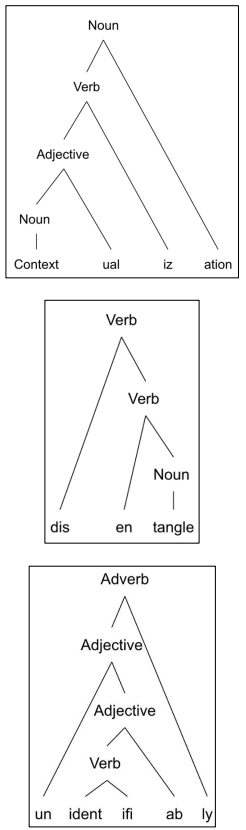

Imagem associada para resolução da questão

Now analyze the following statements.

I. -context- and -tangle- are free roots, while -ident- is a bound root.

II. These three words are formed both by prefixation and suffixation.

III. In the noun, -ual- and -iz- are derivational suffixes, while in the adverb, -ifi- and -ab- are inflectional suffixes.

IV. dis- and en- both have negative meanings.

V. The head of the noun is -ation, the head of the verb is en- and the head of the adverb is -ly.

The correct statements are

Alternativas
Q2238772 Inglês
Choose the only alternative which contains a compound word in the sentence.
Alternativas
Q2238771 Inglês
You are teaching your learners at IFMA how to write a research project. You asked students to write the introduction of the research project. Learners handed in the written assignment, and now you are writing comments for their feedback. In this context, analyze the statements below, with your comment and the area being focused on:
I. Comment: the introduction should briefly describe the theme of your research, its aims and explain the importance of your research. Area: communicative aim of the genre.
II. Comment: I can understand your point here, but connect the sentences in this paragraph using linkers. Also, avoid repetition of words by using pronouns and synonyms. Area: organization and coherence.
III. Comment: avoid talking to your reader, that is not typical of introduction in research projects. Area: language accuracy.
IV. Comment: your target reader is the professor and/or another researcher, so use formal language, avoiding contractions and colloquial expressions. Area: appropriate register of the genre.
V. Comment: use present perfect here, since there is no time reference for the action and this can happen again. Area: appropriate tone of the genre.
VI. Comment: you discuss a number of different points in a single block. Divide it into different paragraphs. Area: layout and organization.
The statements in which the feedback comment is completely in line with the area are
Alternativas
Q2238770 Inglês
You are an English language professor at IFMA and you are teaching your learners the genre “discursive essay”. Which of the rhetorical moves below are NOT usually typical of this genre?
Alternativas
Q2238769 Inglês
You are an English language professor at IFMA and you are teaching your learners to write abstracts for academic papers. You asked your learners to analyze the following model abstract:
Abstract Phrasal verbs are important for EFL and ESL education because of their high frequency, but can be difficult for learners because of their number and polysemy. While there are a number of studies on phrasal verbs, the widening focus of such studies has left a gap between theory and practical instruction. This study improves upon previous studies related to teaching phrasal verbs through cognitive linguistics by combining the theory of event conflation with corpus-based research to create a list of phrasal verb particles and meanings that is concise and yet comprehensive enough to account for approximately 95% of common phrasal verb meanings. It also reports the results of an experiment in which learners taught with this particle list improved more on pre-/post-tests of phrasal verbs than learners that studied a list of the most common phrasal verbs as whole entities (p<0.001, d=1.34). Quantitative and qualitative data presented in this study also indicate that learners taught with the particle list improved their ability to conjecture the meanings of novel phrasal verbs more effectively than learners who studied common phrasal verbs as whole units. Key words: Phrasal Verbs, Cognitive Linguistics, Corpus, Instruction Materials, TEFL, Second Language Acquisition.
Source: SPRING, Ryan. Teaching Phrasal Verbs More Efficiently: Using Corpus Studies and Cognitive Linguistics to Create a Particle List. Advances in Language and Literary Studies: Volume: 9 Issue: 5. 2018.
Regarding the genre “abstract” and the model above, choose the correct alternative.
Alternativas
Respostas
41: E
42: D
43: D
44: B
45: D
46: B
47: C
48: A
49: B
50: C
51: B
52: D
53: B
54: E
55: D
56: C
57: B
58: B
59: D
60: E