Questões de Concurso Público POLÍCIA CIENTÍFICA-PR 2007 para Perito Criminal - Engenharia Civil
Foram encontradas 59 questões


Sobre os poderes administrativos, numere a coluna da direita de acordo com a da esquerda.
1. Poder disciplinar
2. Poder de polícia
3. Poder hierárquico
4. Poder regulamentar
( ) Conjunto de atribuições concedidas à Administração Pública para disciplinar e restringir os direitos e liberdades individuais em benefício da coletividade ou do próprio Estado, em busca da preservação da ordem pública.
( ) Apuração e punição das faltas funcionais dos servidores públicos.
( ) Normas expedidas pelo Chefe do Poder Executivo que visam tornar efetivo o cumprimento da lei.
( ) Instrumento para garantia da atuação coordenada da Administração e que consiste na subordinação e coordenação nas relações entre os órgãos e entre os servidores administrativos.
Assinale a alternativa que apresenta a seqüência correta da coluna da direita, de cima para baixo.
Ao Conselho da Polícia Civil do Estado do Paraná, sem prejuízo de outras atribuições, compete:
Assinale a alternativa que contém, exclusivamente, princípios da administração pública, expressos na Constituição da República Federativa do Brasil de 1988.
1. Ao adolescente infrator não se aplicam penas, porém medidas de cunho educativo e protetivo, sem critérios rígidos de duração. 2. O Estatuto da Criança e do Adolescente considera ato infracional a conduta descrita como crime ou contravenção. 3. As medidas socioeducativas não têm como objetivo primário a punição do adolescente infrator, mas sim a sua educação e formação. 4. O Estatuto da Criança e do Adolescente considera como criança a pessoa até os 14 anos de idade incompletos.
Assinale a alternativa correta.
De acordo com a Constituição Federal, a idade mínima para pessoas com menos de dezoito anos começarem a trabalhar é de:
De acordo com o disposto no artigo 144 da Constituição da República Federativa do Brasil de 1988, a segurança pública, dever do Estado, direito e responsabilidade de todos, é exercida para a preservação da ordem pública e da incolumidade das pessoas e do patrimônio, através dos seguintes órgãos:
O texto a seguir é referência para a questão.
Rio de Janeiro (Reuters) – Brazil’s hugely popular television soap-operas usually deal with tear-filled romance. But the violence engulfing the country has upstaged the melodrama and taken one “telenovela” to the top of the ratings.
“Vidas Opostas” (Opposite Lives) is a hit with residents of Rio de Janeiro, where it is set, and around the country, despite complaints that people are weary of the real-life bloodshed and gory newscasts.
“We are showing things as they are in Rio – slums, drug traffickers, corrupt cops, rotten politicians, and common people caught in the middle of all that”, director Alexandre Avancini said.
The prime-time telenovela on the Rede Record network, shot partly in a real slum, has beat leading network Globo in the ratings several times when pitted against big league soccer games – an undeniable sign of popularity in Brazil.
A love-story is not missing. “Vidas Opostas” is the story of a young millionaire heir who loves a girl who lives in a slum, or favela. The favela is controlled by a drug gang that is in the middle of a turf with a rival group, which has the backing of a corrupt cop, a typical scenario in many of Rio’s 600-plus shanty towns.
(http://www.gulf-times.com)
1. The city where “Vidas Opostas” takes place. 2. The title of the melodrama which is a success on Globo network. 3. The name of the actor who plays a corrupt cop. 4. Examples of professions which are present in “Vidas Opostas”. 5. The place where the main female character of the story lives.
The pieces of information present in the text are:
O texto a seguir é referência para a questão.
Rio de Janeiro (Reuters) – Brazil’s hugely popular television soap-operas usually deal with tear-filled romance. But the violence engulfing the country has upstaged the melodrama and taken one “telenovela” to the top of the ratings.
“Vidas Opostas” (Opposite Lives) is a hit with residents of Rio de Janeiro, where it is set, and around the country, despite complaints that people are weary of the real-life bloodshed and gory newscasts.
“We are showing things as they are in Rio – slums, drug traffickers, corrupt cops, rotten politicians, and common people caught in the middle of all that”, director Alexandre Avancini said.
The prime-time telenovela on the Rede Record network, shot partly in a real slum, has beat leading network Globo in the ratings several times when pitted against big league soccer games – an undeniable sign of popularity in Brazil.
A love-story is not missing. “Vidas Opostas” is the story of a young millionaire heir who loves a girl who lives in a slum, or favela. The favela is controlled by a drug gang that is in the middle of a turf with a rival group, which has the backing of a corrupt cop, a typical scenario in many of Rio’s 600-plus shanty towns.
(http://www.gulf-times.com)
According to the text:
O texto a seguir é referência para a questão.
Rio de Janeiro (Reuters) – Brazil’s hugely popular television soap-operas usually deal with tear-filled romance. But the violence engulfing the country has upstaged the melodrama and taken one “telenovela” to the top of the ratings.
“Vidas Opostas” (Opposite Lives) is a hit with residents of Rio de Janeiro, where it is set, and around the country, despite complaints that people are weary of the real-life bloodshed and gory newscasts.
“We are showing things as they are in Rio – slums, drug traffickers, corrupt cops, rotten politicians, and common people caught in the middle of all that”, director Alexandre Avancini said.
The prime-time telenovela on the Rede Record network, shot partly in a real slum, has beat leading network Globo in the ratings several times when pitted against big league soccer games – an undeniable sign of popularity in Brazil.
A love-story is not missing. “Vidas Opostas” is the story of a young millionaire heir who loves a girl who lives in a slum, or favela. The favela is controlled by a drug gang that is in the middle of a turf with a rival group, which has the backing of a corrupt cop, a typical scenario in many of Rio’s 600-plus shanty towns.
(http://www.gulf-times.com)
According to the text, an undeniable sign of popularity in Brazil is:
O texto a seguir é referência para a questão.
Rio de Janeiro (Reuters) – Brazil’s hugely popular television soap-operas usually deal with tear-filled romance. But the violence engulfing the country has upstaged the melodrama and taken one “telenovela” to the top of the ratings.
“Vidas Opostas” (Opposite Lives) is a hit with residents of Rio de Janeiro, where it is set, and around the country, despite complaints that people are weary of the real-life bloodshed and gory newscasts.
“We are showing things as they are in Rio – slums, drug traffickers, corrupt cops, rotten politicians, and common people caught in the middle of all that”, director Alexandre Avancini said.
The prime-time telenovela on the Rede Record network, shot partly in a real slum, has beat leading network Globo in the ratings several times when pitted against big league soccer games – an undeniable sign of popularity in Brazil.
A love-story is not missing. “Vidas Opostas” is the story of a young millionaire heir who loves a girl who lives in a slum, or favela. The favela is controlled by a drug gang that is in the middle of a turf with a rival group, which has the backing of a corrupt cop, a typical scenario in many of Rio’s 600-plus shanty towns.
(http://www.gulf-times.com)
1. It shows violence as it is in a big city. 2. It includes a love-story. 3. It ignores real-life murders, killing and violence. 4. It is the first time Record network has Avancini as a director. 5. It has as a scenario Rio’s more than 600 favelas.
According to the text, the reasons Opposite Lives is a hit are:
De acordo com a NR-6, qual dos itens abaixo NÃO cabe ao empregador quanto aos equipamentos de proteção individual (EPI)?
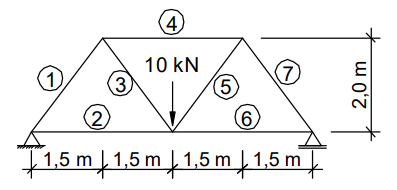
Para a treliça da figura abaixo, com as barras numeradas de 1 a 7, quais das barras estão tracionadas?
1. As barras das armaduras devem ser ancoradas de forma que os esforços a que estejam submetidas sejam integralmente transmitidos ao concreto. 2. A ancoragem por aderência dá-se quando os esforços são ancorados por meio de um comprimento reto ou com grande raio de curvatura, seguido ou não de gancho. 3. Os tipos de emendas das barras são: por traspasse; por luvas com preenchimento metálico, rosqueadas ou prensadas; por solda; por outros dispositivos devidamente justificados. 4. Em tirantes, deve-se utilizar emenda por traspasse.
Assinale a alternativa correta, de acordo com a NBR-6118.
Qual o grau de hiperestaticidade do pórtico plano da figura abaixo?

1. O guarda-corpo deve ter altura de 0,90 m (noventa centímetros), no mínimo, a contar do nível do pavimento. 2. Quando for vazado, os vãos do guarda-corpo devem ter, pelo menos, uma das dimensões igual ou inferior a 0,12 m (doze centímetros). 3. O guarda-corpo deve ser de material rígido e capaz de resistir ao esforço horizontal de 80 kgf/m2 (oitenta quilogramas-força por metro quadrado) aplicado no seu ponto mais desfavorável.
Estão de acordo com a NR-8 os requisitos:
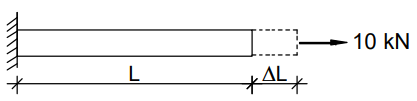
- Considerar π = 3,14. - Carga Crítica de Euler: Pcr = π²EI/(Lfl )², onde I = momento de inércia e Lfl = comprimento de flambagem.
O peso específico aparente de uma amostra de argila é de 1,8 g/cm³, o teor de umidade é de 50% e o peso específico das partículas dessa argila é de 2,4 g/cm³. Qual a porosidade da amostra?
A altura inicial de uma amostra de solo é 2,2 cm, e o seu índice de vazios é 1,2. Submetida a um ensaio de adensamento, a altura se reduz para 1,8 cm. Qual o índice de vazios final da amostra?
Dada uma seção transversal retangular de concreto armado, submetido a flexão simples, com altura útil d = 35 cm, qual a profundidade da linha neutra (x), no limite entre os domínios de deformação 2 e 3?

 Conheça nossos planos