Questões de Concurso Público Prefeitura de Buriticupu - MA 2026 para Professor Ensino Fundamental Nível – II - Anos Finais – 6º ao 9º Ano - Língua Inglesa
Foram encontradas 11 questões


Ano: 2026
Banca:
FSADU
Órgão:
Prefeitura de Buriticupu - MA
Prova:
FSADU - 2026 - Prefeitura de Buriticupu - MA - Professor Ensino Fundamental Nível – II - Anos Finais – 6º ao 9º Ano - Língua Inglesa |
Q4345125
Inglês
Texto associado
Read text below and answer questionão accordingly.
The Future of Language Education: Teachers’
Perceptions About the Surge of Large Language
Models like ChatGPT
(1) Large Language Models (LLMs) like ChatGPT have
been described as a disruptive technology — an
innovation that significantly alters or even revolutionises
an existing industry, often introducing new approaches,
challenging established methodologies, or interpreting
older methods as obsolete.
(2) LLMs are computational models that have the
capability to understand and generate human language.
This capacity to generate human language has the
potential to transform language teaching and learning.
(3) Teachers can use LLM tools to personalise learning,
plan lessons, create quizzes or other learning activities,
and to provide feedback. In second language (L2)
classes, teachers could use these models to explain
grammar, propose improvements in grammar and style,
and facilitate conversational practice. These
affordances are an advantage to instructors, saving
them time and providing personalised instructional
support, and many educators are excited to try working
with LLMs.
(4) But, as it is common with any new technology, many
others are fearful of LLMs’ potential to disturb the way
that students approach classroom learning. Fear of new
technologies is not uncommon because they require
educators to adapt, which can be intimidating;
educators may question their pedagogical effectiveness
or the loss of human interaction.
(5) The results of a survey conducted with 65 language
instructors showed mixed feelings: ranging from
excitement for the pedagogical potential of ChatGPT to
fear of potential academic dishonesty and job security.
(6) Importantly, those who had previously engaged with
the tool expressed greater enthusiasm for its wider
application compared to their counterparts with no such
experience. This suggests that familiarity may mitigate
apprehension and foster a more optimistic outlook on
the potential of ChatGPT in educational settings.
Whether language instructors are in admiration or fear
of ChatGPT, Artificial Intelligence (AI) tools are here to
stay — rather than ignore them, we must quickly learn
to use them, understand the challenges and benefits,
and develop both instructional approaches and policies.
(Adapted from: ZIMOTTI, G.; FRANCES, C.; WHITAKER, L. Technology in
Language Teaching & Learning. Technology in Language Teaching & Learning,
v. 6, n. 2, p. 1-24, 2024. Disponível em: https://doi.org/10.29140/tltl.v6n2.1136.
Acesso em: 30 maio 2026.)
The text describes Large Language Models (LLMs) as
a "disruptive technology." Based on the argument
provided in paragraph 1, which of the following
scenarios best illustrates why LLMs can be considered
disruptive in the context of language education?
Ano: 2026
Banca:
FSADU
Órgão:
Prefeitura de Buriticupu - MA
Prova:
FSADU - 2026 - Prefeitura de Buriticupu - MA - Professor Ensino Fundamental Nível – II - Anos Finais – 6º ao 9º Ano - Língua Inglesa |
Q4345126
Inglês
Texto associado
Read text below and answer questionão accordingly.
The Future of Language Education: Teachers’
Perceptions About the Surge of Large Language
Models like ChatGPT
(1) Large Language Models (LLMs) like ChatGPT have
been described as a disruptive technology — an
innovation that significantly alters or even revolutionises
an existing industry, often introducing new approaches,
challenging established methodologies, or interpreting
older methods as obsolete.
(2) LLMs are computational models that have the
capability to understand and generate human language.
This capacity to generate human language has the
potential to transform language teaching and learning.
(3) Teachers can use LLM tools to personalise learning,
plan lessons, create quizzes or other learning activities,
and to provide feedback. In second language (L2)
classes, teachers could use these models to explain
grammar, propose improvements in grammar and style,
and facilitate conversational practice. These
affordances are an advantage to instructors, saving
them time and providing personalised instructional
support, and many educators are excited to try working
with LLMs.
(4) But, as it is common with any new technology, many
others are fearful of LLMs’ potential to disturb the way
that students approach classroom learning. Fear of new
technologies is not uncommon because they require
educators to adapt, which can be intimidating;
educators may question their pedagogical effectiveness
or the loss of human interaction.
(5) The results of a survey conducted with 65 language
instructors showed mixed feelings: ranging from
excitement for the pedagogical potential of ChatGPT to
fear of potential academic dishonesty and job security.
(6) Importantly, those who had previously engaged with
the tool expressed greater enthusiasm for its wider
application compared to their counterparts with no such
experience. This suggests that familiarity may mitigate
apprehension and foster a more optimistic outlook on
the potential of ChatGPT in educational settings.
Whether language instructors are in admiration or fear
of ChatGPT, Artificial Intelligence (AI) tools are here to
stay — rather than ignore them, we must quickly learn
to use them, understand the challenges and benefits,
and develop both instructional approaches and policies.
(Adapted from: ZIMOTTI, G.; FRANCES, C.; WHITAKER, L. Technology in
Language Teaching & Learning. Technology in Language Teaching & Learning,
v. 6, n. 2, p. 1-24, 2024. Disponível em: https://doi.org/10.29140/tltl.v6n2.1136.
Acesso em: 30 maio 2026.)
In paragraph 3, the text states: "Teachers can use LLM
tools to personalise learning, plan lessons, create
quizzes or other learning activities, and to provide
feedback." What does the modal verb ‘can’ express in
this context?
Ano: 2026
Banca:
FSADU
Órgão:
Prefeitura de Buriticupu - MA
Prova:
FSADU - 2026 - Prefeitura de Buriticupu - MA - Professor Ensino Fundamental Nível – II - Anos Finais – 6º ao 9º Ano - Língua Inglesa |
Q4345127
Inglês
Texto associado
Read text below and answer questionão accordingly.
The Future of Language Education: Teachers’
Perceptions About the Surge of Large Language
Models like ChatGPT
(1) Large Language Models (LLMs) like ChatGPT have
been described as a disruptive technology — an
innovation that significantly alters or even revolutionises
an existing industry, often introducing new approaches,
challenging established methodologies, or interpreting
older methods as obsolete.
(2) LLMs are computational models that have the
capability to understand and generate human language.
This capacity to generate human language has the
potential to transform language teaching and learning.
(3) Teachers can use LLM tools to personalise learning,
plan lessons, create quizzes or other learning activities,
and to provide feedback. In second language (L2)
classes, teachers could use these models to explain
grammar, propose improvements in grammar and style,
and facilitate conversational practice. These
affordances are an advantage to instructors, saving
them time and providing personalised instructional
support, and many educators are excited to try working
with LLMs.
(4) But, as it is common with any new technology, many
others are fearful of LLMs’ potential to disturb the way
that students approach classroom learning. Fear of new
technologies is not uncommon because they require
educators to adapt, which can be intimidating;
educators may question their pedagogical effectiveness
or the loss of human interaction.
(5) The results of a survey conducted with 65 language
instructors showed mixed feelings: ranging from
excitement for the pedagogical potential of ChatGPT to
fear of potential academic dishonesty and job security.
(6) Importantly, those who had previously engaged with
the tool expressed greater enthusiasm for its wider
application compared to their counterparts with no such
experience. This suggests that familiarity may mitigate
apprehension and foster a more optimistic outlook on
the potential of ChatGPT in educational settings.
Whether language instructors are in admiration or fear
of ChatGPT, Artificial Intelligence (AI) tools are here to
stay — rather than ignore them, we must quickly learn
to use them, understand the challenges and benefits,
and develop both instructional approaches and policies.
(Adapted from: ZIMOTTI, G.; FRANCES, C.; WHITAKER, L. Technology in
Language Teaching & Learning. Technology in Language Teaching & Learning,
v. 6, n. 2, p. 1-24, 2024. Disponível em: https://doi.org/10.29140/tltl.v6n2.1136.
Acesso em: 30 maio 2026.)
Which statement best describes the difference
between professionals who had had previous
experience with ChatGPT and those who had not, as
presented by the authors?
Ano: 2026
Banca:
FSADU
Órgão:
Prefeitura de Buriticupu - MA
Prova:
FSADU - 2026 - Prefeitura de Buriticupu - MA - Professor Ensino Fundamental Nível – II - Anos Finais – 6º ao 9º Ano - Língua Inglesa |
Q4345128
Inglês
Texto associado
Read text below and answer questionão accordingly.
The Future of Language Education: Teachers’
Perceptions About the Surge of Large Language
Models like ChatGPT
(1) Large Language Models (LLMs) like ChatGPT have
been described as a disruptive technology — an
innovation that significantly alters or even revolutionises
an existing industry, often introducing new approaches,
challenging established methodologies, or interpreting
older methods as obsolete.
(2) LLMs are computational models that have the
capability to understand and generate human language.
This capacity to generate human language has the
potential to transform language teaching and learning.
(3) Teachers can use LLM tools to personalise learning,
plan lessons, create quizzes or other learning activities,
and to provide feedback. In second language (L2)
classes, teachers could use these models to explain
grammar, propose improvements in grammar and style,
and facilitate conversational practice. These
affordances are an advantage to instructors, saving
them time and providing personalised instructional
support, and many educators are excited to try working
with LLMs.
(4) But, as it is common with any new technology, many
others are fearful of LLMs’ potential to disturb the way
that students approach classroom learning. Fear of new
technologies is not uncommon because they require
educators to adapt, which can be intimidating;
educators may question their pedagogical effectiveness
or the loss of human interaction.
(5) The results of a survey conducted with 65 language
instructors showed mixed feelings: ranging from
excitement for the pedagogical potential of ChatGPT to
fear of potential academic dishonesty and job security.
(6) Importantly, those who had previously engaged with
the tool expressed greater enthusiasm for its wider
application compared to their counterparts with no such
experience. This suggests that familiarity may mitigate
apprehension and foster a more optimistic outlook on
the potential of ChatGPT in educational settings.
Whether language instructors are in admiration or fear
of ChatGPT, Artificial Intelligence (AI) tools are here to
stay — rather than ignore them, we must quickly learn
to use them, understand the challenges and benefits,
and develop both instructional approaches and policies.
(Adapted from: ZIMOTTI, G.; FRANCES, C.; WHITAKER, L. Technology in
Language Teaching & Learning. Technology in Language Teaching & Learning,
v. 6, n. 2, p. 1-24, 2024. Disponível em: https://doi.org/10.29140/tltl.v6n2.1136.
Acesso em: 30 maio 2026.)
In the sentence “But, as it is common with any new
technology, many others are fearful of LLMs’ potential
to disturb the way that students approach classroom
learning”, the word ‘fearful’
Ano: 2026
Banca:
FSADU
Órgão:
Prefeitura de Buriticupu - MA
Prova:
FSADU - 2026 - Prefeitura de Buriticupu - MA - Professor Ensino Fundamental Nível – II - Anos Finais – 6º ao 9º Ano - Língua Inglesa |
Q4345129
Inglês
Texto associado
Read text below and answer questionão accordingly.
The Future of Language Education: Teachers’
Perceptions About the Surge of Large Language
Models like ChatGPT
(1) Large Language Models (LLMs) like ChatGPT have
been described as a disruptive technology — an
innovation that significantly alters or even revolutionises
an existing industry, often introducing new approaches,
challenging established methodologies, or interpreting
older methods as obsolete.
(2) LLMs are computational models that have the
capability to understand and generate human language.
This capacity to generate human language has the
potential to transform language teaching and learning.
(3) Teachers can use LLM tools to personalise learning,
plan lessons, create quizzes or other learning activities,
and to provide feedback. In second language (L2)
classes, teachers could use these models to explain
grammar, propose improvements in grammar and style,
and facilitate conversational practice. These
affordances are an advantage to instructors, saving
them time and providing personalised instructional
support, and many educators are excited to try working
with LLMs.
(4) But, as it is common with any new technology, many
others are fearful of LLMs’ potential to disturb the way
that students approach classroom learning. Fear of new
technologies is not uncommon because they require
educators to adapt, which can be intimidating;
educators may question their pedagogical effectiveness
or the loss of human interaction.
(5) The results of a survey conducted with 65 language
instructors showed mixed feelings: ranging from
excitement for the pedagogical potential of ChatGPT to
fear of potential academic dishonesty and job security.
(6) Importantly, those who had previously engaged with
the tool expressed greater enthusiasm for its wider
application compared to their counterparts with no such
experience. This suggests that familiarity may mitigate
apprehension and foster a more optimistic outlook on
the potential of ChatGPT in educational settings.
Whether language instructors are in admiration or fear
of ChatGPT, Artificial Intelligence (AI) tools are here to
stay — rather than ignore them, we must quickly learn
to use them, understand the challenges and benefits,
and develop both instructional approaches and policies.
(Adapted from: ZIMOTTI, G.; FRANCES, C.; WHITAKER, L. Technology in
Language Teaching & Learning. Technology in Language Teaching & Learning,
v. 6, n. 2, p. 1-24, 2024. Disponível em: https://doi.org/10.29140/tltl.v6n2.1136.
Acesso em: 30 maio 2026.)
In paragraph 6, the sentence “[…] we must quickly
learn to use them […]” could be correctly transformed
into a question without changing its meaning in the
option:
Ano: 2026
Banca:
FSADU
Órgão:
Prefeitura de Buriticupu - MA
Prova:
FSADU - 2026 - Prefeitura de Buriticupu - MA - Professor Ensino Fundamental Nível – II - Anos Finais – 6º ao 9º Ano - Língua Inglesa |
Q4345130
Inglês
Texto associado
Read text below and answer question accordingly.
English Language Teaching in Brazil: A Gap in Policy,
Problems in Practice
Only three percent of Brazilians are estimated to speak
English despite the status of this language as a
mandatory subject. This fact relates to a gap in foreign
language teaching policy documents: the National
Education Guidelines and Framework Law (LDB), and
the National Curriculum Parameters (PCN). These
documents for many years did not prescribe the
necessary conditions for English Language Teaching
(ELT) to take place effectively, often focusing on
reading due to a lack of resources or large classes.
LDB mandated the teaching of a foreign language
chosen locally from grades 5 to 12. A recent reform in
2017 has added that English will be the foreign
language taught in secondary school (from grade 6 up)
throughout the country. Previous versions of LDB,
however, did not mandate the teaching of English,
leading to the perception that only in private language
centers could students learn the language.
The effectiveness of ELT in basic education remains
low because policies impact the quality of teacher
education, the availability of pedagogical resources,
and the number of students in the classroom. Most
schools are equipped with basic materials like
blackboards and chairs, but few have audiovisual
equipment installed in every classroom. This reality
shows why many teachers stick to the textbook most of
the time.
Many English teachers in Brazil do not speak the
language fluently because most undergraduate
programs offer a dual major (English and Portuguese).
Often, aspiring teachers enroll because they actually
want to teach Portuguese. Consequently, these
teachers reproduce in their classrooms the approaches
in which they were taught as students, focusing on
grammar-translation rather than modern communicative
methods.
Misconceptions about the language also contribute to a
lack of motivation. Some believe English is only from
England or the USA. To correct this, BNCC (National
Common Curriculum Base) suggests an intercultural
approach to make the study of a foreign language more
socially and culturally relevant. BNCC aims to raise
awareness of the global web in which English is
involved, and it is treating it as a tool for citizenship.
(Adapted from: BATISTA, F. C. A. English Language Teaching in Brazil: A Gap
in Policy, Problems in Practice. English Language Teaching, v. 13, n. 8, p. 135-
145, 2020. Disponível em: https://doi.org/10.5539/elt.v13n8p135. Acesso em:
30 maio 2026.)
According to text, the low percentage of English
speakers in Brazil is primarily attributed to
Ano: 2026
Banca:
FSADU
Órgão:
Prefeitura de Buriticupu - MA
Prova:
FSADU - 2026 - Prefeitura de Buriticupu - MA - Professor Ensino Fundamental Nível – II - Anos Finais – 6º ao 9º Ano - Língua Inglesa |
Q4345131
Inglês
Texto associado
Read text below and answer question accordingly.
English Language Teaching in Brazil: A Gap in Policy,
Problems in Practice
Only three percent of Brazilians are estimated to speak
English despite the status of this language as a
mandatory subject. This fact relates to a gap in foreign
language teaching policy documents: the National
Education Guidelines and Framework Law (LDB), and
the National Curriculum Parameters (PCN). These
documents for many years did not prescribe the
necessary conditions for English Language Teaching
(ELT) to take place effectively, often focusing on
reading due to a lack of resources or large classes.
LDB mandated the teaching of a foreign language
chosen locally from grades 5 to 12. A recent reform in
2017 has added that English will be the foreign
language taught in secondary school (from grade 6 up)
throughout the country. Previous versions of LDB,
however, did not mandate the teaching of English,
leading to the perception that only in private language
centers could students learn the language.
The effectiveness of ELT in basic education remains
low because policies impact the quality of teacher
education, the availability of pedagogical resources,
and the number of students in the classroom. Most
schools are equipped with basic materials like
blackboards and chairs, but few have audiovisual
equipment installed in every classroom. This reality
shows why many teachers stick to the textbook most of
the time.
Many English teachers in Brazil do not speak the
language fluently because most undergraduate
programs offer a dual major (English and Portuguese).
Often, aspiring teachers enroll because they actually
want to teach Portuguese. Consequently, these
teachers reproduce in their classrooms the approaches
in which they were taught as students, focusing on
grammar-translation rather than modern communicative
methods.
Misconceptions about the language also contribute to a
lack of motivation. Some believe English is only from
England or the USA. To correct this, BNCC (National
Common Curriculum Base) suggests an intercultural
approach to make the study of a foreign language more
socially and culturally relevant. BNCC aims to raise
awareness of the global web in which English is
involved, and it is treating it as a tool for citizenship.
(Adapted from: BATISTA, F. C. A. English Language Teaching in Brazil: A Gap
in Policy, Problems in Practice. English Language Teaching, v. 13, n. 8, p. 135-
145, 2020. Disponível em: https://doi.org/10.5539/elt.v13n8p135. Acesso em:
30 maio 2026.)
According to text and BNCC principles, the
"intercultural approach" is recommended in order to
Ano: 2026
Banca:
FSADU
Órgão:
Prefeitura de Buriticupu - MA
Prova:
FSADU - 2026 - Prefeitura de Buriticupu - MA - Professor Ensino Fundamental Nível – II - Anos Finais – 6º ao 9º Ano - Língua Inglesa |
Q4345132
Inglês
Texto associado
Read text below and answer question accordingly.
English Language Teaching in Brazil: A Gap in Policy,
Problems in Practice
Only three percent of Brazilians are estimated to speak
English despite the status of this language as a
mandatory subject. This fact relates to a gap in foreign
language teaching policy documents: the National
Education Guidelines and Framework Law (LDB), and
the National Curriculum Parameters (PCN). These
documents for many years did not prescribe the
necessary conditions for English Language Teaching
(ELT) to take place effectively, often focusing on
reading due to a lack of resources or large classes.
LDB mandated the teaching of a foreign language
chosen locally from grades 5 to 12. A recent reform in
2017 has added that English will be the foreign
language taught in secondary school (from grade 6 up)
throughout the country. Previous versions of LDB,
however, did not mandate the teaching of English,
leading to the perception that only in private language
centers could students learn the language.
The effectiveness of ELT in basic education remains
low because policies impact the quality of teacher
education, the availability of pedagogical resources,
and the number of students in the classroom. Most
schools are equipped with basic materials like
blackboards and chairs, but few have audiovisual
equipment installed in every classroom. This reality
shows why many teachers stick to the textbook most of
the time.
Many English teachers in Brazil do not speak the
language fluently because most undergraduate
programs offer a dual major (English and Portuguese).
Often, aspiring teachers enroll because they actually
want to teach Portuguese. Consequently, these
teachers reproduce in their classrooms the approaches
in which they were taught as students, focusing on
grammar-translation rather than modern communicative
methods.
Misconceptions about the language also contribute to a
lack of motivation. Some believe English is only from
England or the USA. To correct this, BNCC (National
Common Curriculum Base) suggests an intercultural
approach to make the study of a foreign language more
socially and culturally relevant. BNCC aims to raise
awareness of the global web in which English is
involved, and it is treating it as a tool for citizenship.
(Adapted from: BATISTA, F. C. A. English Language Teaching in Brazil: A Gap
in Policy, Problems in Practice. English Language Teaching, v. 13, n. 8, p. 135-
145, 2020. Disponível em: https://doi.org/10.5539/elt.v13n8p135. Acesso em:
30 maio 2026.)
Mark the following statements as True (T) or False (F)
based on text. Choose the option that corresponds to
the correct sequence.
( ) The LDB made foreign languages mandatory for all high school students.
( ) Most Brazilian schools have high-tech audiovisual equipment preinstalled in every classroom.
( ) The perception that English is only learned in private centers is linked to limited results of past educational laws.
( ) The intercultural approach aims to make English lessons more socially relevant.
( ) The LDB made foreign languages mandatory for all high school students.
( ) Most Brazilian schools have high-tech audiovisual equipment preinstalled in every classroom.
( ) The perception that English is only learned in private centers is linked to limited results of past educational laws.
( ) The intercultural approach aims to make English lessons more socially relevant.
Ano: 2026
Banca:
FSADU
Órgão:
Prefeitura de Buriticupu - MA
Prova:
FSADU - 2026 - Prefeitura de Buriticupu - MA - Professor Ensino Fundamental Nível – II - Anos Finais – 6º ao 9º Ano - Língua Inglesa |
Q4345133
Inglês
Texto associado
Read text below and answer question accordingly.
English Language Teaching in Brazil: A Gap in Policy,
Problems in Practice
Only three percent of Brazilians are estimated to speak
English despite the status of this language as a
mandatory subject. This fact relates to a gap in foreign
language teaching policy documents: the National
Education Guidelines and Framework Law (LDB), and
the National Curriculum Parameters (PCN). These
documents for many years did not prescribe the
necessary conditions for English Language Teaching
(ELT) to take place effectively, often focusing on
reading due to a lack of resources or large classes.
LDB mandated the teaching of a foreign language
chosen locally from grades 5 to 12. A recent reform in
2017 has added that English will be the foreign
language taught in secondary school (from grade 6 up)
throughout the country. Previous versions of LDB,
however, did not mandate the teaching of English,
leading to the perception that only in private language
centers could students learn the language.
The effectiveness of ELT in basic education remains
low because policies impact the quality of teacher
education, the availability of pedagogical resources,
and the number of students in the classroom. Most
schools are equipped with basic materials like
blackboards and chairs, but few have audiovisual
equipment installed in every classroom. This reality
shows why many teachers stick to the textbook most of
the time.
Many English teachers in Brazil do not speak the
language fluently because most undergraduate
programs offer a dual major (English and Portuguese).
Often, aspiring teachers enroll because they actually
want to teach Portuguese. Consequently, these
teachers reproduce in their classrooms the approaches
in which they were taught as students, focusing on
grammar-translation rather than modern communicative
methods.
Misconceptions about the language also contribute to a
lack of motivation. Some believe English is only from
England or the USA. To correct this, BNCC (National
Common Curriculum Base) suggests an intercultural
approach to make the study of a foreign language more
socially and culturally relevant. BNCC aims to raise
awareness of the global web in which English is
involved, and it is treating it as a tool for citizenship.
(Adapted from: BATISTA, F. C. A. English Language Teaching in Brazil: A Gap
in Policy, Problems in Practice. English Language Teaching, v. 13, n. 8, p. 135-
145, 2020. Disponível em: https://doi.org/10.5539/elt.v13n8p135. Acesso em:
30 maio 2026.)
Number the following Verb Tenses (in Column B)
according to the sentences (in Column A). Choose the
option that corresponds to the correct sequence.
Column A
( 1 ) This fact relates to a gap in foreign language teaching policy documents.
( 2 ) […] and it is treating it as a tool for citizenship.
( 3 ) A recent reform in 2017 has added that English […]
( 4 ) Previous versions of LDB, however, did not mandate the teaching of English […]
Column B
( ) Present Perfect
( ) Present Continuous
( ) Present Simple
( ) Past Simple
Column A
( 1 ) This fact relates to a gap in foreign language teaching policy documents.
( 2 ) […] and it is treating it as a tool for citizenship.
( 3 ) A recent reform in 2017 has added that English […]
( 4 ) Previous versions of LDB, however, did not mandate the teaching of English […]
Column B
( ) Present Perfect
( ) Present Continuous
( ) Present Simple
( ) Past Simple
Ano: 2026
Banca:
FSADU
Órgão:
Prefeitura de Buriticupu - MA
Prova:
FSADU - 2026 - Prefeitura de Buriticupu - MA - Professor Ensino Fundamental Nível – II - Anos Finais – 6º ao 9º Ano - Língua Inglesa |
Q4345134
Inglês
Texto associado
Read text below and answer question accordingly.
English Language Teaching in Brazil: A Gap in Policy,
Problems in Practice
Only three percent of Brazilians are estimated to speak
English despite the status of this language as a
mandatory subject. This fact relates to a gap in foreign
language teaching policy documents: the National
Education Guidelines and Framework Law (LDB), and
the National Curriculum Parameters (PCN). These
documents for many years did not prescribe the
necessary conditions for English Language Teaching
(ELT) to take place effectively, often focusing on
reading due to a lack of resources or large classes.
LDB mandated the teaching of a foreign language
chosen locally from grades 5 to 12. A recent reform in
2017 has added that English will be the foreign
language taught in secondary school (from grade 6 up)
throughout the country. Previous versions of LDB,
however, did not mandate the teaching of English,
leading to the perception that only in private language
centers could students learn the language.
The effectiveness of ELT in basic education remains
low because policies impact the quality of teacher
education, the availability of pedagogical resources,
and the number of students in the classroom. Most
schools are equipped with basic materials like
blackboards and chairs, but few have audiovisual
equipment installed in every classroom. This reality
shows why many teachers stick to the textbook most of
the time.
Many English teachers in Brazil do not speak the
language fluently because most undergraduate
programs offer a dual major (English and Portuguese).
Often, aspiring teachers enroll because they actually
want to teach Portuguese. Consequently, these
teachers reproduce in their classrooms the approaches
in which they were taught as students, focusing on
grammar-translation rather than modern communicative
methods.
Misconceptions about the language also contribute to a
lack of motivation. Some believe English is only from
England or the USA. To correct this, BNCC (National
Common Curriculum Base) suggests an intercultural
approach to make the study of a foreign language more
socially and culturally relevant. BNCC aims to raise
awareness of the global web in which English is
involved, and it is treating it as a tool for citizenship.
(Adapted from: BATISTA, F. C. A. English Language Teaching in Brazil: A Gap
in Policy, Problems in Practice. English Language Teaching, v. 13, n. 8, p. 135-
145, 2020. Disponível em: https://doi.org/10.5539/elt.v13n8p135. Acesso em:
30 maio 2026.)
In the sentence “The effectiveness of ELT in basic
education remains low because policies impact the
quality of teacher education”, the word ‘effectiveness’
is
Ano: 2026
Banca:
FSADU
Órgão:
Prefeitura de Buriticupu - MA
Prova:
FSADU - 2026 - Prefeitura de Buriticupu - MA - Professor Ensino Fundamental Nível – II - Anos Finais – 6º ao 9º Ano - Língua Inglesa |
Q4345135
Inglês
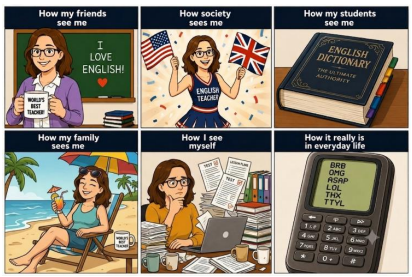
(Adapted from https://br.pinterest.com/pin/48132289740225210/ using AI)
Considering the multimodal construction of this meme, which of the following statements best explains the central critical message conveyed by the image labelled “How it really is in everyday life” in relation to the other five images?

 Conheça nossos planos