Questões de Concurso Público Prefeitura de Nova Palmeira - PB 2025 para Professor de Inglês
Foram encontradas 40 questões


Ano: 2025
Banca:
CPCON
Órgão:
Prefeitura de Nova Palmeira - PB
Provas:
CPCON - 2025 - Prefeitura de Nova Palmeira - PB - Professor de Artes
|
CPCON - 2025 - Prefeitura de Nova Palmeira - PB - Professor de Educação Física |
CPCON - 2025 - Prefeitura de Nova Palmeira - PB - Professor de Geografia |
CPCON - 2025 - Prefeitura de Nova Palmeira - PB - Professor de História |
CPCON - 2025 - Prefeitura de Nova Palmeira - PB - Professor de Inglês |
CPCON - 2025 - Prefeitura de Nova Palmeira - PB - Professor de Matemática |
CPCON - 2025 - Prefeitura de Nova Palmeira - PB - Professor de Português |
CPCON - 2025 - Prefeitura de Nova Palmeira - PB - Professor Polivalente |
CPCON - 2025 - Prefeitura de Nova Palmeira - PB - Psicólogo Educacional |
Q3583226
Pedagogia
Cinco professores de Ciências de uma escola pública foram entrevistados no contexto de uma pesquisa de iniciação científica, cujo
objetivo era compreender como docentes dos Anos Iniciais do Ensino Fundamental planejavam aulas sobre o tema “corpo humano”.
Os resultados indicaram que, entre os entrevistados, apenas um orientava seu planejamento com base em um referencial teórico, a
teoria da aprendizagem significativa de Ausubel.
Com base no contexto apresentado, é CORRETO afirmar que o relato que evidencia explicitamente a fala do entrevistado cujo planejamento era orientado pelo referencial teórico mencionado, é:
Com base no contexto apresentado, é CORRETO afirmar que o relato que evidencia explicitamente a fala do entrevistado cujo planejamento era orientado pelo referencial teórico mencionado, é:
Ano: 2025
Banca:
CPCON
Órgão:
Prefeitura de Nova Palmeira - PB
Provas:
CPCON - 2025 - Prefeitura de Nova Palmeira - PB - Professor de Artes
|
CPCON - 2025 - Prefeitura de Nova Palmeira - PB - Professor de Educação Física |
CPCON - 2025 - Prefeitura de Nova Palmeira - PB - Professor de Geografia |
CPCON - 2025 - Prefeitura de Nova Palmeira - PB - Professor de História |
CPCON - 2025 - Prefeitura de Nova Palmeira - PB - Professor de Inglês |
CPCON - 2025 - Prefeitura de Nova Palmeira - PB - Professor de Matemática |
CPCON - 2025 - Prefeitura de Nova Palmeira - PB - Professor de Português |
CPCON - 2025 - Prefeitura de Nova Palmeira - PB - Professor Polivalente |
CPCON - 2025 - Prefeitura de Nova Palmeira - PB - Psicólogo Educacional |
Q3583227
Pedagogia
“Quando os alunos estão todos organizados e com o livro aberto, iniciamos. Peço a leitura de um deles de forma que eles mesmos
escolham. Ninguém é obrigado a ler. Se lê, ganha um visto; se não lê, não ganha nada, mas também não perde, isto porque tem alunos
mais tímidos... Cada três vistos valem um ponto de participação. Após a leitura, sempre passo uma atividade de reforço. Se faz, ganha
um visto, que também vale pontos para nota. Na aula seguinte, faço a correção. Percebo que alunos se esforçam cada vez mais para
fazer as leituras e realizar as atividades, eles querem ganhar pontos. Por fim, quando dá tempo, começo um outro conteúdo”.
Fonte: ROCHA, D. S. Práticas pedagógicas de professores no ensino de ciências: as metodologias para o tema corpo humano. In: SEMINÁRIO NACIONAL E SEMINÁRIO INTERNACIONAL POLÍTICAS PÚBLICAS, GESTÃO E PRÁXIS EDUCACIONAL, 1., 2024, Salvador. Anais [...]. Salvador: Universidade Estadual do Sudoeste da Bahia, p. 2853-2871, 2024. Adaptado.
A partir desse contexto, à luz da teoria behaviorista de Skinner, avalie as asserções a seguir e a relação entre elas.
I- Os vistos que a professora atribui aos alunos pela realização de tarefas funcionam como reforçadores positivos, aumentando a frequência com que os alunos participam das leituras e executam as atividades. Assim, o aumento da participação dos alunos nas tarefas que valem visto configura uma resposta condicionada.
PORQUE
II- Na teoria de Skinner, é considerado reforçador positivo apenas aqueles eventos ou objetos que vêm após um comportamento e, subsequentemente, aumentam a sua frequência. Assim, diz-se que uma resposta foi condicionada quando seu aumento de frequência está associado a um reforçador positivo sob condições explícitas.
A respeito dessas asserções, assinale a opção CORRETA:
Fonte: ROCHA, D. S. Práticas pedagógicas de professores no ensino de ciências: as metodologias para o tema corpo humano. In: SEMINÁRIO NACIONAL E SEMINÁRIO INTERNACIONAL POLÍTICAS PÚBLICAS, GESTÃO E PRÁXIS EDUCACIONAL, 1., 2024, Salvador. Anais [...]. Salvador: Universidade Estadual do Sudoeste da Bahia, p. 2853-2871, 2024. Adaptado.
A partir desse contexto, à luz da teoria behaviorista de Skinner, avalie as asserções a seguir e a relação entre elas.
I- Os vistos que a professora atribui aos alunos pela realização de tarefas funcionam como reforçadores positivos, aumentando a frequência com que os alunos participam das leituras e executam as atividades. Assim, o aumento da participação dos alunos nas tarefas que valem visto configura uma resposta condicionada.
PORQUE
II- Na teoria de Skinner, é considerado reforçador positivo apenas aqueles eventos ou objetos que vêm após um comportamento e, subsequentemente, aumentam a sua frequência. Assim, diz-se que uma resposta foi condicionada quando seu aumento de frequência está associado a um reforçador positivo sob condições explícitas.
A respeito dessas asserções, assinale a opção CORRETA:
Ano: 2025
Banca:
CPCON
Órgão:
Prefeitura de Nova Palmeira - PB
Provas:
CPCON - 2025 - Prefeitura de Nova Palmeira - PB - Professor de Artes
|
CPCON - 2025 - Prefeitura de Nova Palmeira - PB - Professor de Educação Física |
CPCON - 2025 - Prefeitura de Nova Palmeira - PB - Professor de Geografia |
CPCON - 2025 - Prefeitura de Nova Palmeira - PB - Professor de História |
CPCON - 2025 - Prefeitura de Nova Palmeira - PB - Professor de Inglês |
CPCON - 2025 - Prefeitura de Nova Palmeira - PB - Professor de Matemática |
CPCON - 2025 - Prefeitura de Nova Palmeira - PB - Professor de Português |
CPCON - 2025 - Prefeitura de Nova Palmeira - PB - Professor Polivalente |
CPCON - 2025 - Prefeitura de Nova Palmeira - PB - Psicólogo Educacional |
Q3583228
Pedagogia
Em seu trabalho de mestrado, a professora Roseli propôs um projeto de pesquisa voltado à análise da efetividade de metodologias
associadas às tendências pedagógicas liberal tradicional e liberal renovada progressivista no Ensino Fundamental. O objetivo do
estudo é identificar qual dessas abordagens apresenta maior eficácia junto a estudantes desse nível de ensino, com foco específico em
turmas de escolas públicas. Para isso, dois grupos foram estruturados:
1) Turma controle: metodologia de ensino fundamentada na perspectiva liberal tradicional;
2) Turma de trabalho: metodologia de ensino alinhada à vertente renovada progressivista.
A partir desse contexto, à luz da discussão de Libâneo sobre as tendências pedagógicas na prática escolar, analise as assertivas a seguir.
I- Nas duas turmas, o professor terá o papel de apoiar o desenvolvimento livre e espontâneo dos alunos, atuando como um guia no processo de aprendizagem. Ele vai orientar e ajudar a organizar o raciocínio dos estudantes, mantendo a aprendizagem centrada neles.
II- Na turma controle, a aula será principalmente expositiva, usando o livro didático e o quadro para apresentar os conteúdos de forma verbal. O foco estará na realização de exercícios e na repetição dos conceitos, com o objetivo de reforçar a aprendizagem.
III- Na turma de trabalho, a aula será prática e participativa, estimulando a interação dos alunos enquanto aprendem fazendo. Para manter coerência com a abordagem escolhida para essa turma, serão usados métodos de resolução de problemas.
IV- Usar uma metodologia de ensino baseada na psicologia genética de Jean Piaget é coerente com a perspectiva pedagógica adotada na turma de trabalho.
É CORRETO o que se afirma apenas em:
1) Turma controle: metodologia de ensino fundamentada na perspectiva liberal tradicional;
2) Turma de trabalho: metodologia de ensino alinhada à vertente renovada progressivista.
A partir desse contexto, à luz da discussão de Libâneo sobre as tendências pedagógicas na prática escolar, analise as assertivas a seguir.
I- Nas duas turmas, o professor terá o papel de apoiar o desenvolvimento livre e espontâneo dos alunos, atuando como um guia no processo de aprendizagem. Ele vai orientar e ajudar a organizar o raciocínio dos estudantes, mantendo a aprendizagem centrada neles.
II- Na turma controle, a aula será principalmente expositiva, usando o livro didático e o quadro para apresentar os conteúdos de forma verbal. O foco estará na realização de exercícios e na repetição dos conceitos, com o objetivo de reforçar a aprendizagem.
III- Na turma de trabalho, a aula será prática e participativa, estimulando a interação dos alunos enquanto aprendem fazendo. Para manter coerência com a abordagem escolhida para essa turma, serão usados métodos de resolução de problemas.
IV- Usar uma metodologia de ensino baseada na psicologia genética de Jean Piaget é coerente com a perspectiva pedagógica adotada na turma de trabalho.
É CORRETO o que se afirma apenas em:
Ano: 2025
Banca:
CPCON
Órgão:
Prefeitura de Nova Palmeira - PB
Provas:
CPCON - 2025 - Prefeitura de Nova Palmeira - PB - Professor de Artes
|
CPCON - 2025 - Prefeitura de Nova Palmeira - PB - Professor de Educação Física |
CPCON - 2025 - Prefeitura de Nova Palmeira - PB - Professor de Geografia |
CPCON - 2025 - Prefeitura de Nova Palmeira - PB - Professor de História |
CPCON - 2025 - Prefeitura de Nova Palmeira - PB - Professor de Inglês |
CPCON - 2025 - Prefeitura de Nova Palmeira - PB - Professor de Matemática |
CPCON - 2025 - Prefeitura de Nova Palmeira - PB - Professor de Português |
CPCON - 2025 - Prefeitura de Nova Palmeira - PB - Professor Polivalente |
CPCON - 2025 - Prefeitura de Nova Palmeira - PB - Psicólogo Educacional |
Q3583229
Pedagogia
Ao longo do tempo, uma unidade de ensino dedicada à Educação de Jovens e Adultos incorporou três tendências pedagógicas distintas,
conforme as necessidades educacionais identificadas. Cada uma contribuiu para a construção do currículo e para a forma de abordar os
conteúdos de ensino na prática educativa, conforme indicado abaixo:
· 1ª Tendência: Os conteúdos de ensino são separados da experiência do estudante e das realidades sociais, valendo pelo valor intelectual. Desse modo, são os conhecimentos e valores acumulados na sociedade pelas gerações adultas e repassados para os estudantes como verdades.
· 2ª Tendência: Os conteúdos de ensino são estabelecidos em função de experiências que o sujeito vivencia diante de desafios cognitivos e situações problemáticas. É mais importante o processo de aquisição do saber do que o saber propriamente dito.
· 3ª Tendência: Os conteúdos de ensino são denominados de temas geradores, extraídos da problematização da prática de vida dos estudantes. A transmissão de conteúdos estruturados a partir de fora é considerada como invasão cultural ou depósito de informação.
A partir desse contexto, à luz das tendências pedagógicas conforme discutido por Libâneo, é CORRETO afirmar que as três tendências pedagógicas adotadas pela unidade de ensino correspondem, respectivamente às seguintes:
· 1ª Tendência: Os conteúdos de ensino são separados da experiência do estudante e das realidades sociais, valendo pelo valor intelectual. Desse modo, são os conhecimentos e valores acumulados na sociedade pelas gerações adultas e repassados para os estudantes como verdades.
· 2ª Tendência: Os conteúdos de ensino são estabelecidos em função de experiências que o sujeito vivencia diante de desafios cognitivos e situações problemáticas. É mais importante o processo de aquisição do saber do que o saber propriamente dito.
· 3ª Tendência: Os conteúdos de ensino são denominados de temas geradores, extraídos da problematização da prática de vida dos estudantes. A transmissão de conteúdos estruturados a partir de fora é considerada como invasão cultural ou depósito de informação.
A partir desse contexto, à luz das tendências pedagógicas conforme discutido por Libâneo, é CORRETO afirmar que as três tendências pedagógicas adotadas pela unidade de ensino correspondem, respectivamente às seguintes:
Ano: 2025
Banca:
CPCON
Órgão:
Prefeitura de Nova Palmeira - PB
Provas:
CPCON - 2025 - Prefeitura de Nova Palmeira - PB - Professor de Artes
|
CPCON - 2025 - Prefeitura de Nova Palmeira - PB - Professor de Educação Física |
CPCON - 2025 - Prefeitura de Nova Palmeira - PB - Professor de Geografia |
CPCON - 2025 - Prefeitura de Nova Palmeira - PB - Professor de História |
CPCON - 2025 - Prefeitura de Nova Palmeira - PB - Professor de Inglês |
CPCON - 2025 - Prefeitura de Nova Palmeira - PB - Professor de Matemática |
CPCON - 2025 - Prefeitura de Nova Palmeira - PB - Professor de Português |
CPCON - 2025 - Prefeitura de Nova Palmeira - PB - Professor Polivalente |
CPCON - 2025 - Prefeitura de Nova Palmeira - PB - Psicólogo Educacional |
Q3583230
Pedagogia
Considere os aspectos relacionados às metas 1 e 2, descritas abaixo, referentes ao Plano Nacional de Educação (PNE), instituído pela
Lei nº 13.005, de 2014, que estabelece diretrizes e metas para a educação no Brasil:
· Meta 1: Universalizar a etapa obrigatória da educação infantil até 2016.
· Meta 2: Universalizar o Ensino Fundamental regular de 9 (nove) anos até 2024.
O gráfico abaixo apresenta a taxa de escolarização no Brasil, por faixa etária, com base nos dados da Pesquisa Nacional por Amostra de Domicílios Contínua – Educação, referente ao período de 2016 a 2023.
Gráfico 1 – Taxa de escolarização, segundo os grupos de idade (%)
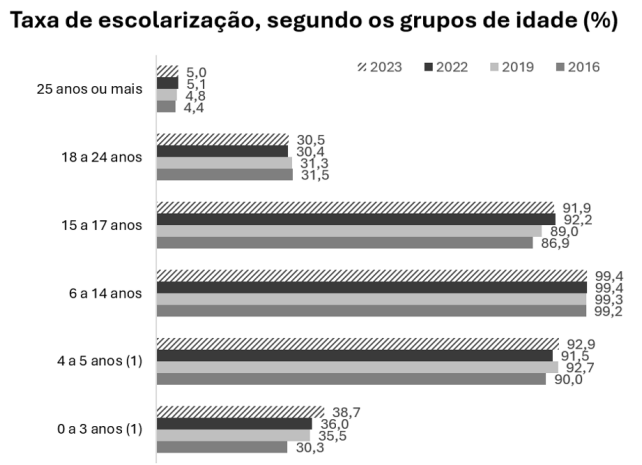
Fonte: Adaptado por CPCON de IBGE, Diretoria de Pesquisas, Coordenação de Pesquisas por Amostra de Domicílios, Pesquisa Nacional por Amostra de Domicílios Contínua 2016/2023. (1) As diferenças entre 2022 e 2023 são significativas ao nível de confiança de 95%.
A partir deste contexto, marque a alternativa CORRETA.
· Meta 1: Universalizar a etapa obrigatória da educação infantil até 2016.
· Meta 2: Universalizar o Ensino Fundamental regular de 9 (nove) anos até 2024.
O gráfico abaixo apresenta a taxa de escolarização no Brasil, por faixa etária, com base nos dados da Pesquisa Nacional por Amostra de Domicílios Contínua – Educação, referente ao período de 2016 a 2023.
Gráfico 1 – Taxa de escolarização, segundo os grupos de idade (%)
Fonte: Adaptado por CPCON de IBGE, Diretoria de Pesquisas, Coordenação de Pesquisas por Amostra de Domicílios, Pesquisa Nacional por Amostra de Domicílios Contínua 2016/2023. (1) As diferenças entre 2022 e 2023 são significativas ao nível de confiança de 95%.
A partir deste contexto, marque a alternativa CORRETA.
Ano: 2025
Banca:
CPCON
Órgão:
Prefeitura de Nova Palmeira - PB
Prova:
CPCON - 2025 - Prefeitura de Nova Palmeira - PB - Professor de Inglês |
Q3583506
Inglês
Texto associado
Text 1
Teenage girls face dangers online - Internet - Brief
Article
When it comes to the Internet, teenage girls are extremely computer-savvy, but also emotionally vulnerable and disturbed by
how frequently they are exposed to sexual content online, according to a study from the Girl Scout Research Institute (GSRI),
conducted with the assistance of Girl Games, Inc.
Computer-savvy girls are considered "smart," "fun," and "social" by those in the study, and most agree that girls who do not
spend time on the computer risk being regarded as unqualified for good jobs in the future. Girls use the Internet as an outlet to express
intense emotions and build social self-confidence, and said they find their online experiences mainly positive, empowering, and safe.
However, the study found that sometimes they rely too much on their own judgment in making decisions about how to behave
online. When asked how they know what is safe or unsafe behavior on the Internet, 84% cited their own common sense; 51% stated
learning from parents; and four percent said "nothing is that bad online because it's not really real." (Multiple responses were
permitted.) Unfortunately for some teenage girls, common sense does not always protect them. The Net Effect found that:
· Thirty percent of online respondents reported that they had been sexually harassed in a chat room.
· Only seven percent informed their mothers or fathers about the harassment, most fearing their parents would overreact and
ban them from computer usage altogether.
· Most girls try to avoid pornographic sites, calling them "disturbing," but say they are frequently spammed or end up on these
sites accidentally.
· Some fail to see online crime as serious because it is in the realm of cyberspace.
"Girls are extremely aware of Internet dangers, but feel that parents underestimate their level of awareness about online risks,"
explains Whitney Roban, lead researcher of the study. She cites girls' desire for adults fully to understand their online lives as one of the
key findings: "Girls want to continue to enjoy the benefits of the Internet, and they want to do it safely."
Girls concede that they think they can do many inappropriate things online without their parents' knowledge. Eighty-six percent
said they could chat in a chat room with parents' knowledge; 57% could read parents' e-mail; and 54% could carry on a cyber affair.
While girls report rarely entering into cyber romances, they often think about cyber relationships. They usually don't discuss these
feelings with parents because they sense they won't be understood. At the same time, most girls think they are "too smart" to do bad
things, but feel that they deserve more trust from their parents.
From: http://findarticles.com/p/articles/mi_m1272/is_2685_130/ai_87706330/Accessed May 18, 2011.
According to the study conducted by the Girl Scout Research Institute (GSRI), what do teenage girls primarily rely on to determine safe
behavior on the Internet?
Ano: 2025
Banca:
CPCON
Órgão:
Prefeitura de Nova Palmeira - PB
Prova:
CPCON - 2025 - Prefeitura de Nova Palmeira - PB - Professor de Inglês |
Q3583507
Inglês
Texto associado
Text 1
Teenage girls face dangers online - Internet - Brief
Article
When it comes to the Internet, teenage girls are extremely computer-savvy, but also emotionally vulnerable and disturbed by
how frequently they are exposed to sexual content online, according to a study from the Girl Scout Research Institute (GSRI),
conducted with the assistance of Girl Games, Inc.
Computer-savvy girls are considered "smart," "fun," and "social" by those in the study, and most agree that girls who do not
spend time on the computer risk being regarded as unqualified for good jobs in the future. Girls use the Internet as an outlet to express
intense emotions and build social self-confidence, and said they find their online experiences mainly positive, empowering, and safe.
However, the study found that sometimes they rely too much on their own judgment in making decisions about how to behave
online. When asked how they know what is safe or unsafe behavior on the Internet, 84% cited their own common sense; 51% stated
learning from parents; and four percent said "nothing is that bad online because it's not really real." (Multiple responses were
permitted.) Unfortunately for some teenage girls, common sense does not always protect them. The Net Effect found that:
· Thirty percent of online respondents reported that they had been sexually harassed in a chat room.
· Only seven percent informed their mothers or fathers about the harassment, most fearing their parents would overreact and
ban them from computer usage altogether.
· Most girls try to avoid pornographic sites, calling them "disturbing," but say they are frequently spammed or end up on these
sites accidentally.
· Some fail to see online crime as serious because it is in the realm of cyberspace.
"Girls are extremely aware of Internet dangers, but feel that parents underestimate their level of awareness about online risks,"
explains Whitney Roban, lead researcher of the study. She cites girls' desire for adults fully to understand their online lives as one of the
key findings: "Girls want to continue to enjoy the benefits of the Internet, and they want to do it safely."
Girls concede that they think they can do many inappropriate things online without their parents' knowledge. Eighty-six percent
said they could chat in a chat room with parents' knowledge; 57% could read parents' e-mail; and 54% could carry on a cyber affair.
While girls report rarely entering into cyber romances, they often think about cyber relationships. They usually don't discuss these
feelings with parents because they sense they won't be understood. At the same time, most girls think they are "too smart" to do bad
things, but feel that they deserve more trust from their parents.
From: http://findarticles.com/p/articles/mi_m1272/is_2685_130/ai_87706330/Accessed May 18, 2011.
What is one of the main reasons why teenage girls avoid reporting incidents of online harassment to their parents, according to the
study?
Ano: 2025
Banca:
CPCON
Órgão:
Prefeitura de Nova Palmeira - PB
Prova:
CPCON - 2025 - Prefeitura de Nova Palmeira - PB - Professor de Inglês |
Q3583508
Inglês
Texto associado
Text 1
Teenage girls face dangers online - Internet - Brief
Article
When it comes to the Internet, teenage girls are extremely computer-savvy, but also emotionally vulnerable and disturbed by
how frequently they are exposed to sexual content online, according to a study from the Girl Scout Research Institute (GSRI),
conducted with the assistance of Girl Games, Inc.
Computer-savvy girls are considered "smart," "fun," and "social" by those in the study, and most agree that girls who do not
spend time on the computer risk being regarded as unqualified for good jobs in the future. Girls use the Internet as an outlet to express
intense emotions and build social self-confidence, and said they find their online experiences mainly positive, empowering, and safe.
However, the study found that sometimes they rely too much on their own judgment in making decisions about how to behave
online. When asked how they know what is safe or unsafe behavior on the Internet, 84% cited their own common sense; 51% stated
learning from parents; and four percent said "nothing is that bad online because it's not really real." (Multiple responses were
permitted.) Unfortunately for some teenage girls, common sense does not always protect them. The Net Effect found that:
· Thirty percent of online respondents reported that they had been sexually harassed in a chat room.
· Only seven percent informed their mothers or fathers about the harassment, most fearing their parents would overreact and
ban them from computer usage altogether.
· Most girls try to avoid pornographic sites, calling them "disturbing," but say they are frequently spammed or end up on these
sites accidentally.
· Some fail to see online crime as serious because it is in the realm of cyberspace.
"Girls are extremely aware of Internet dangers, but feel that parents underestimate their level of awareness about online risks,"
explains Whitney Roban, lead researcher of the study. She cites girls' desire for adults fully to understand their online lives as one of the
key findings: "Girls want to continue to enjoy the benefits of the Internet, and they want to do it safely."
Girls concede that they think they can do many inappropriate things online without their parents' knowledge. Eighty-six percent
said they could chat in a chat room with parents' knowledge; 57% could read parents' e-mail; and 54% could carry on a cyber affair.
While girls report rarely entering into cyber romances, they often think about cyber relationships. They usually don't discuss these
feelings with parents because they sense they won't be understood. At the same time, most girls think they are "too smart" to do bad
things, but feel that they deserve more trust from their parents.
From: http://findarticles.com/p/articles/mi_m1272/is_2685_130/ai_87706330/Accessed May 18, 2011.
Which of the following sentences contains a correct word formation based on the original word found in the text?
Ano: 2025
Banca:
CPCON
Órgão:
Prefeitura de Nova Palmeira - PB
Prova:
CPCON - 2025 - Prefeitura de Nova Palmeira - PB - Professor de Inglês |
Q3583509
Inglês
Texto associado
Text 1
Teenage girls face dangers online - Internet - Brief
Article
When it comes to the Internet, teenage girls are extremely computer-savvy, but also emotionally vulnerable and disturbed by
how frequently they are exposed to sexual content online, according to a study from the Girl Scout Research Institute (GSRI),
conducted with the assistance of Girl Games, Inc.
Computer-savvy girls are considered "smart," "fun," and "social" by those in the study, and most agree that girls who do not
spend time on the computer risk being regarded as unqualified for good jobs in the future. Girls use the Internet as an outlet to express
intense emotions and build social self-confidence, and said they find their online experiences mainly positive, empowering, and safe.
However, the study found that sometimes they rely too much on their own judgment in making decisions about how to behave
online. When asked how they know what is safe or unsafe behavior on the Internet, 84% cited their own common sense; 51% stated
learning from parents; and four percent said "nothing is that bad online because it's not really real." (Multiple responses were
permitted.) Unfortunately for some teenage girls, common sense does not always protect them. The Net Effect found that:
· Thirty percent of online respondents reported that they had been sexually harassed in a chat room.
· Only seven percent informed their mothers or fathers about the harassment, most fearing their parents would overreact and
ban them from computer usage altogether.
· Most girls try to avoid pornographic sites, calling them "disturbing," but say they are frequently spammed or end up on these
sites accidentally.
· Some fail to see online crime as serious because it is in the realm of cyberspace.
"Girls are extremely aware of Internet dangers, but feel that parents underestimate their level of awareness about online risks,"
explains Whitney Roban, lead researcher of the study. She cites girls' desire for adults fully to understand their online lives as one of the
key findings: "Girls want to continue to enjoy the benefits of the Internet, and they want to do it safely."
Girls concede that they think they can do many inappropriate things online without their parents' knowledge. Eighty-six percent
said they could chat in a chat room with parents' knowledge; 57% could read parents' e-mail; and 54% could carry on a cyber affair.
While girls report rarely entering into cyber romances, they often think about cyber relationships. They usually don't discuss these
feelings with parents because they sense they won't be understood. At the same time, most girls think they are "too smart" to do bad
things, but feel that they deserve more trust from their parents.
From: http://findarticles.com/p/articles/mi_m1272/is_2685_130/ai_87706330/Accessed May 18, 2011.
In the provided text, which word can be considered a synonym for "underestimate"?
Ano: 2025
Banca:
CPCON
Órgão:
Prefeitura de Nova Palmeira - PB
Prova:
CPCON - 2025 - Prefeitura de Nova Palmeira - PB - Professor de Inglês |
Q3583510
Pedagogia
Which of the following alternatives shows the primary role of the English language in the Brazilian National Common Curricular Base
(BNCC)?
Ano: 2025
Banca:
CPCON
Órgão:
Prefeitura de Nova Palmeira - PB
Prova:
CPCON - 2025 - Prefeitura de Nova Palmeira - PB - Professor de Inglês |
Q3583511
Inglês
Which of the following sentences is an example of the passive voice?
Ano: 2025
Banca:
CPCON
Órgão:
Prefeitura de Nova Palmeira - PB
Prova:
CPCON - 2025 - Prefeitura de Nova Palmeira - PB - Professor de Inglês |
Q3583512
Inglês
Which of the following sentences demonstrates a correct use of a gradual comparative structure?
Ano: 2025
Banca:
CPCON
Órgão:
Prefeitura de Nova Palmeira - PB
Prova:
CPCON - 2025 - Prefeitura de Nova Palmeira - PB - Professor de Inglês |
Q3583513
Inglês

Garfield, Jim Davis 2011 Paws, Incall Rights Reserved / Dist Universal Ucuck
In the comic strip, what is the main point being humorously highlighted by Garfield's reaction in the last panel?
Ano: 2025
Banca:
CPCON
Órgão:
Prefeitura de Nova Palmeira - PB
Prova:
CPCON - 2025 - Prefeitura de Nova Palmeira - PB - Professor de Inglês |
Q3583514
Inglês
In the sentence "She had studied for hours; nevertheless, she still found the test extremely difficult," what is the function of the linking
word "nevertheless"?
Ano: 2025
Banca:
CPCON
Órgão:
Prefeitura de Nova Palmeira - PB
Prova:
CPCON - 2025 - Prefeitura de Nova Palmeira - PB - Professor de Inglês |
Q3583515
Inglês
In the sentence "Each student must bring their own laptop to the seminar," which determinant is used, and what does it convey?
Ano: 2025
Banca:
CPCON
Órgão:
Prefeitura de Nova Palmeira - PB
Prova:
CPCON - 2025 - Prefeitura de Nova Palmeira - PB - Professor de Inglês |
Q3583516
Inglês
In the sentence "Had she known about the meeting, she would have attended it," which aspect of the verb structure is demonstrated?
Ano: 2025
Banca:
CPCON
Órgão:
Prefeitura de Nova Palmeira - PB
Prova:
CPCON - 2025 - Prefeitura de Nova Palmeira - PB - Professor de Inglês |
Q3583517
Inglês
In the sentence "The quick brown fox jumped over the lazy dog," which type of noun structure is primarily used?
Ano: 2025
Banca:
CPCON
Órgão:
Prefeitura de Nova Palmeira - PB
Prova:
CPCON - 2025 - Prefeitura de Nova Palmeira - PB - Professor de Inglês |
Q3583518
Linguística
In the context of linguistic variation in English language teaching, which approach best supports the understanding and appreciation of
dialectal differences among learners?
Ano: 2025
Banca:
CPCON
Órgão:
Prefeitura de Nova Palmeira - PB
Prova:
CPCON - 2025 - Prefeitura de Nova Palmeira - PB - Professor de Inglês |
Q3583519
Inglês
Researchers say they have found the likely time in history when human beings first began to speak. Dr Steven Mithen, an
archaeologist and expert in prehistory, suggested that basic language was formed around 1.6 million years ago. This is eight times
earlier than many scientists thought. Experts in evolution previously believed that spoken human language began around 200,000
years ago. Mithen said his studies show that the first human language developed either in eastern or southern Africa. He said the ability
to speak helped evolution. He said speech was, "without doubt, the key which made much of subsequent human physical and cultural
evolution possible".
Dr Mithen explains how he believes human speech developed so long ago in his new book called, "The Language Puzzle". He says our brain quickly increased in size just over 1.5 million years ago. This increase changed the structure of our brain. An area called the frontal lobe developed. This is the part of the brain that produces language. Another important change was the development of our vocal tract. This is where we produce sound, and therefore speech. Mithen said speech allowed humans to spread around the world. It meant humans could do three important things. They could think of and plan future actions, and they could pass on knowledge. Mithen said language "changed the human story profoundly".
https://www.independent.co.uk/news/science/archaeology/human-language-study-origins-speaking-b2514451.html
https://uk.news.yahoo.com/celebrity/humans-speaking-lot-longer-originally-145649872.html
https://sciworthy.com/how-did-humans-learn-to-speak/
According to Dr. Steven Mithen, what was the most significant consequence of the development of human speech for early humans?
Dr Mithen explains how he believes human speech developed so long ago in his new book called, "The Language Puzzle". He says our brain quickly increased in size just over 1.5 million years ago. This increase changed the structure of our brain. An area called the frontal lobe developed. This is the part of the brain that produces language. Another important change was the development of our vocal tract. This is where we produce sound, and therefore speech. Mithen said speech allowed humans to spread around the world. It meant humans could do three important things. They could think of and plan future actions, and they could pass on knowledge. Mithen said language "changed the human story profoundly".
https://www.independent.co.uk/news/science/archaeology/human-language-study-origins-speaking-b2514451.html
https://uk.news.yahoo.com/celebrity/humans-speaking-lot-longer-originally-145649872.html
https://sciworthy.com/how-did-humans-learn-to-speak/
According to Dr. Steven Mithen, what was the most significant consequence of the development of human speech for early humans?
Ano: 2025
Banca:
CPCON
Órgão:
Prefeitura de Nova Palmeira - PB
Prova:
CPCON - 2025 - Prefeitura de Nova Palmeira - PB - Professor de Inglês |
Q3583520
Inglês
New Technologies in the English Language Classroom
The integration of new technologies in English language classrooms has revolutionized teaching and learning processes, enabling more interactive and engaging lessons. Digital tools such as language-learning apps, interactive whiteboards, and online resources provide students with diverse and flexible opportunities to practice English both in and out of the classroom. According to Warschauer and Healey (1998), these resources help accommodate different learning styles and needs, facilitating student-centered learning that encourages autonomy and active engagement with the language. Furthermore, teachers can tailor their materials to be more relevant and accessible, enhancing students' motivation and interest in language acquisition.
Another significant advancement is the use of artificial intelligence (AI) and adaptive learning platforms, which can analyze students' progress and tailor activities accordingly. Platforms like Duolingo and Babbel utilize algorithms to personalize lessons based on individual performance, ensuring that students are consistently challenged at the right level (Godwin-Jones, 2019). This targeted approach allows students to improve at their own pace, addressing specific weaknesses and reinforcing strengths. Moreover, virtual and augmented reality technologies are increasingly employed to create immersive language experiences. By simulating real-life situations, these tools enable students to practice language skills in authentic contexts, which helps increase their confidence and fluency.
Finally , new technologies also enable a global approach to language learning, connecting students with peers and native speakers worldwide through video conferencing and social media. Platforms like Zoom and Skype allow students to engage in live conversations, enhancing their listening and speaking skills in real-time. According to Sykes et al. (2008), such interactions promote intercultural understanding and give students a practical application for their language skills, which can increase both their motivation and proficiency. As technology continues to evolve, its role in English language classrooms will undoubtedly expand, fostering an environment where students can learn more effectively and creatively. Godwin-Jones, R. (2019). Emerging Technologies: The Evolution and Impact of Language-Learning Apps. *Language Learning & Technology*, 23(2), 5–17. Sykes, J. M., Oskoz, A., & Thorne, S. L. (2008). Web 2.0, Synthetic Immersive Environments, and the Future of Language Education. *CALICO Journal*, 25(3), 528–546.
Warschauer, M., & Healey, D. (1998). Computers and Language Learning: An Overview. *Language Teaching*, 31(2), 57–71.
According to the text, how do artificial intelligence (AI) and adaptive learning platforms contribute to the learning process in English language classrooms?
The integration of new technologies in English language classrooms has revolutionized teaching and learning processes, enabling more interactive and engaging lessons. Digital tools such as language-learning apps, interactive whiteboards, and online resources provide students with diverse and flexible opportunities to practice English both in and out of the classroom. According to Warschauer and Healey (1998), these resources help accommodate different learning styles and needs, facilitating student-centered learning that encourages autonomy and active engagement with the language. Furthermore, teachers can tailor their materials to be more relevant and accessible, enhancing students' motivation and interest in language acquisition.
Another significant advancement is the use of artificial intelligence (AI) and adaptive learning platforms, which can analyze students' progress and tailor activities accordingly. Platforms like Duolingo and Babbel utilize algorithms to personalize lessons based on individual performance, ensuring that students are consistently challenged at the right level (Godwin-Jones, 2019). This targeted approach allows students to improve at their own pace, addressing specific weaknesses and reinforcing strengths. Moreover, virtual and augmented reality technologies are increasingly employed to create immersive language experiences. By simulating real-life situations, these tools enable students to practice language skills in authentic contexts, which helps increase their confidence and fluency.
Finally , new technologies also enable a global approach to language learning, connecting students with peers and native speakers worldwide through video conferencing and social media. Platforms like Zoom and Skype allow students to engage in live conversations, enhancing their listening and speaking skills in real-time. According to Sykes et al. (2008), such interactions promote intercultural understanding and give students a practical application for their language skills, which can increase both their motivation and proficiency. As technology continues to evolve, its role in English language classrooms will undoubtedly expand, fostering an environment where students can learn more effectively and creatively. Godwin-Jones, R. (2019). Emerging Technologies: The Evolution and Impact of Language-Learning Apps. *Language Learning & Technology*, 23(2), 5–17. Sykes, J. M., Oskoz, A., & Thorne, S. L. (2008). Web 2.0, Synthetic Immersive Environments, and the Future of Language Education. *CALICO Journal*, 25(3), 528–546.
Warschauer, M., & Healey, D. (1998). Computers and Language Learning: An Overview. *Language Teaching*, 31(2), 57–71.
According to the text, how do artificial intelligence (AI) and adaptive learning platforms contribute to the learning process in English language classrooms?

 Conheça nossos planos