Questões de Concurso Público Prefeitura de Tavares - PB 2022 para Professor II - Língua Estrangeira/Inglês
Foram encontradas 40 questões


De acordo com o Art. 23 da Lei de Diretrizes e Bases da Educação Nacional (LDB 9394/96), “a educação básica poderá organizar-se em séries anuais, períodos semestrais, ciclos, alternância regular de períodos de estudos, grupos não-seriados, com base na idade, na competência e em outros critérios, ou por forma diversa de organização, sempre que o interesse do processo de aprendizagem assim o recomendar.” Faz parte da educação básica: a Educação Infantil, o Ensino Fundamental e o Ensino Médio. Levando em consideração o que determina a LDB, observe as regras da segunda coluna e relacione-as com cada etapa da educação básica.
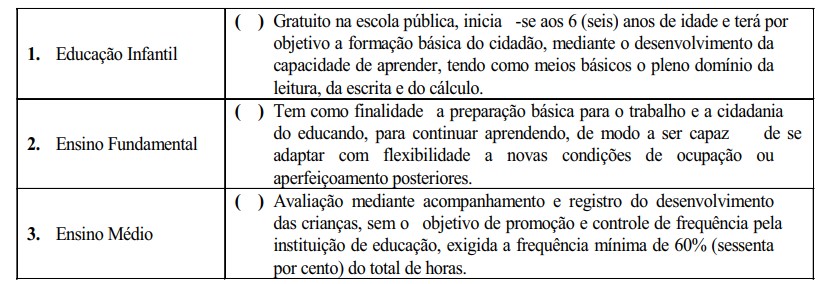
A sequência CORRETA dessa associação é:
A Emenda Constitucional nº 108/2020 altera a Constituição Federal para estabelecer critérios de distribuição da cota municipal do Imposto sobre Operações Relativas à Circulação de Mercadorias e sobre Prestações de Serviços de Transporte Interestadual e Intermunicipal e de Comunicação (ICMS), para disciplinar a disponibilização de dados contábeis pelos entes federados, para tratar do planejamento na ordem social e para dispor sobre o Fundo de Manutenção e Desenvolvimento da Educação Básica e de Valorização dos Profissionais da Educação (Fundeb); altera o Ato das Disposições Constitucionais Transitórias e dá outras providências. Analise as proposições e coloque (V) para verdadeiro e (F) para falso, em relação ao que preconiza a Emenda Constitucional nº 108/2020:
( ) Os Estados, o Distrito Federal e os Municípios destinarão parte dos recursos a que se refere o caput do art. 212 desta Constituição à manutenção e ao desenvolvimento do ensino na educação básica e à remuneração condigna de seus profissionais.
( ) A distribuição dos recursos e de responsabilidades entre o Distrito Federal, os Estados e seus Municípios é assegurada mediante a instituição, no âmbito de cada Estado e do Distrito Federal, de um Fundo de Manutenção e Desenvolvimento da Educação Básica e de Valorização dos Profissionais da Educação (Fundeb), de natureza contábil.
( ) Os fundos referidos no inciso I do caput deste artigo serão constituídos por 20% (vinte por cento) dos recursos a que se referem os incisos I, II e III do caput do art. 155, o inciso II do caput do art. 157, os incisos II, III e IV do caput do art. 158, as alíneas "a" e "b" do inciso I e o inciso II do caput do art. 159 desta Constituição.
( ) Os recursos referidos no inciso II do caput deste artigo serão distribuídos entre cada Estado e seus Municípios de forma igualitária, independentemente do número de alunos das diversas etapas e modalidades da educação básica presencial matriculados nas respectivas redes.
Marque a alternativa que contém a sequência CORRETA de preenchimentos dos parênteses:
O Plano Nacional de Educação (PNE), com vigência entre 2014 e 2024, constitui um documento que define compromissos colaborativos entre os entes federativos e diversas instituições pelo avanço da educação brasileira. A agenda contemporânea de políticas públicas educacionais encontra no PNE uma referência para a construção e acompanhamento dos planos de educação estaduais e municipais, o que o caracteriza como uma política orientadora para ações governamentais em todos os níveis federativos e impõe ao seu acompanhamento um alto grau de complexidade. Dentre outras, são metas do PNE:
I- universalizar, até 2016, a educação infantil na pré-escola para as crianças de 4 (quatro) a 5 (cinco) anos de idade e ampliar a oferta de educação infantil em creches, de forma a atender, no mínimo, 50% (cinquenta por cento) das crianças de até 3 (três) anos até o final da vigência deste PNE.
II- universalizar o ensino fundamental de 9 (nove) anos para toda a população de 6 (seis) a 14 (quatorze) anos e garantir que pelo menos 95% (noventa e cinco por cento) dos alunos concluam essa etapa na idade recomendada, até o último ano de vigência deste PNE.
III- oferecer educação em tempo integral em, no mínimo, 50% (cinquenta por cento) das escolas públicas, de forma a atender, pelo menos, 25% (vinte e cinco por cento) dos(as) alunos(as) da educação básica.
A alternativa que responde CORRETAMENTE é:
A Base Nacional Comum Curricular (BNCC) é um documento de caráter normativo que define o conjunto orgânico e progressivo de aprendizagens essenciais que todos os alunos devem desenvolver ao longo das etapas e modalidades da Educação Básica, de modo a que tenham assegurados seus direitos de aprendizagem e desenvolvimento, em conformidade com o que preceitua o Plano Nacional de Educação (PNE). Na BNCC, a área de Linguagens é composta pelos seguintes componentes curriculares: Língua Portuguesa, Arte, Educação Física e, no Ensino Fundamental – Anos Finais, Língua Inglesa. A finalidade é possibilitar aos estudantes participar de práticas de linguagem diversificadas, que lhes permitam ampliar suas capacidades expressivas em manifestações artísticas, corporais e linguísticas, como também seus conhecimentos sobre essas linguagens, em continuidade às experiências vividas na Educação Infantil.
De acordo com esse documento, a área de Linguagens deve garantir aos alunos o desenvolvimento de competências específicas.
Analise as proposições e coloque (V) para verdadeiro e (F) para falso, em relação a algumas dessas competências previstas na BNCC:
( ) Utilizar diferentes linguagens – verbal (oral ou visual-motora, como Libras, e escrita), corporal, visual, sonora e digital –, para se expressar e partilhar informações, experiências, ideias e sentimentos em diferentes contextos e produzir sentidos que levem ao diálogo, à resolução de conflitos e à cooperação.
( ) Compreender e utilizar tecnologias digitais de informação e comunicação de forma crítica, significativa, reflexiva e ética nas diversas práticas sociais (incluindo as escolares), para se comunicar por meio das diferentes linguagens e mídias, produzir conhecimentos, resolver problemas e desenvolver projetos autorais e coletivos.
( ) Conhecer e explorar diversas práticas de linguagem (artísticas, corporais e linguísticas) em diferentes campos da atividade humana para continuar aprendendo, ampliar suas possibilidades de participação na vida social e colaborar para a construção de uma sociedade excludente e antidemocrática.
Marque a alternativa que contém a sequência CORRETA de preenchimentos dos parênteses.
De acordo com Oliveira (2013), a interdisciplinaridade começou a ser abordada no Brasil a partir da Lei Nº 5.692/71. Desde então, sua presença no cenário educacional brasileiro tem se tornado mais presente e, mais ainda, com a nova Lei de Diretrizes e Bases Nº 9.394/96 e com os Parâmetros Curriculares Nacionais. Além da sua grande influência na legislação e nas propostas curriculares, a interdisciplinaridade tornou-se cada vez mais presente no discurso e na prática de professores. Sobre interdisciplinaridade, podemos afirmar que:
I- Autilização da interdisciplinaridade como forma de desenvolver um trabalho de integração dos conteúdos de uma disciplina com outras áreas de conhecimento é uma proposta que contribui para o aprendizado do aluno.
II- É possível a interação entre disciplinas aparentemente distintas. Esta interação é uma maneira complementar ou suplementar que possibilita a formulação de um saber crítico-reflexivo deve ser valorizado cada vez no processo de ensino-aprendizado.
III- Trabalhar nessa perspectiva exige uma postura do professor que vai além do que está descrito nos documentos oficiais, pois é necessário que ele assuma uma atitude exógena e que faça uso de metodologias didáticas iguais para todos os alunos, sem distinção.
A alternativa que responde CORRETAMENTE é:
TEXT I –
The crisis of the new coronavirus made access to education difficult for black and poor students. In English teaching, it is necessary to consider issues that have already distanced this group from learning the language, such as: difficulty in accessing technology, lack of monitoring by a family member, black girls and housework and representativeness in English teaching.
Newsroom11 / Nov. 2021
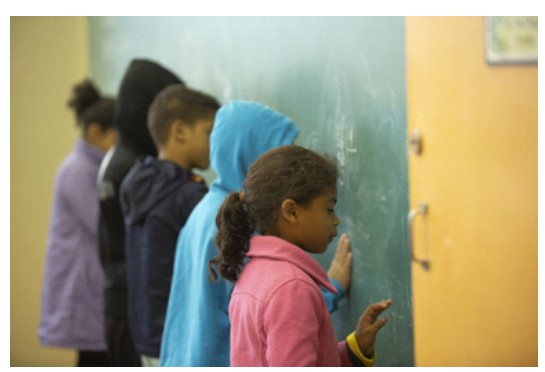
If inequality was already a reality in Brazilian education, in 2020, due to the Covid-19 pandemic — with closed schools and the adoption of remote education — the situation worsened even more. The report by the United Nations Children's Fund (UNICEF), “Scenarios of School Exclusion in Brazil”, points out that, at the end of 2020, more than 5 million Brazilian students aged 6 to 17 were without access to schools.
Of this total, more than 40% were represented by children aged 6 to 10 years, an age group in which education was almost universal in the country before the crisis of the new coronavirus. In this scenario, young people from poor, black, brown and indigenous families were the most affected.
Another data, presented by PNAD Covid, a survey by the Brazilian Institute of Geography and Statistics (IBGE), points out the supply of materials for attending classes from home: among white students in elementary school, 89% received school activities in the pandemic, among black and brown students this percentage drops to 77%.
It is a worrying context and, based on this information, we can make a cut about the exclusion of black children and teenagers and even girls in education, more specifically in English teaching. What factors further hindered these students' access to knowledge of the language? What were the problems already faced in language learning before the pandemic?
Adapted from: https://www.inglesnasescolas.org/en/headline/teaching-english-to-girls-and-black-students-problems-faced-even-before-the-pandemic/. Accessed on January 24th, 2022.
Answer question according to TEXT I.
According to the text, it is RIGHT to say that
TEXT I –
The crisis of the new coronavirus made access to education difficult for black and poor students. In English teaching, it is necessary to consider issues that have already distanced this group from learning the language, such as: difficulty in accessing technology, lack of monitoring by a family member, black girls and housework and representativeness in English teaching.
Newsroom11 / Nov. 2021
If inequality was already a reality in Brazilian education, in 2020, due to the Covid-19 pandemic — with closed schools and the adoption of remote education — the situation worsened even more. The report by the United Nations Children's Fund (UNICEF), “Scenarios of School Exclusion in Brazil”, points out that, at the end of 2020, more than 5 million Brazilian students aged 6 to 17 were without access to schools.
Of this total, more than 40% were represented by children aged 6 to 10 years, an age group in which education was almost universal in the country before the crisis of the new coronavirus. In this scenario, young people from poor, black, brown and indigenous families were the most affected.
Another data, presented by PNAD Covid, a survey by the Brazilian Institute of Geography and Statistics (IBGE), points out the supply of materials for attending classes from home: among white students in elementary school, 89% received school activities in the pandemic, among black and brown students this percentage drops to 77%.
It is a worrying context and, based on this information, we can make a cut about the exclusion of black children and teenagers and even girls in education, more specifically in English teaching. What factors further hindered these students' access to knowledge of the language? What were the problems already faced in language learning before the pandemic?
Adapted from: https://www.inglesnasescolas.org/en/headline/teaching-english-to-girls-and-black-students-problems-faced-even-before-the-pandemic/. Accessed on January 24th, 2022.
Answer question according to TEXT I.
The crisis of the new coronavirus and the adoption of remote education
TEXT I –
The crisis of the new coronavirus made access to education difficult for black and poor students. In English teaching, it is necessary to consider issues that have already distanced this group from learning the language, such as: difficulty in accessing technology, lack of monitoring by a family member, black girls and housework and representativeness in English teaching.
Newsroom11 / Nov. 2021
If inequality was already a reality in Brazilian education, in 2020, due to the Covid-19 pandemic — with closed schools and the adoption of remote education — the situation worsened even more. The report by the United Nations Children's Fund (UNICEF), “Scenarios of School Exclusion in Brazil”, points out that, at the end of 2020, more than 5 million Brazilian students aged 6 to 17 were without access to schools.
Of this total, more than 40% were represented by children aged 6 to 10 years, an age group in which education was almost universal in the country before the crisis of the new coronavirus. In this scenario, young people from poor, black, brown and indigenous families were the most affected.
Another data, presented by PNAD Covid, a survey by the Brazilian Institute of Geography and Statistics (IBGE), points out the supply of materials for attending classes from home: among white students in elementary school, 89% received school activities in the pandemic, among black and brown students this percentage drops to 77%.
It is a worrying context and, based on this information, we can make a cut about the exclusion of black children and teenagers and even girls in education, more specifically in English teaching. What factors further hindered these students' access to knowledge of the language? What were the problems already faced in language learning before the pandemic?
Adapted from: https://www.inglesnasescolas.org/en/headline/teaching-english-to-girls-and-black-students-problems-faced-even-before-the-pandemic/. Accessed on January 24th, 2022.
Answer question according to TEXT I.
In the sentence “What factors further hindered these students' access to knowledge of the language?” (in bold) the word “hindered” can be replaced by
TEXT II - Text for question.
The challenges of learning English skills and the integration of social media and video conferencing tools to help ESL learners coping with the challenges during COVID-19 pandemic: a literature review
Yong Hua Ying, Winson Eng Wei Siang, Maslawati Mohamad
Abstract
During the COVID-19 pandemic, the abrupt closures of all learning institutions have caused English as a Second Language (ESL) learners to have significant difficulties learning the English language especially for speaking skills. Speaking is one of the most important skills to learn because it is the primary mode of communication around the world. However, the majority of ESLlearners are still trying to improve their English speaking abilities. Since the implementation of the COVID-19 lockdowns, e-learning has been a well-known solution all over the world. Learners and educators need more time to adjust to online teaching and learning because most of them are exploring new technical innovations and strategies to be used in the classroom. As a result, this study includes a literature review on the challenges ESL learners encounter in learning speaking skills, as well as the use of social media and video conferencing tools to teach speaking skills. Lack of motivation and self-confidence, fear, hesitation, and limited vocabulary are some of the challenges faced by ESL learners. Hence, it is vital to determine the technology intervention used in teaching and developing speaking skills among these learners based on previous study. During the COVID-19 pandemic, some of the interventions in teaching speaking skills included utilizing social media and video conferencing applications like Facebook, WhatsApp, and others for online teaching and learning. Educators of ESLmight then pick the ones that would work best in their particular classroom.
Keywords: E-Learning, Learning of Language Skills, Social Media, Video Conferencing Tools, COVID-19 Pandemic Adapted from: https://www.scirp.org/journal/paperinformation.aspx?paperid=110450. Accessed on January 20 , 2022. th
In line with the abstract, we may infer that
TEXT II - Text for question.
The challenges of learning English skills and the integration of social media and video conferencing tools to help ESL learners coping with the challenges during COVID-19 pandemic: a literature review
Yong Hua Ying, Winson Eng Wei Siang, Maslawati Mohamad
Abstract
During the COVID-19 pandemic, the abrupt closures of all learning institutions have caused English as a Second Language (ESL) learners to have significant difficulties learning the English language especially for speaking skills. Speaking is one of the most important skills to learn because it is the primary mode of communication around the world. However, the majority of ESLlearners are still trying to improve their English speaking abilities. Since the implementation of the COVID-19 lockdowns, e-learning has been a well-known solution all over the world. Learners and educators need more time to adjust to online teaching and learning because most of them are exploring new technical innovations and strategies to be used in the classroom. As a result, this study includes a literature review on the challenges ESL learners encounter in learning speaking skills, as well as the use of social media and video conferencing tools to teach speaking skills. Lack of motivation and self-confidence, fear, hesitation, and limited vocabulary are some of the challenges faced by ESL learners. Hence, it is vital to determine the technology intervention used in teaching and developing speaking skills among these learners based on previous study. During the COVID-19 pandemic, some of the interventions in teaching speaking skills included utilizing social media and video conferencing applications like Facebook, WhatsApp, and others for online teaching and learning. Educators of ESLmight then pick the ones that would work best in their particular classroom.
Keywords: E-Learning, Learning of Language Skills, Social Media, Video Conferencing Tools, COVID-19 Pandemic Adapted from: https://www.scirp.org/journal/paperinformation.aspx?paperid=110450. Accessed on January 20 , 2022. th
Based on Text II, analyze the following sentences and check True (T) or False (F):
( ) ESLlearners' speaking skills were negatively affected in remote classes.
( ) Lack of motivation, fear, hesitation, limited vocabulary and lack of equipment for online classes are some of the challenges faced by ESLlearners.
( ) This research comprises a literature review on the challenges faced by ESLlearners and alternatives to teach speaking skills.
Choose the alternative with the CORRECT sequence:
TEXT II - Text for question.
The challenges of learning English skills and the integration of social media and video conferencing tools to help ESL learners coping with the challenges during COVID-19 pandemic: a literature review
Yong Hua Ying, Winson Eng Wei Siang, Maslawati Mohamad
Abstract
During the COVID-19 pandemic, the abrupt closures of all learning institutions have caused English as a Second Language (ESL) learners to have significant difficulties learning the English language especially for speaking skills. Speaking is one of the most important skills to learn because it is the primary mode of communication around the world. However, the majority of ESLlearners are still trying to improve their English speaking abilities. Since the implementation of the COVID-19 lockdowns, e-learning has been a well-known solution all over the world. Learners and educators need more time to adjust to online teaching and learning because most of them are exploring new technical innovations and strategies to be used in the classroom. As a result, this study includes a literature review on the challenges ESL learners encounter in learning speaking skills, as well as the use of social media and video conferencing tools to teach speaking skills. Lack of motivation and self-confidence, fear, hesitation, and limited vocabulary are some of the challenges faced by ESL learners. Hence, it is vital to determine the technology intervention used in teaching and developing speaking skills among these learners based on previous study. During the COVID-19 pandemic, some of the interventions in teaching speaking skills included utilizing social media and video conferencing applications like Facebook, WhatsApp, and others for online teaching and learning. Educators of ESLmight then pick the ones that would work best in their particular classroom.
Keywords: E-Learning, Learning of Language Skills, Social Media, Video Conferencing Tools, COVID-19 Pandemic Adapted from: https://www.scirp.org/journal/paperinformation.aspx?paperid=110450. Accessed on January 20 , 2022. th
The words however, since and hence belong, respectively, to the following word classes:
TEXT III -
My experience: one of the advantages of online tools is that they allow teachers and students to exercise their creativity
Cicinato do Carmo, English teacher that also works with initial and continuing education of teachers in Rio de Janeiro
Sept 20, 2021
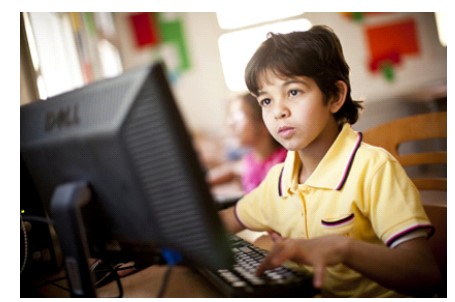
I have been an English teacher for about 30 years. During this period, in addition to working in the classroom, both in the public and private sectors, I have also been working with training, education and development of English language teachers at Troika – in continuing and initial education. At the moment, I coordinate an English program in Rio de Janeiro with teachers from kindergarten to high school, and I guide undergraduate interns that will be English teachers.
Lyrics Training - Students are very fond of Lyrics Training. I've had experiences with students from elementary school to high school, each one has its specificity, its degree of difficulty and requirement. For example, high school students are very fond of challenges. For example, they really enjoy it when they select a more challenging level where they need to be quicker with answers. And even more so when they decide to organize themselves into groups and compete with each other singing songs.
Youglish- Youglish is very interesting for vocabulary reinforcement in context, when we are exploring a particular word, which offers greater difficulty in understanding, contextualization and use. In addition to the pronunciation, it manages to bring, through videos and other resources, the context of use of that term. Sometimes teaching only the meaning of a word can give the wrong impression that it can be used in different contexts, but there are subtle meanings that need a more concrete communicative element so that the student can perceive its use.
Wordwall - Wordwall offers a bank with different game format options for the same content. One can create an activity, for example, with specific vocabulary of farm animals, and the website offers game possibilities based on that vocabulary list, such as memory game, train, cards, pac man, spin the wheel. The activities are geared towards secondary education. With the older ones, from the moment they are more used to the platform, we can open up for them to choose the type of game they prefer to do that activity.
Mentimeter - I use Mentimeter for preparing presentations. It's like PowerPoint, only interactive. It is a presentation tool filled with interactive elements with viewers. For example, if I have a question about the subject of the class, I present it on the slide and a code will appear. Then, by cell phone, students access and respond. And those answers can create a word cloud instantly, in real time. From there, we can move towards a discussion. I like to use the tool for warm up activities. For example, I ask “What did you have for breakfast today?”; and, based on the answers (milk, tea), we warm up with a discussion and then move on to the content of the class.
ISLCollective - ISLCollective is very good for creating class material. It is an activity repository that is organized into interactive video sessions, PowerPoint and vocabulary or grammar worksheets. We teachers create content and feed the platform. You can search and use ready-made materials, or do something more customized, as it allows us to change and adapt these materials. It makes a copy of the original content with all rights reserved and assigned, but one can customize, delete or add something to the activity.
Gamilab - It is an educational game bank, which allows us to create very simple games, and whose platform is similar to mobile and video games. It has more gamification elements than many others we use, such as elements of the dynamics, mechanics and components that are part of the gamification process (difficulty level progression, challenges and rewards), with a well-described narrative.
One of the possibilities for creation is a mountain bike competition. As the runner walks the race path, golden boxes with questions (multiple choice) appear that must be answered in order for the player to win prizes. It is a competition like a video game, with great appeal for our students.
It is possible to create games for all levels, from kindergarten on, and it can be used both on computer and mobile. The games can be created individually or collaboratively – there is the ability to add collaborators, so that students can organize themselves into groups, each one at home, develop a game and present it to the class. They can send the link of the game they have created and everyone plays.
Live Worksheets - Live Worksheets website also makes it possible to create interactive exercises. We can create, for example, an exercise of connecting (matching), which can be done on the screen of the computer or cell phone itself, which makes it easier for the student as well.
These platforms are all free and students don't need to have an account, we can just use the link. The only thing is that, if I want to create some activity that can be measured later, I need everyone to be registered and to log in to the platform. Gamilab, ISLCollective and Live Worksheets, for example, generate a report and I can find out which students participated and what difficulties were encountered in relation to the score generated by each one of them.
Adapted from: https://www.inglesnasescolas.org/en/experience/my-experience-one-of-the-advantages-of-online-tools-is-that-they-allow-teachers-andstudents-to-exercise-their-creativity/. Accessed on January 15th, 2022.
Answer question according to TEXTIII.
TEXT III -
My experience: one of the advantages of online tools is that they allow teachers and students to exercise their creativity
Cicinato do Carmo, English teacher that also works with initial and continuing education of teachers in Rio de Janeiro
Sept 20, 2021
I have been an English teacher for about 30 years. During this period, in addition to working in the classroom, both in the public and private sectors, I have also been working with training, education and development of English language teachers at Troika – in continuing and initial education. At the moment, I coordinate an English program in Rio de Janeiro with teachers from kindergarten to high school, and I guide undergraduate interns that will be English teachers.
Lyrics Training - Students are very fond of Lyrics Training. I've had experiences with students from elementary school to high school, each one has its specificity, its degree of difficulty and requirement. For example, high school students are very fond of challenges. For example, they really enjoy it when they select a more challenging level where they need to be quicker with answers. And even more so when they decide to organize themselves into groups and compete with each other singing songs.
Youglish- Youglish is very interesting for vocabulary reinforcement in context, when we are exploring a particular word, which offers greater difficulty in understanding, contextualization and use. In addition to the pronunciation, it manages to bring, through videos and other resources, the context of use of that term. Sometimes teaching only the meaning of a word can give the wrong impression that it can be used in different contexts, but there are subtle meanings that need a more concrete communicative element so that the student can perceive its use.
Wordwall - Wordwall offers a bank with different game format options for the same content. One can create an activity, for example, with specific vocabulary of farm animals, and the website offers game possibilities based on that vocabulary list, such as memory game, train, cards, pac man, spin the wheel. The activities are geared towards secondary education. With the older ones, from the moment they are more used to the platform, we can open up for them to choose the type of game they prefer to do that activity.
Mentimeter - I use Mentimeter for preparing presentations. It's like PowerPoint, only interactive. It is a presentation tool filled with interactive elements with viewers. For example, if I have a question about the subject of the class, I present it on the slide and a code will appear. Then, by cell phone, students access and respond. And those answers can create a word cloud instantly, in real time. From there, we can move towards a discussion. I like to use the tool for warm up activities. For example, I ask “What did you have for breakfast today?”; and, based on the answers (milk, tea), we warm up with a discussion and then move on to the content of the class.
ISLCollective - ISLCollective is very good for creating class material. It is an activity repository that is organized into interactive video sessions, PowerPoint and vocabulary or grammar worksheets. We teachers create content and feed the platform. You can search and use ready-made materials, or do something more customized, as it allows us to change and adapt these materials. It makes a copy of the original content with all rights reserved and assigned, but one can customize, delete or add something to the activity.
Gamilab - It is an educational game bank, which allows us to create very simple games, and whose platform is similar to mobile and video games. It has more gamification elements than many others we use, such as elements of the dynamics, mechanics and components that are part of the gamification process (difficulty level progression, challenges and rewards), with a well-described narrative.
One of the possibilities for creation is a mountain bike competition. As the runner walks the race path, golden boxes with questions (multiple choice) appear that must be answered in order for the player to win prizes. It is a competition like a video game, with great appeal for our students.
It is possible to create games for all levels, from kindergarten on, and it can be used both on computer and mobile. The games can be created individually or collaboratively – there is the ability to add collaborators, so that students can organize themselves into groups, each one at home, develop a game and present it to the class. They can send the link of the game they have created and everyone plays.
Live Worksheets - Live Worksheets website also makes it possible to create interactive exercises. We can create, for example, an exercise of connecting (matching), which can be done on the screen of the computer or cell phone itself, which makes it easier for the student as well.
These platforms are all free and students don't need to have an account, we can just use the link. The only thing is that, if I want to create some activity that can be measured later, I need everyone to be registered and to log in to the platform. Gamilab, ISLCollective and Live Worksheets, for example, generate a report and I can find out which students participated and what difficulties were encountered in relation to the score generated by each one of them.
Adapted from: https://www.inglesnasescolas.org/en/experience/my-experience-one-of-the-advantages-of-online-tools-is-that-they-allow-teachers-andstudents-to-exercise-their-creativity/. Accessed on January 15th, 2022.
Answer question according to TEXTIII.
TEXT III -
My experience: one of the advantages of online tools is that they allow teachers and students to exercise their creativity
Cicinato do Carmo, English teacher that also works with initial and continuing education of teachers in Rio de Janeiro
Sept 20, 2021
I have been an English teacher for about 30 years. During this period, in addition to working in the classroom, both in the public and private sectors, I have also been working with training, education and development of English language teachers at Troika – in continuing and initial education. At the moment, I coordinate an English program in Rio de Janeiro with teachers from kindergarten to high school, and I guide undergraduate interns that will be English teachers.
Lyrics Training - Students are very fond of Lyrics Training. I've had experiences with students from elementary school to high school, each one has its specificity, its degree of difficulty and requirement. For example, high school students are very fond of challenges. For example, they really enjoy it when they select a more challenging level where they need to be quicker with answers. And even more so when they decide to organize themselves into groups and compete with each other singing songs.
Youglish- Youglish is very interesting for vocabulary reinforcement in context, when we are exploring a particular word, which offers greater difficulty in understanding, contextualization and use. In addition to the pronunciation, it manages to bring, through videos and other resources, the context of use of that term. Sometimes teaching only the meaning of a word can give the wrong impression that it can be used in different contexts, but there are subtle meanings that need a more concrete communicative element so that the student can perceive its use.
Wordwall - Wordwall offers a bank with different game format options for the same content. One can create an activity, for example, with specific vocabulary of farm animals, and the website offers game possibilities based on that vocabulary list, such as memory game, train, cards, pac man, spin the wheel. The activities are geared towards secondary education. With the older ones, from the moment they are more used to the platform, we can open up for them to choose the type of game they prefer to do that activity.
Mentimeter - I use Mentimeter for preparing presentations. It's like PowerPoint, only interactive. It is a presentation tool filled with interactive elements with viewers. For example, if I have a question about the subject of the class, I present it on the slide and a code will appear. Then, by cell phone, students access and respond. And those answers can create a word cloud instantly, in real time. From there, we can move towards a discussion. I like to use the tool for warm up activities. For example, I ask “What did you have for breakfast today?”; and, based on the answers (milk, tea), we warm up with a discussion and then move on to the content of the class.
ISLCollective - ISLCollective is very good for creating class material. It is an activity repository that is organized into interactive video sessions, PowerPoint and vocabulary or grammar worksheets. We teachers create content and feed the platform. You can search and use ready-made materials, or do something more customized, as it allows us to change and adapt these materials. It makes a copy of the original content with all rights reserved and assigned, but one can customize, delete or add something to the activity.
Gamilab - It is an educational game bank, which allows us to create very simple games, and whose platform is similar to mobile and video games. It has more gamification elements than many others we use, such as elements of the dynamics, mechanics and components that are part of the gamification process (difficulty level progression, challenges and rewards), with a well-described narrative.
One of the possibilities for creation is a mountain bike competition. As the runner walks the race path, golden boxes with questions (multiple choice) appear that must be answered in order for the player to win prizes. It is a competition like a video game, with great appeal for our students.
It is possible to create games for all levels, from kindergarten on, and it can be used both on computer and mobile. The games can be created individually or collaboratively – there is the ability to add collaborators, so that students can organize themselves into groups, each one at home, develop a game and present it to the class. They can send the link of the game they have created and everyone plays.
Live Worksheets - Live Worksheets website also makes it possible to create interactive exercises. We can create, for example, an exercise of connecting (matching), which can be done on the screen of the computer or cell phone itself, which makes it easier for the student as well.
These platforms are all free and students don't need to have an account, we can just use the link. The only thing is that, if I want to create some activity that can be measured later, I need everyone to be registered and to log in to the platform. Gamilab, ISLCollective and Live Worksheets, for example, generate a report and I can find out which students participated and what difficulties were encountered in relation to the score generated by each one of them.
Adapted from: https://www.inglesnasescolas.org/en/experience/my-experience-one-of-the-advantages-of-online-tools-is-that-they-allow-teachers-andstudents-to-exercise-their-creativity/. Accessed on January 15th, 2022.
Answer question according to TEXTIII.
Choose the option that best defines the phenomenon that occurred in the sentences below:
“For example, they really enjoy it when they select a more challenging level where they need to be quicker with answers.”
“[…] which offers greater difficulty in understanding, contextualization and use.”
“[…] but there are subtle meanings that need a more concrete communicative element […].”
“With the older ones [...].”
“[…] which makes it easier for the student as well.”
TEXT III -
My experience: one of the advantages of online tools is that they allow teachers and students to exercise their creativity
Cicinato do Carmo, English teacher that also works with initial and continuing education of teachers in Rio de Janeiro
Sept 20, 2021
I have been an English teacher for about 30 years. During this period, in addition to working in the classroom, both in the public and private sectors, I have also been working with training, education and development of English language teachers at Troika – in continuing and initial education. At the moment, I coordinate an English program in Rio de Janeiro with teachers from kindergarten to high school, and I guide undergraduate interns that will be English teachers.
Lyrics Training - Students are very fond of Lyrics Training. I've had experiences with students from elementary school to high school, each one has its specificity, its degree of difficulty and requirement. For example, high school students are very fond of challenges. For example, they really enjoy it when they select a more challenging level where they need to be quicker with answers. And even more so when they decide to organize themselves into groups and compete with each other singing songs.
Youglish- Youglish is very interesting for vocabulary reinforcement in context, when we are exploring a particular word, which offers greater difficulty in understanding, contextualization and use. In addition to the pronunciation, it manages to bring, through videos and other resources, the context of use of that term. Sometimes teaching only the meaning of a word can give the wrong impression that it can be used in different contexts, but there are subtle meanings that need a more concrete communicative element so that the student can perceive its use.
Wordwall - Wordwall offers a bank with different game format options for the same content. One can create an activity, for example, with specific vocabulary of farm animals, and the website offers game possibilities based on that vocabulary list, such as memory game, train, cards, pac man, spin the wheel. The activities are geared towards secondary education. With the older ones, from the moment they are more used to the platform, we can open up for them to choose the type of game they prefer to do that activity.
Mentimeter - I use Mentimeter for preparing presentations. It's like PowerPoint, only interactive. It is a presentation tool filled with interactive elements with viewers. For example, if I have a question about the subject of the class, I present it on the slide and a code will appear. Then, by cell phone, students access and respond. And those answers can create a word cloud instantly, in real time. From there, we can move towards a discussion. I like to use the tool for warm up activities. For example, I ask “What did you have for breakfast today?”; and, based on the answers (milk, tea), we warm up with a discussion and then move on to the content of the class.
ISLCollective - ISLCollective is very good for creating class material. It is an activity repository that is organized into interactive video sessions, PowerPoint and vocabulary or grammar worksheets. We teachers create content and feed the platform. You can search and use ready-made materials, or do something more customized, as it allows us to change and adapt these materials. It makes a copy of the original content with all rights reserved and assigned, but one can customize, delete or add something to the activity.
Gamilab - It is an educational game bank, which allows us to create very simple games, and whose platform is similar to mobile and video games. It has more gamification elements than many others we use, such as elements of the dynamics, mechanics and components that are part of the gamification process (difficulty level progression, challenges and rewards), with a well-described narrative.
One of the possibilities for creation is a mountain bike competition. As the runner walks the race path, golden boxes with questions (multiple choice) appear that must be answered in order for the player to win prizes. It is a competition like a video game, with great appeal for our students.
It is possible to create games for all levels, from kindergarten on, and it can be used both on computer and mobile. The games can be created individually or collaboratively – there is the ability to add collaborators, so that students can organize themselves into groups, each one at home, develop a game and present it to the class. They can send the link of the game they have created and everyone plays.
Live Worksheets - Live Worksheets website also makes it possible to create interactive exercises. We can create, for example, an exercise of connecting (matching), which can be done on the screen of the computer or cell phone itself, which makes it easier for the student as well.
These platforms are all free and students don't need to have an account, we can just use the link. The only thing is that, if I want to create some activity that can be measured later, I need everyone to be registered and to log in to the platform. Gamilab, ISLCollective and Live Worksheets, for example, generate a report and I can find out which students participated and what difficulties were encountered in relation to the score generated by each one of them.
Adapted from: https://www.inglesnasescolas.org/en/experience/my-experience-one-of-the-advantages-of-online-tools-is-that-they-allow-teachers-andstudents-to-exercise-their-creativity/. Accessed on January 15th, 2022.
Answer question according to TEXTIII.
TEXT IV - Text for question.
A tale of two zooms (by Adrienne)
September 17, 2020
Elementary school teachers: Stop talking!
High school teachers: Please someone talk!
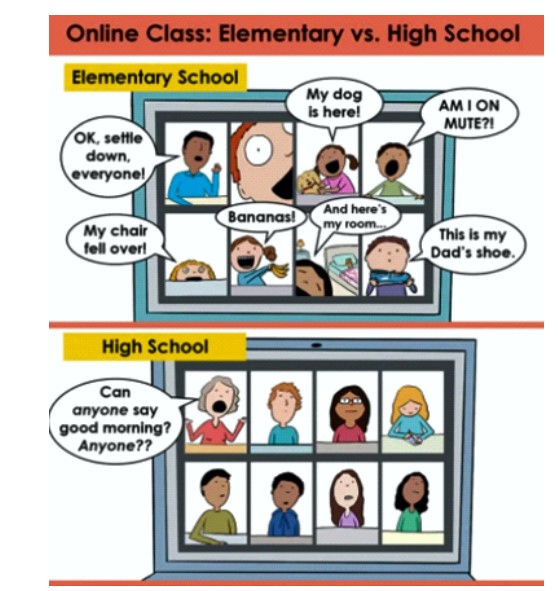
Available from: https://www.hedgerhumor.com/a-tale-of-two-zooms/. Accessed on January 10th, 2022.
TEXT IV - Text for question.
A tale of two zooms (by Adrienne)
September 17, 2020
Elementary school teachers: Stop talking!
High school teachers: Please someone talk!
Available from: https://www.hedgerhumor.com/a-tale-of-two-zooms/. Accessed on January 10th, 2022.
Choose the option that best suits this rule:
TEXTV-
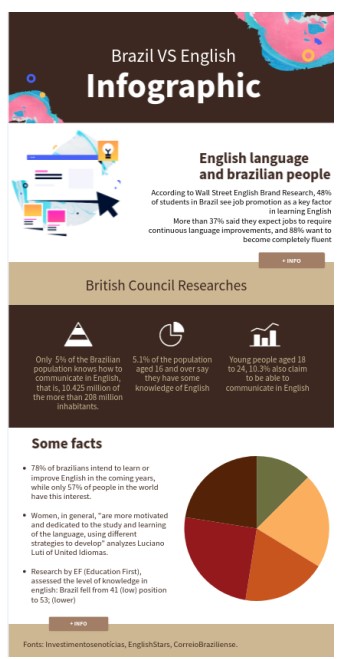
(by Cecismoura – May 28, 2021) Available from: https://view.genial.ly/60b17af8a30a0b0d332783d4/interactive-content-infografico-english-vs-brazil. Accessed on January 10th, 2022.
Answer question according to TEXT V.
TEXTV-
(by Cecismoura – May 28, 2021) Available from: https://view.genial.ly/60b17af8a30a0b0d332783d4/interactive-content-infografico-english-vs-brazil. Accessed on January 10th, 2022.
Answer question according to TEXT V.
Based on Text V, analyze the following sentences and check True (T) or False (F):
( ) Continuous language improvement is a requirement of most Brazilian jobs.
( ) Young people in Brazil believe they manage to communicate in English.
( ) Brazilians' knowledge of English has increased lately.
Choose the alternative with the CORRECT sequence:
TEXTV-
(by Cecismoura – May 28, 2021) Available from: https://view.genial.ly/60b17af8a30a0b0d332783d4/interactive-content-infografico-english-vs-brazil. Accessed on January 10th, 2022.
Answer question according to TEXT V.

 Conheça nossos planos