Questões de Concurso Público Prefeitura de Bandeirante - SC 2019 para Professor de Inglês
Foram encontradas 20 questões


Ano: 2019
Banca:
AMEOSC
Órgão:
Prefeitura de Bandeirante - SC
Prova:
AMEOSC - 2019 - Prefeitura de Bandeirante - SC - Professor de Inglês |
Q4339330
Não definido
Conforme a LDB, Lei de Diretrizes e Bases da Educação, artigo 24, é correto afirmar que no
currículo do ensino fundamental será ofertada a língua inglesa a partir do:
Ano: 2019
Banca:
AMEOSC
Órgão:
Prefeitura de Bandeirante - SC
Prova:
AMEOSC - 2019 - Prefeitura de Bandeirante - SC - Professor de Inglês |
Q4339331
Não definido
Os PCNs, Parâmetros Curriculares Nacionais, trazem alguns critérios de avaliação das
habilidades comunicativas quanto à compreensão escrita em inglês. A este respeito, é incorreto
afirmar que cabe ao aluno:
Ano: 2019
Banca:
AMEOSC
Órgão:
Prefeitura de Bandeirante - SC
Prova:
AMEOSC - 2019 - Prefeitura de Bandeirante - SC - Professor de Inglês |
Q4339332
Não definido
Dentre os conteúdos relativos ao conhecimento sistêmico, conforme os Parâmetros
Curriculares Nacionais, podem ser citados:
I. Atribuição de significado a diferentes aspectos morfológicos, sintáticos e fonológicos;
II. Reconhecimento de diferentes tipos de texto a partir de indicadores de organização textual;
III. Valorização do conhecimento de outras culturas como forma de compreensão do mundo em que vive;
IV. Identificação de conectores que indicam uma relação semântica.
Sobre os itens acima, podemos dizer que:
I. Atribuição de significado a diferentes aspectos morfológicos, sintáticos e fonológicos;
II. Reconhecimento de diferentes tipos de texto a partir de indicadores de organização textual;
III. Valorização do conhecimento de outras culturas como forma de compreensão do mundo em que vive;
IV. Identificação de conectores que indicam uma relação semântica.
Sobre os itens acima, podemos dizer que:
Ano: 2019
Banca:
AMEOSC
Órgão:
Prefeitura de Bandeirante - SC
Prova:
AMEOSC - 2019 - Prefeitura de Bandeirante - SC - Professor de Inglês |
Q4339333
Não definido
Sobre metodologia de ensino da língua inglesa, com relação ao Método de Gramática e
Tradução, analise os itens a seguir como utilizando (V) para Verdadeiro ou (F) para Falso:
(__) - Depois que as regras e listas de vocabulário são ensinados, prescreve-se a tradução de exercícios que seguem as explicações gramaticais dadas. A compreensão das regras e leituras é testada pela tradução;
(__) - A língua nativa e a língua alvo são constantemente comparadas;
(__) - O foco é o oferecimento de diferentes oportunidades aos alunos para ouvir e falar, apesar da ênfase na leitura e na tradução.
O resultado da análise para os itens é, respectivamente:
(__) - Depois que as regras e listas de vocabulário são ensinados, prescreve-se a tradução de exercícios que seguem as explicações gramaticais dadas. A compreensão das regras e leituras é testada pela tradução;
(__) - A língua nativa e a língua alvo são constantemente comparadas;
(__) - O foco é o oferecimento de diferentes oportunidades aos alunos para ouvir e falar, apesar da ênfase na leitura e na tradução.
O resultado da análise para os itens é, respectivamente:
Ano: 2019
Banca:
AMEOSC
Órgão:
Prefeitura de Bandeirante - SC
Prova:
AMEOSC - 2019 - Prefeitura de Bandeirante - SC - Professor de Inglês |
Q4339334
Não definido
Texto associado
A carved rock found in Jordan may be the oldest known chess piece
A palm-sized sandstone object found in 1991 at an Early Islamic trading outpost in what’s
now southern Jordan appears to be the oldest known chess piece.
This roughly 1,300-year-old rectangular piece of rock with two hornlike projections on top
resembles several rooks, also known as castles, that have been found at other Islamic sites in the
region. But those other rooks date to a century or more later, John Oleson, an archaeologist at the
University of Victoria in Canada, said. He presented his analysis of the carved rock on November
21 at the annual meeting of the American Schools of Oriental Research.
Simpler board games than chess go back roughly 4,000 years in Eurasia. Surviving written
accounts indicate that chess originated in India at least 1,400 years ago, Oleson said. Merchants
and diplomats probably carried the game westward. The suspected chess piece, excavated at
Humayma, located on what was once a major trade route, dates to between 680 and 749, when an
Islamic family owned and ran the site.
“Chess became very popular in the early Islamic world,” Oleson said. It also brought together
people with diverse backgrounds. Islamic texts from that time portray chess matches between
Muslims and Christians and between rich and poor players.
Rooks from southwestern Asia in the shape of two-horse chariots date to as early as the late
700s. The two-pronged shape of early Islamic rooks may have been meant to represent such
chariots, Oleson said.
The possibly record-setting Humayma rook is now stored at the University of Victoria. At his
home nearby, Oleson noted ruefully, his 10-year-old grandson regularly beats him at chess.
(Adapted from: https://www.sciencenews.org/article/carved-rock-found-jordan-may-be-oldest-known-chess-piece).
In the title, when mentioning that the piece could be “the oldest found”, it means that:
Ano: 2019
Banca:
AMEOSC
Órgão:
Prefeitura de Bandeirante - SC
Prova:
AMEOSC - 2019 - Prefeitura de Bandeirante - SC - Professor de Inglês |
Q4339335
Não definido
Texto associado
A carved rock found in Jordan may be the oldest known chess piece
A palm-sized sandstone object found in 1991 at an Early Islamic trading outpost in what’s
now southern Jordan appears to be the oldest known chess piece.
This roughly 1,300-year-old rectangular piece of rock with two hornlike projections on top
resembles several rooks, also known as castles, that have been found at other Islamic sites in the
region. But those other rooks date to a century or more later, John Oleson, an archaeologist at the
University of Victoria in Canada, said. He presented his analysis of the carved rock on November
21 at the annual meeting of the American Schools of Oriental Research.
Simpler board games than chess go back roughly 4,000 years in Eurasia. Surviving written
accounts indicate that chess originated in India at least 1,400 years ago, Oleson said. Merchants
and diplomats probably carried the game westward. The suspected chess piece, excavated at
Humayma, located on what was once a major trade route, dates to between 680 and 749, when an
Islamic family owned and ran the site.
“Chess became very popular in the early Islamic world,” Oleson said. It also brought together
people with diverse backgrounds. Islamic texts from that time portray chess matches between
Muslims and Christians and between rich and poor players.
Rooks from southwestern Asia in the shape of two-horse chariots date to as early as the late
700s. The two-pronged shape of early Islamic rooks may have been meant to represent such
chariots, Oleson said.
The possibly record-setting Humayma rook is now stored at the University of Victoria. At his
home nearby, Oleson noted ruefully, his 10-year-old grandson regularly beats him at chess.
(Adapted from: https://www.sciencenews.org/article/carved-rock-found-jordan-may-be-oldest-known-chess-piece).
According to the text:
Ano: 2019
Banca:
AMEOSC
Órgão:
Prefeitura de Bandeirante - SC
Prova:
AMEOSC - 2019 - Prefeitura de Bandeirante - SC - Professor de Inglês |
Q4339336
Não definido
Texto associado
A carved rock found in Jordan may be the oldest known chess piece
A palm-sized sandstone object found in 1991 at an Early Islamic trading outpost in what’s
now southern Jordan appears to be the oldest known chess piece.
This roughly 1,300-year-old rectangular piece of rock with two hornlike projections on top
resembles several rooks, also known as castles, that have been found at other Islamic sites in the
region. But those other rooks date to a century or more later, John Oleson, an archaeologist at the
University of Victoria in Canada, said. He presented his analysis of the carved rock on November
21 at the annual meeting of the American Schools of Oriental Research.
Simpler board games than chess go back roughly 4,000 years in Eurasia. Surviving written
accounts indicate that chess originated in India at least 1,400 years ago, Oleson said. Merchants
and diplomats probably carried the game westward. The suspected chess piece, excavated at
Humayma, located on what was once a major trade route, dates to between 680 and 749, when an
Islamic family owned and ran the site.
“Chess became very popular in the early Islamic world,” Oleson said. It also brought together
people with diverse backgrounds. Islamic texts from that time portray chess matches between
Muslims and Christians and between rich and poor players.
Rooks from southwestern Asia in the shape of two-horse chariots date to as early as the late
700s. The two-pronged shape of early Islamic rooks may have been meant to represent such
chariots, Oleson said.
The possibly record-setting Humayma rook is now stored at the University of Victoria. At his
home nearby, Oleson noted ruefully, his 10-year-old grandson regularly beats him at chess.
(Adapted from: https://www.sciencenews.org/article/carved-rock-found-jordan-may-be-oldest-known-chess-piece).
In the text, the quoted speech below, in reported speech, is:
“Chess became very popular in the early Islamic world,” Oleson said.
Ano: 2019
Banca:
AMEOSC
Órgão:
Prefeitura de Bandeirante - SC
Prova:
AMEOSC - 2019 - Prefeitura de Bandeirante - SC - Professor de Inglês |
Q4339337
Não definido
Texto associado
A carved rock found in Jordan may be the oldest known chess piece
A palm-sized sandstone object found in 1991 at an Early Islamic trading outpost in what’s
now southern Jordan appears to be the oldest known chess piece.
This roughly 1,300-year-old rectangular piece of rock with two hornlike projections on top
resembles several rooks, also known as castles, that have been found at other Islamic sites in the
region. But those other rooks date to a century or more later, John Oleson, an archaeologist at the
University of Victoria in Canada, said. He presented his analysis of the carved rock on November
21 at the annual meeting of the American Schools of Oriental Research.
Simpler board games than chess go back roughly 4,000 years in Eurasia. Surviving written
accounts indicate that chess originated in India at least 1,400 years ago, Oleson said. Merchants
and diplomats probably carried the game westward. The suspected chess piece, excavated at
Humayma, located on what was once a major trade route, dates to between 680 and 749, when an
Islamic family owned and ran the site.
“Chess became very popular in the early Islamic world,” Oleson said. It also brought together
people with diverse backgrounds. Islamic texts from that time portray chess matches between
Muslims and Christians and between rich and poor players.
Rooks from southwestern Asia in the shape of two-horse chariots date to as early as the late
700s. The two-pronged shape of early Islamic rooks may have been meant to represent such
chariots, Oleson said.
The possibly record-setting Humayma rook is now stored at the University of Victoria. At his
home nearby, Oleson noted ruefully, his 10-year-old grandson regularly beats him at chess.
(Adapted from: https://www.sciencenews.org/article/carved-rock-found-jordan-may-be-oldest-known-chess-piece).
The verb “presented”, in “He presented his analysis of the carved rock on November 21” means,
in Portuguese:
Ano: 2019
Banca:
AMEOSC
Órgão:
Prefeitura de Bandeirante - SC
Prova:
AMEOSC - 2019 - Prefeitura de Bandeirante - SC - Professor de Inglês |
Q4339338
Não definido
The past simple of “study” is:
Ano: 2019
Banca:
AMEOSC
Órgão:
Prefeitura de Bandeirante - SC
Prova:
AMEOSC - 2019 - Prefeitura de Bandeirante - SC - Professor de Inglês |
Q4339339
Não definido
Complete the sentence using the verb in the present perfect continuous form.
“I’m sorry to keep you waiting. I hope you ________ long.”
“I’m sorry to keep you waiting. I hope you ________ long.”
Ano: 2019
Banca:
AMEOSC
Órgão:
Prefeitura de Bandeirante - SC
Prova:
AMEOSC - 2019 - Prefeitura de Bandeirante - SC - Professor de Inglês |
Q4339340
Não definido
In English, the plural of “foot” is:
Ano: 2019
Banca:
AMEOSC
Órgão:
Prefeitura de Bandeirante - SC
Prova:
AMEOSC - 2019 - Prefeitura de Bandeirante - SC - Professor de Inglês |
Q4339341
Não definido
Choose the right alternative:
“Jane read all these books by ________.”
Ano: 2019
Banca:
AMEOSC
Órgão:
Prefeitura de Bandeirante - SC
Prova:
AMEOSC - 2019 - Prefeitura de Bandeirante - SC - Professor de Inglês |
Q4339342
Não definido
Texto associado
A questão diz respeito ao Texto. Leia-o atentamente antes de respondê-la.
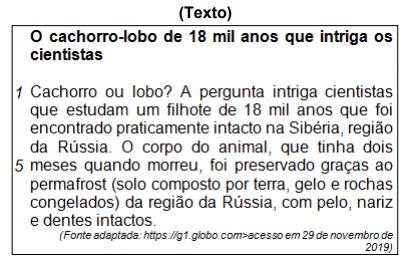
Acerca dos encontros vocálicos e consonantais, analise:
I. Há encontro consonantal em “cachorro” (linha 1);
II. A palavra “Rússia” (linha 4) possui um ditongo;
III. Há encontro consonantal em “pergunta” (linha 1).
Dos itens acima:
I. Há encontro consonantal em “cachorro” (linha 1);
II. A palavra “Rússia” (linha 4) possui um ditongo;
III. Há encontro consonantal em “pergunta” (linha 1).
Dos itens acima:
Ano: 2019
Banca:
AMEOSC
Órgão:
Prefeitura de Bandeirante - SC
Prova:
AMEOSC - 2019 - Prefeitura de Bandeirante - SC - Professor de Inglês |
Q4339343
Não definido
Texto associado
A questão diz respeito ao Texto. Leia-o atentamente antes de respondê-la.
O sinônimo da palavra “intacto” (linha 3), no contexto em que está inserida, é:
Ano: 2019
Banca:
AMEOSC
Órgão:
Prefeitura de Bandeirante - SC
Prova:
AMEOSC - 2019 - Prefeitura de Bandeirante - SC - Professor de Inglês |
Q4339344
Não definido
Texto associado
A questão diz respeito ao Texto. Leia-o atentamente antes de respondê-la.
Analise o período a seguir para responder s questão:
"A pergunta intriga cientistas que estudam um filhote de 18 mil anos que foi encontrado praticamente intacto na Sibéria, região da Rússia.” (linhas 1 a 4).
É correto afirmar que a partícula “que” destacada exerce função morfológica de:
"A pergunta intriga cientistas que estudam um filhote de 18 mil anos que foi encontrado praticamente intacto na Sibéria, região da Rússia.” (linhas 1 a 4).
É correto afirmar que a partícula “que” destacada exerce função morfológica de:
Ano: 2019
Banca:
AMEOSC
Órgão:
Prefeitura de Bandeirante - SC
Prova:
AMEOSC - 2019 - Prefeitura de Bandeirante - SC - Professor de Inglês |
Q4339345
Não definido
Texto associado
A questão diz respeito ao Texto. Leia-o atentamente antes de respondê-la.
Analise o período a seguir para responder s questão:
"A pergunta intriga cientistas que estudam um filhote de 18 mil anos que foi encontrado praticamente intacto na Sibéria, região da Rússia.” (linhas 1 a 4).
É correto afirmar que a partícula “que” destacada introduz uma:
"A pergunta intriga cientistas que estudam um filhote de 18 mil anos que foi encontrado praticamente intacto na Sibéria, região da Rússia.” (linhas 1 a 4).
É correto afirmar que a partícula “que” destacada introduz uma:
Ano: 2019
Banca:
AMEOSC
Órgão:
Prefeitura de Bandeirante - SC
Prova:
AMEOSC - 2019 - Prefeitura de Bandeirante - SC - Professor de Inglês |
Q4339346
Não definido
Texto associado
A questão diz respeito ao Texto. Leia-o atentamente antes de respondê-la.
Analise o período a seguir para responder s questão:
"A pergunta intriga cientistas que estudam um filhote de 18 mil anos que foi encontrado praticamente intacto na Sibéria, região da Rússia.” (linhas 1 a 4).
A palavra "[...] cientistas [...]", no contexto em que está inserida, exerce função sintática de:
"A pergunta intriga cientistas que estudam um filhote de 18 mil anos que foi encontrado praticamente intacto na Sibéria, região da Rússia.” (linhas 1 a 4).
A palavra "[...] cientistas [...]", no contexto em que está inserida, exerce função sintática de:
Ano: 2019
Banca:
AMEOSC
Órgão:
Prefeitura de Bandeirante - SC
Prova:
AMEOSC - 2019 - Prefeitura de Bandeirante - SC - Professor de Inglês |
Q4339347
Não definido
O povo Xokleng é habitante originário do sul do Brasil, sendo que sua língua e cultura não
existem em outro lugar. Hoje vivem cerca de três mil pessoas do povo Xokleng na terra indígena
que abrange, no estado de Santa Catarina, os três municípios de:
Ano: 2019
Banca:
AMEOSC
Órgão:
Prefeitura de Bandeirante - SC
Prova:
AMEOSC - 2019 - Prefeitura de Bandeirante - SC - Professor de Inglês |
Q4339348
Não definido
O clima subtropical úmido é predominante em Santa Catarina. Nessa faixa climática, as chuvas
são constantes e bem distribuídas ao longo do ano, existindo secas apenas:
Ano: 2019
Banca:
AMEOSC
Órgão:
Prefeitura de Bandeirante - SC
Prova:
AMEOSC - 2019 - Prefeitura de Bandeirante - SC - Professor de Inglês |
Q4339349
Não definido
A maior lua de Saturno ganhou, em 2019, um mapa geológico que revela seis ambientes
presentes no satélite. Segundo especialistas, a maior parte desta lua é feita de materiais orgânicos.
Planícies representam 65% da lua e as dunas, 17%. O nome desta lua é:

 Conheça nossos planos