Questões de Concurso
Comentadas sobre voz ativa e passiva | passive and active voice em inglês
Foram encontradas 296 questões


Read the text and answer the question.
Scientists store entire human genome on ‘memory crystal’ that could survive billions of years
By Rosa Rahimi, CNN. Published 7:53 AM EDT, Fri September 20, 2024
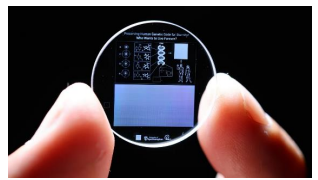
The crystal features a visual key, intended to explain what it contains to whoever finds it. University of Southampton/PA
Scientists in the United Kingdom have stored the entire human genome on a “5D memory crystal,” in the hope that it could be used in the future as a blueprint to bring humanity back from extinction.
The crystal, which was developed by a team of researchers at the University of Southampton’s Optoelectronics Research Centre, could also be used to create a record of plant and animal species faced with extinction.
It can hold up to 360 terabytes of information for billions of years and can withstand extreme conditions, including freezing, fires, direct impact force, cosmic radiation and temperatures of up to 1,000 degrees Celsius, the university said in a press statement published Thursday.
In 2014, the crystal was awarded the Guinness World Record for “most durable digital storage material.” Kazansky’s team used ultra-fast lasers to inscribe the human genome data into voids as small as 20 nanometers (a nanometer is about one-billionth of a meter).
They describe the data storage on the crystal as 5D because the information is translated into five different dimensions of its nanostructures — their height, length, width, orientation and position.
“The 5D memory crystal opens up possibilities for other researchers to build an everlasting repository of genomic information from which complex organisms like plants and animals might be restored should science in the future allow,” said Peter Kazansky, a professor of optoelectronics, who led the team at Southampton.
The team had to consider who – or what – would retrieve the information, so far off into the future.
It could be an intelligence (species or machine) – or it could be found in a future so distant that no frame of reference would exist for it. To help whoever finds it, the researchers included a visual key.
“The visual key inscribed on the crystal gives the finder knowledge of what data is stored inside and how it could be used,” said Kazansky.
“Their work is super impressive,” said Thomas Heinis, who leads research on DNA storage at Imperial College London and was not involved in the study. However, he says questions remain about how such data could be read in the future.
“What Southampton presents probably has a higher durability, however, this begs the question: what for? Future generations? Sure, but how will they know how to read the crystal? How will they know how to build the device to read the crystal? Will the device be available in hundreds of years?” he added. “I can barely connect my 10-year-old iPod and listen to what I listened back then.”
For now, the crystal is stored in the Memory of Mankind archive, a time capsule within a salt cave in Austria.
In 2018, Kazansky and his team used the memory crystal technology to store Isaac Asimov’s “Foundation” trilogy of science fiction books, which were then launched into space aboard a Tesla Roadster. The technology has also been used to store major documents from human history, including the Universal
Declaration of Human Rights and the Magna Carta. Earlier this year, scientists revealed a plan to safeguard Earth’s species in a cryogenic biorepository on the moon, intended to save species in the event of a disaster on our home planet.
https://edition.cnn.com/2024/09/20/science/human-genome-crystal-intl-scli/index.html
"The crystal, which was developed by a team of researchers at the University of Southampton’s Optoelectronics Research Centre, could also be used to create a record of plant and animal species faced with extinction.”
Read the text III to answer the question.
TEXT III
A new report into world education shows Finland has the best system. The global study is called "The Learning Curve" and is from the British magazine "The Economist". It aims to help governments provide a better education to students. The 52-page report looked at the education system in 50 countries. Researchers analysed millions of statistics on exam grades, literacy rates, attendance, and university graduation rates. Asia did well in the report, with South Korea, Hong Kong, Japan and Singapore finishing second, third, fourth and fifth. The United States came 17th in the study, while Mexico, Brazil and Indonesia filled the bottom three positions in the top 50.
The Learning Curve reported on five things that education leaders should remember. The first is that spending lots of money on schools and teachers does not always mean students will learn. Second is that "good teachers are essential to high-quality education". The report said teachers should be "treated as the valuable professionals they are, not as technicians in a huge, educational machine". Numbers three and four are that a country's culture must have a strong focus on the importance of education, and parents have a key part to play. Finally, countries need to "educate for the future, not just the present." The report said: "Many of today's job titles…simply did not exist 20 years ago."
Sources:
http://www.timeshighereducation.co.uk/story.asp?sectioncode=26&storycode=421944&c=1
http://thelearningcurve.pearson.com/content/download/bankname/components/filename/FINAL%20LearningCurve_Final.pdf
3
Choose the sentence with the correct transformation to passive voice:
"The team won the championship after months of rigorous training and strategizing."
Google as well as Yahoo, Microsoft and AOL among
others are gearing up to keep a much closer eye on all of us,
so that within five years these and other firms will routinely
track our movements, friends, interests, purchases and
5 correspondence – then make money by helping marketers
take advantage of the information.
These companies' brash plans are pushing us toward a
thorny choice that will determine the future of computing.
Google and other Web-oriented, information-service giants are
10 determined to build a breathtaking array of services based on
your personal information, and they're betting you'll be willing
to share it with them in order for you to reap the benefits. But
if we cooperate and let them in on the details of our lives, we'll
lose much of our privacy, and possibly a lot more.
15 A privacy backlash, however, would stifle these potentially
revolutionary services before they get off the ground – and
leave the computer industry's biggest plans for growth in
tatters. That may be just what some people want. The U.S.
Congress is considering four bills that would make it illegal to
20 collect and share information online or through cell phones
about people without clearer warning and permission. These
sorts of restrictions are already in effect throughout much of
Europe, thanks in part to European Union directives on privacy
and electronic communications passed in 2002 and 2003.
25 The good news is that there's no reason to choose
between technology and privacy. New technologies are
emerging that can doctor our data so that companies know
just enough about us to ply us with customized services, while
preventing them from getting a clear picture of our private
lives. The question is again one of trust: in this case, whether
people will come to trust the companies that are trying to build
these new technologies.
(abridged from Next Frontiers in Newsweek, April 3, 2006)
Mark the one item which contains the best passive alternative for we'll lose much of our privacy (lines 13-14):
Assinale a alternativa que contém a voz passiva da sentença: “Did the noise frighten them?”.
INSTRUCTIONS: Read the text carefully and then answer the questions from 33 to 38 by choosing the correct alternative.
Brazil corruption scandals: All you need to know
For the past three years, Brazil has been gripped by a scandal which started with a state-owned oil company and grew to encapsulate people at the very top of business - and even presidents.
On the face of it, it is a straightforward corruption scandal - albeit one involving millions of dollars in kickbacks and more than 80 politicians and members of the business elite.
But as the tentacles of the investigation dubbed Operation Car Wash fanned out, other scandals emerged.
It has led to some of those who have found themselves accused claiming they are the victims of political plots, designed to bar them from office.
What is Operation Car Wash?
Operation Car Wash began in March 2014 as an investigation into allegations that Brazil's biggest construction firms overcharged state-oil company Petrobras for building contracts.
Investigators accused directors at the firm - named the world's most ethical oil and gas company in 2008 - of skimming the extra money off the top as a bribe for awarding the contract.
Which is bad enough - but then the Workers' Party found itself dragged into the corruption scandal amid allegations of having funneled some of these funds to pay off politicians and buy their votes and help with political campaigns.
Among those accused in the scandal were dozens of politicians, and Luiz Inacio Lula da Silva - the country's extremely popular former president, known affectionately as "Lula".
In the sentence: ''For the past three years, Brazil has been gripped by a scandal…'' the underlined expression is:
Read the excerpt below and answer the questions 34 to 40.
- The transfer of Alaska from Russia to the United States formed one of those unbelievable incidents of
- history because by 1867, Russia was nervously eager to get rid of it, while the United States still
- recovering from the Civil War and immersed in the impending impeachment of President Johnson,
- refused to accept it on any terms.
- At this impasse an extraordinary man monopolized center stage. He was not a Russian, a fact which
- would become important more than a century later, but a soi-disant baron of dubious background; half
- Austrian, half Italian, and a charmer who was picked up in 1841 for temporary duty representing Russia in
- the United States and who lingered there till 1868. In that time, Edouard de Stoeckl, parading himself as a
- nobleman, although no one could say for sure how or when or even if he had earned his title, became
- such an ardent friend of America that he married an American heiress and took upon himself the task of
- acting as marriage broker between Russia, which he called homeland, and the United States, his adopted
- residence.
- He faced a most difficult task, for when the United States showed hesitancy about accepting Alaska,
- support for the sale withered in Russia, and later when Russia wanted to sell, half a dozen of the most
- influential American politicians led by Secretary of State William Seward of New York looked far into the
- future and saw the desirability of acquiring Alaska to serve as America's artic bastion, yet the hard-
- headed businessmen in the Senate, the House and the general public opposed the purchase with all the
- scorn they could summon. 'Seward's Icebox' and 'Seward's Folly' were two of the gentler jibes. Some
- critics accused Seward of being in the pay of the Russians; others accused De Stoeckl of buying votes in
- the House. One sharp satirist claimed that Alaska contained nothing but polar bears and Eskimos, and
- many protested that America should not accept this useless, frozen domain even if Russia wanted to give
- it away.
- Many pointed out that Alaska had no wealth of any kind, not even reindeer, which proliferated in other
- northern areas, and experts affirmed that an arctic area like this could not possibly have any minerals or
- other deposits of value. On and on went the abuse of this unknown and somewhat terrifying land, and the
- castigations would have been comical had they not influenced American thinking and behavior and
- condemned Alaska to decades of neglect.
- But an ingenious man like Baron de Stoeckl was not easily diverted from his main target, and with
- Seward's unflinching support and admirable statesmanship, the sale squeaked by with a favorable margin
- of one vote. By such a narrow margin did the United States come close to losing one of her potentially
- valuable acquisitions, but of course, had one viewed Alaska from the vantage point of frozen Fort Nulato
- in 1867, with the thermometer at minus-fifty-seven and about to be attacked by hostile Athapascans, the
- purchase at more than $7,000,000 would have seemed a poor bargain.
- Now the comedy intensified, became burlesque, for although the U.S Senate had bought the place,
- the U.S. House refused to appropriate the money to pay for it, and for many tense months the sale hung
- in the balance. When a favorable vote was finally taken, it was almost negated by the discovery that
- Baron de Stoeckl had disposed of $125,000 in cash for which he refused to give an accounting. Widely
- suspected of having bribed congressmen to vote for land that was obviously worthless, the baron waited
- until the sale was completed, then quietly slipped out of the country, his life's ambition having been
- achieved.
- One congressman with a keen sense of history, economics and geopolitics said of the whole affair:
- 'If we were so eager to show Russia our appreciation of the help she gave us during the Civil War, why
- didn't we give her the seven million and tell her to keep her damned colony? It'll never be of any use to
- us.'
Excerpt from: MICHENER, James A. Alaska. Fawcett Books: New York, 1988, p. 369 - 370.
The sequence 'was not easily diverted' (line 28) presents the same passive voice structure in all of the following, EXCEPT for:
The passive voice is often used in formal texts. Switching to the active voice will make your writing clearer and easier to read.
(i) A great deal of meaning is conveyed by a few well-chosen words.
(ii) A mass of gases wrap around our planet.
(iii) Waste materials are disposed of in a variety of ways.
The sentence below uses a specific grammar structure, which one? Choose the CORRECT answer.
“The office was cleaned yesterday.”
Instruction: Answer questions 41 to 53 based on the following text.
Why Learning Is A New Procrastination
- The tremendous world of online courses, blogs, social media, free eBooks, podcasts, and
- webinars provides the best ever opportunity to broaden your knowledge in almost every sphere
- you can imagine. Thanks to technological advancement and the instant access to the internet,
- everyone can now study from home. It seems like it would be foolishly not to seize this
- opportunity and improve your skills and knowledge. Moreover, you are kind of forced to do so
- since the contemporary world has raised the bar higher than ever before. It literally invited you
- to gather the pace and ___________ even more.
- It is not surprising that, ultimately, you try to be everywhere and do everything. No doubt,
- you do your best to constantly gather tiny bits of information from as many channels as
- possible, because you are afraid that you will fall behind if you stop. After all, you enter a
- learning crunch mode. You do not afford to miss anything and try to read every book you could
- get your hands on. You listen to every single podcast your smartphone could download and take
- every online course your paycheck would allow to take.
- All in all, you learn. As much as possible. As intense as you manage to. You learn how to
- write and publish a new book. You learn how to launch a successful blog. You learn how to hit
- your goal on Kickstarter. You learn how to build the next “unicorn”. You learn how to land a job
- of your dream. You learn how to successfully sell thousands of items on Amazon. You learn how
- to make millions of dollars in passive income.
- However, the problem is that you do everything except taking action. All those activities do
- not take you closer to the things you want to accomplish. Better knowledge does not make you
- more influential, powerful, and successful unless you apply it. The key secret to success is not
- ________ expertise, but the ability to use it.
- Knowledge is worthless unless it is applied. Needless to say that studying is crucial.
- However, the thing is that it should take the entirely new form now. You should stop learning
- from someone else’s experiences, knowledge, failures, and wins and start learning from your
- own mistakes, adventures, ___________, and bold actions.
- Learning has become a major trend of the 21st century. Sadly, it has also become a new
- form of procrastination. You consciously postpone the first step justifying this by your eagerness
- to broaden the knowledge and learn new things. You put the start date off justifying this by
- your desire to pick up new skills that would help you succeed faster. You procrastinate over
- chasing your own aspirations because doing the things on your own and creating your own story
- of success is far more complicated than reading about someone else’s one. Meanwhile, no one
- would really reproach you for wasting your time. Also, you feel comfortable about staying within
- this zone of ease and convenience forever.
- However, the point is that you already have and know everything you need to start off. In
- fact, there is nothing more you need to learn in order to take the first step. Embrace the truth.
- No matter how good your theoretical knowledge is, you will face a lot of obstacles while
- applying it. You will have to deal with issues that have never been described or covered in any
- book. You will have to look for the solutions and make the spontaneous decisions that no one
- probably has ever thought of. You will have to design your own road to success.
- Transform your learning process from the continuous the procrastination into an
- unstoppable process of absorbing invaluable expertise based on your own experience. It might
- seem counterintuitive, but the old-fashioned way of learning is what holds you back. This is
- what makes your triumphs suck.
- Constant learning, evaluating of ideas, thinking, and visualizing your journey towards your
- major aspirations will not take you far from the place you are now. Actions will. You can sit and
- research, and research, and research, while someone else is already reaping huge rewards for
- his or her fruitful and hard work. Stop learning now. Become bold enough to take the first step
- and start learning from your own experience.
Source: https://medium.com/the-coffeelicious/why-learning-is-a-new-procrastination-104b53107e8b
Consider the following extract from the text and the sentences that follow:
“You will have to deal with issues that have never been described or covered in any book. You will have to look for the solutions and make the spontaneous decisions that no one probably has ever thought of.”
I. ‘have never been described’ is in the past perfect.
II. ‘will have to look for’ is in the future perfect.
III. ‘has ever thought of’ is in the passive voice.
Which ones are INCORRECT?
The Rise of the “Bike Bus” Movement
01 On Earth Day* 2022, Sam Balto, a physical education teacher in Portland, convinced a few
02 dozen parents to send their kids to school on their bikes and posted the first in a series of videos
03 that turned his “bike bus” into a viral sensation. Balto has continued documenting his weekly
04 bike buses with joyous videos that show students rolling to school while he blasts music from an
05 eclectic collection of artists, including AC/DC, Metallica, and OneRepublic. Over time, these
06 boisterous bike buses have grown to more than 150 kids. “The more these kids practice riding
07 bikes, the more confident they become. And now they want to keep riding on non-bike bus days,
08 and even on rainy days!” said Balto.
09 Balto’s bike bus is much more than a fad. His TikTok and Twitter videos have raked in
10 millions of views, inspiring similar initiatives in New York, New Jersey, Florida, Utah, Ohio, and
11 Texas. Bike buses previously existed in European cities such as Barcelona and London, but new
12 ones in cities like Cape Town are now joining the trend. Nancy Pullen-Seufert, the director of the
13 National Center for Safe Routes to School, said biking and walking to school have myriad benefits,
14 including “improving air quality, improving safety for walkers and bicyclists, increasing physical
15 activity, and making it easier for school buses and others who can’t actively travel to school to
16 arrive to school on time.”
17 Balto has also triggered real political change by working with lawmakers to pass a so-called
18 “Bike Bus Bill”, that was signed into law by Oregon Governor Tina Kotek in August. “The bill
19 brings flexibility so school districts can now use student transportation funds, which were
20 previously only for school buses, to pay for crossing guards or adults to lead walking school buses
21 or bike buses. It’s awesome.” Balto said. And he is not the only bike bus leader driving positive
22 change in Oregon… Last year, Megan Ramey, who has been organizing a bike bus ___ 2020, was
23 named the Safe Routes to School Manager at Hood River County School District and since then,
24 she has secured nearly $11 million in funding to make it safer for kids to walk and bike to school.
25 “I feel like I'm in a cash-grabbing machine. We just got $7 million to create an off-road trail to
26 the high school. This means kids will be able to bike to high school on a green trail instead of a
27 car-centered road,” said Ramey.
28 Nearly 90% of kids walked to school in 1969. Half a century later, in 2017, that number
29 had fallen to just 10%. That year, a third of students took the school bus and more than half
30 were driven in a private vehicle. This has led to more pollution, with researchers finding that
31 toxic car fumes have an adverse effect on attention, reasoning, and academic performance
32 among school children. In New York, the Open Schools Program has helped increase biking and
33 walking in the 65 schools that restricted traffic during drop-off and pick-up times this year, said
34 Sabina Sethi Unni, who works at Open Plans, a non-profit that supports the shift to walkable
35 cities. “This program makes kids more comfortable with walking and biking at a young age. When
36 they get older, they will be cyclists instead of car users,” said Unni.
(Available in: https://www.distilled.earth/p/the-rise-of-the-bike-bus-movement – text especially adapted for this test).
*Earth Day: a day in April designated for promoting concern for the environment (Merriam-Webster).
Mark the sentence below that shows the adapted excerpt “Balto has triggered real political change (…)” (l. 17) correctly rewritten in the passive voice, in the same verb tense.
Choose the sentence in the passive voice.
A frase “The fruits are being sold by my son” na voz ativa fica:
Village’s Amateur Archaeologists Find Lost Tudor Palace
- When a group of amateur archaeologists set out to find the buried remains of a Tudor palace
- in their Northamptonshire village five years ago, they knew the odds were against them. “Many
- of us were brought up in the village, and you hear about this lost palace, and wonder whether
- it’s a myth or real. So we just wanted to find it”, said Chris Close, the chair of the Collyweston
- Historical and Preservation Society (Chaps) which made the discovery of the Palace of
- Collyweston in a back garden this year. “But we’re a bunch of amateurs. We had no money, no
- expertise, no plans, no artist impressions to go off, and nothing remaining of the palace. It was
- naivety and just hard work that has led us to it”.
- The site was found using geophysical surveys and ground-penetrating radar. Various
- attempts had been made in the 1980s and 90s to find Collyweston Palace, the home of Henry
- VII’s mother, Lady Margaret Beaufort. However, without the advantage of modern technology,
- none had succeeded. The palace was famous during the 15th century and several historic events
- took place there. The pre-wedding celebrations of Margaret Tudor to James IV of Scotland in
- 1503 took place in the palace, and Henry VIII is recorded as holding court there on 16 and 17
- October 1541. By the mid-17th century, it had fallen into disrepair, and until the Chaps dig
- uncovered the palace walls in March, there was very little remaining evidence of its existence.
- “A number of things have only really come to light as we’ve done this project”, said Close.
- “As you do more and more research, and various different records start to become unearthed,
- we realized Collyweston had privy councils being run from here, which is of massive national
- importance”. Historians from the University of York helped verify the group’s findings and identify
- the palace through some uncovered stone moldings, and will work with Chaps on more
- excavations to further reveal the structure and conserve it for the future.
- The Chaps team, which comprises more than 80 members ranging from teenagers to people
- in their 70s and 80s, first set out their plan to find the palace in March 2018, using “local folktales
- and hearsay” to help refine their search area. They carried out geophysical surveys and used
- ground-penetrating radar (GPR) to help reveal the location of the palace walls, before securing
- permission from homeowners to excavate in gardens. “We’ve done it all on an absolute
- shoestring”, said Close. “We’ve basically done an £80,000-£90,000 project for roughly £13,000.
- For us, being a little society, to have achieved this with no money, or expertise, or plans, I think
- it’s something that the whole society should be proud of”.
(Available at: https://www.theguardian.com/science/2023/dec/06/tudor-collyweston-palace-northamptonshire-found-in-garden-by-amateur-archeologists - text especially adapted for this test).
The sentence “Many of us were brought up in the village” (l. 02-03) is in the simple past and passive voice. Which sentence below is also an example of a simple past passive structure?
O texto seguinte servirá de base para responder às questões de 1 a 9.
Valdivia Figurines and the appeal of 'the oldest'
(1º§) The logo for the Ecuadorian Ministry of Culture website is about my favourite thing of the afternoon which is saying a lot since I spent much of the day reading about giant Olmec heads. Three Valdivia Figurines in the colours of the Ecuadorian flag? I am sold! Golly, I love Valdivia figurines for all the right and all the wrong reasons.
(2º§) There are two things that can easily be said about Valdivia figurines: they are VERY Ecuadorian and they are VERY looted. The first explains why they appear prominently on the Ministry of Culture website (and on stencilled graffiti around Quito circa 2007). Ancient Ecuador has played second fiddle to Ancient Peru since the early days of archaeology. The Valdivia culture, however, represents something that Peru doesn't have, 'the oldest'. Everyone loves 'the oldest', national pride, etc. etc.
(3º§) Who else loves 'the oldest'? Collectors and Museums. If the Valdivia pottery sequence is the oldest in the new world, collectors want a slice of that pie. Heck, even better than some junky pottery, the Valdivia made interesting figurines: lovely ladies that look good on stark black backgrounds in auction catalogues. They are part of 'the oldest' yet they also look good.
(4º§) Valdivia sites are famously looted and Valdivia figurines are famously faked. A few years back I started doing some initial work into looting in Ecuador (which led to fieldwork in Quito and the cloud forest that didn't really go anywhere as of yet) and I, like anyone else going down that road, came across Bruhns and Hammond's 1983 Journal of Field Archaeology piece 'A Visit to Valdivia'. Knowing nothing at all about Ecuador at the time, I had never heard of Valdivia, a wonder since the only Ecuadorian archaeology books that Cambridge owns are a few by the late Betty Meggars and Emilio Estrada from the 1950s and 1960s which link uber-ancient Ecuador to Jomon Period Japan (yeah...I know). As Bruhns and Hammond relate, Meggars detected faking at Valdivia immediately after the start of her excavations: practical jokers who discovered a market for their copies. As the market for the pieces grew, the presumed fakes get more and more elaborate and fanciful...and Valdivia sites were just looted to pieces.
(5º§) So really with Valdivia we are left with a situation where we don't know what is real. It is directly comparable to the Cycladic Figurine problem: the corpus is mostly looted, it contains tons of forms not found in the limited archaeological excavations that have been conducted, and we intellectual consumers of artefacts don't know what to believe. To me Valdivia figurines are the perfect looting Catch 22: they warrant study so that the interested public can learn about 'the oldest', but they can't be studied because collectors wanted 'the oldest' so sites were looted and buckets of fakes were produced.
(6º§) In 2007 I bought a fake Valdivia figurine in Otavalo which now stands in a Spondylus shell on my counter and watches me cook. The fella selling it to me told me it was real. I knew it wasn't but made to put it back saying something along the lines that law breaking makes me sick. He quickly agreed that it wasn't real and cut his asking price by a ton. Que Sera. Three cheers, Ecuadorian Ministry of Culture, your logo is the best.
https://www.anonymousswisscollector.com/2012/09/valdivia-figurines-a
nd-appeal-of-oldest.html
Which sentence in the text contains a passive construction?
The passive voice cannot be used in all verb tenses, even if it fits the required structure. It is composed of the verb 'to be' followed by the main verb in the past continuous form.

 Conheça nossos planos