Questões de Concurso Comentadas sobre voz ativa e passiva | passive and active voice em inglês

Foram encontradas 296 questões

Q2291639 Inglês
READ TEXT I AND ANSWER QUESTION

Text I

English Language Learning In Brazil

        According to the BNCC1 , learning English enables students to engage and participate in a globalized and pluralistic world. It allows students to develop a critical mindset and exercise their citizenship rights while expanding the possibilities of interaction and mobility. In this sense, the BNCC outlines three critical implications for the English curriculum. The first is the globalized nature of English, in which the concepts of language, territory and culture are reconsidered since English speakers are no longer found only in countries where English is the official language. The second implication concerns broadening the definition of literacy, bringing the concept of “multi-literacies” to the Brazilian curriculum as students expand their linguistic knowledge, and English becomes a symbolic asset for Brazilians to express themselves in a different language. Finally, the third implication concerns different teaching approaches, which implies embracing the culture and traditions of the language, not only the formal grammatical standards, breaking with aspects related to “correctness”, “accuracy”, and “proficiency”.

        […]

        Even in a challenging context, it is clear that Brazil has made significant progress by approving a new and flexible curriculum for upper secondary schools and putting English mandatory in the standard part of the curriculum. However, major efforts are still required to ensure the smooth implementation of this reform, which the pandemic and the difficulties in coordination across the national and subnational levels have already hindered. 

1BNCC: Base Nacional Comum Curricular

Adapted from: https://www.thedialogue.org/analysis/english-language-learning-inbrazil/

 
The excerpt “major efforts are still required” (2nd paragraph) is in the
Alternativas
Q2267404 Inglês
Which sentence is in the Passive Voice? Choose the CORRECT answer.
Alternativas
Q2240735 Inglês
The following excerpts from the text were adapted and they are all in passive voice, EXCEPT for: 
Alternativas
Q2206406 Inglês
“The Little Prince”, now, is a movie

Alex Weiss

    An all-time favourite children’s book, The Little Prince by Antoine de Saint-Exupéry has been turned into a beautifully animated movie — and it’s finally being released. The inspiring lessons, timeless story, and beautiful quotes from The Little Prince make this a perfect choice for an on-screen adaptation. At one point or another, your parents read this book to you when you were a child, and then you picked it up later on in life, realising how incredibly important this small book truly is.
The sentence in bold type in the text is in the 
Alternativas
Q2204958 Inglês
Text I

What is English as a Lingua Franca?

      ‘English’, as a language, has for some time been seen as a global phenomenon and, therefore, as no longer defined by fixed territorial, cultural and social functions. At the same time, people using English around the world have been shaping it and adapting it to their contexts of use and have made it relevant to their socio-cultural settings. English as a Lingua Franca, or ELF for short, is a field of research interest that was born out of this tension between the global and the local, and it originally began as a ramification of the World Englishes framework in order to address the international, or, rather, transnational perspective on English in the world. The field of ELF very quickly took on a nature of its own in its attempt to address the communication, attitudes, ideologies in transnational contexts, which go beyond the national categorisations of World Englishes (such as descriptions of Nigerian English, Malaysian English and other national varieties). ELF research, therefore, has built on World Englishes research by focusing on the diversity of English, albeit from more transnational, intercultural and multilingual perspectives.
      ELF is an intercultural medium of communication used among people from different socio-cultural and linguistic backgrounds, and usually among people from different first languages. Although it is possible that many people who use ELF have learnt it formally as a foreign language, at school or in an educational institution, the emphasis is on using rather than on learning. And this is a fundamental difference between ELF and English as a Foreign Language, or EFL, whereby people learn English to assimilate to or emulate native speakers. In ELF, instead, speakers are considered language users in their own right, and not failed native speakers or deficient learners of English. Some examples of typical ELF contexts may include communication among a group of neuroscientists, from, say, Belgium, Brazil and Russia, at an international conference on neuroscience, discussing their work in English, or an international call concerning a business project between Chinese and German business experts, or a group of migrants from Syria, Ethiopia and Iraq discussing their migration documents and requirements in English. The use of English will of course depend on the linguistic profile of the participants in these contexts, and they may have another common language at their disposal (other than English), but today ELF is the most common medium of intercultural communication, especially in transnational contexts.
        So, research in ELF pertains to roughly the same area of research as English as a contact language and English sociolinguistics. However, the initial impetus to conducting research in ELF originated from a pedagogical rationale – it seemed irrelevant and unrealistic to expect learners of English around the world to conform to native norms, British or American, or even to new English national varieties, which would be only suitable to certain socio-cultural and geographical locations. So, people from Brazil, France, Russia, Mozambique, or others around the world, would not need to acquire the norms originated and relevant to British or American English speakers, but could orientate themselves towards more appropriate and relevant ways of using English, or ELF. Researchers called for “closing a conceptual gap” between descriptions of native English varieties and new empirical and analytical approaches to English in the world. With the compilation of a number of corpora, ELF empirical research started to explore how English is developing, emerging and changing in its international uses around the world. Since the empirical corpus work started, research has expanded beyond the pedagogical aim, to include explorations of communication in different domains of expertise (professional, academic, etc.) and in relation to other concepts and research, such as culture, ideology and identity.

Adapted from https://www.gold.ac.uk/glits-e/ back-issues/english-as-a-lingua-franca/

In the opening sentence, the verb phrase in “‘English’, as a language, has for some time been seen” is in the
Alternativas
Q2201492 Inglês

Read the sentences from the text given and tick the alternative with the passive voice structure.


I. This realization can be used to your advantage as a teacher.

II. It exposes them to different ways of thinking.

III. They are being given appropriate materials and practice for their own needs.

Alternativas
Q2184935 Inglês
Text: The importance of the PowerPoint as a classroom resource
(Text adapted from Teachers: 5 Tips for Creating Great PowerPoint Presentations, retrieved

   PowerPoint is a resource developed by Microsoft and released initially in 1990. It is mainly used in professional meeting presentations all over the world.
    One of these professions is in educational area: teacher.
    PowerPoint presentation is spread among teachers because it is different from lecturing or teaching with a textbook; it is also a way of sharing content with students.
    To produce a PowerPoint correctly, teachers need to know how to put the slides together, it can be an effective way of reinforcing content to students so that they are better able to retain it. Otherwise, teachers can print and distribute the PowerPoint presentation or post it online, so students can go back and access it as reference material. However, if it is not put together correctly, a PowerPoint presentation can disengage and make students bored.
   To develop PowerPoint presentation is simple and it can also provide a fun time noticed by its characteristics: basic, simple, and not distracting, it can be focused on keywords; for instance, always be sure to include a summary slide of what the presentation is intending to accomplish as well as a table of contents on the different topics that will be covered in the program. The summary slide serves as the main topic and what students should learn after viewing the presentation. Then, at the end of the PowerPoint presentation, teachers should include another summary slide, going over everything that was just covered and, again, highlighting the main point.

Bottom line
    PowerPoint presentations need to have a purpose and the teacher must make sure that the purpose is understood.

Add pictures
    Teachers can reinforce the content with pictures, charts, symbols, and other images. In fact, sometimes it’s better to have more pictures than text in a PowerPoint presentation, because images work to reinforce a content main point.
     Teachers typically will just share it with their classes, so they can pull images straight from the Internet. However, for teachers who are making more public and widespread presentations, copyright law needs to be considered (Brazil Information Access Law nº 12.527; Art. 31; paragraph 3; item II). 

Add video
      Pictures can help to reinforce a main point or support content, as well as videos. Some research affirm that students enjoy watching videos and retain information from them well, especially if the video is engaging, interesting and informative. Teachers can embed videos right from YouTube or from their desktops to complement a PowerPoint presentation.

Practice
      Nothing turns off a class like a poorly put together PowerPoint presentation, so teachers should always be sure to do a quick rehearsal before they present it to the class. While testing it, make sure all the images load up on the slides, videos load up properly and audio works, too. Also, it’s important for teachers to make sure that there’s a way to connect their computer, or upload anything that’s storing the PowerPoint presentation, to a larger TV monitor or projector screen so the whole class does not have to huddle around a computer screen to view it. Teachers should also make sure that any text can be read and understood. Be sure that the color scheme is good.

Make it fun
    A PowerPoint presentation can be an innovative way of teaching. It’s a more interesting and engaging way for students to learn than the typical lecture. Teachers should embrace this teaching resource and have fun with it. Throw in some jokes, possibly some funny pictures and be sure to get creative with presentations.

      As we previously noted, the more students enjoy a lecture, presentation, or activity, the more likely they are to retain information. 
Read the fragments from the text and tick the alternative that is not a passive voice structure.
Alternativas
Q2184916 Inglês
A questão foi desenvolvida em língua inglesa e/ou língua portuguesa oficial do Brasil. 
Notice the passive voice structure in this sentence: “These themes were codified into pictures” (by the educators). Now choose the alternative with the correct passive voice structure.
Alternativas
Q2174631 Inglês
Which sentence is in the Passive Voice? Choose the CORRECT answer.
Alternativas
Q2170185 Inglês
Marque a alternativa correta quanto às formas de voz passiva:
Alternativas
Q2170184 Inglês
Observe o período abaixo e assinale a alternativa que corresponde à voz passiva dessa construção:
They should have locked the jewels in a safe.
Alternativas
Q2124643 Inglês
       Language teachers, like other teachers, had to quickly rethink priorities and means of delivery in response to the Covid-19 pandemic as well as measures to manage the pandemic. It isn’t surprising then that some of the findings in our 2021 survey relate to the pandemic.
       Language teaching was suspended by local education boards at one in five primary schools in January 2021 due to Covid-19, and the impact has been felt more acutely in deprived areas. Teachers in state secondary schools report that two in five pupils in Key Stage 3 (lower secondary) did not engage with language learning during the first national lockdown, leading to time lost to language learning for a lot of pupils.
         Dr Ian Collen said that “the most disadvantaged pupils are most likely to have been negatively affected by the impact of Covid-19, experiencing greater disruption to their language learning and fewer international opportunities. Looking to the future, schools should consider giving more curriculum time to languages, as well as more opportunities to use languages in real life, such as visits abroad.”
       Many teachers reported that they cannot wait to get back to face-to-face teaching in the classroom. Despite the barriers they have faced over the past year, it is encouraging to see how they pivoted to remote learning during the national lockdowns.


Internet: <www.britishcouncil.org> (adapted).

Based on the previous text, judge the following item. 


In the second paragraph, the sentence “Language teaching was suspended by local education boards at one in five primary schools in January 2021 due to Covid-19” is in the passive voice and could be correctly rewritten as Due to Covid-19, local education boards suspended language teaching at one in five primary schools in January 2021.

Alternativas
Q2104973 Inglês

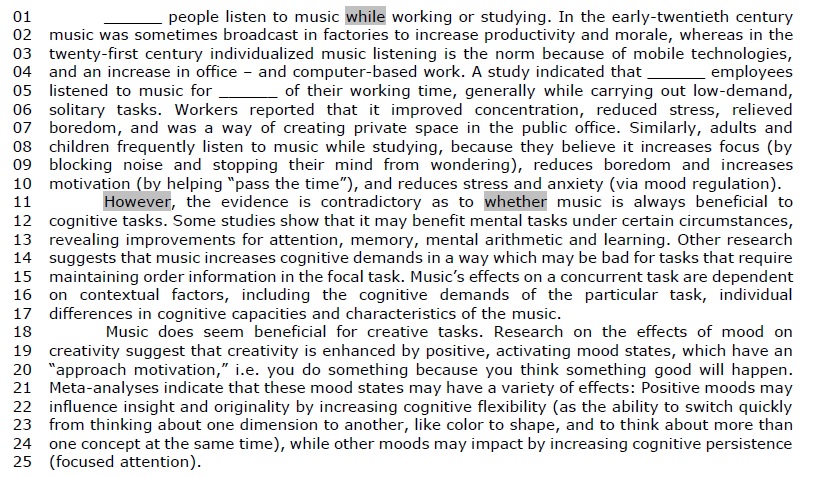
Music Enabling Cognitive Work


(Avaliable in: ASHLEY, R. and TIMMERS, R. (Editors) The Routledge Companion to Music Cognition. New York: Routledge, 2017 – text adapted specially for this test). 

Analyze the following statements about the sentence “In the early-twentieth century music was sometimes broadcast in factories to increase productivity and morale”
(l. 01-02): I. “Music was sometimes broadcast” is in the simple present, in a passive voice structure.
II. The adverb “sometimes” could be replaced by “rarely” with no changes in meaning.
III. The word “increase” could be translated as “aumentar”.

Which ones are correct?
Alternativas
Q2102923 Inglês
Training for the Javelin

The javelin is over 400,000 years old. This long, pointed stick was first used as a weapon before it became an integral event in the Olympic Games. Though even as a sport, it can still cause damage today.

Javelin throwers can become injured because they often repeat the same action many times during training or competitions. There is especially a risk of elbow injury if athletes bend their arms the wrong way when they throw the javelin. As with all sports, it’s important to warm up properly before practicing the javelin.

For people considering taking up this sport, here are some suggestions for preventing injury:

1. Practice with a professional coach. It’s essential to develop a good technique from the beginning.

2. Develop healthy eating habits and a good diet with lots of fruit, vegetables, and protein (chicken or fish). Don’t skip breakfast on the day of the competition.

3. When competing ___________sports events, plan the day properly. Competitions can begin ____________the morning, so start your warm up when you get up. Do exercises for your arms, legs, back, and neck before you put your gym clothes and go the stadium.

4. It’s important for athletes to keep their body temperatures up, so after warming up, it’s best to wear a tracksuit while waiting for the event to begin. Sometimes the different parts of the competitions take place at different times. In between, keep your throwing arm warm. For example, wrap a towel around it while you’re waiting. 

5. After the competition, many athletes want to relax and hang out with their friends, but don’t finish the competition without cooling down first. Put ice on the throwing arm for about a quarter of an hour. This prevents injuries after the event.

6. Finally, don’t practice too much. Only Olympic athletes need to practice every day. Sports are for fun. Just enjoy the event.
Analyze the sentences according to structure and grammar use.
1. The underlined words in the sentence “This long, pointed stick was first used as a weapon…” is an example of active voice in the past tense.
2. The words in bold “they” and “their”, in the text, are being used as a personal pronoun and a possessive adjective, respectively.
3. The negative form of the following sentence: “Do exercises for your arms, legs, back, and neck…” is “Don’t exercise your arms, legs, back, and neck…”.
4. The word ‘properly’ in “it’s important to warm up properly before practicing the javelin.” is an adverb that means correctly or satisfactorily.

Choose the alternative which contains the correct sentences.

Alternativas
Q2095727 Inglês
Instruction: answer question based on the following text.


What is Quality Assurance?


Available at: https://www.glassdoor.com/Job-Descriptions/Quality-Assurance.htm
Find the sentence with the passive voice structure in the same verb tense as “products made by the company” (line 03).
Alternativas
Q2074616 Inglês

Cybersecurity: An overview of cyber challenges facing the nation, and actions needed


Federal agencies and the nation’s critical infrastructure — such as energy, transportation systems, communications, and financial services — depend on Information Technology (IT) systems to carry out operations and process essential data. However, the risks to these IT systems are increasing—including insider threats from witting or unwitting employees, escalating and emerging threats from around the globe, and the emergence of new and more destructive attacks. Rapid developments in new technologies, such as artificial intelligence, the Internet of Things, and ubiquitous Internet and cellular connectivity, can also introduce security issues. Over 28,000 security incidents were reported by federal civilian agencies to the Department of Homeland Security in FY 2019.

Additionally, since many government IT systems contain vast amounts of personally identifiable information (PII), federal agencies must protect the confidentiality, integrity, and availability of this information—and effectively respond to data breaches and security incidents. Likewise, the trend in the private sector of collecting extensive and detailed information about individuals needs appropriate limits.

To highlight the importance of these issues, Government Accountability Office (GAO) has designated information security as a government-wide high-risk area since 1997. This high-risk area was expanded in 2003 to include the protection of critical cyber infrastructure and, in 2015, to include protecting the privacy of PII.

GAO has made about 3,300 recommendations to federal agencies to address cybersecurity shortcomings—and we reported that more than 750 of these had not been fully implemented as of December 2020. We designated 67 as priority, meaning that we believe they warrant priority attention from heads of key departments and agencies.

Adapted from: https://www.gao.gov/cybersecurity. Available on November 16th, 2022

Which of the sentences from the text presented below is in the Passive Voice?
Alternativas
Q2026126 Inglês
“They are rebuilding all the Finnish schools” in the passive voice:
Alternativas
Q2026118 Inglês
Text 2:

What makes a school good? (Part II)

Another reason the schools may be so successful is the teachers. Teachers in Finland are seen as very important. They are well respected and the field of education is considered to be a science, with its own methodology, theory and principles. Every teacher studies for five years before they can teach. This is in contrast with the status of education in many other countries. Perhaps this explains why it's actually rather difficult to get a job as a teacher in Finland, as well as the reason that it's such a popular job.

In order to get students' opinions about what makes a school 'good', I visited my local school playground to do a little informal research. The thirteen-year-olds I spoke to were interested to hear about the Finnish schools. I asked them if they thought British schools were too strict and whether they thought more students would go to university if things were changed. Fay, one of the best students in her year, said she didn't think British students would benefit from a school that was too easy-going. She felt her teachers weren't strict enough, and that was why few students in her school went on to higher education.

So it seems that the Finnish education system has come up with a 'formula' that works successfully in that country. Their example can serve as a model for other countries, but each country will have to work hard to put together an education system that will meet the needs of its people.

Taken from: Chapman, Joanne. Laser B1 +. Teacher's book. Macmillan, 2008.

“Teachers in Finland are seen as very important.” (fifth paragraph)

The corresponding sentence in the active voice is:

Alternativas
Q2022974 Inglês

Text 4A1-I


President Joe Biden predicted Thursday that student loan borrowers will start receiving relief – which is currently on hold over a court challenge – within weeks, projecting confidence that his administration will win the challenge. “We’re going to win that case. I think in the next two weeks you’re going to see those checks going out”, Biden told a TV news correspondent.

The Biden administration started taking student debt forgiveness applications on October 14 and officials have said it could take weeks to process and grant relief. Eligible borrowers won’t be receiving actual checks. Instead, they will see up to a $ 20,000 reduction in their student debt balances. The Department of Education has told borrowers who are eligible for automatic debt relief, without filing an application, not to expect the debt cancellation before November 14.

A federal appeals court put a temporary hold on the administration’s student loan forgiveness program last week, which barred the government from canceling loans covered under the new policy while the court considers a challenge brought by six Republican-led states. The Biden administration is also facing lawsuits from Arizona Attorney General Mark Brnovich, and conservative groups such as the Job Creators Network Foundation and the Cato Institute.

Biden’s student loan forgiveness program, first announced in August, aims to deliver debt relief to millions of borrowers before federal student loan payments resume in January after a nearly three-year, pandemic-related pause.

The President made his comments during an interview with a local TV station network during his visit to Syracuse, New York, to tout a new deal on semiconductor manufacturing. With less than two weeks until the midterm elections Biden took questions on the economy, his message to voters, and the stalled student debt relief program. President Joe Biden is canceling some federal student loan debt, making a once pie-in-the-sky idea a reality. The application officially opened Monday, allowing low- and middle-class federal student loan borrowers to apply for up to $ 20,000 in debt relief.

https: <www.edition.cnn.com> (adapted). 


According to the Cambridge Dictionary, reported speech or indirect speech is the act of reporting something that was said, without using exactly the same words. In light of this information, the sentence “We’re going to win that case”, said by Biden, should be, in reported speech,
Alternativas
Q2016698 Inglês
Critical Literacy

    Critical literacies are not new among scholars and researchers in literacy education. However, due to different theoretical bases, there is no unique definition of “critical literacy”. In their broadest sense, critical literacies refer to the ability to read texts going beyond their superficial meaning. That is, it implies approaching texts in a reflective way to understand working ideologies such as power, inequality, and injustice. In the realm of critical literacy, text is understood as a “vehicle through which individuals communicate with one another using the codes and conventions of society” (Robinson & Robinson, 2003, p. 3). Texts, in this sense, can be either songs, novels, poems, conversations, pictures, movies, and so on. […]

    Hence, the critical literacies approach is generally contrasted with functional literacy. The former views literacy as a social practice, while the latter views literacy as the mastery of linguistic skills. In addition, Manning (1999) developed a framework to distinguish critical literacies from functional literacy by establishing the difference between their respective ideology purpose, literacy curriculum, and instruction. On the one hand, the main objective of functional literacy is to produce skilled workers for the marketplace. Consequently, the curriculum is restrictive and the instruction is individualistic and competitive. On the other hand, for critical literacies, texts are not neutral but marked by power messages, dominating interests, and hidden agendas. In order to deconstruct these texts and unveil their ideological messages and power relationships, the curriculum is to employ materials from the everyday world as text and analytic tools.

    Critical scholars have overtly supported the idea that there is not a single procedure for incorporating critical literacies into the classroom, given that the particularities of the context where the foreign language is taught differ from one another. Thus, an approach to critical literacies “needs to be continually redefined in practice” (Comber, 2001, p. 274).


Adapted from: Jiménez, M.C. G. and Gutiérrez, C.P. “Engaging English as a Foreign Language Students in Critical Literacy Practices: The Case of a Teacher at a Private University” available at http://www.scielo.org.co/scielo.php?script= sci_arttext&pid=S1657-07902019000100091&lng=en&nrm=iso
The verb phrase in “where the foreign language is taught” (3rd paragraph) is in the
Alternativas
Respostas
201: C
202: D
203: A
204: D
205: D
206: D
207: B
208: A
209: C
210: A
211: B
212: C
213: C
214: D
215: C
216: B
217: C
218: A
219: A
220: C