Questões de Concurso
Comentadas sobre vocabulário | vocabulary em inglês
Foram encontradas 2.466 questões


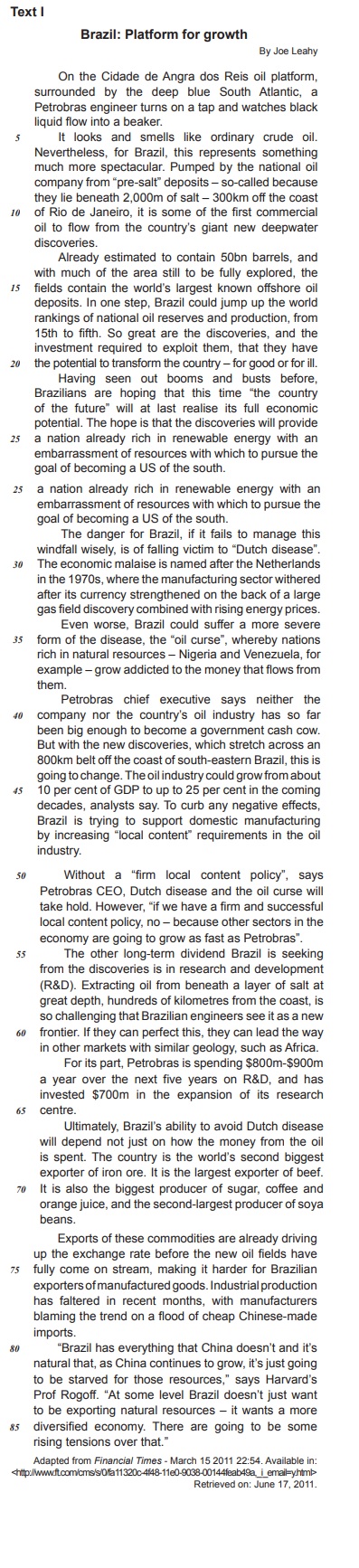


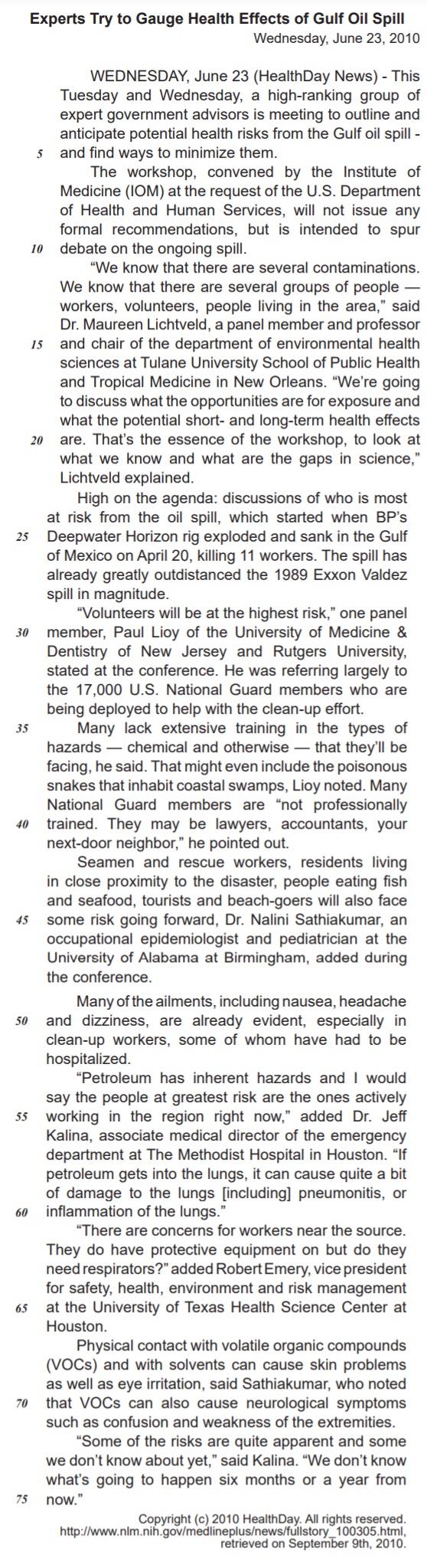
Based on the text above, judge the items below.

Written by Laura Hill
Water and oil don’t mix. We see this every day; just try washing olive oil off your hands without soap or washing your face in the morning with only water. It just doesn’t work!
When an oil spill occurs in the ocean, like the catastrophe in the Gulf of Mexico, what do scientists do to clean up the toxic mess? There are a number of options for an oil spill cleanup and most efforts use a combination of many techniques. The fact that oil and water don’t mix is a blessing and a curse. If oil mixed with water, it would be difficult to divide the two.
Crude oil is less dense than water; it spreads out to make a very thin layer (about one millimetre thick) that floats on top of the water. This is good because we can tell what is water and what is oil. It is also bad, because it means the oil can spread really quickly and cover a very large area, which becomes difficult to manage. Combined with wind, ocean currents and waves, oil spill cleanup starts to get really tricky.
Chemical dispersants can be used to break up big oil slicks into small oil droplets. They work like soaps by emulsifying the hydrophobic (waterrepelling) oil in the water. These small droplets can degrade in the ecosystem quicker than the big oil slick. But unfortunately, this means that marine life of all sizes ingest these toxic, broken-down particles and chemicals.
If the oil is thick enough, it could be set fire, a process called “in situ burning”. Because the oil is highly flammable and floats on top of the water, it is very easy to set it alight. It’s not environmentallyfriendly though; the combustion of oil releases thick smoke that contains greenhouse gases and other dangerous air pollutants.
Some techniques can contain and recapture spilled oil without changing its chemical composition. Booms float on top of the water and act as barriers to the movement of oil. Once the oil is controlled, it can be gathered using sorbents. “Sorbent” is a fancy word for sponge. These sponges absorb the oil and allow it to be collected by siphoning it off the water.
However, weather and sea conditions can prevent and obstruct the use of booms, sorbents and in situ burning. Imagine trying to perform these operations on the open sea with wind, waves and water currents moving the oil (and your boat!) around on the water.
What about the plants and animals? It’s easy to forget about the organisms in the sea that are under water. Out of sight, out of mind! There is not much we can do to help them. But when oil reaches the shore it impacts sensitive coastal environments including the many fish, bird, amphibian, reptilian, and crustaceanspecies that live there. We have easy access to these areas and there are some things we can do to clean up. For the plants, it is often a matter of setting them on fire, or leaving them to degrade the oil naturally. Sometimes, we can spray the oil with nutrients (phosphorus and nitrogen) that can encourage the growth of specialized microorganisms. For species that can tolerate our soaps, manpower is needed to wash every affected animal. Yet, if the animal has tried to lick itself clean, it can die from ingesting the toxic oil.
Unfortunately, there can be many negative economic and social impacts, in addition to the environmental impacts of oil spills and, as you’ve just read, the clean up techniques are far from perfect. Prevention is the very best cleanup technique we have. http://www.curiocity.ca/everyday-science/environme... -cleaning-up-a-spill.html, retrieved on Dec 10, 2010
'CityVille' now bigger on Facebook than 'FarmVille'
(Mashable) -- Facebook game developer Zynga has proved once
again that it knows exactly what it needs to do to keep millions of
Facebook users happy and occupied.
In less than a month, its latest game "CityVille"___ ______
(become) the most popular application on Facebook, surpassing
Zynga's previous hit "FarmVille" in all areas.
According to AppData, "CityVille" now has 16.8 million daily
active users, compared to "FarmVille's" 16.4 million. Looking at
monthly active users, "CityVille" is also ahead with 61.7 million
users, while "FarmVille" trails behind with 56.8 million users.
Zynga's "FrontierVille" and "Texas HoldEm Poker" also round out
the top five: put those four apps together (we'll disregard the fact
that many of those users overlap for a second) and you have a
very impressive number: 184 million active users across four
games.
The only non-Zynga app in the top five list is "Phrases," _____ at
one point threatened to take the top place, but is now
overshadowed by both "CityVille" and "FarmVille."
"CityVille's" future success wasn't hard to predict after an
amazingly good start at the beginning of December, but it's still
impressive to see Zynga amassing tens of millions of users in a
matter of days, proving that all that venture capital that went into
the company isn't there by accident.
Fonte :cnn.com
as:
In order to introduce new vocabulary, the teacher shows the students her handbag and everything that is in it. In this situation, which technique is the teacher using to teach new words?
Leia os diálogos abaixo:
1. A: Your sister cleaned the house yesterday.
B: No, I cleaned the house yesterday.
2. A: Your sister cleaned the house yesterday.
B: No, I cleaned the house yesterday.
3. A: Your sister cleaned the house yesterday.
B: No, I cleaned the house yesterday.
Com base na ênfase dada na produção de cada uma das respostas de “B” nos diálogos 1, 2 e 3, pode-se concluir que a aprendizagem de aspectos fonológicos da língua inglesa está intimamente relacionada à
A música “Hunting High and Low” foi um dos grandes sucessos da banda norueguesa A-ha na década de 80. Leia a letra da canção e responda a questão.
Hunting High and low
(Paul Waaktaar-Savoy)
Here I am
And within the reach of my hands
She sounds asleep
And she's sweeter now
Than my wildest dream
Could have seen her.
And I watch her sleeping away
But I know I'll be
Hunting high and low
Ah, there's no end
To the lengths I'll go to
Find her again
Upon this my dreams are depending
Through the dark
I sense the pounding of her heart
Next to mine
She's the sweetest love
I could find
So I guess I'll be
Hunting high and low
Do you know what it means
To love you
I'm hunting high and low
And now she's telling me
She's got to go away
I'll always be hunting high and low
Only for you
Watch me tearing myself to pieces,
Oh, for you I'll be hunting high and low
(Extraído do site www .vagalume.com.br)
Leia o texto seguinte e responda a questão.
Translegal, LLC
Translegal, LLC works to formulate strategies to accomplish our clients' international business goals. We provide specialized consulting services related to international legal and commercial issues, including business development, coordinating international commercial litigation dispute resolution cases, legal research, Hague and Inter-American Convention applications and requests, global trademark registrations, government relations and translations.
Translegal founder, Francisco Laguna, has worked in international law and consulting firm settings both in the United States and abroad, including countries such as Colombia, the Dominican Republic, France, Luxembourg and Spain.
Mr. Laguna comprehends the differences among legal and commercial cultures. He bridges the gaps between common law and civil law systems, understands the nuances of doing business internationally and advises clients accordingly. Mr. Laguna works with clients and the professionals of the TransLegal Network to formulate specific strategies to accomplish their goals or to resolve disputes.
Our services include international consulting and research, foreign and domestic service of process, foreign evidence requests, including the taking of sworn testimony, government relations, global trademark searches and registration, transnational administrative procedures and translations.
With offices in over 30 countries, the Translegal Network provides coordinated multinational consulting services by notaries public, attorneys, lobbyists, research associates and other professionals.
(Extraído do site www.translegalinc.com)

 Conheça nossos planos