Questões de Concurso
Comentadas sobre vocabulário | vocabulary em inglês
Foram encontradas 2.364 questões


as designers, sometimes they demur. "Designer? I can't even
draw a stick figure!" But you don't need to. Whether you know it
or not, you're already a designer.
Every time librarians create a bookmark, decide to house
a collection in a new spot, or figure out how a new service
might work, they're making design decisions. This is what I like
to call design by neglect or unintentional design. Whether library
employees wear name tags is a design decision. The length of
loan periods and whether or not you charge fines is a design
decision. Anytime you choose how people will interact with your
library, you're making a design decision. All of these decisions
add up to create an experience, good or bad, for your patrons.
When we are mindful of our roles as library experience
designers, we can make more informed design choices. This
awareness can provide better experiences for our patrons and
demonstrate that we care about them.
Really. People will notice, [CONJUNCTION] not
necessarily consciously, if we [VERB] the time to think about
them when we're developing our services. The secret here is not
to think of library patrons, users, or customers: we need to think
of people. We need to consider their lives and what they're trying
to accomplish. This act, which can only be done by cultivating
the skill of empathy, is the most important ? and perhaps the
most difficult ? part of user experience design.
(Adapted from
http://www.libraryjournal.com/article/CA6713142.html?nid=2673
&source=title&rid=1105906703)
Posted on Friday March 27th, 2009 by Jebediah Reed
To give some sense of the pace of public works
construction in China, the city of Guangzhou is planning to open
83 miles of new subway lines by the end of next year.
Meanwhile, New York ? a city of about the same size ? has
been playing around with the 1.7-mile Second Avenue line for
decades now. China also builds subways rather cheaply ? $100
million per mile versus $ 2.4 billion per mile in the Big Apple.
Not surprisingly, projects there are more aggressive in all
respects: there are 60 tunnel boring machines operating in
Guangzhou, while only one is slated for the Second Avenue
project; workers put in five 12-hour shifts a week (and if they
don't like it, they can go pound glacial till); and seizing property
is a breeze.
An article in the Business section of today's NY Times
(Clash of Subways and Car Culture in Chinese Cities by Keith
Bradsher) [VERB] a smart look at the forces at play as China
goes on a transit infrastructure spending spree while it
simultaneously becomes evermore sprawling and car-centric.
Here's one interesting passage, [CONJUNCTION] the
story is worth reading in its entirety:
Western mass transit experts applaud China for investing
billions in systems that will put less stress on the environment
and on cities. But they warn that other Chinese policies, like
allowing real estate developers to build sprawling new suburbs,
undermine the benefits of the mass transit boom.
Mr. Chan Shao Zhang , a 67-year-old engineer in charge
of the works in Guangzhou, defended Guangzhou's combination
of cars and subways, saying that the city built a subway line to a new Toyota assembly plant to help employees and suppliers
reach it.
Subways have been most competitive in cities like New
York that have high prices for parking, and tolls for bridges and
tunnels, discouraging car use. Few Chinese cities have been
willing to follow suit, other than Shanghai, which charges a fee of
several thousand dollars for each license plate.
The cost and physical limitations of subways have
discouraged most cities from building new ones. For instance,
only Tokyo has a subway system that carries more people than
its buses. The buses are cheaper and able to serve far more
streets but move more slowly, pollute more and contribute to
traffic congestion.
China has reason to worry. It surpassed the United
States in total vehicle sales for the first time in January, although
the United States remained slightly ahead in car sales. But in
February, China overtook the United States in both, in part
because the global downturn has hurt auto sales much more in
the United States than in China.
There are many countervaling forces ..X.. China has
passed its own stimulus package and the government is eager
to put people to work, create economic activity, and build
modern infrastructure. The Guangzhou project is part of major
national transit buildout. But the nation's cities are also sprawling
beasts, and in that sense, more suited to cars than trains. Not
shockingly, many Chinese prefer the former.
(Adapted from http://www.infrastructurist.com/2009/03/27/-
building-a-subway-is-96-percent-cheaper-in-china/)
Posted on Friday March 27th, 2009 by Jebediah Reed
To give some sense of the pace of public works
construction in China, the city of Guangzhou is planning to open
83 miles of new subway lines by the end of next year.
Meanwhile, New York ? a city of about the same size ? has
been playing around with the 1.7-mile Second Avenue line for
decades now. China also builds subways rather cheaply ? $100
million per mile versus $ 2.4 billion per mile in the Big Apple.
Not surprisingly, projects there are more aggressive in all
respects: there are 60 tunnel boring machines operating in
Guangzhou, while only one is slated for the Second Avenue
project; workers put in five 12-hour shifts a week (and if they
don't like it, they can go pound glacial till); and seizing property
is a breeze.
An article in the Business section of today's NY Times
(Clash of Subways and Car Culture in Chinese Cities by Keith
Bradsher) [VERB] a smart look at the forces at play as China
goes on a transit infrastructure spending spree while it
simultaneously becomes evermore sprawling and car-centric.
Here's one interesting passage, [CONJUNCTION] the
story is worth reading in its entirety:
Western mass transit experts applaud China for investing
billions in systems that will put less stress on the environment
and on cities. But they warn that other Chinese policies, like
allowing real estate developers to build sprawling new suburbs,
undermine the benefits of the mass transit boom.
Mr. Chan Shao Zhang , a 67-year-old engineer in charge
of the works in Guangzhou, defended Guangzhou's combination
of cars and subways, saying that the city built a subway line to a new Toyota assembly plant to help employees and suppliers
reach it.
Subways have been most competitive in cities like New
York that have high prices for parking, and tolls for bridges and
tunnels, discouraging car use. Few Chinese cities have been
willing to follow suit, other than Shanghai, which charges a fee of
several thousand dollars for each license plate.
The cost and physical limitations of subways have
discouraged most cities from building new ones. For instance,
only Tokyo has a subway system that carries more people than
its buses. The buses are cheaper and able to serve far more
streets but move more slowly, pollute more and contribute to
traffic congestion.
China has reason to worry. It surpassed the United
States in total vehicle sales for the first time in January, although
the United States remained slightly ahead in car sales. But in
February, China overtook the United States in both, in part
because the global downturn has hurt auto sales much more in
the United States than in China.
There are many countervaling forces ..X.. China has
passed its own stimulus package and the government is eager
to put people to work, create economic activity, and build
modern infrastructure. The Guangzhou project is part of major
national transit buildout. But the nation's cities are also sprawling
beasts, and in that sense, more suited to cars than trains. Not
shockingly, many Chinese prefer the former.
(Adapted from http://www.infrastructurist.com/2009/03/27/-
building-a-subway-is-96-percent-cheaper-in-china/)
management tweaks are nice. But its changes to the
System Tray - aka the Notification Area - have a huge
positive effect.
Changes in Windows 7 transform the System Tray from
an intrusive eyesore (in Windows Vista) into a useful set of
shortcuts and other controls.
In the past, no feature of Windows packed more
frustration per square inch than the System Tray. It quickly grew
dense with applets that users did not want in the first place, and
many of the uninvited guests employed word balloons and
other intrusive methods to alert users to uninteresting facts at
inopportune moments. At their worst, System Tray applets
behaved like belligerent squatters, and Windows did little to put
users [PARTICLE] in charge.
In Windows 7, applets can't pester you unbidden
because software installers can't dump them into the System
Tray. Instead, applets land in a holding pen that appears only
when you click it, a much-improved version of the overflow area
used in previous incarnations of the Tray. Applets in the pen
can't float word balloons at you unless you permit them to do so.
In Windows 7, applets can't pester you unbidden
because software installers can't dump them into the System
Tray. Instead, applets land in a holding pen that appears only
when you click it, a much-improved version of the overflow area
used in previous incarnations of the Tray. Applets in the pen
can't float word balloons at you unless you permit them to do so.
It's a cinch to drag them into the System Tray or out of it again,
so you enjoy complete control over which applets reside there.
More good news: Windows 7 largely dispenses with the
onslaught of word-balloon warnings from the OS about
troubleshooting issues, potential security problems, and the like.
A new area called Action Center - a revamped version of Vista's
Security Center - queues up such alerts so you can deal with
them at your convenience. Action Center does issue
notifications of its own from the System Tray, but you can shut
these off if you don't want them pestering you.
All of this helps make Windows 7 the least distracting,
least intrusive Microsoft OS in a very long time. It's a giant step
forward from the days when Windows thought nothing of
interrupting your work to inform you that it had detected unused
icons on your desktop.
(Adapted from
http://www.pcworld.com/article/172602/windows_7_review.html)
management tweaks are nice. But its changes to the
System Tray - aka the Notification Area - have a huge
positive effect.
Changes in Windows 7 transform the System Tray from
an intrusive eyesore (in Windows Vista) into a useful set of
shortcuts and other controls.
In the past, no feature of Windows packed more
frustration per square inch than the System Tray. It quickly grew
dense with applets that users did not want in the first place, and
many of the uninvited guests employed word balloons and
other intrusive methods to alert users to uninteresting facts at
inopportune moments. At their worst, System Tray applets
behaved like belligerent squatters, and Windows did little to put
users [PARTICLE] in charge.
In Windows 7, applets can't pester you unbidden
because software installers can't dump them into the System
Tray. Instead, applets land in a holding pen that appears only
when you click it, a much-improved version of the overflow area
used in previous incarnations of the Tray. Applets in the pen
can't float word balloons at you unless you permit them to do so.
In Windows 7, applets can't pester you unbidden
because software installers can't dump them into the System
Tray. Instead, applets land in a holding pen that appears only
when you click it, a much-improved version of the overflow area
used in previous incarnations of the Tray. Applets in the pen
can't float word balloons at you unless you permit them to do so.
It's a cinch to drag them into the System Tray or out of it again,
so you enjoy complete control over which applets reside there.
More good news: Windows 7 largely dispenses with the
onslaught of word-balloon warnings from the OS about
troubleshooting issues, potential security problems, and the like.
A new area called Action Center - a revamped version of Vista's
Security Center - queues up such alerts so you can deal with
them at your convenience. Action Center does issue
notifications of its own from the System Tray, but you can shut
these off if you don't want them pestering you.
All of this helps make Windows 7 the least distracting,
least intrusive Microsoft OS in a very long time. It's a giant step
forward from the days when Windows thought nothing of
interrupting your work to inform you that it had detected unused
icons on your desktop.
(Adapted from
http://www.pcworld.com/article/172602/windows_7_review.html)

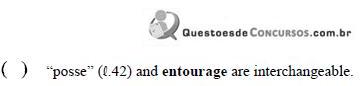
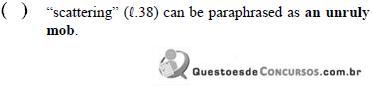


O texto a seguir deve ser utilizado para responder às questões de números 46 a 50.
When the market received the IBM PC bang in the mid-1980, Microsoft, thanks to IBM came up with MS-DOS. The runner up was Digital Research. So, in August 12, 1981 Microsoft starts working at MS-DOS. They started from a clone of QDOS for which they paid $50000, clone renamed as PC-DOS.
But MS-DOS got alive only thanks to COMPAQ who managed to clone the IBM BIOS and so the world got a new player on the computer manufacturers. Thanks to this, Microsoft began licensing its operating system for use on non-IBM PC clones and so MS-DOS (Microsoft Disk Operating System) entered the scene.
In 1985, Microsoft moves to Ireland and there they founded the first international production facility. And there, on November 20 Microsoft released its first retail version of Microsoft Windows, originally a graphical extension for its MS-DOS operating system. In August, Microsoft and IBM partnered in the development of a different operating system called 0S/2. OS/2 was marketed in connection with a new hardware design proprietary to IBM, the PS/2. Shortly afterwards on February 16, 1986, Microsoft relocated to Redmond, Washington. Around one month later, on March 13, the company went public with an IPO, raising US$61 million at US$21.00 per share. By the end of the trading day, the price had risen to US$28.00. In 1987, Microsoft eventually released their first version of OS/2 to OEMS.
The early versions of Windows were often thought of as just graphical user interfaces or desktops, mostly because they were started from MS-DOS and used it for file system services. However even the carliest 16-bit Windows versions already assumed many typical operating system functions, notably having their own executable file format and providing their own device drivers (timer, graphics, printer, mouse, keyboard and sound) for applications. Unlike DOS, Windows allowed users to execute multiple graphical applications at the same time, through co-operative multitasking, something which competitors (like GEM) did not offer. Finally, Windows implemented an elaborate, segment-based, software virtual memory scheme which allowed it to run applications larger than available memory: code segments and resources were swapped in and thrown away when memory became scarce, and data segments moved in memory when a given application had relinquished processor control, typically waiting for user input. Examples include Windows 1.0 (1985) and Windows 2.0 (1987) and its close relative Windows/286.
[Extraído de: http://news.soft32.com/windows-evolution 1629.html]
Um termo no texto que apresenta o significado de trocado é:
Esta cláusula deve ser bem traduzida para o inglês.
Esta cláusula precisa obrigatoriamente ser bem traduzida para o inglês.
Convém que esta cláusula seja bem traduzida para o inglês.
Esta cláusula poderá ser bem traduzida para o inglês.
Select the option with the set of appropriate translations for the expressions in bold in the sentences above.
Os ingleses conseguiram encontrar uma forma de resolver aquele impasse de difícil solução.
Este dicionário é muito abrangente.
Ele me disse: “Não estou bem aqui. Quero ir embora mesmo”.
Eu gosto dela porque ela é tão elegante e autêntica.
Which of the alternatives contains a set of solutions that appropriately translates the expressions in bold, using the context of the sentences provided above.
Pick the option that contains the adequate translation for the sentence “Recebi a sua carta e anexo àquela carta recebi o seu cheque.”
“Sugere-se que...” / “Sabe-se que...” / “Acredita-se que...”
Mark the option that provides a suitable translation into English for the expressions above.
Em sede policial, restaram infrutíferas todas as tentativas, encetadas desde o ano de 2006, de realizar a oitiva de João Aviador, tendo a autoridade policial apresentado o relatório de fls. 2009.
Consider the excerpt above and choose the alternative that presents the proper translation into English.
Which option contains a correct correspondence of meaning?
Windows
By Scott Gilbertson November 19, 2008
Microsoft plans to offer Windows users a new antivirus
package designed to protect the OS from viruses, spyware,
rootkits and trojans. The new software is tentatively code-
named Morro, and will be available for free to Windows XP,
Vista and 7 users sometime in the second half of 2009.
The new software will reportedly use very minimal resources,
which means it should work well with older PCs. If fact,
Microsoft says Morro has been specially designed for older
PCs and low-spec machines popular in developing nations. In
addition to its minimal processor demands, Morro has been
developed to use very little bandwidth,making it ideal for those
without broadband connections.
Morro will replace Microsoft's current, paid service, Windows
Live One Care, which has been available on a subscription
basis for $50 per year.
While a free, antivirus solution that ships with Windows would
be a boon for the average user, it could also mean trouble for
third-party software solutions. Given that a bundled solution
could raise antitrust concerns and would no doubt see
competitors like McAfee and Grisoft reaching for the lawyers
Microsoft will be offering Morro as a separate download.
Assuming Morro can deliver decent security it should be a
welcome free addition to Windows, but we don't suggest
throwing away your third-party software just yet. Antivirus
software suites will likely continue to hold an edge over Morro
by offering additional handy tools like password managers,
identity theft protection and browser-based phishing
protection.
Still, if you've been running Windows with no antivirus software
at all,Morrowill no doubt be better than nothing, and it's hard to
argue with free.



 Conheça nossos planos