Questões de Concurso
Comentadas sobre vocabulário | vocabulary em inglês
Foram encontradas 2.364 questões


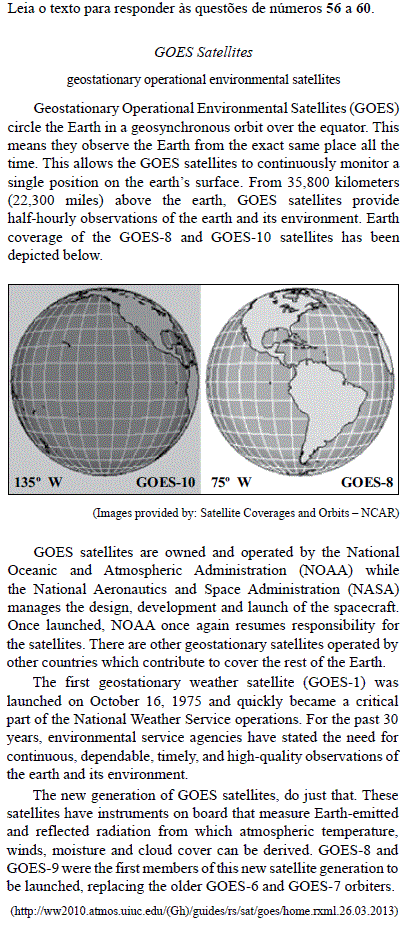
No segundo parágrafo, o termo while em – GOES satellites are owned and operated by the National Oceanic and Atmospheric Administration (NOAA) while the National Aeronautics and Space Administration (NASA) manages the design, development and launch of the spacecraft. – é corretamente substituído por
Supercomputers
One definition for a supercomputer is “the most powerful computer available at any given time.” These machines are used to solve complex problems such as the design of a supersonic aircraft, modeling of global climates, the structure of oil-bearing formations within the Earth, the molecular design of new drugs, or the prediction of complex financial behavior in securities markets. Two of the first supercomputers were the Control Data Corporation CDC 6600 and CDC 7600. Both were developed by Seymour Cray, one of the founders of CDC. In 1972, Cray left to found Cray Research, Inc., and in 1976 developed the Cray-1, generally acknowledged to be the first true supercomputer.
The Cray-1 used high-speed emitter coupled logic (ECL), the fastest (and most power hungry) logic circuits available at the time. The computer was packaged as a 6.5 ft. high cylinder surrounded by a circular seat. Each circuit board was mounted on a copper heat exchanger through which liquid freon was circulated. The total power consumption of the computer was 128 KW! Processing speed was 130 MFLOPS (millions of floating-point operations per second). In all, 63 Cray-1 computers were sold (at a cost of $5.1 million each).
[Extraído de: The 80x86 Family, John Uffenbeck, 2nd Ed., 1998]
Considerando o contexto, o termo “heat exchanger” pode ser corretamente traduzido por
Modem control software has to test the condition of the CTS and DSR signals before transmitting information to the modem. The modem also has to be conditioned by the computer by applying a logic zero on the modem connections DTR and RTS .
If one of the two communications interface adapters discussed earlier in this chapter is used, most of the modem control is already accomplished by these devices. For example, the Intel 8251A has all four of the pin connections required for modem control, while the Motorola MC6850 contains only some of the connections.
[Extraído de: Microprocessors and Peripherals, Barry B. Brey, Maxwell Macmillan International Editions, 1991]
Considerando o seguinte trecho do texto: “most of the modem control is already accomplished by these devices”, uma tradução possível para accomplished, no contexto, é:
Asphalt versus concrete
Which material is better for your project?
Before a public works (or street maintenance, or road repair) department can decide whether to use concrete or asphalt in a specific application, the department manager must arm himself with information to help him make the best choice.
Asphalt is more common for a department to specify than
concrete. “Asphalt over concrete – that’s the standard. It is
what has been done for so long. But because it is the “standard”
doesn’t necessarily make it the best option for all applications.
Concrete may be better in some instances, the first of which is
new construction. In urban metropolitan areas, where new roads
are being built and existing roadways are being expanded, using
concrete may be a good way to minimize future inconvenience.
Funding is a big challenge. People are looking for short-term
fixes, which have a political impact.
Asphalt also can be specified as a long-term solution. Some pavement types must be completely removed and reconstructed when they reach the end of their design life, but total removal and reconstruction due to structural failure of a thick asphalt pavement is rare. With a thick asphalt structure, it is possible to obtain a ‘Perpetual Pavement’ one that can last indefinitely, with the only rehabilitation being milling of the surface followed by an asphalt overlay. Perpetual Pavement is a relatively new type of asphalt concrete pavement designed to resist structural fatigue distress for at least 50 years. Maintenance is limited to replacement of the surface course
(http://www.pwmag.com/bridges/ asphalt-versus-concrete.aspx.20.03.2006.Adaptado)
The term over in – “Asphalt over concrete” – that’s the standard. – means that
In the excerpt of the fourth paragraph – Paramagnetic properties are due to the presence of some unpaired electrons – the expression due to can be replaced, without changing its meaning, for
No trecho do quinto parágrafo – Brazil’s unemployment rate, however, is not fully comparable to jobless rates in developed countries as a large portion of the population is either underemployed or works informally – a palavra as pode ser substituída, sem alteração de sentido, por
No trecho do terceiro parágrafo – Brazil’s unemployment rate remains at historically low levels despite sluggish economic activity. – a palavra despite equivale, em português a
Today is the 10th annual World Toilet Day. Sponsored by the Singapore-based World Toilet Organization, the event is meant to build awareness about the risks that lack of sanitation present to the physical, emotional and psychological health of 2.6 billion people around the world. Fortunately, poor sanitation is receiving an increasing amount of attention from NGOs, academics and other problem-solvers around the world. But there isn’t time to waste, since lack of hygiene contributes to diarrheal diseases that claim the lives of 1.5 million poor children each year.
Earlier this year, The Gates Foundation awarded a total of $3 million to researchers at 8 universities as part of its Reinvent the Toilet competition. Unlike the innovations that are taking place with flush toilets, these grants are aimed at designing, developing and prototyping waterless, hygienic toilets that cost less than $0.05 per user per day. The foundation also awarded a $4.8 million grant to the London School of Hygiene and Tropical Medicine (LSHTM) for a project called Sanitation Ventures. For it, researchers are developing ways to speed up the decomposition process in pit latrines. Organisms such as tiger worms, placed near the surface of the latrines, can effectively increase the speed of composting. Beneath that, in a filtration bed, liquid waste is further treated by aerobic bacteria. The end product is a treated sewage material that can later be used as a fertilizer.
And if that sounds gross, well, get over it. Human-waste-based fertilizer has been used in many parts of the world for centuries. The key is to process it correctly — at the right temperature and for enough time — to ensure that all pathogens are eliminated. In fact, aside from better public health, one of the major benefits of developing sanitation solutions for the developing world is creating an end product with value, such as fertilizer or biochar for energy.
(http://www.smartplanet.com/blog/design-architecture/ safe-sanitation-systems-close-the-loop-on-poop/2084-19/11/2011. Adaptado)
No terceiro parágrafo, a expressão aside from em – In fact, aside from better public health, one of the major benefits of developing sanitation solutions for the developing world… – equivale a
Um antônimo para a palavra biggest é
Leia o texto para responder à questão.
Brazil’s Average Unemployment Rate Falls to Record Low in 2012
By Dow Jones Business News
January 31, 2013
Brazil’s unemployment rate for 2012 fell to 5.5%, down from the previous record low of 6.0% recorded last year, the Brazilian Institute of Geography and Statistics, or IBGE, said Thursday. In December, unemployment fell to 4.6% compared with 4.9% in November, besting the previous record monthly low of 4.7% registered in December 2011, the IBGE said.
The 2012 average unemployment rate was in line with the 5.5% median estimate of economists polled by the local Estado news agency. Analysts had also pegged December’s unemployment rate at 4.4%.
Brazil’s unemployment rate remains at historically low levels despite sluggish economic activity. Salaries have also been on the upswing in an ominous sign for inflation – a key area of concern for the Brazilian Central Bank after a series of interest rate cuts brought local interest rates to record lows last year. Inflation ended 2012 at 5.84%.
The average monthly Brazilian salary retreated slightly to 1,805.00 Brazilian reais ($908.45) in December, down from the record high BRL1,809.60 registered in November, the IBGE said. Wages trended higher in 2012 as employee groups called on Brazilian companies and the government to increase wages and benefits to counter higher local prices. Companies were also forced to pay more to hire and retain workers because of the country’s low unemployment.
The IBGE measures unemployment in six of Brazil’s largest metropolitan areas, including São Paulo, Rio de Janeiro, Salvador, Belo Horizonte, Recife and Porto Alegre. Brazil’s unemployment rate, however, is not fully comparable to jobless rates in developed countries as a large portion of the population is either underemployed or works informally without paying taxes. In addition, workers not actively seeking a job in the month before the survey don’t count as unemployed under the IBGE’s methodology. The survey also doesn’t take into account farm workers.
(www.nasdaq.com. Adaptado)
No trecho do quinto parágrafo – Brazil’s unemployment rate, however, is not fully comparable to jobless rates in developed countries as a large portion of the population is either underemployed or works informally – a palavra as pode ser substituída, sem alteração de sentido, por
Regarding the language underlined in the text, it can be said that
Read the sentence below and choose the alternative that can substitute the underlined words.
“Two medications commonly used to treat high blood pressure can often halt1 or delay the progression of kidney disease in people with diabetes: angiotensin-converting enzyme (ACE) inhibitors and angiotensin receptor blockers (ARBs). Careful control of blood sugar levels also protects the kidneys from further damage2 .”
Kidney Disease, an Underestimated Killer.
Available in: http://well.blogs.nytimes.com
Vigilance needed to ensure safe infant food
WHO and FAO alert countries to possible spread of
melamine-contaminated dairy products
WHO and the UN Food and Agriculture Organization (FAO) are urging affected countries to ensure safe feeding of millions of infants following the ongoing melamine-contaminated milk crisis in China. The two agencies also call on countries to be alert to the possible spread of melamine-contaminated dairy products.
“While breastfeeding is the ideal way of providing infants with the nutrients they need for healthy growth and development, it is also critical to ensure that there is an adequate supply of safe powdered infant formula to meet the needs of infants who are not breastfed”, said Dr Jorgen Schlundt, Director of the WHO Food Safety Department.
Replacing powdered infant formula with other products such as condensed milk, honey mixed with milk, or fresh milk is inappropriate as such products would put at risk the safety and nutritional status of this vulnerable population group, the two agencies advised.
“Restoring consumer confidence is critical. Melamine-contaminated products should be removed from the food chain in order to prevent further exposure. The safe supply of dairy products needs to be restored immediately,” said Dr Ezzeddine Boutrif, Director of the FAO Nutrition and Consumer Protection Division.
Safe feeding for infants
WHO recommends that all infants should be fed exclusively with breast milk for the first six months of life. No other liquid or food, not even water, is needed during this period. Thereafter, infants should receive adequate and safe complementary foods while breastfeeding continues up to two years of age and beyond.
Following reports of findings of imported melaminecontaminated products in several countries over the last two weeks, countries should closely monitor their markets. The two agencies highlighted that melamine-contaminated products could reach markets in other countries through both formal and informal trade. Getting information about the origin of the product, up-to-date recall information or in some cases testing for melamine contamination might be considered. If found contaminated, appropriate actions such as product recall and safe disposal should be taken, based on an assessment of the risk to human health.
Safe supply of food critical
Food safety is not the sole responsibility of public authorities. The food industry is also responsible for ensuring a safe supply of food to the consumer. “It is critical that the industry strongly invests in food safety and adopts a food safety culture covering the food chain from raw materials through to the final product,” said Dr Boutrif.
Incidents such as melamine contamination in China not only impact food safety and human health but also put the livelihoods of hundreds of millions of dairy farmers at risk. “There is a need for countries to do major investment in strengthening their food control and food-borne disease surveillance systems as it could minimize the potential occurrence of food safety incidents like this one”, said Dr Schlundt.
The melamine-contaminated dairy products event first came to the attention of the international organizations on 11th September. Both WHO and FAO have used the International Food Safety Authorities Network (INFOSAN) to inform and update national food safety authorities on this crisis, one of the largest in recent years.
Over 54,000 children have sought medical treatment in China after drinking melamine-contaminated infant formula. Almost 12,900 are currently hospitalized.
Melamine is commonly used in food contact materials (e.g. containers, labels, etc.) and can also be used in agriculture production such as fertilizer. Whether this has a potential for carry-over into food at low concentrations (usually in the range of microgram per kilogram) and further impact on human health may need further evaluation.
Melamine on its own is of low toxicity. But animal studies have suggested that kidney problems occur when melamine is present in combination with cyanuric acid, a potential impurity of melamine. The level of melamine found in the contaminated infant formula has been as high as 2,560 miligram per kilogram of food, while the level of cyanuric acid is unknown.
Available in: http://www.who.int
Read the sentence below and choose the alternative that presents the synonym to the underlined word.
“Over 54,000 children have sought medical treatment in China after drinking melamine-contaminated infant formula.”
Anxiety Medication: Over Prescribed and
Causing Overdoses
According to a story on NBC New York, more and more patients are ending up in New York City hospitals having over dosed on Xanax. Xanax is in the benzodiaziepine family of drugs and it’s used to treat anxiety, nervousness, and panic attacks by decreasing brain activity.
Xanax Overdoses Way Up
NBC New York reports:
Between 2004 and 2009, New York City emergency room visits involving Xanax and other anti-anxiety prescription drugs known as benzodiazepines increased more than 50 percent. That’s up from 38 out of 100,000 New Yorkers in 2004 to 59 out of 100,000 New Yorkers.
It’s not the drug by itself that causes the overdoses, but used in combination with other drugs and alcohol, it creates a toxic cocktail which isn’t easily metabolized in the body.
The drug is habit forming and withdrawal symptoms can include sweating, shaking, difficulty falling asleep, difficulty concentrating, depression, and nervousness. Many fear that the drug is being over prescribed.
“I don’t believe they take the time with the patients to figure out what the problems are,” Cali Estes, a drug counselor said to NBC New York. “A doctor who is running short on time and nurses and probably isn’t paid as much as he or she used to be finds it easier to say, ‘OK, this person has a problem, here’s your script, have a nice day. Where’s my next patient?’”
Whitney Houston’s Death Tied to Xanax and Other Drugs
Whitney Houston’s recent death is raising questions as to this and other sedatives. Xanax is most often criticized by those in the psychiatric community because it only lasts 6 to 20 hours.
Forbes reports:
On the face of it, this seems like a great combination – you get a quick hit of anxiety relief and the drug leaves your system within a 24-hour period. But in practice what often happens is that because the drug acts so quickly and dissipates quickly, the patient begins taking more of it to maintain the effect. Two pills a day turns into four, which turns into six and so forth.
According to the CDC, prescription drug overdose is now the leading cause of accidental death in the U.S., topping automobile accidents for the first time in 30 years. Currently, Xanax is the 11th most widely prescribed drug in the nation.
Available in: http://blogs.discovery.com
Read the sentence below taken from the text and analyze the assertions.
“Two pills a day turns into four, which turns into six and so forth.”
I. The phrasal verb “to turn into” can be replaced by “in turn”.
II. “Which” refers to the last quantity of pills mentioned.
III. The expression “so forth” infers that, after having 6 pills, the patient restarts taking four pills.
The correct assertion(s) is(are)
The best synonym for “twisted" in “twisted ideology" is: a) Confusing.
European Union member states could cut their plastic bag use by 80%, the European commission has said, by
charging for bags or even banning them.
Plastic bags are a major cause ofseaborne pollution, which is a serious hazard for marine life, and some regions have already
moved to cut their use through charging. The UK deputy Prime Minister, Nick Clegg, has pledged to bring forward charges in
England that will affect single-use bags given out by supermarkets.
The European commission is proposing a new directive that would require member states to choose between three methods
ofreducing the waste from bags: charges, national reduction targets, or an outright ban.
The packaging industry has responded by saying that most people use their plastic bags more than once, for instance using
them as bins, but that does not cut the overall use.
When plastic bags, or pieces of them, find their way into the seas, they are a major hazard to marine life. A whale found dead
on the Southern Spanish coast was found to have swallowed 17kg of plastic waste, including plastic bags. Fish, seabirds and
mammals can ali ingest plastic, which they cannot digest and which can clog up their guts or cause choking.
One of the key problems with plastic bags is that they are so light and small that they easily escape into the environment,
defying attempts to recycle them. The European commission has identified this as a key reason for cutting the use ofthe bags,
and other plastic packaging. The first moves to legislate atan EU levei were made in 2011, and today's announcement is likely
to take at least two years to put into practice.
According to the most recent estimates, from 2008, the EU produces 3.4m tonnes of plastic bags in a year.

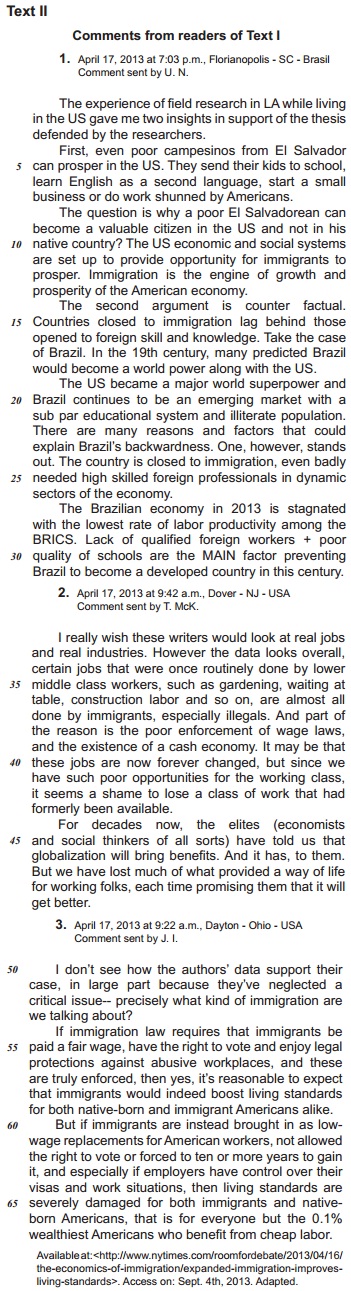
In Texts I and II, in terms of reference, one notices that

 Conheça nossos planos