Questões de Concurso Comentadas sobre vocabulário | vocabulary em inglês

Foram encontradas 2.365 questões

Q566948 Inglês


The relative pronoun which in the fragment of the text “which include banks, insurance companies, pension funds, organized exchanges, and the many other companies" (lines 24-26) refers to
Alternativas
Q566946 Inglês


In the fragment of the text “the efficient allocation of economic resources is achieved by a financial system that allocates money to those people and for those purposes that will yield the greatest return” (lines 19-22), the verb form yield can be replaced, without change in meaning, by
Alternativas
Q566644 Inglês
A questão abaixo tomará por base o seguinte texto, Operations Management: Text and Cases – Marshall, Abernathy, Miller, Olsen, Rosenbloom and Wyckoff – pg. 18: 
In any real case it is clear that the nature of the problem should focus your analysis. Instead, we have tried to show several steps that might be useful in an analysis. These steps are summarized below:
- Define the process. Determine the tasks and the flows of information and goods. Also, determine where it is possible to store goods in the process. This effort can be recorded in a process flow diagram. 
- Determine the range of capacity for the process. This will require an analysis of each task and a comparison of how these tasks are balanced. In addition determine the effect of storage in the system on the capacity of tasks and flows. Inventories may allow the process to operate out of balance for some time, but in the long run the capacity of the process is limited by the capacity of its slowest task.
- Determine the cost of inputs (labor, materials, energy and capital) and relate these costs to the output (a good or a service). This will result in the calculation of the average cost of a unit of output or the marginal cost of a unit of output or both. Once this is done it may be possible to determine the value of the output in some market by comparing the cost, quality and timeliness of this output to the needs of that market.
In the second sentence of the first step, what is another word that could replace “goods”, without changing the meaning of the phrase?
Alternativas
Q555339 Inglês
                        
In reference to the vocabulary used in the text What do our flags say about us?, judge the next item.

In the sentence “Each one will be considered individually, before this long list is finally whittled down to the final four." (R. 19 to 21), “whittled down" can be correctly replaced by selected.
Alternativas
Q555006 Inglês
Based on the above text, judge the next item.

In the text, the word “offshoot" (R.34) means origin.


Alternativas
Q554653 Inglês

                                             Smart Greenhouse

Control the light, watering, temperature, and humidity of your greenhouse – automatically.

                                                                                                                                  Kevin Farnham

      Smart Greenhouse, one of three professional category winner in the 2014 IoT Developer Challenge, is an Internet of Things (IoT) device and application that monitors and controls a greenhouse environment. The concept for Smart Greenhouse came into being after the core team – Dzmitry Yasevich, Pavel Vervenko, and Vladimir Redzhepov – attended JavaOne Russia in April 2013. There, the team saw presentations of a smart house, various robots, and other devices, all controlled by Java.

      Yasevich notes, “We were impressed by these solutions and had an idea to do something like that. Pavel Vervenko suggested making an automated greenhouse. Everyone liked the idea!”.

      First, the team selected the hardware. “We started to use Raspberry Pi as a basis”, Yasevich says. “It is a compact but fullfedged computer with 700 MHz and memory at 512 MB. This system costs around $35”.

      However, early on, a safety concern arose. “Current under high voltage passes in the greenhouse, and there is an automatic watering system, so it was necessary to properly consider all the aspects related to insulation”, Yasevich says.

(http://www.oraclejavamagazine-digital.com/8ef38d6e6f63e8971b9487ddb4bd4bdc/558dae0a/pp/javamagazine20150304-1429053481000c51ce41 0c1-pp.pdf?lm=1429053481000)

In the sentence “The concept for Smart Greenhouse came into being after the core team – Dzmitry Yasevich, Pavel Vervenko, and Vladimir Redzhepov – attended JavaOne Russia…", the underlined expression can be substituted, without the sentence losing its meaning, by: 
Alternativas
Q553465 Inglês
Robotic surgery linked to 144 deaths in the US Surgical robots allow doctors to improve recovery time and minimise scarring 

    A study into the safety of surgical robots has linked the machines' use to at least 144 deaths and more than 1,000 injuries over a 14-year period in the US. 
    The events included broken instruments falling into patients' bodies, electrical sparks causing tissue burns and system errors making surgery take longer than planned. The report notes that the figures represent a small proportion of the total number of robotic procedures. But it calls for fresh safety measures.
    "Despite widespread adoption of robotic systems for minimally invasive surgery, a non-negligible number of technical difficulties and complications are still being experienced during procedures," the study States.
    "Adoption of advanced techniques in design and operation of robotic surgical systems may reduce these preventable incidents in the future." Robotic surgery can reduce the risk of infections and help patients heal more quickly.
      More accidents
   The work was carried out by researchers at the University of Illinois at Urbana-Champaign, the Massachusetts Institute of Technology and Chicago's Rush University Medicai Center.
    Their paper says 144 deaths, 1,391 injuries and 8,061 device malfunctions were recorded out of a total of more than 1.7 million robotic procedures carried out between January 2000 and December 2013.
    This was based on reports submitted by hospitais, patients, device manufacturers and others to the US Food and Drug Administration, and the study notes that the true number could be higher.
     Surgical robot 
     Surgeons face the risk of broken parts causing injury or lengthening procedures.
    Its authors say the number of injuries and deaths per procedure has remained relatively constant since 2007. But due to the fact that the use of robotic systems is increasing "exponentially", they add, this means that the number of accidents is increasing every year.
    They highlight that when problems do occur, people are several times more likely to die if the surgery involves their heart, lungs, head and/or neck rather than gynaecological and urological procedures.
    They acknowledge that the data does not pinpoint why, but suggest it is because the former are more complex types of operations for which robots are less commonly used, so there is less experience and expertise available.
    The researchers did not, however, compare accident rates with similar operations in which robots were not used. Their study has not been peer reviewed.
(http://www.bbc.com/news/technology-33609495f)
Choose the alternative whith the best synonim of the word widespread, boldfaced in the text.
Alternativas
Q542362 Inglês

In reference to the content of the text, its vocabulary and syntactic structure, decide whether the following statements are right (C) or wrong (E).

The use of the words “dome” (R.54) and “temples” (R.55) has the effect of creating a faint aura of saintliness and religiousness about Orlando.
Alternativas
Q542348 Inglês

About the vocabulary the author uses in his text, decide whether the statements below are right (C) or wrong (E).

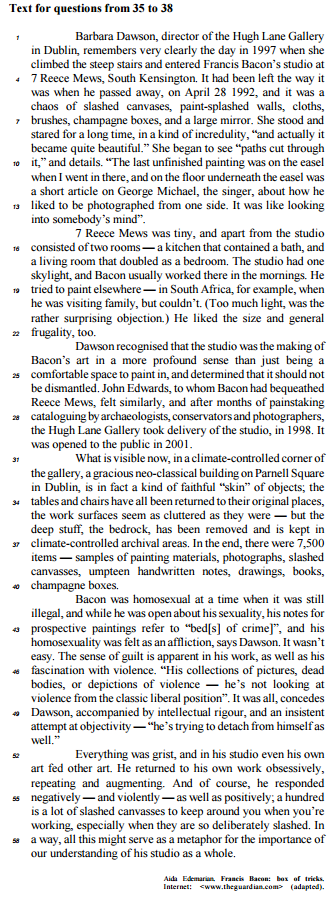
“prospective paintings” (l.43) can be understood as paintings about which Bacon was still thinking or planning.

Alternativas
Q542346 Inglês

About the vocabulary the author uses in his text, decide whether the statements below are right (C) or wrong (E).

“umpteen” (l.39) could be correctly replaced by torn.

Alternativas
Q539464 Inglês

In the 8th paragraph of Text I (lines 81-94), the word vacancies is used three times.


To avoid one more repetition, the author chose as synonym for vacancies the word

Alternativas
Q539459 Inglês
In the fragment of Text I “CEB research shows that five-in-six hiring managers believe their new graduate hires present a lack of the skills and knowledge they consider necessary” (lines 9-12), the word lack can be replaced, without change in meaning, by
Alternativas
Q537970 Inglês

What if there were no bees? 

    It's a beautiful day for a picnic, but minutes after you spread a blanket on the grass and unpack an impressive selection of sandwiches, fruit salad and a show-stopping cherry pie, you discover an uninvited guest. A bee is making the rounds, buzzing around your head and scaring all your friends. You're about to swipe at the winged interloper with your shoe, but then think better of it. 
      It's a good thing, too, because bee populations are dwindling. Consider these United States Department of Agriculture (USDA) survey results, based on 21.7 percent of the 2.6 million bee colonies in the United States. During the 2013-2014 winter, more than 23 percent of honeybees in the managed colonies included in the survey had died. The winter before that was even worse, when more than 30 percent of the hives died [source: Jones].  
     And honeybees aren't the only bees at risk. There are more than 20,000 species of bees in the Hymenoptera order that are crucial to life as we know it [source: Encyclopedia Britannica]. So what would happen if there were no bees at all?
     Bees rely on pollen and nectar from plants for food. The nectar is later transformed into honey and the pollen is transferred from plant to plant as the bees travel, resulting in crosspollination. In fact, bees pollinate as much as 70 percent of the planet's top 100 food crops, including apples, avocadoes, cucumbers, nuts, squash and more [source: Greenpeace].
     Many of the diverse flavors and nutritional components in our food are the direct result of bees at work. And, without the crucial role bees play in agriculture, the world's food supplies would likely suffer. That's because an estimated one-third of all the food we eat relies on bees to flourish. Some of the foods we eat simply wouldn't exist without bees. Almonds, for instance, rely entirely on bees for pollination. In California alone, the almond crop needs 1.4 million bee colonies for successful pollination [source: USDA]. 
     If there were no bees, our food supply would be less varied and less available. While we might not go extinct, we would certainly need to find edible alternatives to many of the mainstay foods we currently enjoy -- particularly those crops dependent on bees for pollination -- and figure out ways to stave off economic hardship and famine until new cultivation methods could be developed.

Source: adapted from http://science.howstuffworks.com/science-vs-myth/what-if/what-if-no-bees in June, 2015 
Na frase “It's a good thing, too, because bee populations are dwindling", a palavra destacada pode ser melhor substituída por:
Alternativas
Q537968 Inglês

What if there were no bees? 

    It's a beautiful day for a picnic, but minutes after you spread a blanket on the grass and unpack an impressive selection of sandwiches, fruit salad and a show-stopping cherry pie, you discover an uninvited guest. A bee is making the rounds, buzzing around your head and scaring all your friends. You're about to swipe at the winged interloper with your shoe, but then think better of it. 
      It's a good thing, too, because bee populations are dwindling. Consider these United States Department of Agriculture (USDA) survey results, based on 21.7 percent of the 2.6 million bee colonies in the United States. During the 2013-2014 winter, more than 23 percent of honeybees in the managed colonies included in the survey had died. The winter before that was even worse, when more than 30 percent of the hives died [source: Jones].  
     And honeybees aren't the only bees at risk. There are more than 20,000 species of bees in the Hymenoptera order that are crucial to life as we know it [source: Encyclopedia Britannica]. So what would happen if there were no bees at all?
     Bees rely on pollen and nectar from plants for food. The nectar is later transformed into honey and the pollen is transferred from plant to plant as the bees travel, resulting in crosspollination. In fact, bees pollinate as much as 70 percent of the planet's top 100 food crops, including apples, avocadoes, cucumbers, nuts, squash and more [source: Greenpeace].
     Many of the diverse flavors and nutritional components in our food are the direct result of bees at work. And, without the crucial role bees play in agriculture, the world's food supplies would likely suffer. That's because an estimated one-third of all the food we eat relies on bees to flourish. Some of the foods we eat simply wouldn't exist without bees. Almonds, for instance, rely entirely on bees for pollination. In California alone, the almond crop needs 1.4 million bee colonies for successful pollination [source: USDA]. 
     If there were no bees, our food supply would be less varied and less available. While we might not go extinct, we would certainly need to find edible alternatives to many of the mainstay foods we currently enjoy -- particularly those crops dependent on bees for pollination -- and figure out ways to stave off economic hardship and famine until new cultivation methods could be developed.

Source: adapted from http://science.howstuffworks.com/science-vs-myth/what-if/what-if-no-bees in June, 2015 
Na frase “figure out ways to stave off economic hardship and famine until new cultivation methods could be developed", a palavra pode ser melhor substituída, considerando o contexto, por:
Alternativas
Q537966 Inglês

What if there were no bees? 

    It's a beautiful day for a picnic, but minutes after you spread a blanket on the grass and unpack an impressive selection of sandwiches, fruit salad and a show-stopping cherry pie, you discover an uninvited guest. A bee is making the rounds, buzzing around your head and scaring all your friends. You're about to swipe at the winged interloper with your shoe, but then think better of it. 
      It's a good thing, too, because bee populations are dwindling. Consider these United States Department of Agriculture (USDA) survey results, based on 21.7 percent of the 2.6 million bee colonies in the United States. During the 2013-2014 winter, more than 23 percent of honeybees in the managed colonies included in the survey had died. The winter before that was even worse, when more than 30 percent of the hives died [source: Jones].  
     And honeybees aren't the only bees at risk. There are more than 20,000 species of bees in the Hymenoptera order that are crucial to life as we know it [source: Encyclopedia Britannica]. So what would happen if there were no bees at all?
     Bees rely on pollen and nectar from plants for food. The nectar is later transformed into honey and the pollen is transferred from plant to plant as the bees travel, resulting in crosspollination. In fact, bees pollinate as much as 70 percent of the planet's top 100 food crops, including apples, avocadoes, cucumbers, nuts, squash and more [source: Greenpeace].
     Many of the diverse flavors and nutritional components in our food are the direct result of bees at work. And, without the crucial role bees play in agriculture, the world's food supplies would likely suffer. That's because an estimated one-third of all the food we eat relies on bees to flourish. Some of the foods we eat simply wouldn't exist without bees. Almonds, for instance, rely entirely on bees for pollination. In California alone, the almond crop needs 1.4 million bee colonies for successful pollination [source: USDA]. 
     If there were no bees, our food supply would be less varied and less available. While we might not go extinct, we would certainly need to find edible alternatives to many of the mainstay foods we currently enjoy -- particularly those crops dependent on bees for pollination -- and figure out ways to stave off economic hardship and famine until new cultivation methods could be developed.

Source: adapted from http://science.howstuffworks.com/science-vs-myth/what-if/what-if-no-bees in June, 2015 
De acordo com o texto, na frase “we would certainly need to find edible alternatives to many of the mainstay foods we currently enjoy", a melhor tradução para a palavra destacada, tendo em vista o contexto, é
Alternativas
Q525265 Inglês
Based on the previous text, judge the following items.

The word 'robust' (R.15) can be correctly replaced by effective without this bringing any change of meaning to the sentence.


Alternativas
Q525263 Inglês
According to the previous text, judge the following items.


The word 'changing' (R.13) conveys the idea that threats are constantly evolving.


Alternativas
Q519207 Inglês
Choose the alternative that presents the antonym of the word enough.
Alternativas
Q519202 Inglês
What is malnutrition?

    A malnourished person finds that their body has difficulty doing normal things such as growing and resisting disease. Physical work becomes problematic and even learning abilities can be diminished. For women, pregnancy becomes risky and they cannot be sure of producing nourishing breast milk.

   When a person is not getting enough food or not getting the right sort of food, malnutrition is just around the corner. Even if people get enough to eat, they will become malnourished if the food they eat does not provide the proper amounts of micronutrients – vitamins and minerals – to meet daily nutritional requirements.

   Disease and malnutrition are closely linked. Sometimes disease is the result of malnutrition, sometimes it is a contributing cause. In fact, malnutrition is the largest single contributor to disease in the world, according to the UN's Standing Committee on Nutrition (SCN).

Window of opportunity

The first two years of life are a critical “window of opportunity”. In this period it is possible to prevent the largely irreversible damage that follows early childhood undernutrition. WFP's operations routinely focus on the earliest phase of life, i.e. from conception (-9 months) to 24 months of age. We try to ensure under-twos receive the vitamins and minerals they need.

   There are two sides to eliminating malnutrition: sustaining the quality and quantity of food a person eats and ensuring adequate health care and a healthy environment.
Choose the alternative that presents the synonym of the noun “malnourishment".
Alternativas
Q519062 Inglês

                                      What causes hunger?

      The world produces enough to feed the entire global population of 7 billion people. And yet, one person in eight on the planet goes to bed hungry each night. In some countries, one child in three is underweight. Why does hunger exist? There are many reasons for the presence of hunger in the world and they are often interconnected. Here are six that we think are important.  


      Poverty trap

      People living in poverty cannot afford nutritious food for themselves and their families. This makes them weaker and less able to earn the money that would help them escape poverty and hunger. This is not just a day-to-day problem: when children are chronically malnourished, or ‘stunted’, it can affect their future income, condemning them to a life of poverty and hunger. In developing countries, farmers often cannot afford seeds, so they cannot plant the crops that would provide for their families. They may have to cultivate crops without the tools and fertilizers they need. Others have no land or water or education. In short, the poor are hungry and their hunger traps them in poverty. 


      Lack of investment in agriculture

      Too many developing countries lack key agricultural infrastructure, such as enough roads, warehouses and irrigation. The results are high transport costs, lack of storage facilities and unreliable water supplies. All conspire to limit agricultural yields and access to food. Investments in improving land management, using water more efficiently and making more resistant seed types available can bring big improvements. Research by the UN Food and Agriculture Organization shows that investment in agriculture is five times more effective in reducing poverty and hunger than investment in any other sector. 


      Climate and weather

      Natural disasters such as floods, tropical storms and long periods of drought are on the increase – with calamitous consequences for the hungry poor in developing countries. Drought is one of the most common causes of food shortages in the world. In 2011, recurrent drought caused crop failures and heavy livestock losses in parts of Ethiopia, Somalia and Kenya. In 2012 there was a similar situation in the Sahel region of West Africa. In many countries, climate change is exacerbating  already adverse natural conditions. Increasingly, the world’s fertile farmland is under threat from erosion, salination and desertification. Deforestation by human hands accelerates the erosion of land which could be used for growing food.


      War and displacement

      Across the globe, conflicts consistently disrupt farming and food production. Fighting also forces millions of people to flee their homes, leading to hunger emergencies as the displaced find themselves without the means to feed themselves. The conflict in Syria is a recent example. In war, food sometimes becomes a weapon. Soldiers will starve opponents into submission by seizing or destroying food and livestock and systematically wrecking local markets. Fields are often mined and water wells contaminated, forcing farmers to abandon their land. Ongoing conflict in Somalia and the has contributed significantly to the level of hunger in the two countries. By comparison, hunger is on the retreat in more peaceful parts of Africa such as Ghana and Rwanda.  


      Unstable markets

      In recent years, the price of food products has been very unstable. Roller-coaster food prices make it difficult for the poorest people to access nutritious food consistently. The poor need access to adequate food all year round. Price spikes may temporarily put food out of reach, which can have lasting consequences for small children. When prices rise, consumers often shift to cheaper, less-nutritious foods, heightening the risks of micronutrient deficiencies and other forms of malnutrition.  


      Food wastage

      One third of all food produced (1.3 billion tons) is never consumed. This food wastage represents a missed opportunity to improve global food security in a world where one in 8 is hungry. Producing this food also uses up precious natural resources that we need to feed the planet. Each year, food that is produced but not eaten guzzles up a volume of water equivalent to the annual flow of Russia’s Volga River. Producing this food also adds 3.3 billion tons of greenhouse gases to the atmosphere, with consequences for the climate and, ultimately, for food production. 


Choose the alternative that presents the phrasal verb that, once conjugated, can properly replace “on the retreat” in the sentence below.


“[ ] hunger is on the retreat in more peaceful parts of Africa such as Ghana and Rwanda.”

Alternativas
Respostas
2001: A
2002: A
2003: A
2004: E
2005: E
2006: C
2007: E
2008: E
2009: C
2010: E
2011: D
2012: B
2013: A
2014: E
2015: C
2016: C
2017: C
2018: B
2019: E
2020: E